
Pallet display size is the first thing a retailer checks — and the easiest thing to get wrong. A display built at 48 inches tall for Publix arrives at a Walmart expecting 72 and is sent back to the warehouse. A half-pallet footprint ordered for a Costco endcap arrives as a full pallet and does not fit the position. Every pallet display project starts with the same two questions: what footprint, and how tall — and both answers are dictated by the retailer, not by preference.
This guide consolidates standard pallet display sizes into one reference: the GMA pallet footprints every retailer builds on, the height and weight limits that change by placement and chain, and a retailer-by-retailer spec matrix you can use before you brief a factory. It is written for brand managers, procurement teams, and buyers who need to order a compliant pallet display the first time.
Why Pallet Display Size Is a Hard Constraint
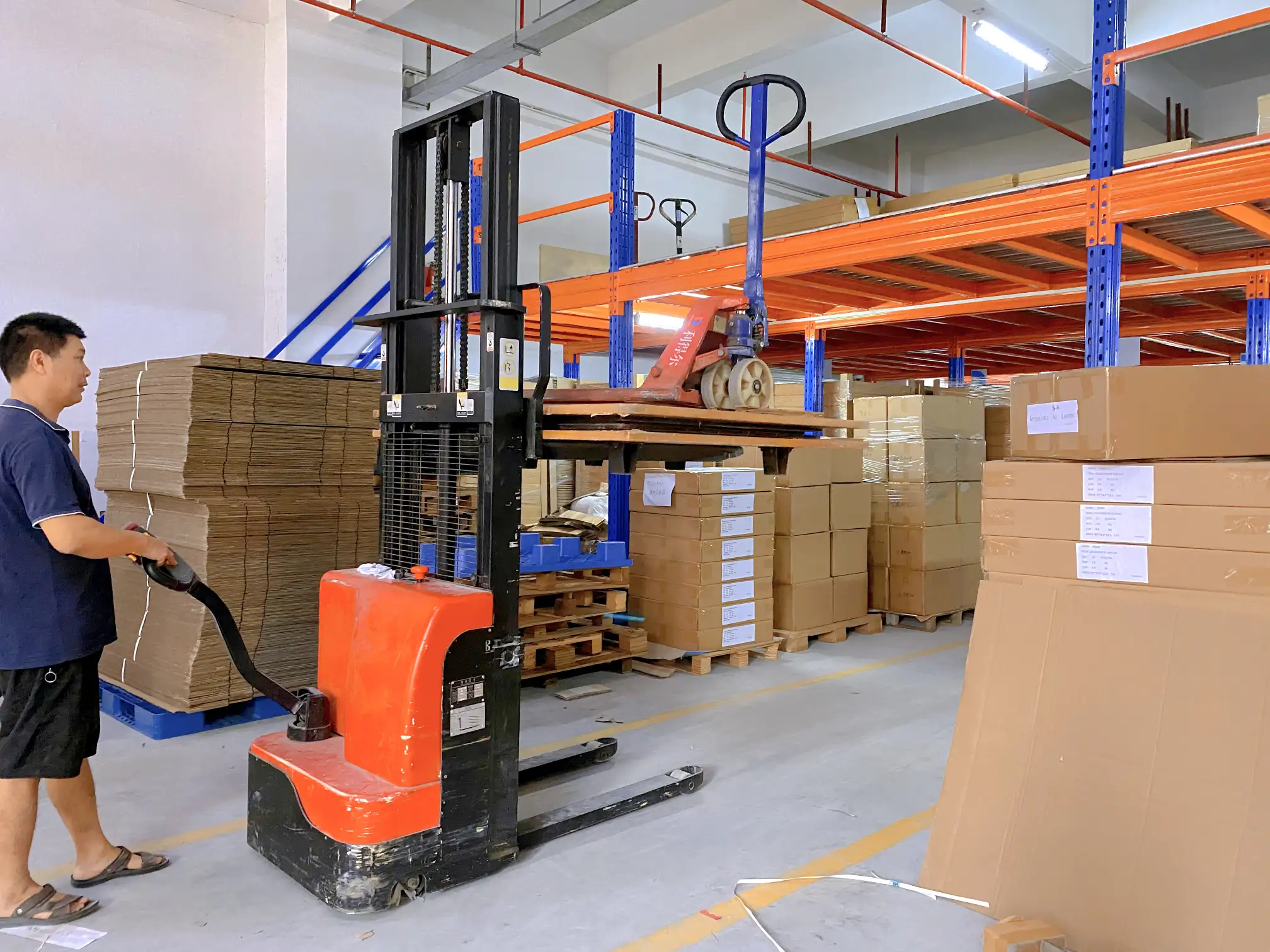
A pallet display is not a free-standing fixture that can be any size. It sits on a pallet, and the pallet has to move through the retailer's distribution center, ride on a pallet jack, fit a racking position, and occupy a planned spot on the sales floor. Every one of those steps has a dimension attached to it. If any dimension is wrong, the display is rejected before it ever reaches a shopper.
Two rules explain most size failures:
- The footprint is fixed by the pallet, not by the product. Almost every US retailer builds pallet displays on the standard GMA (Grocery Manufacturers Association) pallet. The physical pallet measures 48 × 40 inches. Some retailers orient the 48-inch side front-to-back and some orient the 40-inch side front-to-back, which is why you will see both "48 × 40" and "40 × 48" in retailer spec sheets — the board is the same, the loading direction differs.
- Overhang is the most common rejection reason. A display that extends past the pallet edge by even an inch can catch on racking, shift during transit, or get snagged by a pallet jack. Most retailers allow zero overhang; Home Depot allows only ±0.25 inches per side, the strictest in the industry. The display must sit squarely on the pallet surface.
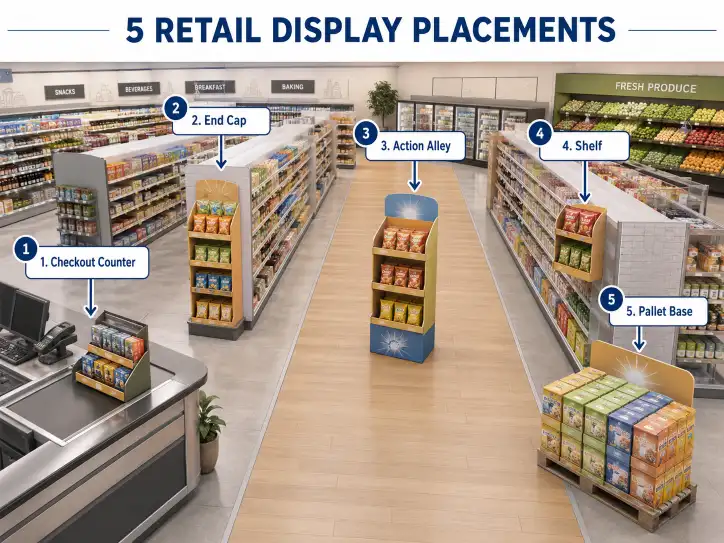
Because the footprint is non-negotiable, the size levers you actually control are the height, the loaded weight, and the board grade that supports both. Those three variables are what this guide covers next. For a visual of how pallet displays fit into the retail environment, see our pallet display range.
Standard Pallet Display Sizes: Full, Half, and Quarter
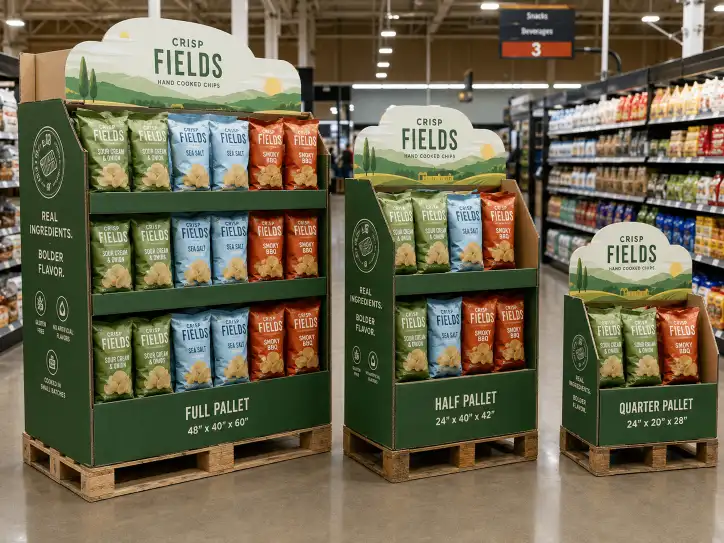
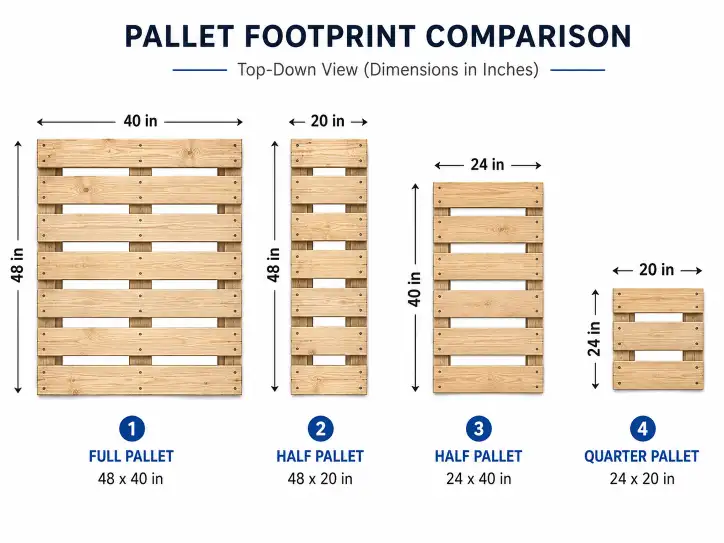
Pallet displays come in three standard footprints, all derived from the 48 × 40-inch GMA pallet. Each step down roughly halves the surface area, which is what lets a smaller footprint fit endcaps, side positions, and aisle intercepts that a full pallet cannot.
| Footprint | Dimensions (L × W) | Surface area | Best for |
|---|---|---|---|
| Full pallet | 48 × 40 in | 1,920 in² | High-volume floor programs, club stores |
| Half pallet (long) | 48 × 20 in | 960 in² | Endcaps, narrow floor positions |
| Half pallet (wide) | 24 × 40 in | 960 in² | Side positions, smaller promotions |
| Quarter pallet | 24 × 20 in | 480 in² | Small promos, checkout, aisle intercepts |
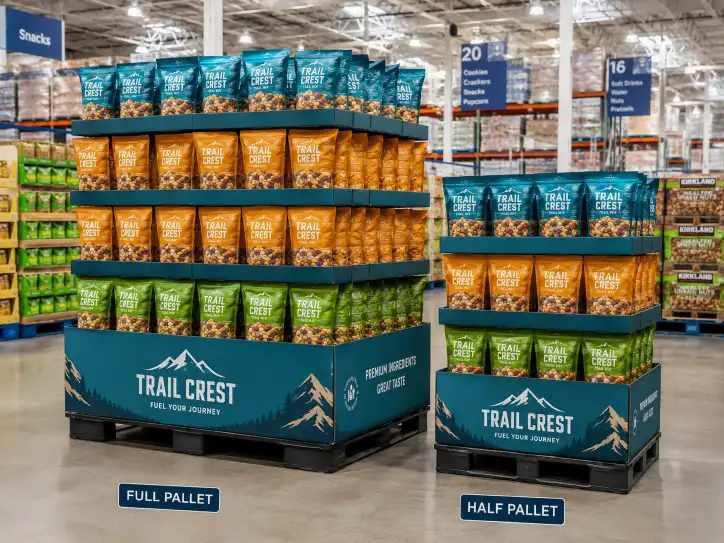
The two half-pallet orientations matter because they match different floor positions. The 48 × 20 half pallet is the "half-length" version — it keeps the full 48-inch depth of a standard pallet but is only 20 inches wide, which fits an endcap or a narrow aisle. The 24 × 40 half pallet is the "half-width" version — 24 inches deep and 40 inches wide — used where the store wants a wide but shallow footprint. Both are accepted at club stores such as Costco and Sam's Club for endcap and side positions; our half pallet display guide for club stores covers when the smaller footprint is the right call.
The practical takeaway: choose the footprint by the floor position you have been assigned, not by the product. If the retailer has given you an endcap, a half pallet is usually the fit; if the program is a full-floor feature, a full pallet is expected. The club store display requirements guide explains how Costco and Sam's Club assign these positions.
How Height Limits Change the Size Decision
Height is measured the same way by every retailer: from the floor to the top of the display, including the pallet base. The pallet itself is typically 5–6 inches tall, so a display listed at 72 inches has only about 66 inches of usable product space above the deck. Designers who forget the pallet base routinely overbuild by 6 inches and get rejected.
Height limits vary more than footprints, because they are tied to where the display sits:
| Placement | Typical max height | Notes |
|---|---|---|
| Standard floor position | 66–72 in | Most grocery and club floor displays |
| Power aisle / endcap | 48–60 in | Lower profile to preserve sightlines |
| Racking / shelf position | 48 in | Must fit the retailer's rack beam |
| Checkout / front end | 42–48 in | Must not block register visibility |
| Club store floor (Costco) | Up to 84 in | Requires buyer confirmation per location |
The spread between 48 and 84 inches is why the same product can need three different display sizes for three retailers. Publix caps floor displays at 48 inches — the strictest of any major chain — while Costco allows up to 84 inches in some clubs. If you design for the taller ceiling and ship to the shorter one, the display will not be placed. The retailer matrix in the next section gives the exact limits chain by chain.
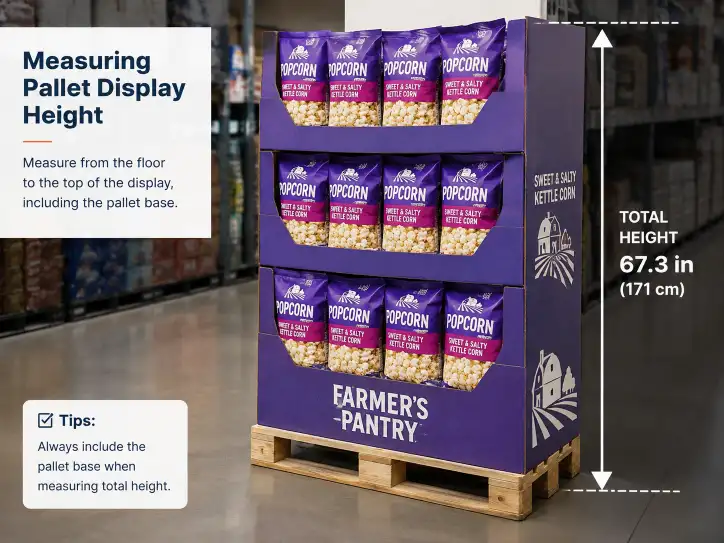
Height is the single most common dimension error in pallet display orders because it is quoted two ways: some factories quote "display height" excluding the pallet, and retailers enforce it including the pallet. Always confirm which one is being quoted.
Weight Capacity and Board Grade by Pallet Size
The footprint and height determine how much product a display can carry, but the board grade determines whether it survives the weight. Pallet displays carry far more than standard floor displays because they are loaded at the factory and shipped as one unit.
| Footprint | Typical loaded weight | Recommended board |
|---|---|---|
| Full pallet (48 × 40) | 1,000–2,500 lb | Double-wall BC-flute for most loads |
| Half pallet (48 × 20 / 24 × 40) | 500–1,200 lb | B-flute or C-flute single wall |
| Quarter pallet (24 × 20) | 250–600 lb | E-flute or B-flute |
Two structural rules apply at every size:
- Heaviest product on the bottom layers, closest to the pallet, so the display does not become top-heavy as it sells down.
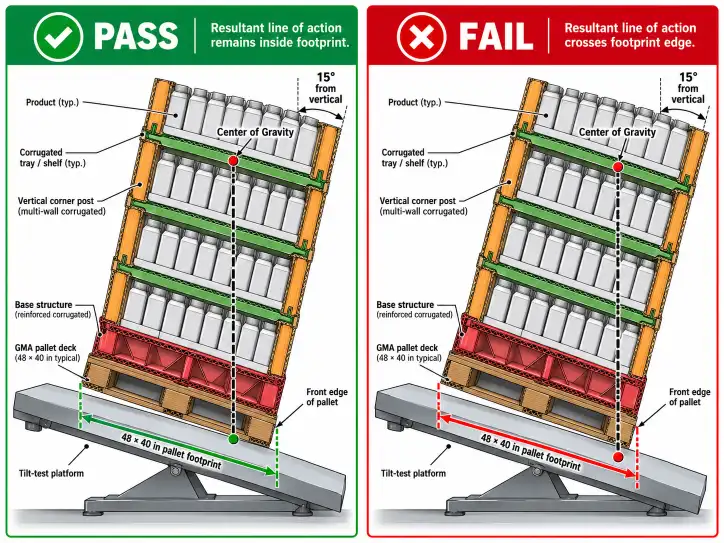
- Stability at partial sell-through — the display must stand on its own after 30–50% of the product is removed. This is where trays, dividers, and correct board selection do the work; a display that passes empty is worse than one that fails full.
For the full structural picture — ECT ratings, flute selection, load testing, and transit standards — see our display fixture structural design guide, which covers the load capacity and stability math behind every pallet display.
Retailer-by-Retailer Pallet Display Spec Matrix
This is the reference most buyers bookmark. Each retailer publishes its own pallet display requirements, and they differ on footprint orientation, height, weight, and pallet type. The table below consolidates the current specifications for the chains we cover in depth; every entry links to the full requirement guide for that retailer.
| Retailer | Pallet footprint | Max height | Max weight | Key difference |
|---|---|---|---|---|
| Costco | 48 × 40 in GMA | 72 in (up to 84 with approval) | up to 2,500 lb | GMA pallet only, pre-filled preferred, four-way entry |
| Sam's Club | 48 × 40 in GMA | 72–80 in | ~2,000 lb | Pre-filled required for most programs, Walmart compliance system |
| Walmart | 48 × 40 in GMA block | 72 in (54 in power aisle) | 2,000 lb | GMA block pallet, zero overhang, stretch hood only |
| Kroger | 48 × 40 in GMA | 66 in floor / 60 in endcap | 2,000 lb | 4 in minimum deck height, 2 in max overhang |
| Home Depot | 40 × 48 in GMA | 72 in floor / 48 in rack | 2,500 lb | ±0.25 in overhang, block or stringer pallet, corner boards over 48 in |
| Target | 40 × 48 in GMA | 48 in (66 in power aisle) | 1,500 lb | White corrugate, visual aesthetic review |
| CVS | 40 × 48 in GMA | 60 in | 1,500 lb | UCC-128 labels on two sides |
| Walgreens | 40 × 48 in GMA | 60–66 in | 1,500 lb | Zero-touch setup, under 3 minutes |
| Publix | 40 × 48 in GMA | 48 in (54 in with approval) | 2,000 lb | Strictest height limit, zero overhang, aisle clearance |
Three patterns to notice in the matrix:
- Club stores (Costco, Sam's Club) want big and pre-filled. They sell off the pallet, so they expect a tall, factory-loaded unit that goes straight to the floor. Their club store requirements center on height, pallet quality, and full-load stability.
- Drug and mass retailers (CVS, Walgreens, Target) run shorter and lighter. Heights of 48–66 inches and weight caps of 1,500 lb reflect shelf-based formats and faster labor constraints, not pallet-based selling.
- Home improvement (Home Depot) is a different weight class. 2,500 lb capacity and the industry's strictest overhang tolerance reflect heavy, bulky products — the reason the Home Depot guide treats pallet and racking displays as separate designs.
When a program spans multiple retailers, do not assume one display fits all — the matrix makes the conflicts obvious (a 72-inch Walmart display cannot ship to a 48-inch Publix). For the largest chains, the individual guides also cover labeling, structural testing, and packing, which complete the compliance picture.
How to Choose the Right Pallet Display Size
Choosing the right pallet display size is a four-step decision, and it should be made in this order:
- Lock the retailer and the floor position first. The retailer's requirement guide sets the footprint, height ceiling, and weight cap. Nothing downstream matters until this is confirmed. If you are targeting club stores, start with the Costco and Sam's Club specs; for grocery, Kroger and Publix.
- Fit the product into the footprint. Total the product's outer carton dimensions and the pack pattern (units per tray, trays per layer). The loaded footprint must sit fully inside the pallet with no overhang — that is the hard constraint on how many units per layer you can carry.
- Set the height from the position, not the product. The placement (floor, endcap, racking, checkout) determines the height ceiling. With the footprint and height fixed, the number of layers is whatever fits — which is why the same product yields a different case count per retailer.
- Confirm the board grade against the loaded weight. Once the case count is known, total the weight and match it to a board grade that keeps the display stable at partial sell-through. When in doubt, the structural design guide walks through the ECT and flute selection.
A common mistake is starting from the product instead of the retailer. A brand designs a beautiful tall display for its hero product, then discovers the target chain caps floor displays at 48 inches and has to redesign. Running the decision in the order above — retailer, footprint, height, board — prevents that rework.
Not every product belongs on a full pallet. If your program is a small-format promotion, a half pallet display or a quarter-pallet unit may fit the position better and cost less to ship. Match the size to the assigned space, not to the product's ego.
Beyond Standard Sizes: Half Pallets, Pallet Skirts, and Pre-Filled Units
Standard sizes are the starting point, but three variants regularly change how a pallet display is speced:
- Half pallet displays — 48 × 20 or 24 × 40 footprints for endcaps and side positions at club and mass retailers. See the half pallet club store guide for when the smaller footprint wins, and the Walmart half pallet design guide for a category-specific example.
- Pallet skirts — a printed corrugated or paper skirt wrapped around the pallet base. The skirt does not change the footprint, but it converts the bare pallet into a branding surface and hides pallet defects. Our pallet skirt display guide covers the sizes, materials, and print options.
- Pre-filled pallet displays — units loaded with product at the factory and shipped retail-ready. Because the loaded weight is set before shipping, pre-filling changes the structural and packing requirements. The pre-filled pallet display guide explains the cost and compliance trade-offs, and the retail-ready pallet display guide covers what club store buyers expect from the finished unit.
These variants still obey the same footprint and height rules from the matrix — they change how the display is built, branded, and loaded, not the dimensions the retailer enforces.
Conclusion
Pallet display size is decided by the retailer, and the decision is more specific than most buyers expect. The footprint comes from the GMA pallet — 48 × 40 inches, with half and quarter options — and the height and weight limits come from the chain and the placement. Costco allows up to 84 inches; Publix caps at 48. A display that is right for one is wrong for the other, and the rejection happens at the receiving dock, not in the store.
The efficient path is to confirm three numbers before briefing a factory: the retailer's footprint orientation, the height ceiling for the assigned position, and the weight cap for the loaded unit. The retailer matrix in this guide gives you those numbers at a glance, and the linked requirement guides give you the full detail behind them.
For the underlying pallet standard, the Grocery Manufacturers Association (GMA) publishes the pallet specification most US retailers build their display requirements around, and FEFCO publishes the corrugated board standards that determine how a display meets those dimensions under load. When you are ready to spec a display, send your target retailer, floor position, product dimensions, and projected case weight to our team — we will size the footprint, set the height, and recommend the board grade, then produce a sample you can verify against the retailer's spec before production.
FAQ
What are the standard pallet display sizes?
Pallet displays come in four standard footprints built on the GMA pallet: full pallet 48 × 40 inches, half pallet in two orientations (48 × 20 and 24 × 40 inches), and quarter pallet 24 × 20 inches. The right footprint depends on the retailer and the floor position assigned.
What size pallet do retail displays use?
Most US retailers build pallet displays on the standard GMA pallet measuring 48 × 40 inches. Some chains orient the 48-inch side front-to-back and others orient the 40-inch side, which is why spec sheets may list either 48 × 40 or 40 × 48.
What are the dimensions of a half pallet display?
A half pallet display is either 48 × 20 inches (half-length, for endcaps and narrow floor positions) or 24 × 40 inches (half-width, for side positions). Both have half the surface area of a full pallet at 960 square inches.
How tall can a pallet display be?
Height is measured from the floor to the top of the display, including the pallet base. Standard floor displays run 66–72 inches, power aisles and endcaps 48–60 inches, and racking positions 48 inches. Costco allows up to 84 inches in some clubs, while Publix caps at 48 inches.
Can one pallet display work for every retailer?
No. Retailers differ on footprint orientation, height limit, weight cap, and pallet type — for example, a 72-inch Walmart display will not fit Publix's 48-inch limit. Each chain's requirements must be confirmed before production.
What is the weight limit for a pallet display?
Full pallet displays typically carry 1,000–2,500 lb depending on the retailer; half pallets carry 500–1,200 lb; quarter pallets 250–600 lb. The board grade and tray structure must support the loaded weight and stay stable as product sells down.

9 Responses