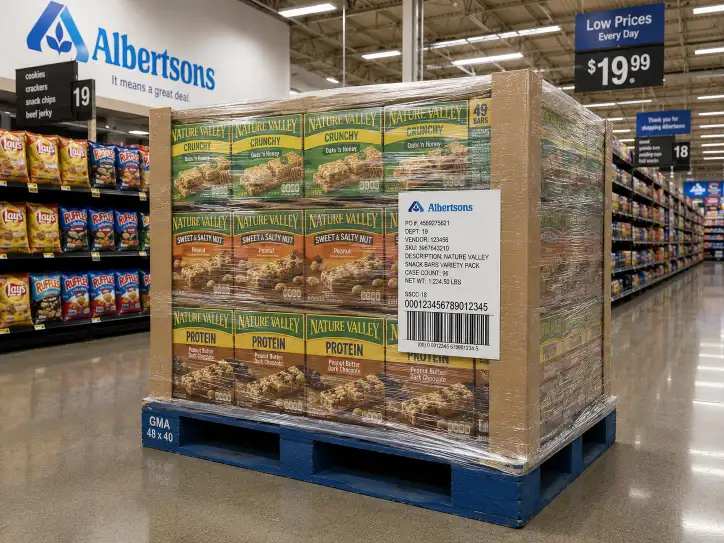
Albertsons Companies operates more than 2,200 stores across the United States under familiar regional banners including Albertsons, Safeway, Vons, Jewel-Osco, Shaw's, Acme, Tom Thumb, Randalls, and others. It is the second largest supermarket chain in North America by store count, and its vendor compliance framework applies uniformly across all banners. For display vendors, Albertsons enforces a consistent standard: GMA 48 × 40 inch pallets, a strict 48-inch loaded height limit, 1,500 lb weight cap, display-ready corrugated packaging, GS1-128 labeling with SSCC-18, and EDI 856 ASN transmission within 2 hours of shipment departure.
This guide covers the Albertsons pallet display requirements that apply across all banners: the GMA 48 × 40 pallet spec, the 48-inch height and 1,500 lb weight limits, display-ready case (DRC) requirements, GS1-128 labeling on two adjacent sides, EDI 850/856/810 compliance, the chargeback schedule ($100–$500 per violation), and how Albertsons compares with Kroger and Publix on the rules that catch vendors at receiving.
Why Albertsons Is Different for Display Vendors
Albertsons Companies is the second largest grocery chain in the US, and its vendor compliance system is designed to work uniformly across more than 2,200 stores under a dozen regional banners. For display vendors, three facts define how sourcing works for Albertsons:
- One compliance manual, all banners. Whether the display ships to a Safeway in California, a Jewel-Osco in Chicago, or an Albertsons in Texas, the same vendor compliance manual applies. The pallet spec, the labeling format, and the ASN requirement are consistent across the company — which means one spec brief covers the entire program.
- The 48-inch height limit is strict. Albertsons enforces a 48-inch maximum loaded height including the pallet — one of the tightest limits in grocery, matching Publix and stricter than Aldi's 60 inches. Displays designed for taller programs must be redesigned.
- EDI 856 must transmit within 2 hours. Albertsons requires the advance ship notice within 2 hours of shipment departure, with GS1-128 labels on two adjacent sides of every pallet and matching SSCC-18 data. Late transmissions and label mismatches trigger chargebacks in the $100–$500 range per violation.
The practical implication: Albertsons display compliance is about precision at low height. The 48-inch cap and 1,500 lb weight limit mean the display is compact, but the labeling and EDI discipline is every bit as strict as the larger chains.
Albertsons Pallet Requirements: Size, Type, and Condition
Albertsons operates on the standard GMA grocery pallet with consistent condition requirements:
| Requirement | Albertsons standard |
|---|---|
| Pallet size | GMA 48 × 40 in |
| Entry type | 4-way entry |
| Acceptable types | Standard GMA pallets, structurally sound |
| Condition | Dry, clean, free of damage |
| Broken boards | Rejected |
| Mixed SKUs | Not allowed on one pallet unless pre-approved |
| Overhang / underhang | Not permitted |
The condition standard at Albertsons is typical of major grocery chains — pallets must be dry and clean, not just structurally sound — but the no-overhang rule is enforced consistently at the DC level. A display that overhangs the pallet edge on any side is a receiving failure. For the GMA footprint context across grocery retailers, the pallet display sizes guide shows where Albertsons' 48 × 40 standard sits next to Kroger, Publix, and Aldi.
Height, Weight, and Load Limits
Albertsons enforces tight physical limits that reflect its grocery store format:
| Limit | Albertsons standard | Comparison |
|---|---|---|
| Max loaded height | 48 inches (including pallet) | Kroger: 60–66 in; Publix: 48 in |
| Max weight per pallet | 1,500 lb | Kroger: 2,000 lb; Publix: 2,000 lb |
| Pallet footprint | GMA 48 × 40 in | Standard grocery |
| Overhang | Zero — product must sit fully inside the pallet | Enforced at receiving |
The 48-inch height limit is among the strictest in US grocery. It forces a 2–3 tier pallet display design — a display built for Aldi at 60 inches or Kroger at 66 inches must be reduced by 1–2 tiers for Albertsons. The 1,500 lb weight cap is also tighter than the standard 2,000 lb GMA rating used at Kroger and Publix, which means high-density products need structural attention sooner.
For half-pallet and quarter-pallet options that work within these limits, the retail-ready pallet display guide covers the corrugated design principles that apply in the grocery channel, and the pre-filled pallet display guide explains the factory-loading model.
Display-Ready Case Requirements
Albertsons requires display-ready corrugated (DRC) packaging that goes directly to the sales floor with no repacking:
| Requirement | Albertsons standard |
|---|---|
| Display readiness | Product must be shoppable directly from the pallet display |
| No metal banding | Straps and banding must be plastic, not metal |
| Assembly | Easy to set up without cutting straps |
| Product orientation | Product oriented to be shoppable without restacking |
| Graphics | Retailer-compliant graphic panels |
| Corner boards | Required for load stability in transit |
| Stretch wrap | Clear wrap, applied evenly, product visible |
The no-metal-banding rule is specific and enforced: any display or pallet that arrives with metal straps or banding is rejected at receiving. Plastic banding only. The product orientation rule also matters for display design: the case on the pallet must be oriented so that the product faces the shopper when the display is placed on the floor — not sideways or upside down requiring store staff to rotate it.
For the corrugated structures that meet these requirements, our PDQ display guide covers tray and shipper formats, and the display fixture structural design guide explains the ECT ratings needed for grocery distribution stacking.
Labeling and EDI Compliance
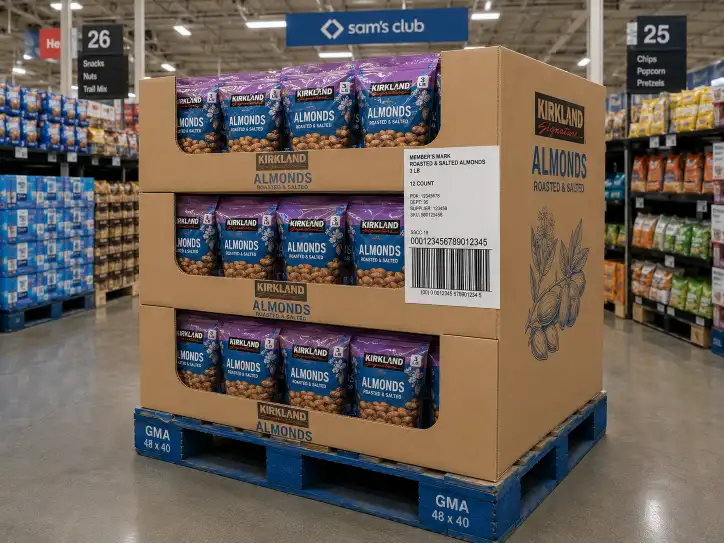
Albertsons labeling and EDI requirements follow the GS1-128 framework and are enforced uniformly across all banners:
| Requirement | Albertsons standard |
|---|---|
| Label standard | GS1-128 (UCC-128) with unique SSCC-18 per pallet |
| Label data | SSCC-18, GTIN, lot/batch number, pack date, weight |
| Label placement | Two adjacent sides of each pallet |
| Barcode quality | ANSI/ISO Grade C or better |
| EDI documents | 850 (PO), 856 (ASN), 810 (invoice) |
| ASN timing | Within 2 hours of shipment departure |
| EDI provider | SPS Commerce or approved VAN |
| Certification | Required for 850, 856, and 810 before production |
The two-adjacent-side label requirement is standard practice at major retailers, but the ASN timing at Albertsons — within 2 hours of departure, not at the end of the day — is tighter than chains that allow 24 hours. For a display program with multiple pallets,theASN must be generated and transmitted at the loading dock, not after the truck has left. Vendors who already ship to Walmart or Costco will recognize the GS1-128 format; the Albertsons-specific additions are the 48-inch height limit incorporated into the label's ship-to data and the consistent banner-level requirement for the same label format.
Chargeback Prevention
Albertsons enforces compliance through its vendor compliance manual with a published chargeback schedule:
| Chargeback category | Reported penalty | Prevention |
|---|---|---|
| Missing or late ASN | $150–$500 per occurrence | Transmit EDI 856 within 2 hours of departure |
| Incorrect or missing GS1-128 label | $100–$500 per violation | Verify labels on two adjacent sides before wrapping |
| ASN mismatch with shipment | Deduction | Match every SSCC to the 856 data |
| Pallet condition failure | Rejection | Inspect pallets for damage, moisture, and cleanliness |
| Incorrect pallet configuration | Rejection | Confirm 48 × 40 GMA, no overhang |
| Mixed SKUs without approval | Rejection | Single-SKU pallet unless pre-authorized |
| Delivery routing violation | $200–$500 per occurrence | Follow the routing guide for the specific DC |
The pattern is the same as every major chain: non-compliance costs more than the fix. For a display program, the most common chargebacks come from label errors and ASN timing, not from the physical display itself — which means the label artwork and the EDI workflow should be confirmed in the sample stage, not adjusted after production. See the sampling process for what to check.
Albertsons vs Kroger vs Publix: How the Grocers Compare
Albertsons, Kroger, and Publix are three of the largest traditional grocery chains in the US, and their pallet display requirements reflect different operational models:
| Requirement | Albertsons | Kroger | Publix |
|---|---|---|---|
| Store count | ~2,200 (multi-banner) | ~2,700 | ~1,400 |
| Pallet footprint | GMA 48 × 40 in | GMA 48 × 40 in | GMA 40 × 48 in |
| Max loaded height | 48 in | 60–66 in | 48 in |
| Max weight per pallet | 1,500 lb | 2,000 lb | 2,000 lb |
| Pallet condition | Dry, clean, damage-free | Standard | Standard |
| ASN timing | Within 2 hours | Standard | Standard |
| Label placement | Two adjacent sides | Standard | Standard |
The practical takeaway: Albertsons is the most restrictive of the three on height (48 inches vs Kroger's 60–66 inches) and weight (1,500 lb vs 2,000 lb), and its 2-hour ASN deadline is tighter than the industry average. A display that works at Kroger at 60 inches and 2,000 lb will not fit the Albertsons spec without a redesign to reduce both height and weight.
How to Order Compliant Displays for Albertsons
The cleanest path to an Albertsons display program is to brief the factory against the company's uniform spec from the first quote:
- Spec standard GMA 48 × 40 pallets — dry, clean, 4-way entry, no damage. Single-SKU only unless authorized.
- Design to 48 inches loaded height — measure from the floor including the pallet. A display designed for a 60-inch program must be reduced.
- Keep loaded weight under 1,500 lb — if the product is high-density, reduce tiers or adjust the board grade.
- Use display-ready corrugated cases — product oriented to be shoppable, no metal banding, plastic straps only.
- Spec GS1-128 labels on two adjacent sides — SSCC-18, GTIN, lot/batch, pack date, weight. Verify ANSI Grade C+ barcode quality.
- Set up EDI 856 transmission within 2 hours of departure — automate through SPS Commerce or an approved VAN. Complete certification for 850, 856, and 810 before the first shipment.
- Order a physical sample — load the real product, wrap it to Albertsons spec, apply labels on two adjacent sides, and verify the 48-inch height, 1,500 lb weight, and label data against the PO and ASN.
Conclusion
Albertsons pallet display requirements are built on a consistent framework that applies across the company's 2,200+ stores under all banners: GMA 48 × 40 pallets, a strict 48-inch height limit, 1,500 lb weight cap, display-ready case packaging with no metal banding, GS1-128 labels on two adjacent pallet sides, and EDI 856 ASN transmission within 2 hours of departure. The height and weight limits are among the tightest in grocery, and the ASN deadline is shorter than the industry average — both constraints that must be built into the factory brief, not adjusted after production.
Because Albertsons publishes its requirements in its vendor compliance manual, the authoritative sources are the Albertsons Companies Supplier Portal and the Vendor Compliance Manual for the current standards, with the Albertsons EDI guide covering ASN and label rules and GS1 defining the label standard. When you are ready to spec an Albertsons display, send us the product dimensions, case count, and target banner — we will size the display to the 48-inch height limit, spec the pallet and labels to the company standard, and produce a sample you can verify against the ASN before the bulk run.
FAQ
What pallet does Albertsons require?
Albertsons requires standard GMA 48 × 40 inch pallets in dry, clean condition. Pallets must be structurally sound with no broken boards. Mixed SKUs are not allowed on one pallet unless pre-approved.
What is the height limit for Albertsons pallet displays?
The maximum loaded height is 48 inches including the pallet. This is one of the strictest limits in grocery, matching Publix and tighter than Kroger (60–66 inches) and Aldi (60 inches).
What is the weight limit for Albertsons pallet displays?
The maximum weight per pallet is 1,500 lb, which is below the standard 2,000 lb GMA rating used at Kroger and Publix.
Does Albertsons require display-ready packaging?
Yes. Albertsons requires display-ready corrugated cases that go directly to the floor with no repacking. Product must be oriented to be shoppable, and no metal banding is allowed.
What labeling does Albertsons require?
GS1-128 labels with unique SSCC-18 per pallet, placed on two adjacent sides. Labels must include the GTIN, lot/batch number, pack date, and weight. Barcode quality must meet ANSI/ISO Grade C or better.
Does Albertsons require EDI?
Yes. Albertsons requires EDI 850 (PO), 856 (ASN), and 810 (invoice) through SPS Commerce or an approved VAN. The ASN must be transmitted within 2 hours of shipment departure.
What chargebacks does Albertsons assess?
Reported penalties include $150–$500 for missing or late ASNs, $100–$500 for incorrect GS1-128 labels, and $200–$500 for routing violations.
Can I use the same display for Albertsons and Kroger?
Not without checking. Albertsons' 48-inch height limit and 1,500 lb weight cap are both tighter than Kroger's 60–66 inch and 2,000 lb limits. Each retailer's spec must be confirmed separately.