Executive Summary
This white paper examines the structural, protective, and scheduling requirements for coffee pallet displays at Costco warehouse clubs. It is intended for coffee brands preparing their first or next Costco pallet display program. The paper establishes that coffee presents a unique dual-demand pattern — steady year-round core sales plus a concentrated holiday gift-set peak — and that the display must therefore be engineered around two distinct product classes: heavy bulk bags and lightweight, crushable pod boxes. Recommendations cover weight separation, material grading, coffee-oil protection, and production scheduling. All structural recommendations assume compliance with ISTA 3E transit testing.
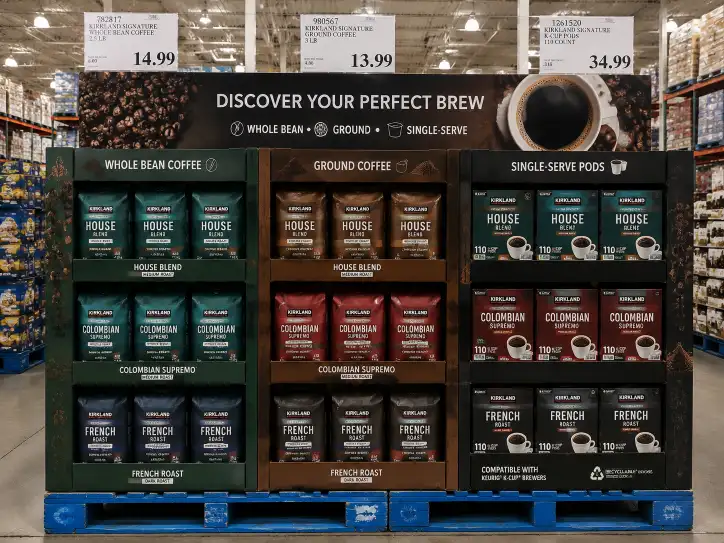
1. Background: Coffee as a Dual-Demand Category
Coffee at Costco does not behave like a single seasonal category. It combines two demand curves. The first is year-round core demand: whole bean bags, ground coffee, and pods sell steadily in every month because coffee consumption is continuous. The second is the holiday peak: gift sets and variety packs concentrate in November and December. A display designed only for the year-round core will underperform in Q4; a display designed only for the holiday peak will underperform for ten months of the year. Successful programs accommodate both demand curves within one structure.
2. Product Classification and Physical Properties
For display engineering purposes, coffee products divide into two classes:
Class A — Bulk Bags. Whole bean and ground coffee in 2 to 5 pound bags. Weight per unit: 2 to 5 pounds. High density, prone to oil transfer, requires the strongest trays.
Class B — Pod Boxes and Lightweight Items. Single-serve pod boxes, samplers, and accessories. Weight per unit: under 1 pound. Compressible, easily crushed, requires containment rather than reinforcement.
This binary classification drives every subsequent recommendation in this paper.
3. Structural Design: Weight Separation
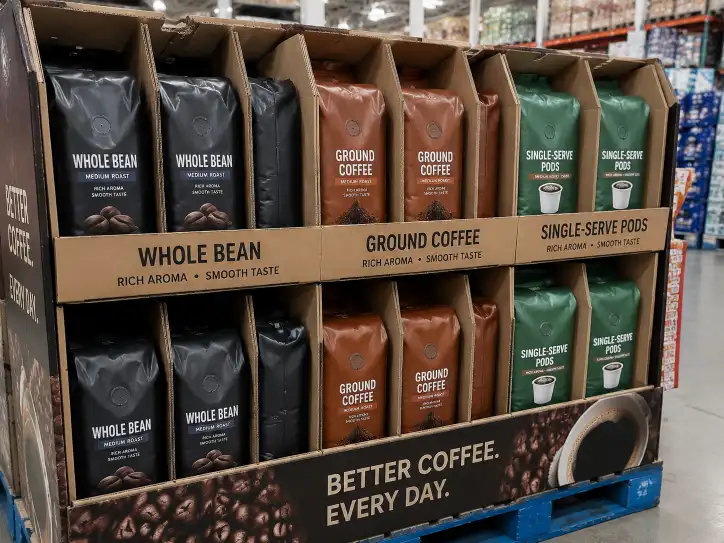
Class A products must occupy the bottom layers; Class B products must occupy the upper layers. Placing a 3-pound coffee bag above a pod box will crush the pod box during transit and during the in-store life of the display. The separation must be designed into the tray structure, not left to the store team. Each Class A bag requires an individual compartment with a cavity depth of at least 50 percent of the bag height. For bags fitted with one-way degassing valves, the compartment wall must not block the valve — a detail that is easy to miss and expensive to discover after production.
4. Material Specification
The following material grades are specified by product class:
| Product Class | Material Grade | Max Layers |
|---|---|---|
| Bulk bags (2–3 lb) | Double-wall BC flute, 44 ECT min | 3–4 |
| Large bulk bags (3–5 lb) | Double-wall BC flute, 61 ECT + corner supports | 2–3 |
| Pod boxes, samplers | C flute single-wall, 29 ECT | 5–6 |
| Lightweight accessories | B or E flute single-wall | 5–6 |
The graduated-strength approach — heavy board only where the weight sits — is the same principle documented in our display materials guide. Over-specifying every layer adds cost without benefit.
5. Compartment Design for Pod Boxes
Class B pod boxes are lightweight but crushable. Each box requires its own compartment with C flute single-wall dividers, fitted snugly to prevent movement. For variety packs containing multiple pod flavors, cross-lock dividers keep each flavor separate and organized. The compartment design should prevent boxes from sliding during vibration, which is the most common cause of scuffed packaging on arrival. Pre-loaded PDQ trays are recommended for samplers — these are packed at the factory and placed directly on the display, reducing store labor and preserving presentation quality.
6. Protection Standards: Coffee Oil and Dust
Coffee presents a protection challenge that most categories do not. Coffee beans contain natural oils that migrate to the corrugated board over time, leaving stains. Ground coffee generates fine dust that settles on display graphics and makes the display look dirty. Two protections are specified. First, moisture-resistant coating on all trays that contact coffee packaging. Second, sealed product packaging to prevent oil transfer and dust escape. The oil-and-dust issue is analogous to the chemical-protection requirements in our Costco household displays guide, where reactive products demand coated trays.
7. PDQ Trays for Samplers and Variety Packs
Single-serve pod samplers and variety packs benefit from the PDQ format. PDQ trays are factory-packed, reducing in-store labor, and their cross-lock dividers keep roast levels and flavors organized. B flute or E flute single-wall is sufficient for pod boxes. The tray sizing rules follow the same logic as the PDQ guidance in our peg and PDQ display documentation. Each PDQ tray should hold 6 to 12 units depending on box size.
8. Printing and Finish Recommendations
Coffee is purchased on brand preference, roast profile, and packaging design. Litho-laminated printing is recommended to reproduce coffee bean imagery, brewing scenes, and lifestyle photography accurately. For specialty coffee brands, matte lamination conveys a natural, artisanal character. For mainstream brands, bold, clean graphics with strong color contrast perform best. The finish options — matte, gloss, spot UV — are compared in our display printing and finishing methods guide.
9. Testing Standards
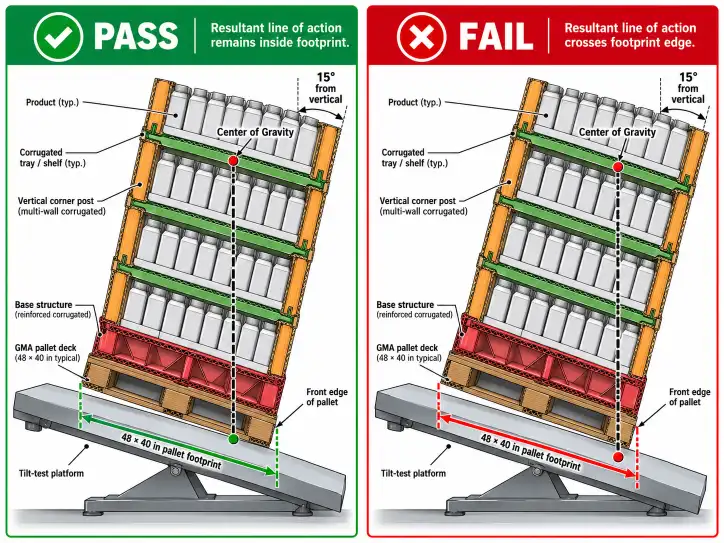
All pallet displays require ISTA 3E testing. For coffee displays, the three most common failure modes are: bag shifting from inadequate compartment sizing, pod box crushing from overhead weight, and tray collapse from heavy bags. Compression testing is mandatory for any display with Class A products on the bottom layer. Testing must use actual products in their real packaging — sealed bags with degassing valves behave differently from empty boxes. Test failures that are not corrected before production become chargebacks and rejected displays; the financial consequences are detailed in our Costco display chargebacks guide.
10. Scheduling: The Dual-Deadline Model
Coffee displays follow a dual-deadline model. For year-round core programs, plan 3 to 4 months of lead time. For holiday gift-set programs, production must be complete by September for November in-store placement, with design beginning in May or June. The holiday window is the binding constraint: late delivery forfeits the Q4 peak entirely. Brands should also avoid scheduling production in the July-to-September factory crunch, when capacity is absorbed by holiday programs across all categories. The full approval timeline is outlined in our Costco display approval process guide.
Conclusion and Reference
This white paper concludes that a Costco coffee display must be engineered as a dual-purpose structure: strong enough to carry Class A bulk bags on the bottom, gentle enough to protect Class B pod boxes on the top, and protected against the oil and dust that are unique to coffee. Brands that follow the material, compartment, and scheduling specifications above reduce the risk of failed testing and missed seasonal windows. For further industry reference, consult the National Coffee Association (NCA) and the Specialty Coffee Association (SCA). For structural and testing reference, see the standards cited throughout this paper.
FAQ
How do I separate bulk coffee bags from single-serve pods?
Coffee bags (2 to 3 pounds each) go on the bottom layer with double-wall trays. Pod boxes are lightweight — they go on upper layers. Never put heavy bags above pods.
What material grade is needed for bulk coffee bags?
Coffee bags need BC flute double-wall with 44 ECT minimum. For large bags (3 to 5 pounds), use 61 ECT with corner supports. For bags with degassing valves, ensure the valve is not blocked.
How do I protect against coffee oil and dust?
Coffee oils can stain the board and dust can settle on graphics. Use moisture-resistant coating on all trays. Seal coffee bags to prevent oil transfer and dust escape.
What compartment design works for pod boxes?
Each pod box needs its own compartment with C flute single-wall dividers. For variety packs, use cross-lock dividers to keep flavors separate. The compartment should fit snugly.
When should I start production for holiday coffee gift sets?
Production must be complete by September for November in-store placement. Start design in May or June. Coffee is a high-volume category, so plan ahead.