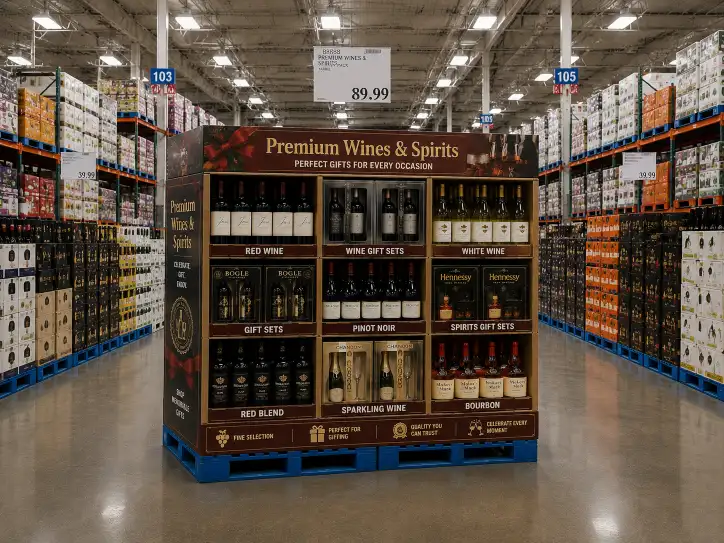
There is one decision that determines whether your wine display at Costco succeeds or fails, and it is not the graphics, the shelf layout, or the promotional timing. It is how you protect the bottles. A single broken bottle during transit can destroy an entire pallet of product, and the standard Costco pallet display requirements are not enough to prevent it. Wine is heavy — a full pallet easily exceeds 2,000 pounds — and fragile, which makes it the hardest category to ship. This article argues that every other design decision should follow from the bottle-protection decision, and explains why.
The Thesis: Bottle Protection Drives Every Other Decision
If you design your wine display around the product's look, you will make compromises on structure that come back to hurt you. If you design around bottle protection first, everything else — the layout, the graphics, the layer count — falls into place. This is the opposite of how most categories work, and it is worth understanding why.
Reason 1: The Cost of a Broken Bottle Is Not Just the Bottle
A broken wine bottle during transit costs you the bottle, the product, the packaging of everything around it, and quite possibly the entire display. Wine stains corrugated board, soaks into adjacent cartons, and makes a pallet unsellable. Add the chargeback from Costco and the damage to your brand relationship, and a single broken bottle is a five-figure problem. This is why bottle protection is not a detail — it is the core of the design. The full cost structure of failed displays is covered in our Costco display chargebacks guide.
Reason 2: Wine Bottles Are Heavier Than They Look
A standard 750ml wine bottle weighs 2.5 to 3 pounds. A full pallet of wine easily exceeds 2,000 pounds. That weight means two things. First, the bottom trays must support a massive load — you need double-wall BC flute with 44 ECT minimum for all bottle layers, and 61 ECT with corner supports for bottles over 1 liter. Second, the weight compresses the bottles below, so the number of layers is limited to 3 to 4 for standard bottles and 2 to 3 for heavy liquor. You can see the same weight logic applied to other heavy categories in our pallet display for heavy products guide.
Reason 3: Bottles Move Unless You Stop Them
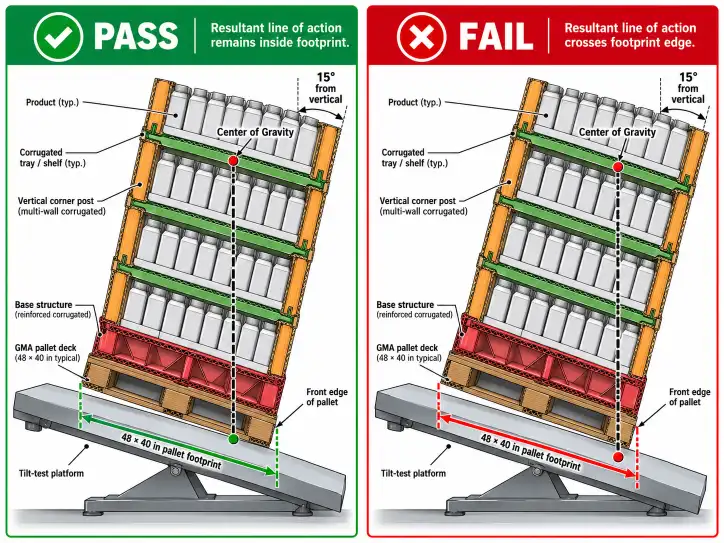
Bottle movement is the most common cause of breakage. Glass slides against glass, caps loosen under vibration, and containers shift into each other. The solution is a compartment that holds the bottle firmly — no room to shift. Use tapered compartment designs that match the bottle shape. For round bottles, hexagonal or square compartments prevent rotation. Internal divider locks keep compartments from flexing during transport. If a bottle can move even a quarter of an inch during vibration, it can crack. This is the standard enforced by ISTA 3E transit testing.
Reason 4: Gift Sets Compound the Problem
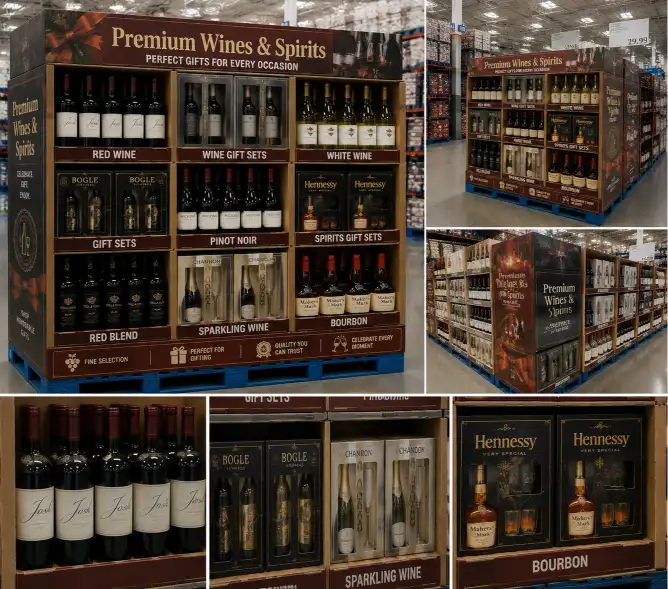
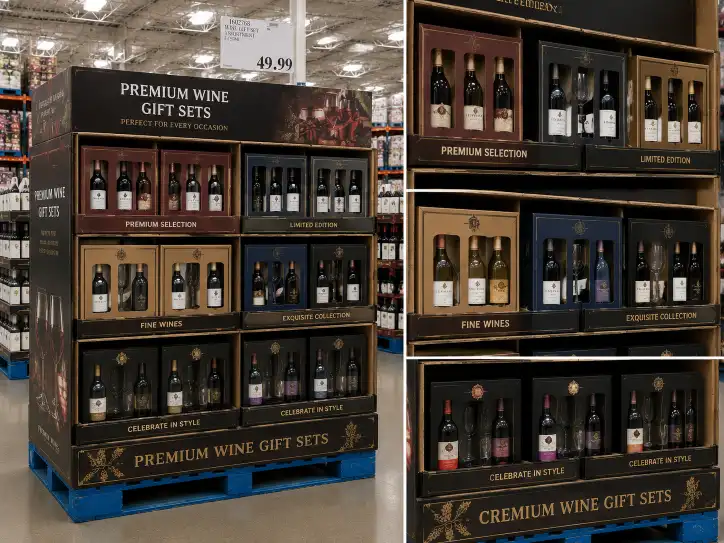
Wine and spirits gift sets — a bottle plus glasses or accessories in a box — are the hardest products to protect. They are oddly shaped, so a standard compartment does not fit. They contain a bottle, so they carry the same breakage risk. And they sell almost entirely in the holiday window, when there is no time to redesign. Each gift set needs its own compartment sized to its exact dimensions, with double-wall trays. For lightweight gift sets, C flute single-wall with 29 ECT is sufficient, but never compromise on the compartment fit.
Reason 5: Moisture Is a Silent Killer
Wine bottles sweat. When they move between temperature zones during shipping, condensation forms on the glass and soaks into the corrugated board. Moisture damage weakens the trays and can cause collapse long after the transit test is over. Apply moisture-resistant coating to every tray. For high-risk shipments, polybag each bottle individually. Moisture protection is the same principle we apply to chemical products in our Costco household displays guide.
Reason 6: The Holiday Window Leaves No Room for Failure
The holiday season (November to December) accounts for 40 to 50 percent of annual wine and spirits sales at Costco. Production must be complete by September for November in-store placement. That deadline means there is no time to re-test, re-design, or re-ship if a display fails. The brands that succeed are the ones that get bottle protection right on the first attempt, because the schedule does not allow a second one. The full scheduling logic is in our Costco display approval process guide.
Reason 7: Testing Is Your Last Defense
ISTA 3E testing catches what design misses. For wine and spirits, the most common failures are bottle breakage from inadequate padding, cap loosening from vibration, and tray collapse from excessive weight. Test with actual bottles filled to their real weight — empty bottles behave completely differently. Include both a breakage check and a leak check in the test protocol. If it fails in the lab, it fails in the warehouse. Our Costco bulk display testing guide walks through the protocol.
The Counter-Argument: Doesn't Bottle Protection Add Too Much Cost?
Some brands push back, arguing that individual compartments, foam inserts, and moisture-resistant coating drive up the unit cost. This is a false economy. The cost of one failed display — in product, chargebacks, and lost time — dwarfs the cost of proper bottle protection. And graduated material selection keeps the cost controlled: heavy board only where the bottles sit, lighter board for gift sets and accessories. The material grades by product type:
| Product Type | Material Grade | Max Layers |
|---|---|---|
| Standard 750ml wine | BC flute double-wall, 44 ECT | 3–4 |
| 1L+ liquor bottles | BC flute double-wall, 61 ECT + corner supports | 2–3 |
| Gift sets with bottles | BC flute double-wall | 2–3 |
| Lightweight gift sets | C flute single-wall, 29 ECT | 4–5 |
The Conclusion Follows From the Thesis
If bottle protection is the most important decision, then your process should start there: design the compartment to hold the bottle motionless, choose the material to support the weight, protect against moisture, and only then worry about layout and graphics. That order guarantees a display that arrives intact, sells down cleanly, and protects your relationship with Costco. It is the same first-principles approach that wins in every heavy category — and wine is the heaviest of them all.
FAQ
How do I prevent glass bottles from breaking during shipping?
Every bottle needs its own compartment sized to fit the specific shape. The cavity depth should be at least 60 percent of the bottle height. Use foam inserts or padding between bottles.
What material grade is needed for wine bottles?
A 750ml wine bottle weighs about 2.5 to 3 pounds. Use BC flute double-wall with 44 ECT minimum. For 1L+ bottles, use BC flute with 61 ECT and corner supports.
How do I design compartments for gift sets?
Each gift set needs its own compartment sized to the specific dimensions. Use double-wall trays for gift sets containing bottles. For lightweight gift sets, C flute single-wall is sufficient.
When should I start production for holiday wine displays?
Production must be complete by September for November in-store placement. Start design in May or June. The holiday season accounts for 40 to 50 percent of annual sales.
What moisture protection is needed for wine displays?
Apply moisture-resistant coating to all trays. For high-risk shipments, polybag each bottle. Moisture can cause tray collapse.
Conclusion
The argument is straightforward: bottle protection is the most important decision in your wine display, and every other decision should follow from it. Design the compartment to stop movement, choose the material to carry the weight, and protect against moisture. Do that, and your display survives shipping, sells down cleanly, and keeps Costco happy. For more information on wine and spirits regulations, refer to the Alcohol and Tobacco Tax and Trade Bureau (TTB) and the Wine Institute.