Every Costco pallet display starts as raw corrugated board before it becomes a structure. The board grade was decided during structural engineering, but whether that grade is actually available, at what price, and on what schedule is a material sourcing question. A display that is engineered perfectly on paper can still fail a Costco program if the factory cannot source the board, hold the lead time, or protect the loaded unit through transit. Material sourcing is where engineering meets the real supply chain.
This guide covers how a display factory actually sources material for Costco programs: how corrugated board is bought, how paper prices move display cost, how material lead times are planned around Costco launch dates, and how sourcing decisions protect the finished display from warehouse to sales floor. It is written from the factory floor — for buyers who want to understand what drives their display cost and schedule, and for the people who need to ask the factory the right questions before committing to a launch date.
01 Where Corrugated Board Comes From
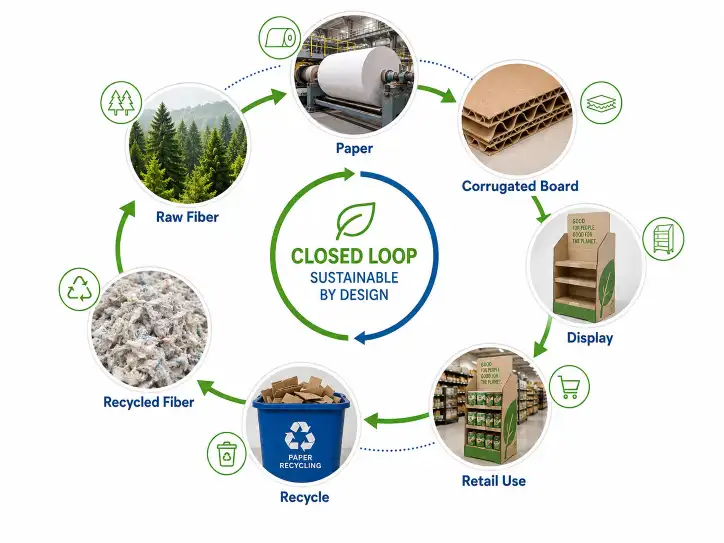
Corrugated board is not made by display factories. It is manufactured by paper mills and corrugating plants, and the display factory buys it in one of two forms: as corrugated sheets or as board rolls that are converted in-house. Understanding where the board comes from explains why grades, prices, and lead times behave the way they do.
The Supply Chain in Four Steps
| Stage | Who Does It | What Happens |
|---|---|---|
| 1. Pulp and paper | Paper mills | Wood pulp becomes linerboard and medium — the two papers that form corrugated board |
| 2. Corrugating | Corrugating plants | Linerboard and medium are fluted and glued into single, double, or triple wall board |
| 3. Sheet plant / converter | Display factory | Buys board, prints, dies, and glues it into the display structure |
| 4. Assembly | Display factory or co-packer | Loads product, attaches the pallet, and prepares the unit for shipment |
Most display factories, including ours, operate as sheet plants: we buy finished corrugated board and convert it into displays. That means our material supply depends on what the corrugating plants in our region produce, their capacity, and their delivery schedules.
Board Forms a Factory Buys
| Form | How It Is Used | Why It Matters |
|---|---|---|
| Corrugated sheets | Cut to size and die-cut into display panels | The most common purchase form — quick, flexible, no in-house corrugating |
| Board rolls | For long-run high-volume panels | Lower unit cost at high volume, requires converting equipment |
| Printed-on-board | Litho-lam or pre-print applied by the board supplier | Keeps heavy print off the factory floor, but locks the print to the board source |
| Specialty substrates | Moisture-resistant, coated, or flame-retardant board | For beverage, chilled, or high-moisture Costco programs |
The sourcing decision is not just "which grade" — it is also "which form." Buying sheets gives flexibility across projects. Buying rolls gives a cost advantage only when a single program runs at very high volume.
02 How Board Grades Are Purchased
The board grade table from structural engineering (single wall, double wall BC, triple wall) defines what strength the display needs. Material sourcing translates that engineering decision into a purchase: which flute combination, which basis weights, which quality level, and which supplier can deliver it.
What the Factory Specifies When Buying Board
| Specification | What It Controls | Example for a Costco Program |
|---|---|---|
| Flute combination | Structural strength and thickness | BC double wall for a beverage pallet display |
| Basis weight (gsm/lb) | Liner and medium weight, hence strength and cost | 200 gsm liner + 150 gsm medium for heavy trays |
| Board quality level | Recycled vs. virgin fiber content | Virgin fiber where moisture resistance and stacking are critical |
| ECT rating | Edge crush strength — the number that matters for stacking | ECT 51 lb/in for a two-high stackable pallet display |
| Moisture resistance | Water- and humidity-related strength loss | Wax-coated or barrier board for chilled beverage programs |
| Print surface | Litho-lam sheet vs. pre-printed liner vs. direct flexo | Litho-lam for high-graphics headers, direct flexo for structural panels |
Recycled vs. Virgin Fiber
The fiber source is a real sourcing decision, not a marketing label:
| Fiber Type | Strength | Moisture Behavior | Cost | Typical Use |
|---|---|---|---|---|
| Virgin fiber | Highest | Best moisture resistance | Highest | Heavy products, stacked displays, long transit |
| Recycled (OCC) | Good, variable | Absorbs moisture more readily | Lower | Light trays, PDQs, short transit |
| Blended | Middle | Middle | Middle | Most general Costco displays |
Costco does not require a specific fiber source, but the structural test results do. A recycled board with a lower ECT rating will not pass the same stacking and compression test as a virgin board of the same nominal grade. The factory sources the fiber that delivers the test result the program needs.
03 Paper Price and Display Cost
Corrugated board is a commodity whose price follows global paper markets. A display factory does not control paper prices, but it must plan around them — and buyers should understand that a display quote reflects the paper market at the time of quoting.
What Moves Corrugated Board Prices
| Driver | Direction | How It Reaches the Display Quote |
|---|---|---|
| OCC (recycled paper) prices | Up → board up | Recycled liner and medium get more expensive |
| Pulp prices | Up → board up | Virgin fiber grades rise with global pulp markets |
| Energy costs | Up → board up | Corrugating is energy-intensive; energy passes into board price |
| Freight / logistics | Up → delivered board up | Board shipped from mill to sheet plant adds freight |
| Capacity utilization | High → prices firm | When corrugating plants run full, discounts shrink and lead times stretch |
How Factories Manage Paper Price Risk
| Approach | What It Does |
|---|---|
| Fixed-price quotation window | The factory locks board price for the duration of the quote, so the buyer's price does not change mid-project |
| Material surcharge clauses | Large board price movements can be passed through, transparently, if the market shifts between quote and production |
| Forward buying for confirmed programs | Once a Costco program is confirmed, the factory buys board ahead to lock price and guarantee supply |
| Board substitution within spec | If one supplier's board moves out of budget, the factory requalifies an equivalent ECT grade from another source |
For a Costco program, the factory practice is to confirm the board price at the same time the display structure is approved — so the buyer sees a stable price from sample to production. If the paper market shifts sharply between sample approval and mass production, the factory flags it early rather than surprising the buyer at invoice time.
04 Material Lead Times and Costco Launch Dates
A Costco display program is scheduled to a launch date. The factory's material lead time is the first constraint in that schedule — before printing, before die-cutting, before assembly, board must arrive. Understanding material lead times is how buyers avoid the most common Costco program failure: a launch date committed without checking board availability.
Where Material Lead Time Sits in the Schedule
| Stage | Typical Duration | Material Dependency |
|---|---|---|
| Structural design and sample | 1–2 weeks | Sample board only — usually available immediately |
| Board sourcing and confirmation | 1–3 weeks | The point where grade, price, and availability are locked |
| Print plates and dies | 1–2 weeks | Runs parallel with board confirmation |
| Mass production | 2–4 weeks | Depends on board arriving on schedule |
| Pre-filled assembly | 1–2 weeks | Product and board must arrive together |
| Transit to Costco | 2–4 weeks | Depends on ocean or rail schedule |
What Affects Board Availability
| Factor | Effect on Lead Time |
|---|---|
| Grade availability | Common grades (BC, C, B) are stocked and fast; specialty grades (moisture-resistant, triple wall) are made to order |
| Regional capacity | When corrugating plants run at high utilization, standard lead times stretch |
| Seasonal demand | Q3–Q4 holiday programs create board demand spikes across the industry |
| Buyer confirmation speed | Every day the buyer spends approving the sample is a day the factory cannot order board |
The Rule: Lock Material Before You Lock the Launch Date
A factory that manages Costco programs well will not accept a launch date until the board is confirmed. The sequence is:
- Structural sample approved → grade confirmed
- Board order placed and delivery date confirmed
- Production slot booked
- Launch date committed to the buyer
Skipping step 2 is how programs miss launch dates. Buyers can protect the schedule by confirming samples fast and by asking the factory directly: "Is the board for this program ordered, and what is its confirmed arrival date?"
05 Sourcing for Pre-Filled vs. Flat-Pack Programs
Costco displays ship in different forms — pre-filled with product, semi-assembled, or flat-pack. Each form changes the material sourcing plan, because the board is exposed to different handling and transit conditions.
How Sourcing Differs by Ship Form
| Ship Form | Sourcing Implication |
|---|---|
| Pre-filled (loaded with product) | Board must arrive at the factory early enough to be built and loaded before ship date; the loaded unit puts compression on the board, so grade must include a transit safety margin |
| Flat-pack | Board ships as panels; sourcing can be later and cheaper, but the buyer or retailer does the final assembly |
| Semi-assembled | Some structure pre-built, some flat; middle ground for both sourcing and labor |
Product Arrival and Board Arrival Must Align
For a pre-filled Costco display, the factory is coordinating two inbound flows: board arriving from the corrugating plant, and product arriving from the brand's warehouse. Both must arrive in the same production window.
| Inbound Flow | Arrives From | When It Must Arrive |
|---|---|---|
| Corrugated board | Corrugating plant | Before assembly starts |
| Printed labels | Print house | Before packing |
| Product | Brand / co-packer | Before loading — typically 1–2 weeks before ship date |
| GMA pallets | Pallet supplier | Before the base is built |
A factory that manages both flows keeps the assembly line running. A factory that only tracks board loses time to product delays, and vice versa. For the full picture of how pre-filled loading works, see our pre-filled pallet displays guide.
06 Supply Chain Protection: Board Moisture, Humidity, and Transit
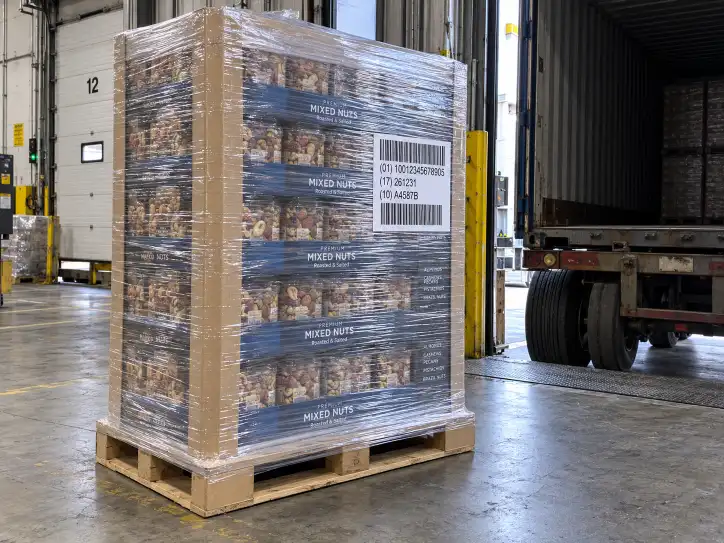
Corrugated board loses strength when it absorbs moisture. The material sourcing decision — which fiber, which coating, which barrier — is the first defense against the two biggest transit threats to a Costco display: humidity and handling.
Moisture and Corrugated Strength
| Moisture Level | Strength Remaining | What It Means for the Display |
|---|---|---|
| Dry (normal) | 100% | Rated structural performance |
| High humidity storage | 50–70% | Stacking and compression margin shrinks before the display is even loaded |
| Wet (contact) | 20–40% | Structural failure risk, board softens, edges crush |
Ocean transit to Costco warehouse regions exposes loaded displays to extended humidity. The sourcing plan counters this in three ways:
| Defense | What the Factory Sources |
|---|---|
| Moisture-resistant board | Wax-coated, poly-coated, or moisture-barrier liner for chilled or high-humidity programs |
| Barrier layer sheets | Poly or wax sheets between product layers where condensation is expected |
| Wrap and containment | Stretch wrap, corner boards, and desiccant planned at the packing stage |
Handling and Compression in Transit
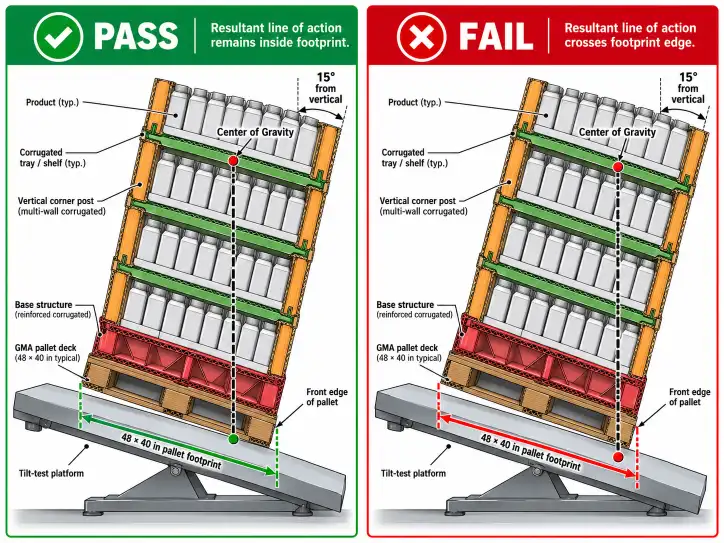
The board grade must carry not only the product load but the dynamic loads of distribution. A display that passes its static compression test can still fail after repeated forklift handling, stacking, and vibration. The sourcing table should always include the transit environment:
- Long ocean transit → add a grade or a moisture barrier
- Multiple warehouse transfers → stronger corner protection
- High stacking in the container → higher ECT or top caps
- Chilled distribution → moisture-resistant board regardless of grade
For the structural side of transit protection — load paths, board grades, and the 2.5× safety factor — see our Costco display structural engineering guide. For the general export packing methods, see our export packing guide.
07 Certifications and Documentation in Material Sourcing
Costco display programs increasingly ask for proof that the material supply chain is controlled. The factory's sourcing documentation becomes part of the approval package.
What Factories Are Commonly Asked to Provide
| Document | What It Proves |
|---|---|
| Board mill certificates | The ECT, basis weight, and grade of the board actually used — traceability to the supplier |
| FSC / PEFC chain-of-custody | That paper fiber comes from certified responsible sources — required by some brand programs |
| Test reports | Compression, ECT, and moisture results on the sourced board |
| Supplier qualification records | That the corrugating plant meets quality and capacity requirements |
The FSC Question for Costco Displays
Some brands that sell into Costco require FSC-certified board because their corporate sustainability commitments flow into the packaging. The sourcing implication:
- FSC board is a separate supply line with its own chain-of-custody paperwork
- Not all corrugating plants offer FSC board — the factory must confirm the certified source before quoting
- FSC board may carry a small price premium and a slightly longer lead time
A factory that keeps FSC-certified board in its regular supplier list can quote FSC programs without adding a special sourcing delay. A factory that has to find a certified source mid-project adds weeks.
08 The Material Sourcing Review Checklist
Before a Costco display program moves into mass production, the factory runs this sourcing review. It confirms that the board is not just engineered — it is actually bought, confirmed, and scheduled.
| Check | Status |
|---|---|
| Board grade confirmed against the engineering spec | ☐ |
| Flute combination, basis weight, and ECT specified to the supplier | ☐ |
| Fiber source confirmed (virgin / recycled / blended) and matched to the test requirement | ☐ |
| Paper price risk reviewed — fixed price, surcharge clause, or forward buy | ☐ |
| Board order placed and delivery date confirmed before launch date is locked | ☐ |
| Moisture protection sourced for the transit environment | ☐ |
| FSC or chain-of-custody documentation arranged if the program requires it | ☐ |
| Product arrival date aligned with board arrival for pre-filled programs | ☐ |
| Mill certificates and test reports prepared for the approval package | ☐ |
09 How the Factory Turns Material into a Costco-Ready Unit
Material sourcing is the invisible half of a Costco display program. The visible half — the structure, the print, the loaded product — is what the buyer approves. The invisible half is why it arrives on time and survives the trip:
- Source the board by the engineering spec — grade, flute, basis weight, and ECT bought from a qualified supplier
- Lock the price and the delivery — board confirmed before the launch date is committed
- Plan the moisture defense — fiber, coating, and wrap matched to the transit route
- Align the two inbound flows — board and product arriving in the same production window
- Document the supply chain — mill certificates, FSC paperwork, and test reports in the approval package
This is how a factory proves it can deliver a Costco display program — not by owning a corrugating plant, but by sourcing the right board, on the right schedule, at a price the buyer can hold. For the full range of display formats Leader Display develops for club stores, visit our Costco display product page. For how a program moves from sourcing into buyer approval, see our Costco display approval process guide. And to understand the chargebacks that a weak supply chain can trigger, see our Costco display chargebacks guide.
FAQ
Q: Where do factories buy corrugated board for Costco displays?
A: Display factories buy finished corrugated board from corrugating plants — as sheets for most projects, or as rolls for very high-volume programs. The board is specified by flute combination, basis weight, ECT rating, and fiber source, then converted into the display structure.
Q: How does paper price affect the cost of a Costco display?
A: Corrugated board is a commodity. Recycled paper (OCC), pulp, energy, and freight prices all move board prices. Factories manage this with fixed-price quotation windows, forward buying for confirmed programs, and transparent surcharge clauses if the market shifts sharply.
Q: Why does a Costco display need a long material lead time?
A: Board must be ordered, produced, and delivered before display production can start. Common grades are fast, but specialty grades (moisture-resistant, triple wall, FSC-certified) are made to order. The factory locks material delivery before committing to a launch date.
Q: Should Costco display board be virgin fiber or recycled?
A: It depends on the test requirement, not a fixed rule. Virgin fiber gives the highest strength and moisture resistance; recycled board is lighter on cost but loses strength in humidity. The fiber is matched to the compression, stacking, and transit tests the program must pass.
Q: What is the biggest material sourcing mistake on Costco programs?
A: Committing to a launch date before the board is confirmed. Board availability, price, and delivery must be locked before production is scheduled — otherwise the program misses the launch or pays a surprise material cost.
Q: Does Costco require FSC-certified board?
A: Costco does not publish a universal FSC requirement for every display, but brands that sell into Costco often require certified board to meet their own sustainability commitments. The factory confirms whether chain-of-custody documentation is needed before quoting.
Q: How does the factory protect the display from humidity in transit?
A: With a combination of moisture-resistant board, barrier layer sheets, and stretch wrap / corner board containment. The moisture defense is matched to the actual transit route — ocean transit needs more protection than regional trucking.
Q: What documentation should the factory provide for material sourcing?
A: Board mill certificates (grade, ECT, basis weight), FSC or PEFC chain-of-custody where required, test reports on the sourced board, and supplier qualification records. These documents go into the Costco approval package.