A Costco pallet display is engineered, not assembled. Every layer — the GMA pallet base, the corrugated structure, the corner supports, the product load, and the transit packaging — carries a share of the total load, and each share must be calculated before the first sample is cut. When a display fails at Costco, it almost always fails for a structural reason: a board grade chosen by habit instead of by load, a corner post that never carried the compression it was expected to carry, or a pallet base that sagged under the product it was never designed for. These failures result in rejected shipments and chargebacks, which is why understanding Costco compliance starts at the engineering stage, not the inspection stage.
This guide covers Costco display structural engineering from the factory floor: how load paths work, how board grade is selected, how the pallet base is built, how reinforcement is added where product weight concentrates, and how the finished structure is verified before mass production. It is written for the engineers and buyers who need to know how a display actually holds up — not just what the spec sheet says. For the full list of Costco dimensional and labeling specs, refer to our Costco pallet display requirements guide.
01 What "Structural Requirements" Mean at Costco
Costco does not publish one universal structural standard for every display. Requirements are set per program — by product, by buyer, and by warehouse region — and the factory is expected to engineer to the load, not to a generic template. That said, the structural expectations that come up in nearly every Costco display program fall into four fixed categories:
| Category | What It Governs | Typical Expectation |
|---|---|---|
| Load capacity | How much product weight the display must carry without permanent deformation | Bottom structure rated for the full product load plus stacking load |
| Stability | Whether the display stays upright during shopping and handling | Must not tip in a tilt test at 15 degrees or during customer pull |
| Stacking | Whether empty or loaded displays survive warehouse stacking | Two-high stacking of empty displays, or rated stacking of loaded displays |
| Transit survival | Whether the display and product arrive undamaged after distribution | Compression, vibration and drop resistance per distribution test profiles |
Each of these maps to a specific part of the structure. The table below shows the link between the Costco expectation and the engineering element that delivers it:
| Costco Expectation | Engineering Element |
|---|---|
| Full product load without sag | Shelf/tray board grade, span length, and internal support |
| No tipping during shopping | Base footprint, center of gravity, and corner post bracing |
| Two-high warehouse stacking | Top cap strength, vertical load path through posts and base |
| Transit survival | Pallet base rigidity, product containment, and packing support |
The rest of this guide walks through each engineering element in the order a factory designs them: load path first, then board grade, then the pallet base, then reinforcement, then verification.
02 The Load Path: How Weight Travels Through a Display
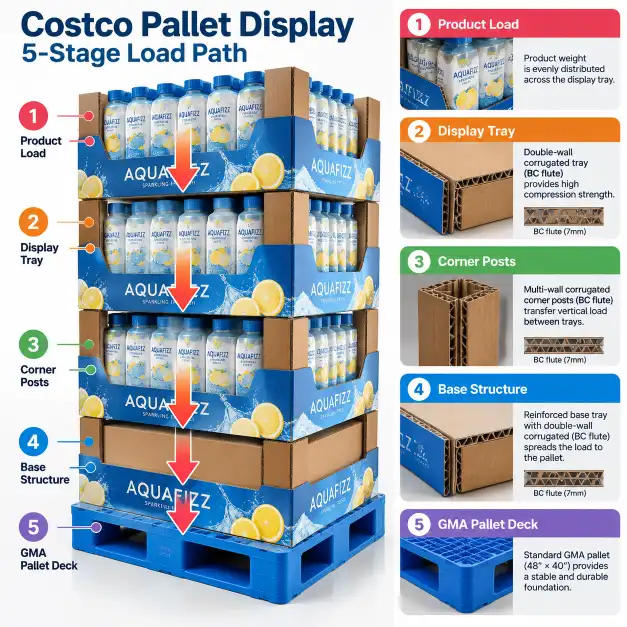
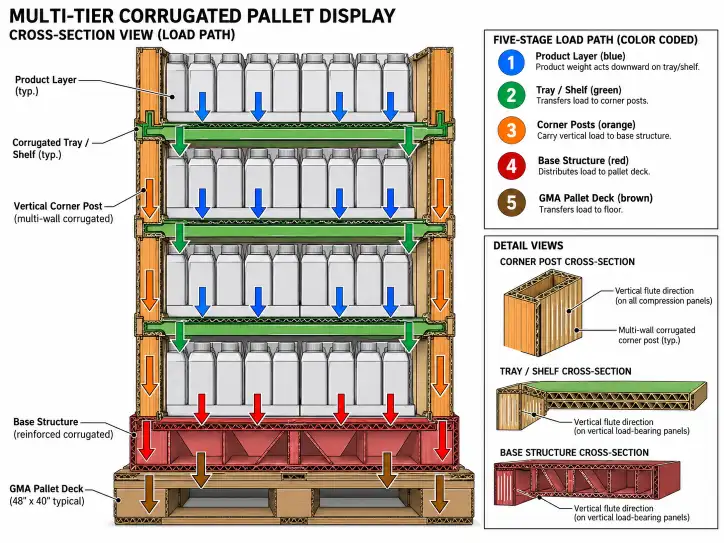
Every structural decision starts with the load path — the route product weight takes from the top layer down to the warehouse floor. A display with a clear, continuous load path distributes weight evenly and needs less material. A display with broken or indirect load paths concentrates stress and fails early.
The Standard Costco Load Path
For a typical pallet display, product weight travels through five stages:
- Product layer → weight rests on trays or shelves
- Tray/shelf panel → transfers weight to the side walls or riser posts
- Side walls / corner posts → the vertical compression members
- Base structure / pallet skirt → spreads the load across the pallet deck
- GMA pallet deck → transfers the load to the forklift forks and floor
Load Path Rules That Prevent Failure
| Rule | Why It Matters |
|---|---|
| Keep vertical loads directly over support points | Weight that lands between supports creates bending stress the board was not selected for |
| Align tray edges with side wall flute direction | Corrugated carries compression along the flute direction, not across it |
| Avoid notches or cut-outs in load-bearing walls | Every opening interrupts the vertical load path and weakens the panel |
| Use continuous corner posts for multi-tier displays | Stacked trays transfer their weight through the posts; a gap between posts breaks the path |
| Place heavy products at the bottom | Weight below the center of gravity improves stability and reduces required board grade |
Where Load Paths Break
The most common structural failures at Costco come from three load path breaks. These are the same types of issues documented in the pallet display for heavy products guide, where the weight magnifies every design weakness:
- Shelf spans too long for the board grade — a tray spanning a wide opening sags in the middle because the corrugated flutes carry compression but the panel flexes across the span.
- Tray edges unsupported at the corners — the tray edge sits between two support posts instead of on them, so the corner of the tray carries the load with no vertical member underneath.
- Cut-outs interrupting a load-bearing wall — a hand hole or window placed in a wall that is carrying compression creates a stress concentration that can start a crease or buckle.
A factory that draws the load path on the design before cutting the sample avoids these three failures at the drawing stage, where they cost nothing to fix.
03 Board Grade Selection: Engineering the Corrugated Structure
Board grade is the single most common cause of Costco display rejection — and the single most common place factories try to save cost. Selecting board by load is the core of display structural engineering.
Corrugated Grades That Appear in Costco Displays
| Grade | Flute Combination | Typical Use in Club Store Displays |
|---|---|---|
| Single wall (B flute) | B | Light PDQ trays, shelf inserts, lightweight product trays |
| Single wall (C flute) | C | General trays, light floor displays, product shelves |
| Single wall (E flute / micro) | E | Printed panels, headers, branding surfaces — not for load bearing |
| Double wall (BC) | B + C | The workhorse of club store displays — heavy trays, pallet displays, base structures |
| Double wall (EB) | E + B | Printed structural panels where graphics quality and strength are both needed |
| Triple wall | B + C + B (or similar) | Very heavy products, high stacking loads, reinforced pallet bases |
For a broader comparison of corrugated material options and flute characteristics, see our corrugated grades guide.
Board Grade Decision Factors
| Factor | Engineering Consideration |
|---|---|
| Total product load | Heavier total load pushes the base and lower trays toward double wall or higher |
| Shelf/tray span | Longer spans require higher board strength or intermediate support to prevent sag |
| Layer count | More layers means more weight transferred to the bottom trays and base |
| Stacking requirement | Two-high stacking of loaded displays requires the bottom structure to carry twice the product load |
| Flute direction | Vertical panels must have flutes running vertically to carry compression |
| Moisture / humidity | High-humidity environments reduce corrugated strength — factor a safety margin |
| Printing method | Litho-lam or pre-print adds a liner that can slightly increase board strength; flexo direct print does not |
The Engineering Decision Table
The table below is the decision sequence a factory runs through before confirming a board grade — not a fixed rulebook, because every product load is different:
| Step | Question | Decision |
|---|---|---|
| 1 | What is the total weight per display? | Establishes the starting grade for the base structure |
| 2 | How is the weight distributed across trays? | Determines per-tray grade and whether intermediate supports are needed |
| 3 | Does the display need to be stackable two-high? | If yes, add a full grade or add top caps to spread the stacking load |
| 4 | What are the tray/shelf spans? | Longer spans require higher ECT or added center support |
| 5 | What flute direction will the load follow? | Confirm vertical flutes on all compression panels |
| 6 | What is the transit environment? | Add reinforcement or higher grade for long, high-vibration transit |
The 2.5× Safety Factor Rule
Costco display programs commonly require the bottom structure to carry at least 2.5 times the actual product weight when the display is stacked or when the product is loaded. This is not a fixed Costco universal spec in every case — it is the de facto engineering margin that appears across club store programs, because it covers:
- Stacking of loaded displays (bottom unit carries its own load plus the unit above)
- Vibration and shock during transit, which multiply effective load
- Moisture reduction in board strength during ocean freight
- Partial sell-through where shoppers remove product unevenly and shift the load
A factory that designs to a 2.5× margin builds a display that passes testing the first time. A factory that designs to exactly 1× will watch the display fail its own compression test.
04 GMA Pallet Base: The Foundation Everything Rests On
The GMA pallet is the part of the display Costco handles directly with forklifts, pallet jacks, and warehouse racking. If the pallet fails, the display fails before it ever reaches the sales floor. Pallet base engineering covers both the pallet itself and how the corrugated structure attaches to it.
GMA Pallet Basics for Costco Displays
| Specification | Standard |
|---|---|
| Footprint | 48 × 40 inches (nominal) |
| Entry | 4-way entry (forklift from all four sides) |
| Construction | Wood stringer or block pallet |
| Deck | Top deck boards spanning the stringers |
| Height tolerance | ±1/8 inch on the nominal 48 × 40 footprint |
| Pallet condition | Must be clean, dry, and free of protruding nails or broken boards |
Pallet Base Engineering Checks
| Check | Why It Matters |
|---|---|
| Deck board spacing | Wide gaps between deck boards can allow the corrugated base to sag between boards |
| Deck support orientation | The corrugated base must sit on the deck boards, not bridge gaps |
| Fastener condition | Protruding nails or staples puncture the corrugated base and start tears |
| Moisture content | Wet or green pallets transfer moisture to the corrugated base and reduce its strength |
| Pallet flatness | A warped or crowned pallet makes the corrugated base and product sit unevenly |
How the Corrugated Structure Attaches to the Pallet
The attachment method determines whether the load path stays continuous from the base into the pallet. Common methods used in club store displays:
| Attachment Method | How It Works | Best For |
|---|---|---|
| Pallet skirt / base sleeve | A corrugated sleeve fits around the pallet footprint and the display structure sits on top of it | Full and half pallet displays with a branded base |
| Base cap / tray over deck | A corrugated tray fits over the pallet deck and the structure locks into the tray | Display structures that ship loaded |
| Stretch wrap containment | Product and display are wrapped to the pallet — the wrap carries lateral load, not vertical load | Pre-filled displays where the wrap holds the load together in transit |
| Stapling / strapping | The base is stapled or strapped to the pallet deck | Displays that must stay fixed to the pallet during handling |
The vertical load must always be carried by the corrugated base panels sitting flat on the deck boards. Stretch wrap and strapping resist lateral movement; they do not replace a load-bearing base.
05 Corner Posts and Vertical Reinforcement: Where Compression Is Carried
In multi-tier and tall Costco displays, the vertical compression members — corner posts, risers, and internal columns — carry the accumulated weight of every layer above them. This is the part of the structure that fails when a display "caves in."
What Carries Compression in a Pallet Display
| Element | Role | Failure Mode |
|---|---|---|
| Corner posts | Carry tray loads down to the base at the four corners | Buckling when the flute direction is wrong or the post is too thin for the load |
| Riser posts / internal columns | Support mid-display shelves or trays | Creasing where the tray edge meets the post if the joint is not reinforced |
| Side walls | Stabilize the structure and carry some vertical load | Bowing outward when the wall height exceeds the board strength |
| Tray stacking collars | Lock stacked trays together vertically | Collapse if the collar is not aligned with the post below |
Corner Post Engineering Rules
- Flutes must run vertically in the post. A corner post with horizontal flutes has almost no compression strength — this is the most common single engineering mistake in corner posts.
- Posts must be continuous or positively locked. A stacked display where each tray has its own short post and relies on friction to transfer load will shift in transit. Posts need locking tabs or a continuous riser.
- Post width scales with load. A 3-inch post may carry a light snack display; a beverage or pet food display needs wider posts or double-wall posts.
- Posts transfer load to the base, not to the tray edge. The post bottom must sit on a base panel that is supported by the pallet deck.
When Reinforcement Is Required
| Condition | Reinforcement Approach |
|---|---|
| Display height over 60 in | Add corner bracing or increase post width |
| Product weight over 20 lb per unit | Double-wall posts or internal support columns |
| Stacked two-high in transit | Top caps + posts rated for double the product load |
| Wide trays with heavy centers | Center support runner under the tray span |
| Long ocean transit | Additional base and lower-tray reinforcement |
Reinforcement is not an afterthought applied when a sample fails — it is planned in the engineering table at the same time as the board grade, because it changes the material cost and the carton size.
06 Stability: Preventing Tip-Over on the Sales Floor
Costco displays sit in open warehouse aisles where shoppers pull products from every side. A display that tips is a safety incident, not just a merchandising failure. Stability engineering is a separate discipline from load capacity.
The Three Stability Forces
| Force | Effect on Display |
|---|---|
| Product pull | Shoppers removing front products shifts the center of gravity forward |
| Uneven sell-through | Products removed from one side leaves the display top-heavy on that side |
| Customer impact | Shoppers or carts brushing the display add a lateral force |
Stability Engineering Rules
| Rule | Engineering Action |
|---|---|
| Keep the center of gravity low | Heavy product layers at the bottom, light layers at the top |
| Match footprint to height | Tall displays need a wider base or a heavier base structure |
| Braced corners resist pull | Corner posts tied into the base resist forward pull better than freestanding walls |
| Front cut-outs have limits | A deep front opening lowers the front wall and reduces resistance to forward pull — verify against the tilt requirement |
| Do not overhang the pallet | Product or structure hanging past the pallet edge reduces effective base width and creates a pivot point |
The Tilt Test
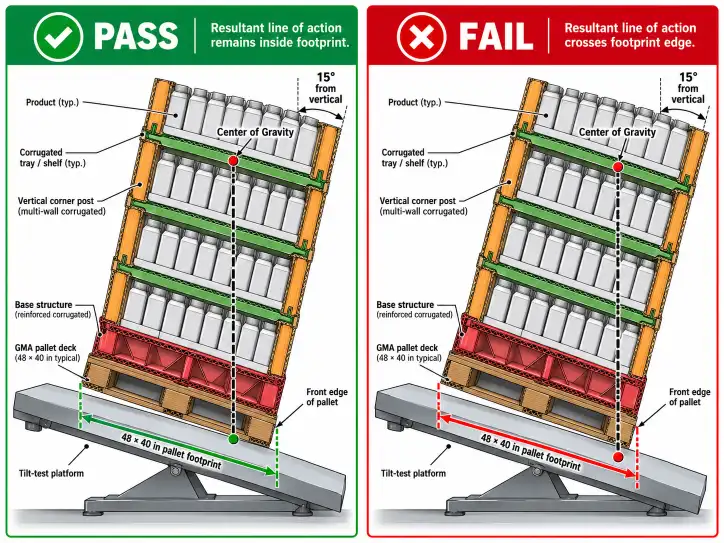
Costco display programs commonly reference a 15-degree tilt test: the display must not tip when tilted 15 degrees from vertical. The engineering check is straightforward:
- A display passes tilt when the vertical line from its center of gravity stays inside the footprint.
- A display fails when heavy product, a tall profile, or a narrow base puts the center of gravity line outside the footprint edge.
This is why tall, narrow displays for light products are safer than tall, narrow displays for heavy products — and why a display that passes load testing can still fail the tilt test.
07 Verification and Testing: Proving the Structure Before Production
Costco display programs expect structural verification before mass production — either from the factory's own lab or from a third-party test house. The testing confirms the engineering table was correct and gives the buyer a document they can attach to the approval.
The Verification Sequence
| Stage | Test | What It Confirms |
|---|---|---|
| 1 | Compression test | The structure carries the rated load without permanent deformation |
| 2 | Tilt test | The display does not tip at the required angle, loaded and partially sold through |
| 3 | Vibration test | The structure and product survive distribution vibration without collapse |
| 4 | Drop / handling test | The palletized display survives forklift and transport handling |
| 5 | Stacking test | Empty or loaded displays survive two-high warehouse stacking |
| 6 | Moisture / conditioning | Board strength is confirmed after humidity exposure simulating transit |
Common Test Standards Referenced for Displays
| Standard | Purpose |
|---|---|
| ISTA 3A / 3E | Distribution testing — vibration, compression, drop for shipped displays |
| ASTM D4169 | Performance testing of shipping containers and systems |
| TAPPI T-811 / T-821 | Edge crush (ECT) and box compression test methods for corrugated |
| In-house load test | Physical test loading the display with product and confirming deflection over time |
These test protocols follow established industry standards — the ISTA 3A general simulation test for shipped products, ASTM D4169 for distribution container performance, and TAPPI T-811 for edge crush testing of corrugated board. A factory running these tests in-house produces the same verification data a third-party lab would confirm, which is why many Costco display programs accept a factory test report when it is submitted with the sample.
What the Factory Should Document
A complete structural verification package for a Costco display program includes:
- Engineering summary — the load path, board grades, reinforcement decisions, and the safety factor applied
- Test report — compression, tilt, vibration, and stacking results
- Deflection data — how much the trays and base deflected under load, and that it recovered
- Sample photos — loaded sample, unloaded sample, and any reinforced areas
- Approved dimensions — final structure footprint and height confirmed against the program spec
A factory that sends this package with the sample shortens the approval cycle because the buyer can verify the structure without re-running every test.
08 The Engineering Review Checklist
Before a Costco display goes into mass production, run this engineering review. It is the checklist a factory uses to confirm the structure was engineered, not just drawn.
| Check | Status |
|---|---|
| Load path drawn and continuous from product to pallet deck | ☐ |
| Board grade selected by load, span, and stacking — not by habit | ☐ |
| Flute direction vertical on all compression panels | ☐ |
| Minimum 2.5× safety factor on the bottom structure | ☐ |
| GMA pallet footprint and condition verified | ☐ |
| Corrugated base sits flat on deck boards with no gaps | ☐ |
| Corner posts continuous or positively locked, flutes vertical | ☐ |
| Center of gravity inside footprint at full load and partial sell-through | ☐ |
| Tilt test passed at 15 degrees | ☐ |
| Compression and transit tests passed | ☐ |
| Stacking requirement confirmed (two-high empty or loaded) | ☐ |
| Engineering summary and test report prepared for approval | ☐ |
09 How the Factory Approves a Costco Structure
A display that passes the engineering review is a display that passes Costco approval without structural surprises. The sequence looks like this:
- Draw the load path — before any sample, confirm where every ounce of weight travels
- Engineer the board grade — select grades by load, span, stacking, and transit
- Build the pallet base correctly — a clean GMA pallet with the corrugated base sitting flat
- Reinforce where weight concentrates — corner posts and internal supports planned, not added after failure
- Verify by testing — compression, tilt, vibration, and stacking documented
- Submit the engineering package — sample plus test report plus dimensions, together
This is how a factory proves it understands Costco display structural requirements — not by owning a spec sheet, but by engineering every display to the load it will actually carry. For an overview of the full range of display formats Leader Display supplies for club stores, visit our Costco display product page. For a step-by-step walkthrough of how a Costco display program moves from engineering to buyer approval, see our Costco display approval process guide.
FAQ
Q: What are the structural requirements for a Costco pallet display?
A: Costco sets structural expectations per program rather than one universal standard. The consistent elements are load capacity for the full product weight, stability (tilt test at 15 degrees), stacking capability, and transit survival. The factory engineers to the actual product load, typically with a 2.5× safety factor on the bottom structure.
Q: What board grade is used for Costco pallet displays?
A: Double wall board (commonly BC flute) is the workhorse for club store displays. Single wall B or C flute is used for light trays and PDQ units, and triple wall can be required for very heavy products or high stacking loads. The grade is selected by load, span, and stacking requirement, not by a fixed rule.
Q: Does Costco require a specific GMA pallet for displays?
A: Costco displays are built on a standard GMA 48 × 40 inch pallet with 4-way entry. The pallet must be clean, dry, and structurally sound. The corrugated base must sit flat on the deck boards so the vertical load transfers to the pallet, not across gaps.
Q: How is a display tested before Costco approval?
A: Structural verification typically includes a compression test, tilt test at 15 degrees, vibration test, and stacking test. Distribution test standards such as ISTA 3A/3E or ASTM D4169 are commonly referenced, and the factory documents the results for the approval package.
Q: Why do Costco displays need a 2.5× safety factor?
A: The 2.5× margin covers stacking of loaded displays, vibration and shock in transit, moisture-related strength loss in ocean freight, and uneven sell-through on the sales floor. It is the de facto engineering margin across club store programs.
Q: What causes a Costco display to fail structurally?
A: The most common causes are board grade selected without reference to load, corner posts with horizontal flutes or broken load paths, trays spanning too far without support, cut-outs interrupting load-bearing walls, and a pallet base that sags because the corrugated base bridges deck gaps.
Q: Can a tall display be stable on a GMA pallet?
A: Yes, if the center of gravity stays inside the footprint at full load and partial sell-through, and if the corner posts are tied into the base. Heavy products must sit low, and the footprint must be matched to the display height.
Q: Is the structural test done by the factory or a third party?
A: Both are accepted in practice. A factory with its own test lab can verify the structure in-house and provide the report. Some programs require a third-party test report — confirm the requirement with the buyer before production.