The cost of a Walmart pallet display is driven by the same factors as any corrugated display — board grade, print method, structural complexity, and packing format — but Walmart's specific program requirements shift the weight of each cost factor compared to a club store or mass retail program. A display that costs $X for a Costco program may cost 10–20% less for a Walmart program of the same product weight, or it may cost the same with different cost allocation across the structural zones.
This guide breaks down Walmart pallet display cost from the factory floor: how each cost factor is affected by Walmart's program requirements, how the cost structure compares to club store displays, and where the factory and vendor can optimize cost without compromising compliance. It is the cost companion to our material sourcing guide (which covers board selection) and our structural engineering guide (which covers structure design) — this guide focuses on what each decision costs.
01 The Walmart Cost Difference vs. Club Store Programs
Before examining individual cost factors, it helps to understand the overall cost position of a Walmart display compared to a club store (Costco / Sam's Club) display of similar product weight and complexity.
Cost Comparison Overview
| Cost Category | Club Store Display | Walmart Display | Difference |
|---|---|---|---|
| Board cost | Higher — ocean-grade board, moisture protection on all panels, heavier grades for long-distance transit | Lower — regional transit allows lighter upper levels, moisture protection on bottom panels only | Walmart: 10–20% lower |
| Print cost | Similar — both use flexo or litho-lam depending on volume | Similar — but Walmart accepts flexo for more programs, which can reduce print cost | Walmart: 0–10% lower |
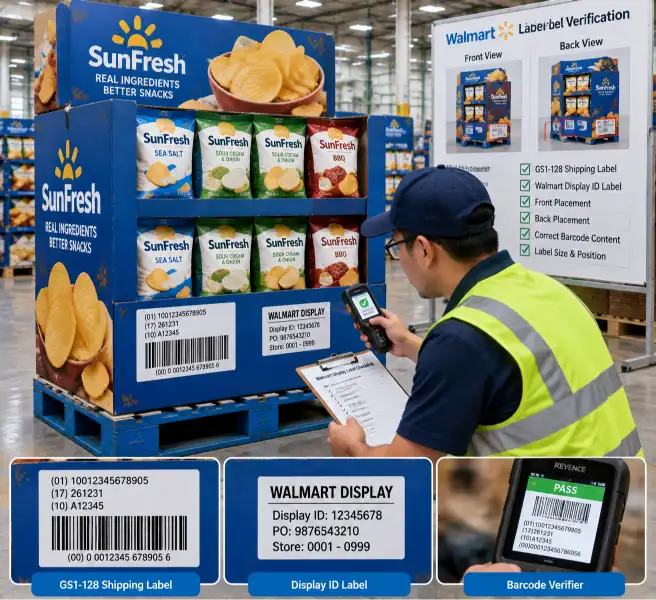
| Label cost | Lower — fewer labels required (front label only, fewer compliance labels) | Higher — front AND back labels, more compliance labels (GS1-128, recyclability, display ID, etc.) | Walmart: 20–30% higher |
| Structure cost | Similar — both use the same basic structural materials | Similar — but Walmart's mixed stacking requirement may push base grade higher | Similar |
| Packing cost | Higher — ocean-grade packing, moisture barriers, export-grade pallets | Lower — regional transit allows simpler packing, domestic pallets | Walmart: 15–25% lower |
| Testing cost | Similar — both require ASTM and distribution testing | Similar | Similar |
The Net Effect
A Walmart pallet display typically costs 5–15% less than a comparable club store display. The savings come from board optimization (lighter upper levels) and simpler packing (no ocean-grade protection). These savings are partially offset by higher label costs and, in some programs, higher base board grade for mixed stacking.
But the cost comparison depends entirely on the specific program. A Walmart power aisle display with litho-lam graphics may cost the same as a club store display with flexo printing. The following sections break down each cost factor so you can see where the money goes.
02 Board Cost: The Largest Cost Factor
Board cost is the single largest material cost in any corrugated display, typically accounting for 35–50% of the total display cost. For Walmart programs, the board cost is optimized differently than for club store programs.
Board Cost by Structural Zone
| Structural Zone | Typical Board Grade (Walmart) | Cost per Square Meter (Estimate) | % of Total Board Cost |
|---|---|---|---|
| Base / bottom structure | Double wall BC | $0.80–$1.20 | 25–30% |
| Heavy-load trays (lower) | Double wall BC | $0.80–$1.20 | 20–25% |
| Light-load trays (upper) | Single wall C or B | $0.40–$0.65 | 10–15% |
| Header / top cap | Double wall EB or single wall E + backing | $0.60–$1.00 | 5–10% |
| Side panels (structural) | Single wall C or double wall BC | $0.40–$0.80 | 5–10% |
| Side panels (non-structural) | Single wall B or C | $0.35–$0.50 | 3–5% |
| Dividers / inserts | Single wall B or C | $0.30–$0.50 | 5–8% |
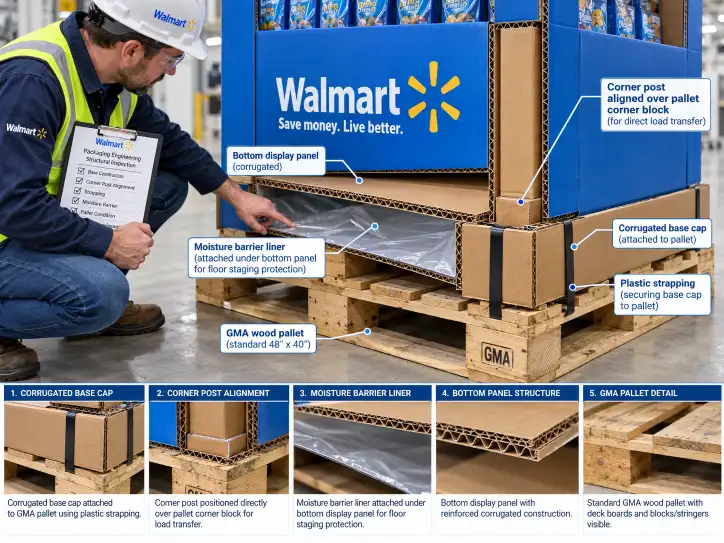
| Moisture barrier (bottom only) | Barrier coating or liner | $0.10–$0.20 per panel | 1–3% |
Board Cost Optimization for Walmart
| Optimization | Cost Impact | When to Apply |
|---|---|---|
| Use single wall C on upper trays instead of double wall BC | Saves 10–20% per tray | When product weight on upper trays is under 5 kg per shelf and transit distance is under 500 miles |
| Use single wall B for non-structural side panels | Saves 5–15% per panel | When side panels are decorative, not load-bearing |
| Specify moisture barrier on bottom panels only | Saves 15–25% on barrier cost | For all Walmart programs — ocean-grade barrier on all panels is not needed |
| Use recycled (OCC) board for moderate-weight programs | Saves 5–10% on board cost | When product weight is under 15 kg per display and floor staging is under 72 hours |
| Standardize on common grades (BC, C, B) | Avoids specialty-grade premium | When the display can be designed within standard flute grades |
For the full board grade selection process and how the grade decision affects cost, see the board grade sections in our Walmart display material sourcing guide and our structural engineering guide.
03 Print Method Cost
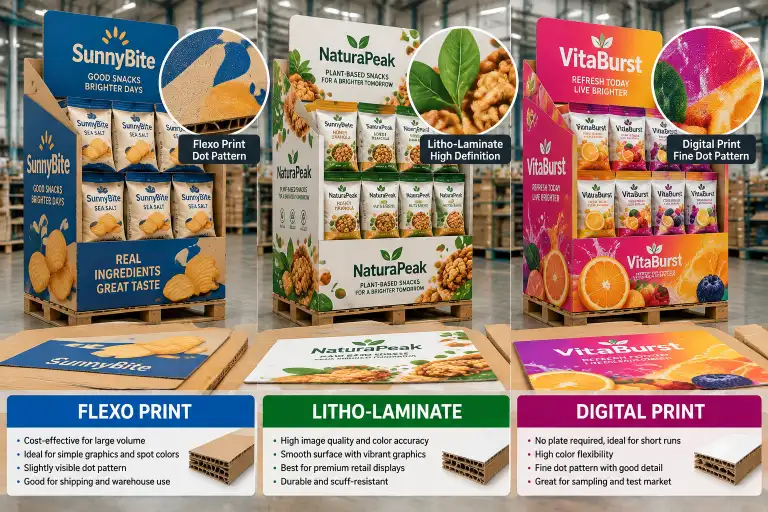
Print method is the second-largest cost factor, typically accounting for 15–25% of the total display cost. The print method selection affects both the unit cost and the upfront plate or tooling cost.
Print Cost Comparison for Walmart Programs
| Print Method | Plate / Setup Cost | Per-Unit Cost (Display) | Best Volume Range for Walmart |
|---|---|---|---|
| Flexographic (pre-print) | $200–$500 per color | $0.50–$1.50 | 5,000+ units |
| Flexographic (post-print) | $100–$300 per color | $0.80–$2.00 | 2,000–10,000 units |
| Litho-laminate | $500–$1,500 (plate + lamination) | $1.50–$4.00 | 1,000–5,000 units |
| Litho-lam header + flexo body | $400–$1,000 (litho-lam header only) | $1.00–$2.50 | 2,000–8,000 units |
| Digital print | $0 (no plates) | $2.00–$5.00 | Under 1,000 units |
How Walmart Program Features Affect Print Cost
| Program Feature | Print Cost Impact | Why |
|---|---|---|
| Power aisle placement | +15–30% | Often pushes toward litho-lam or premium flexo for higher visual impact |
| Grocery aisle placement | Standard | Flexo is acceptable — no cost premium |
| Seasonal / promotional | +10–20% | May require higher-quality print to stand out in seasonal displays |
| Multi-SKU display | +10–25% | More print plates, more changeovers, more complex layout |
| Small footprint (half/quarter pallet) | +5–15% per unit | Fixed print setup cost spread over fewer panels per display |
| Header-only premium print | +0–10% | Litho-lam header + flexo body is a cost-effective split |
For the full print method comparison including quality characteristics and finishing options, see our Walmart display graphics and branding guide.
04 Label and Compliance Cost
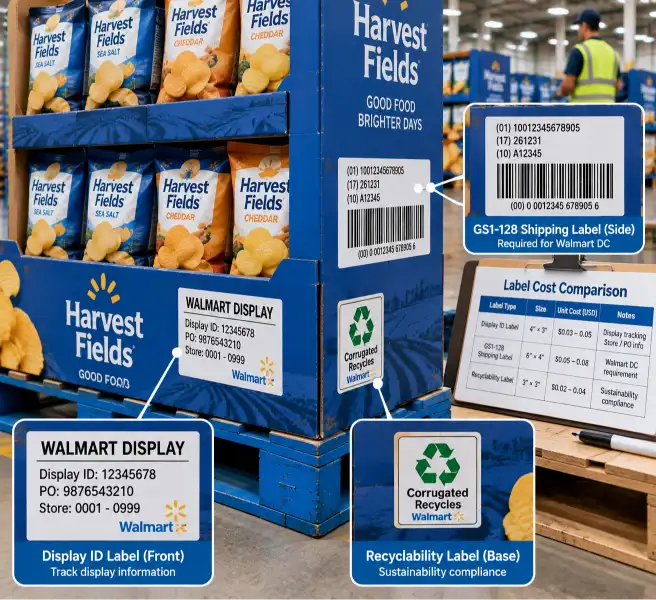
Labels are a small cost factor in absolute terms (typically 1–3% of total display cost), but Walmart's label requirements are more extensive than most other retailers. The label cost adds up when you account for all required labels on every display.
Walmart Display Label Cost Breakdown
| Label Type | Unit Cost (Estimate) | Quantity per Display | Total Label Cost |
|---|---|---|---|
| Display ID label (front + back) | $0.05–$0.10 each | 2 | $0.10–$0.20 |
| GS1-128 barcode label | $0.08–$0.15 | 1 | $0.08–$0.15 |
| Price label / shelf strip | $0.03–$0.08 per shelf | 3–5 shelves | $0.09–$0.40 |
| Product information label | $0.05–$0.10 | 1 | $0.05–$0.10 |
| Pallet label (SSCC-18) | $0.08–$0.15 | 2 (2+ sides) | $0.16–$0.30 |
| Recyclability label | $0.03–$0.08 | 1 | $0.03–$0.08 |
| Total label cost per display | $0.51–$1.23 |
Label Cost Comparison: Walmart vs. Other Retailers
| Retailer | Total Label Cost Per Display (Estimate) | Notes |
|---|---|---|
| Walmart | $0.51–$1.23 | Front AND back labels — biggest label requirement |
| Costco | $0.30–$0.70 | Front label only, fewer compliance labels |
| Target | $0.40–$0.90 | Similar to Walmart but typically one-sided |
| Walgreens | $0.25–$0.60 | Fewer labels overall |
For the complete label specification including placement, barcode quality, and material requirements, see the labels section of our Walmart pallet display requirements guide.
05 Structure Complexity Cost
The complexity of the display structure affects the cost of manufacturing — more die-cut pieces, more assembly steps, more material handling. For Walmart programs, the structure complexity cost is similar to club store programs, but Walmart's specific requirements (mixed stacking, handling endurance) can push certain structural elements to higher cost levels.
Structure Cost Drivers
| Structural Feature | Cost Impact | Walmart Consideration |
|---|---|---|
| Number of die-cut pieces | Each additional piece adds $0.10–$0.50 to manufacturing cost | Walmart displays typically have 5–12 pieces (similar to club store) |
| Base reinforcement | Reinforced base (double-wall, double-layer, or triple-wall) adds $0.50–$2.00 | Walmart's mixed stacking may require heavier base than club store |
| Top cap | Adds $0.30–$0.80 | Required for mixed stacking — not always needed in club store programs |
| Shelf count | Each additional shelf adds $0.20–$0.60 | Similar to other retailers |
| Internal dividers | Each divider adds $0.10–$0.30 | Depends on product configuration, not retailer |
| Locking mechanisms | Tab-and-slot vs. glue — tab-and-slot reduces assembly cost | Walmart accepts both — glue is faster for pre-filled programs |
Optimizing Structure Cost for Walmart
| Approach | Cost Saving | Trade-off |
|---|---|---|
| Reduce piece count by combining functions | 5–15% on manufacturing cost | May increase board grade requirement if a panel must serve both structural and decorative roles |
| Use tab-and-slot instead of glue where possible | 3–8% on assembly cost | Tab-and-slot panels may have slightly looser tolerances |
| Standardize shelf depth across all display levels | 2–5% on die-cutting cost | May not fit all product sizes equally |
| Minimize internal dividers by using product packaging as the divider | 5–10% on insert cost | Only works when product packaging has sufficient compression strength |
06 Packing and Palletizing Cost
Packing and palletizing cost is where Walmart programs diverge most significantly from club store programs. Walmart's regional transit and domestic supply chain allow simpler packing, which reduces cost.
Packing Cost Comparison: Walmart vs. Club Store
| Packing Element | Club Store Display | Walmart Display | Walmart Cost Advantage |
|---|---|---|---|
| Stretch wrap | Heavy-duty, multiple layers, with edge protectors | Standard stretch wrap, single layer for stabilization | 10–20% lower |
| Corner protectors | Required for all corners (ocean freight) | Not always required (domestic trucking) | $0.30–$0.80 per display |
| Moisture barrier | Barrier board or bag on entire display | Bottom-panel barrier only | 15–25% lower |
| Pallet type | Export-grade pallet (ISPM 15, heat-treated) | Domestic GMA pallet (plastic or wood) | $2–$5 per pallet |
| Pallet strapping | Steel strapping for ocean containers | Polyester or polypropylene strapping for domestic | 5–10% lower |
| Desiccant | Required for ocean freight containers | Not required (covered trucking) | $0.10–$0.30 per display |
Flat-Pack vs. Pre-Filled Packing Cost
| Packing Format | Packing Cost | When to Use |
|---|---|---|
| Pre-filled (bulk on pallet) | $1–$3 per display for wrapping and labeling | Single-SKU, high-volume programs — standard for full pallet displays |
| Pre-filled (individual display) | $1–$2 per display for individual stretch wrap + label | Programs where each display is handled individually |
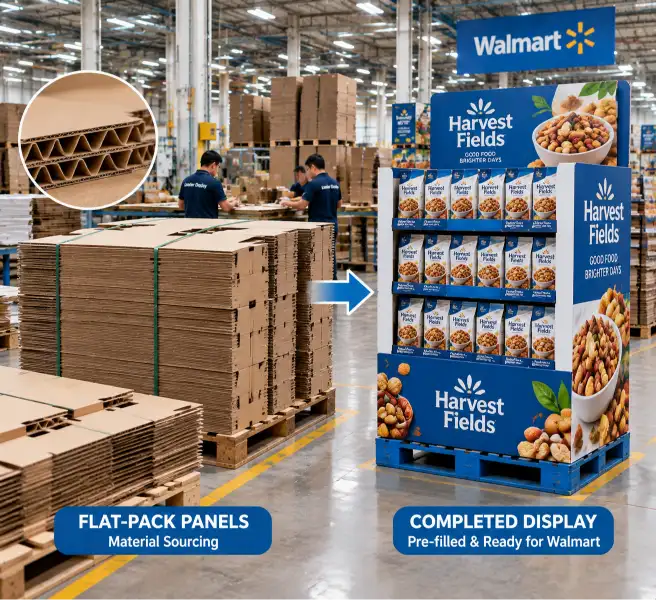
| Flat-pack (panels bundled) | $0.50–$1.50 per display | Multi-SKU programs, long-term programs, or when the vendor packs the product separately |
| Flat-pack (knocked-down bundles) | $0.30–$1.00 per display | Maximum shipping density — panels ship flat, packed into master cartons or bundles |
For how the packing format interacts with the material sourcing plan, see the flat-pack vs. pre-filled section of our Walmart display material sourcing guide.
07 Testing and Compliance Cost
Testing and compliance is a fixed cost per program rather than a per-display cost, but it still affects the total program budget. Walmart requires the same basic testing as most major retailers — the cost difference is in the specific test protocols.
| Test | Walmart Requirement | Cost (Estimate) | Notes |
|---|---|---|---|
| ASTM F1562 (tip-over stability) | Required — 15-degree test | $300–$600 | Same as most retailers |
| ASTM D642 (compression) | Required — base and loaded display | $400–$800 | Same as most retailers |
| ASTM D4169 (distribution vibration) | Required — Walmart DC simulation | $500–$1,000 | Same protocol but shorter duration than club store (regional transit) |
| Barcode verification (ANSI Grade C) | Required per display or per batch | $0.05–$0.15 per label | In-house or third-party |
| Color proof approval | Recommended (not required by Walmart, but recommended to avoid rejection) | $50–$200 per proof | Buyer may require this depending on the program |
Compliance Documentation Cost
| Document | Cost | Required For |
|---|---|---|
| Retail Link registration | $0 (internal process) | All Walmart display programs |
| Compliance certificate | $0–$100 (third-party if needed) | Some programs — confirm with buyer |
| Label specification sheet | $0 (internal production) | All programs — verify labels before production |
| Test report (third-party lab) | $500–$2,000 per test series | Required for new programs or if buyer requests it |
08 Total Cost Estimate by Display Type
The total cost of a Walmart pallet display varies significantly by display type, print method, and program volume. The following estimates are for a typical single-SKU program at a production volume of 5,000 units.
Cost Estimate by Display Type
| Display Type | Board | Labels | Structure | Packing | Testing (per unit, amortized) | Total (Estimate) | |
|---|---|---|---|---|---|---|---|
| Full pallet, flexo print | $3.00–$5.00 | $0.80–$1.50 | $0.60–$1.20 | $1.50–$3.00 | $1.00–$2.00 | $0.10–$0.30 | $7.00–$13.00 |
| Full pallet, litho-lam header + flexo body | $3.00–$5.00 | $1.20–$2.50 | $0.60–$1.20 | $1.50–$3.00 | $1.00–$2.00 | $0.10–$0.30 | $7.40–$14.00 |
| Half pallet, flexo print | $1.50–$3.00 | $0.60–$1.20 | $0.50–$1.00 | $1.00–$2.00 | $0.80–$1.50 | $0.10–$0.30 | $4.50–$9.00 |
| Quarter pallet, flexo print | $0.80–$1.50 | $0.40–$0.80 | $0.50–$1.00 | $0.50–$1.00 | $0.50–$1.00 | $0.10–$0.30 | $2.80–$5.60 |
| PDQ / tray display, flexo print | $0.30–$0.80 | $0.20–$0.50 | $0.30–$0.60 | $0.20–$0.50 | $0.20–$0.50 | $0.05–$0.15 | $1.25–$3.05 |
Cost Estimate by Volume
| Volume | Full Pallet (Flexo) | Full Pallet (Litho-Lam Header) | Half Pallet | Notes |
|---|---|---|---|---|
| 1,000 units | $10–$16 | $11–$18 | $6–$11 | Higher per-unit cost (plate/setup amortized over fewer units) |
| 5,000 units | $7–$13 | $7.40–$14 | $4.50–$9 | Standard cost range |
| 10,000 units | $6–$11 | $6.50–$12 | $4–$8 | Lower per-unit cost (volume discounts on board, print setup amortized) |
| 20,000+ units | $5–$9 | $5.50–$10 | $3.50–$7 | Best volume pricing — board and print both benefit |
09 How the Factory Controls Cost on a Walmart Program
A factory that produces Walmart displays profitably while keeping the unit cost competitive follows a structured cost control process. The key is to make cost decisions in the right order — structural and material decisions first (they have the largest cost impact), then print and label decisions.
- Start with the structural zone cost allocation — Determine what percentage of the total cost should go to base, trays, header, and packing. Walmart programs typically spend 30–35% on base, 25–30% on trays, 15–20% on print/headers, 5–10% on labels, and 10–15% on packing
- Select board grade by zone, not by rule — Use the handling endurance requirement for the base, but optimize the upper levels for the shorter Walmart transit
- Match print method to placement and volume — Power aisle gets a print budget; grocery aisle gets a different print budget
- Account for the full label cost — Walmart's front-and-back label requirement adds $0.20–$0.40 per display compared to single-label retailers
- Pack for domestic transit, not ocean freight — The single biggest cost optimization for Walmart programs is removing the ocean-grade packing requirements
- Run the cost comparison against the program volume — Confirm that the per-unit cost at the actual program volume supports the program budget
This is how a factory proves it understands Walmart pallet display cost — not by offering a single price, but by showing how each cost factor is optimized for Walmart's specific program requirements, transit network, and store environment.
FAQ
Q: How much does a Walmart pallet display cost?
A: A full pallet display for Walmart typically costs $7–$13 per unit at 5,000+ units with flexo printing. Half pallet displays cost $4.50–$9 per unit. The cost varies by board grade, print method, structural complexity, and program volume. These are factory-level estimates and do not include shipping, duties, or buyer-specific markups.
Q: Is a Walmart display cheaper than a Costco display?
A: Typically, yes — 5–15% less for comparable product weight and complexity. The savings come from lighter board grades on upper levels, simpler packing (regional transit vs. ocean freight), and lower moisture protection cost. These savings are partially offset by higher label costs (front AND back labels) and sometimes higher base board grade for mixed stacking.
Q: What is the biggest cost factor in a Walmart display?
A: Board cost is the largest, accounting for 35–50% of the total. The base structure alone often accounts for 25–30% of the board cost. After board, print method is the next largest cost factor at 15–25%.
Q: Does Walmart require litho-laminate printing?
A: No — Walmart accepts flexo printing for most programs. Litho-laminate is recommended for power aisle displays and premium programs, but it is not a universal requirement. The print method should be selected by program volume, placement, and budget.
Q: How can I reduce the cost of a Walmart pallet display?
A: The most effective cost reductions come from board grade optimization (using lighter grades on upper levels), matching the print method to the placement (not over-specifying print for grocery aisle displays), packing for domestic transit (not ocean freight), and reducing piece count through structural consolidation.
Q: Do Walmart's label requirements add significant cost?
A: In absolute terms, no — the total label cost is typically $0.51–$1.23 per display. But compared to other retailers (which may spend $0.30–$0.70), Walmart's front-and-back label requirement adds $0.20–$0.40 per display.
Q: How does program volume affect the per-unit cost?
A: Going from 1,000 units to 5,000 units typically reduces the per-unit cost by 15–25% because setup costs (print plates, die-cutting dies, testing) are amortized over more units. Going from 5,000 to 20,000 units typically reduces cost by another 10–15% through volume board pricing and production efficiency.
Q: Does flat-pack cost less than pre-filled?
A: Yes — flat-pack typically costs 30–50% less in packing and handling cost because panels ship flat with minimal wrapping. However, the total program cost must include the cost of assembling the display at the destination, which may offset some or all of the packing savings.
Q: What is the testing cost per Walmart display?
A: Testing is a fixed program cost, not a per-display cost. At 5,000 units, the amortized testing cost is approximately $0.10–$0.30 per display. At lower volumes, the per-unit testing cost is higher.