The acrylic vs cardboard display decision is not a durability contest — it is a timing contest. An acrylic display is built to stay in one store for years. A corrugated cardboard display is built to sell a campaign for weeks. Both are right, and both are wrong, depending on one thing: how long the display has to work before the product or the message changes. Buyers who compare only "which is stronger" miss the question that actually decides the cost, which is "how many campaigns will this display carry?"
This guide compares acrylic and corrugated cardboard displays on the metrics that matter to a buyer — upfront cost, tooling and minimums, customization and printing, durability, shipping, and sustainability — and then runs the total cost of ownership for a single program against a long-term program. It is written for brand and procurement teams choosing between a permanent fixture and a promotional display.

Quick Answer: Which One Is Better for Your Project?
For most promotional and campaign-driven programs, a corrugated cardboard display is the better choice: it costs less upfront, needs no tooling beyond a die, prints in full color, ships flat, and can be refreshed every season. For a permanent or semi-permanent fixture with a static brand message — a cosmetics counter, a jewelry case display, a pharmacy wall unit meant to last one to three years — an acrylic display can amortize its higher initial cost over a much longer life.
The decision is not acrylic vs cardboard in the abstract. It is: how long does this display need to work, and how often will the message change? If the answer is "one campaign," corrugated wins on total cost. If the answer is "three years with the same graphics," acrylic can win — but only if the store traffic, placement, and product justify the premium.
What We Mean by Acrylic and Corrugated Displays
Acrylic displays are fixtures made from acrylic sheet (PMMA, often sold as plexiglass) or molded acrylic, typically thermoformed or injection-molded into a structure. They are transparent or tinted, rigid, and scratch-resistant. Because they are manufactured with tooling, the unit price is high at low volume, and the structure is semi-permanent by design.
Corrugated cardboard displays are built from corrugated board — a fluted paperboard core between two liners — cut, printed, and folded into a display that ships flat and pops up at the store. They are made from recycled and recyclable paper, print in full color, and are designed for a defined campaign life rather than years of service.
The two materials are not interchangeable. They are answers to different retail problems, and the comparison that follows is about matching the material to the problem. For a deeper look at how corrugated displays are built and specified, see our cardboard display range and the corrugated grades guide.
Side-by-Side: Acrylic vs Corrugated Display
| Factor | Acrylic display | Corrugated cardboard display |
|---|---|---|
| Upfront cost | High (tooling + premium material) | Low (die cost only) |
| Tooling / mold | One-time mold or thermoform tooling | One-time steel-rule die |
| Typical MOQ | Higher, to amortize tooling | Lower, from a few hundred units |
| Customization speed | Slower (tooling + fabrication) | Fast (print + cut + fold) |
| Full-color printing | Limited; UV or screen print, or printed inserts | Excellent; litho or digital full coverage |
| Durability / life | Years, semi-permanent | Weeks to months per campaign |
| Shipping profile | Bulky, often pre-assembled or semi | Flat-pack, freight-efficient |
| Sustainability | Recyclable but niche recycling | Paper-based, curbside recyclable |
| Best fit | Permanent counters, high-end retail | Promotions, launches, seasonal, rollouts |
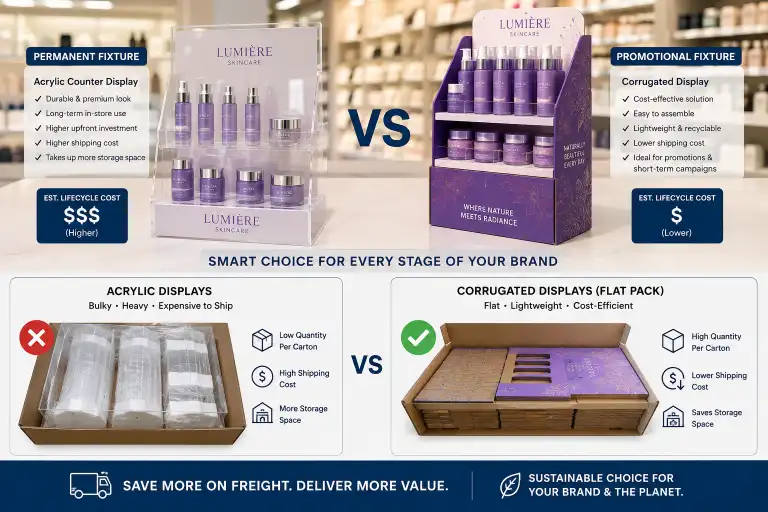
The pattern to notice: acrylic wins on lifespan, corrugated wins on flexibility and cost per campaign. That trade is the entire decision. If a buyer compares them on any single row — say, durability — they will pick acrylic and overpay for a 6-week promotion. If they compare on cost alone, they will pick corrugated and under-build a 3-year fixture. The rows only make sense together.
Total Cost of Ownership: Where the Two Diverge
Total cost of ownership (TCO) is the honest way to compare the two materials, because the unit price tells you almost nothing. An acrylic display can be five to ten times the price of a corrugated display and still be the cheaper choice over three years — and the reverse is equally true for a single campaign.
Consider two ways to run the same product program:
| Program | Acrylic approach | Corrugated approach |
|---|---|---|
| One 8-week launch, 200 stores | ~$80–$250/unit, tooling extra; bulky freight | ~$15–$45/unit, flat-pack freight; full color |
| 8-week launch, total cost | Highest per program; no graphic refresh possible | Lowest per program; brand-refresh ready |
| Four seasonal campaigns / year | Cannot change graphics without new inserts or tooling | New printed display each campaign at similar unit cost |
| 3-year permanent counter | Amortizes tooling; the right call if graphics stay static | Would be rebuilt repeatedly; cost compounds |
The rule that falls out of the table: acrylic pays back only when the display does not change. The moment a program needs fresh messaging, a new promotion, or a seasonal graphic, the acrylic fixture becomes an expensive frame that needs new printed inserts or replacement — while corrugated simply reorders at the same unit price. Brands that run frequent campaigns almost always land on corrugated for the flexibility, even when the per-unit price of acrylic looks "stronger." For a full breakdown of where corrugated costs actually go, see the custom cardboard display cost guide.
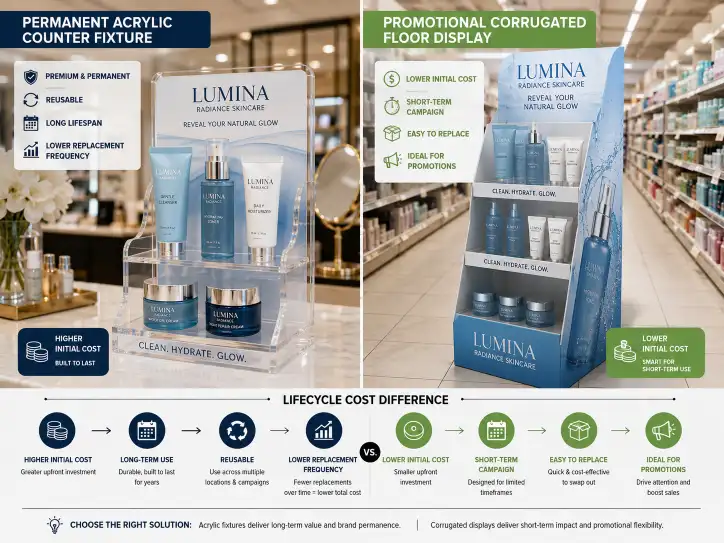
Acrylic is often compared as "one and done" — buy once, keep forever. The flaw in that thinking is that retail programs are not static. The moment a retailer or a brand changes the planogram, the message, or the season, the permanent fixture either adapts (expensive) or becomes obsolete (worse).
When an Acrylic Display Is the Right Call
Acrylic is the right material when the display is part of the store's furniture, not part of a campaign. The conditions that justify acrylic:
- The display stays for a year or more with the same product and message — typically at a cosmetics counter, jewelry case, pharmacy, or premium brand boutique.
- The product benefits from the clear material — showing the item through transparent acrylic, or matching a high-end store interior, where paperboard would look out of place.
- The graphics are permanent — a brand logo, a product name, a category marker that will not change with the season.
- The retailer requires a durable fixture for a high-traffic or high-touch location, where a corrugated unit would wear before the program ends.
Acrylic fixtures shine in cosmetics, fragrance, jewelry, sunglasses, and electronics accessories — categories where the fixture must look premium and survive years of customer handling. If that is the project, the higher upfront cost is a deliberate investment in a long-lived asset.
When a Corrugated Cardboard Display Is the Right Call
Corrugated cardboard is the right material for anything time-boxed, promotional, or iterative. The conditions that favor corrugated:
- The display is for a campaign, launch, or season with a defined end date — the display's job ends when the campaign ends.
- The message will change — next quarter's promotion needs different graphics, and corrugated simply prints a new run.
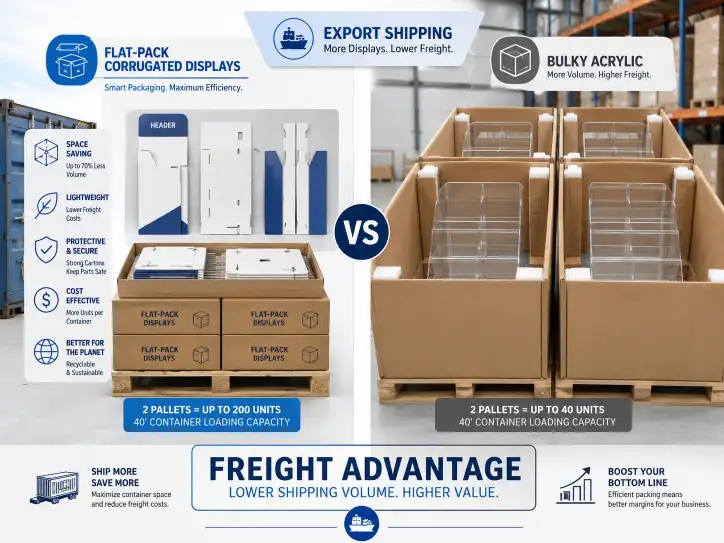
- The rollout is large or multi-store — flat-pack corrugated ships efficiently and keeps landed cost low across hundreds of stores.
- The product mix changes — a display that holds a different SKU next cycle is easy to re-spec in corrugated; in acrylic it means new tooling.
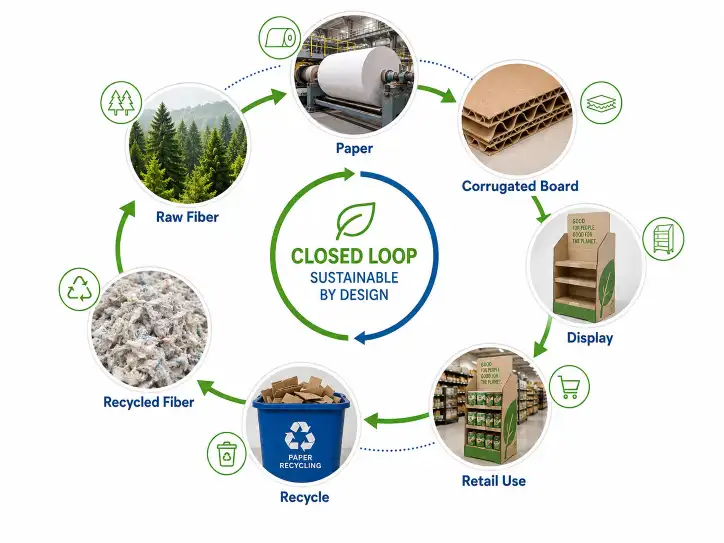
- Sustainability is part of the brief — corrugated is paper-based and curbside recyclable, which many retailers now expect.
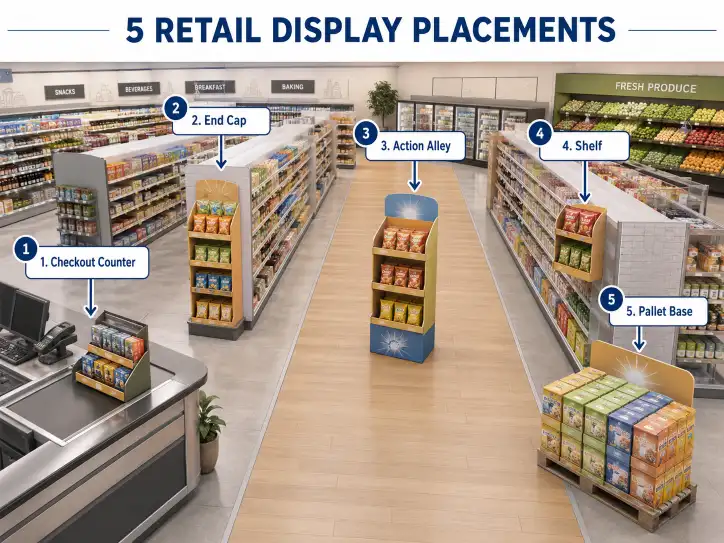
Corrugated is also the standard answer for pallet displays, floor displays, and counter units used in promotional programs across grocery, mass retail, and club stores. For the retail-placement side of that decision, our retail display overview and counter display page show the range of structures corrugated supports.
Which Material Fits Your Category?
The fastest way to narrow the choice is the product category. Each retail category tends toward one material because of how the product is bought and how long the display must last.
| Category | Usually better | Why |
|---|---|---|
| Cosmetics / skincare | Acrylic for counters; corrugated for promos | Counters are permanent; promos are seasonal |
| Jewelry / accessories | Acrylic | Premium look, display case environment |
| Pharmacy / health | Acrylic for walls; corrugated for feature | Permanent fixture vs weekly features |
| Fragrance | Acrylic | High-end presentation, counter display |
| Snacks / confectionery | Corrugated | Campaign-driven, impulse, frequent refresh |
| Beverages | Corrugated | High-volume floor and pallet displays |
| Electronics accessories | Either | Acrylic for premium counters; corrugated for volume |
| Pet products | Corrugated | Promotional, heavy, campaign-driven |
If your category sits in the corrugated column, the comparison is mostly settled: a paper-based display will carry the program at a fraction of the upfront cost, and the printing and finishing guide covers how to make it look premium. If your category leans acrylic, the decision is about whether the program is truly permanent enough to earn back the tooling.
How to Decide in Five Questions
Run the project through these five questions before briefing a factory. They will point to one material almost every time.
- How long must this display stay in store? Under 6 months, corrugated. A year or more, consider acrylic.
- Will the graphics change within that time? If yes, corrugated — acrylic cannot refresh a printed message without new inserts or new tooling.
- What is the rollout size and shipping distance? Large or export, corrugated flat-pack wins on freight and landed cost.
- Does the location need a premium permanent fixture? A high-end counter or display case justifies acrylic; a promo position does not.
- Is sustainability part of the retailer's requirement? Corrugated is paper-based and curbside recyclable; acrylic recycling is far more limited.
If the answers split, default to corrugated and upgrade selectively: many brands run a permanent acrylic counter for the hero line and corrugated for everything promotional. That hybrid is often the most cost-effective plan. To validate the material before committing, order a sampling of a printed corrugated display and compare it against the acrylic quote with the TCO table above.
Conclusion
Acrylic and corrugated cardboard displays are not competing versions of the same product; they are solutions to different retail time horizons. Acrylic earns its premium when a fixture stays in place for years with static graphics. Corrugated wins whenever the display is tied to a campaign, a launch, a season, or a changing message — because it costs less upfront, prints in full color, ships flat, and can be reordered at the same price every cycle. For most brands running promotions across grocery, mass, and club retail, corrugated is the material that matches the way retail programs actually work.
The same material logic already settled the cardboard vs plastic display comparison on this site; this guide applies it specifically to acrylic, where the premium is higher and the justification stricter. For the corrugated side of the comparison, the Fibre Box Association publishes the standards behind corrugated board performance, and the FEFCO code defines the structures available. When you are ready to spec a display, send us the program length, the rollout size, and the product category — we will recommend corrugated, acrylic, or a hybrid, and produce a printed sample so you can compare before you commit.
FAQ
Is acrylic stronger than cardboard for retail displays?
Acrylic is more rigid and longer-lived than corrugated cardboard, which is why it suits permanent fixtures. But a properly designed corrugated display holds its product and survives its campaign life at a fraction of the cost. Strength only matters relative to how long the display must last.
Why are acrylic displays more expensive than cardboard displays?
Acrylic displays carry higher upfront costs from tooling (molds or thermoform tooling) and premium material, plus bulkier shipping. Corrugated displays need only a steel-rule die and print on paper-based board, so unit cost at moderate volume is much lower.
When should I choose an acrylic display instead of cardboard?
Choose acrylic for permanent or semi-permanent fixtures that stay in place a year or more with static graphics — cosmetics counters, jewelry case displays, pharmacy wall units, premium brand boutiques. If the message or product changes, cardboard is usually the better call.
Can cardboard displays look as premium as acrylic?
Corrugated displays can carry full-color litho or digital printing, soft-touch or matte laminates, spot UV, and foil accents, which closes much of the visual gap. The difference is that corrugated is a campaign-grade surface while acrylic is a permanent-grade surface.
Is a cardboard display cheaper over time than acrylic?
For campaigns that repeat — seasonal promotions, launches, refreshed messaging — corrugated is cheaper over time because each cycle reorders at the same low unit price. Acrylic is cheaper only when a single fixture serves for years without change.
Are cardboard displays recyclable?
Yes. Corrugated cardboard displays are paper-based and curbside recyclable through standard retail and municipal programs. Acrylic is technically recyclable but through a much narrower industrial stream, which matters to retailers with sustainability requirements.