
A floor display delivered to Walgreens that takes more than 3 minutes to set up will be rejected at the store. A display missing the SSCC-18 label on two adjacent sides triggers a chargeback of $750. A power wing exceeding 8 inches in depth violates ADA compliance and is removed at the vendor's cost. Walgreens enforces its display requirements through its SPS Commerce compliance system — and vendors who ship non-compliant displays face chargebacks of $500 to $2,000 per violation.
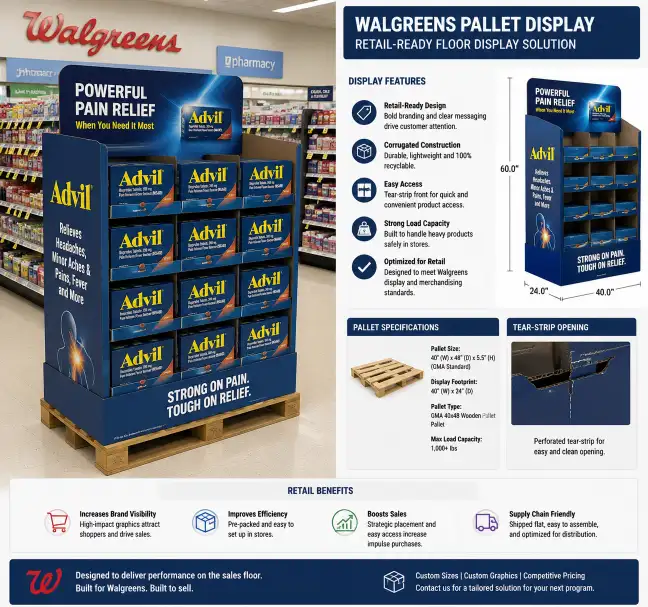
A Walgreens pallet display must meet specific requirements: 40" x 48" GMA pallet footprint, maximum 60–66" height for floor displays (52–54" for endcaps), maximum 1,500 lbs weight, and 100% recyclable materials with no foam or mixed plastics. Walgreens mandates a "zero-touch" display standard — setup must take under 3 minutes with no tools, no tape, and no plastic banding on the display body. Non-compliant displays face chargebacks of $500 to $2,000 per violation, with Walgreens increasing penalties by 10–15% in 2025.
I have manufactured pallet displays for Walgreens vendors for over 16 years. Walgreens operates approximately 8,700 stores across the United States, making it one of the largest drugstore chains and a critical retail channel for health, beauty, and consumable brands. Walgreens is distinct from CVS in several important ways — their "zero-touch" setup mandate, their packaging of automation in distribution centers, and their strong preference for shelf-ready PDQ displays over large floor pads. This guide covers everything you need to design, manufacture, and ship a compliant Walgreens pallet display that passes inspection and avoids chargebacks.
Walgreens Pallet Display Dimensions and Specs
Walgreens uses standard GMA pallet sizes for floor displays and endcap placements. Walgreens is increasingly favoring shelf-ready PDQ displays over large floor pads, so vendors should understand the different display options available.
Core Dimensions
| Specification | Floor Display | Endcap Display | Pallet Pool (Stacked) |
|---|---|---|---|
| Pallet footprint | 40" x 48" GMA | 40" x 48" GMA | 40" x 48" GMA |
| Maximum height | 60"–66" (including pallet) | 52"–54" | 48" per tier if mixed with other SKUs |
| Maximum weight | 1,500 lbs gross (800 lbs typical for floor) | 800 lbs | 1,500 lbs per pallet |
| Overhang | 0" — no overhang allowed | 0" — no overhang allowed | 0" — must fit flush |
| Pallet type | GMA block, 4-way entry | GMA block, 4-way entry | GMA block, 4-way entry |
| Stretch wrap | Outer base only, not on display body | Outer base only | Full wrap on base only |
Height Limits by Store Area
| Store Area | Max Height | Notes |
|---|---|---|
| Floor display (standard) | 60" | Most common for promotional displays |
| Floor display (tall with approval) | 66" | Requires special drop trailer approval |
| Endcap display | 52"–54" | Fits modular shelf height |
| Checkout / front end | 48" | Must not obstruct register view |
| Pharmacy waiting area | 42" | Limited space, smaller displays preferred |
Walgreens vs Other Retailers: Key Differences
| Retailer | Height | Pallet Footprint | Setup Time Rule | Unique Requirement |
|---|---|---|---|---|
| Walgreens | 60–66" floor, 52–54" endcap | 40" x 48" GMA | Under 3 minutes, no tools | Zero-touch mandate, robotic-ready DCs |
| CVS | 60" standard, 72" endcap | 40" x 48" GMA | No specific time rule | UCC-128 label on two sides |
| Target | 48" standard, 66" power aisle | 40" x 48" full / 48" x 30" half | Tool-free setup but no time limit | White corrugate, "clean crisp curated" aesthetic |
| Walmart | 72" | 48" x 40" GMA | No specific time rule | 30% recycled content, stretch hood only |
Weight Distribution Rules
| Requirement | Specification |
|---|---|
| Maximum gross weight (full pallet) | 1,500 lbs per pallet display |
| Typical floor display weight | 800 lbs (for safety and handling) |
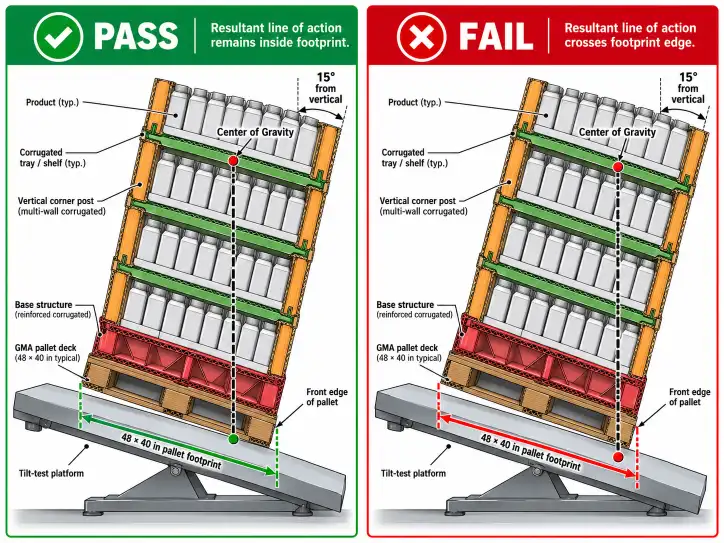
| Center of gravity | Within middle 60% of pallet |
| Shelf load (if multi-shelf) | 15–20 lbs per linear foot |
| Tip-over test | Must pass ASTM F1562 standards |
Walgreens Zero-Touch Setup Requirements
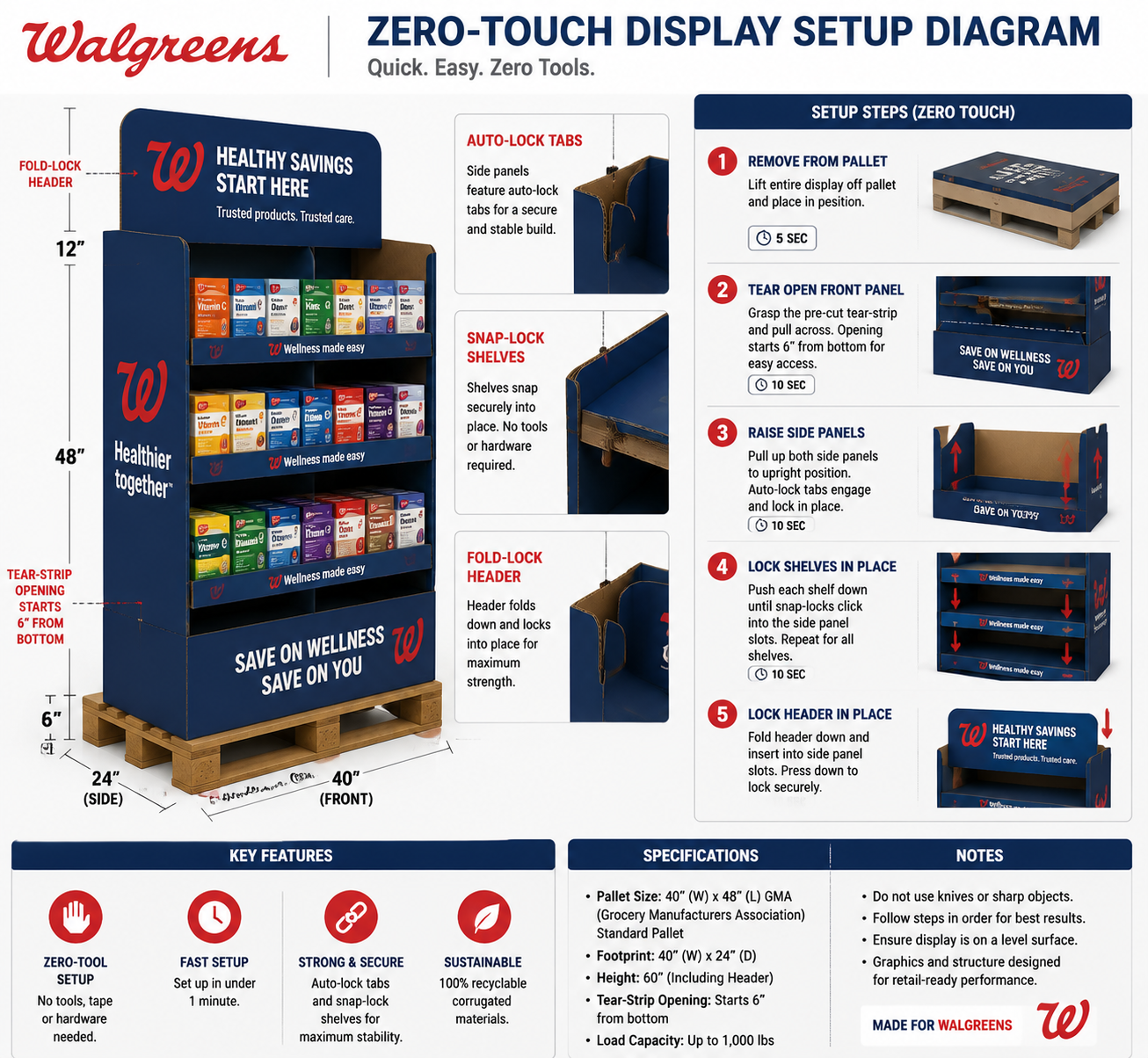
Walgreens has the strictest "zero-touch" setup mandate of any major US retailer. This is driven by store labor constraints — Walgreens stores operate with minimal staff, and displays that require time to set up simply do not get set up.
Zero-Touch Setup Rules
| Requirement | Specification | Why It Matters |
|---|---|---|
| Setup time | Under 3 minutes | Associates will not spend more time on any single display |
| Tools required | Zero — no box cutters, no tape, no glue | Safety rules prohibit box cutters on the sales floor |
| Opening method | Clear tear-strip starting 6" from bottom | Associate must identify the opening without instructions |
| Plastic banding | Not allowed on display body | Banding must be on pallet base only, easy to remove |
| Tape on top | Not allowed | Automated DC robots cannot grip taped surfaces |
| Loose flaps | Not allowed — must lock in place | Flaps catch on automated conveyor systems |
| Assembly instructions | Must be printed on display, not as separate sheet | Instructions get lost — design display to be intuitive |
| One-person setup | Complete setup by one person | Two-person setup doubles labor cost |
The Walgreens Setup Test
Walgreens uses a practical test for new display designs:
- Give the display to an associate who has never seen it before
- Provide no instructions
- Ask them to set it up and place it on the sales floor
- Time the process from pallet arrival to display ready
Pass criteria: Under 3 minutes, no tools, no questions, display is fully assembled and stable.
If the associate needs a box cutter, looks for instructions, or asks "how does this work?" — the display design fails Walgreens' zero-touch standard.
Designing for Zero-Touch
| Feature | Required | Optional (Strongly Recommended) |
|---|---|---|
| Tear-strip opening | Yes — clear, starting 6" from bottom | Color-contrasted pull tab |
| Locking mechanism | Yes — auto-lock tabs or snap-locks | Audible "click" when locked |
| Header attachment | Yes — integrated fold-lock or tab-in-slot | Pre-scored fold line with visual alignment mark |
| Shelf insertion | Yes — tool-free, pre-locked shelves | Shelves that lock automatically when folded down |
| Stretch wrap removal | Yes — perforated pull strip | "Pull here" instruction printed on wrap |
Pallet Type Requirements for Walgreens
Walgreens requires standard GMA-style block pallets for all pallet displays. Pallet condition is strictly enforced because Walgreens distribution centers use automated conveyor and sortation systems.
GMA Block Pallet Specifications
| Feature | Requirement |
|---|---|
| Dimensions | 40" x 48" GMA block pallet |
| Entry type | 4-way entry — required for forklift and pallet jack access |
| Pallet type | GMA block (no stringer pallets) |
| Weight capacity | 2,800 lbs minimum dynamic load |
| CHEP half-pallets | Not allowed without pre-approval |
| Wing pallets | Not allowed |
Pallet Condition Standards
Walgreens distribution centers inspect every inbound pallet. Rejections are immediate and chargebacks follow.
| Condition | Acceptable? | Walgreens Standard |
|---|---|---|
| Cracked boards | No | All boards must be intact |
| Broken blocks | No | All 9 blocks must be sound |
| Protruding nails | No | Maximum 1/8" protrusion |
| Splinters | No | Smooth surface required |
| Warped deck | No | Must be flat and true |
| Stains / mold | No | Any contamination = rejection |
| Repaired pallets | No | No repaired or reconditioned pallets |
| Tare weight marked | Yes — required | Must be clearly visible |
ISPM 15 Requirements
All wood pallets shipped internationally to Walgreens must carry an ISPM 15 stamp showing heat treatment (HT). Walgreens does not accept methyl bromide (MB) treated pallets. Plastic pallets do not require ISPM 15 certification.
Walgreens PDQ Display and Shelf-Ready Requirements
Walgreens is increasingly favoring shelf-ready PDQ displays over floor displays. This is part of a strategy to reduce floor pad allocations and maximize shelf utilization.
PDQ Display Specifications
| Specification | Walgreens Requirement |
|---|---|
| PDQ format | Floor-ready, ship as-is, no tools required |
| Placement | Shelf (primary) or endcap wing (secondary) |
| Maximum shelf PDQ width | Fits Walgreens modular shelf — typically 18"–24" |
| Set up time | Under 30 seconds |
| Opening | Tear-strip, no box cutter required |
| Material | 100% recyclable corrugated |
| Hand holes | Required on both sides for easy carrying |
| Labeling | UPC barcode, Walgreens item number, PO number |
Shelf-Ready Packaging (SRP) Standards
| Requirement | Specification |
|---|---|
| SRP format | Shipper display that fits shelf modular perfectly |
| Product visibility | Clear sightline to product from front |
| Pricing area | Clear, visible, scannable barcode |
| Shelf compatibility | Must fit standard Walgreens shelf depth (typically 14"–16") |
| Tray height | Fits between shelf and next shelf above |
| Recyclability | 100% fiber-based, no mixed materials |
The "Hybrid" Display — Walgreens 2025 Update
Walgreens has introduced a hybrid display concept: a floor display that can be cut down to a half-pad or shelf unit if the floor spot is pulled. This gives Walgreens flexibility to use the display as either a floor pad or shelf PDQ depending on store needs.
| Hybrid Display Feature | Requirement |
|---|---|
| Perforated cut-down line | Must be clearly marked |
| Both halves functional | Top half works as shelf unit, bottom half as base |
| No tools for conversion | Perforated tear line |
| Labeling on both sections | Each section has its own UPC and item number |
For more detail on PDQ design, see my PDQ display guide.
Walgreens Power Wing and Sidekick Display Requirements
Walgreens uses power wing and sidekick displays for impulse purchases at endcaps and checkout areas. These displays must meet strict size and weight limits to maintain ADA compliance and store sightlines.
Power Wing Display Specifications
| Specification | Walgreens Requirement |
|---|---|
| Maximum width | 24" |
| Maximum depth | 8" |
| Maximum height | 36" (including base) |
| Maximum weight (loaded) | 25 lbs total |
| Material | Corrugated or plastic — no glass |
| Attachment method | Steel hang bar fitting standard 1" gondola upright holes |
| Adhesive | Not permitted — must use mechanical attachment |
| Pre-approval | Required 6–8 weeks in advance |
| Planogram compliance | Must match Walgreens planogram for the category |
Sidekick Display Specifications
| Specification | Walgreens Requirement |
|---|---|
| Maximum width | 16" |
| Maximum depth | 6" |
| Maximum height | 24"–36" |
| Maximum weight (loaded) | 10–15 lbs total |
| Attachment method | Pegboard hooks (3/16" standard) or approved removable adhesive |
| Header card | Required — branded, visible above product |
| Anti-tip | Required — hooks must support 2× display weight |
| Adhesive residue | Must remove cleanly — no residue permitted |
Display Placement by Store Zone
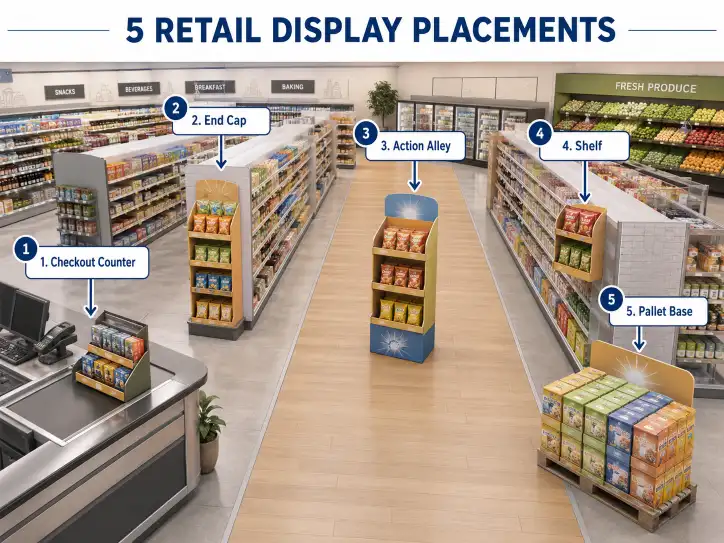
| Store Zone | Display Type | Max Height | Max Width | Max Depth |
|---|---|---|---|---|
| Floor pad (main aisle) | Pallet display | 60" | 40" | 48" |
| Endcap | Pallet display or power wing | 54" | 40" | 48" |
| Side wing | Power wing | 36" | 24" | 8" |
| Shelf | PDQ | Fits shelf height | 18"–24" | 14"–16" |
| Checkout | Counter PDQ or power wing | 48" | 24" | 8" |
| Pharmacy | Counter display | 42" | 18" | 14" |
Material and Sustainability Requirements
Walgreens Boots Alliance (WBA) has set aggressive sustainability goals that apply to all display materials. Walgreens is reducing plastic use across all stores and expects vendors to comply.
Walgreens Sustainability Standards
| Requirement | Standard | Notes |
|---|---|---|
| Recyclability | 100% recyclable | All display materials must be fiber-based |
| Plastic content | Minimize — no plastic on display body | Stretch wrap on pallet base is the only exception |
| Foam (EPS/Styrofoam) | Not allowed | Zero foam in any display component |
| Mixed materials | Not allowed | Display should be mono-material corrugated |
| Inks | Water-based preferred | No solvent-based inks |
| Lamination | Reduce — plastic lamination discouraged | Use aqueous coating instead |
| Recycled content | Preferred but not mandatory | FSC certification preferred |
What Walgreens Rejects on Sustainability Grounds
| Material/Feature | Walgreens Policy |
|---|---|
| EPS foam inserts | Rejected — not recyclable |
| Plastic zip ties on display | Rejected — use corrugated locks instead |
| Mixed-material lamination | Rejected if not separable |
| Wax coatings | Rejected — interferes with recycling |
| Non-fiber advertising materials | Rejected — must be corrugated |
Walgreens 2025 Sustainability Goals
| Goal | Target | Impact on Display Design |
|---|---|---|
| Reduce plastic packaging | 30% reduction by 2026 | Eliminate plastic components from displays |
| Increase recycled content | 50% of displays use recycled board | Specify FSC-certified or recycled board |
| Eliminate problematic plastics | Zero EPS in all packaging by 2026 | Remove all foam from display design |
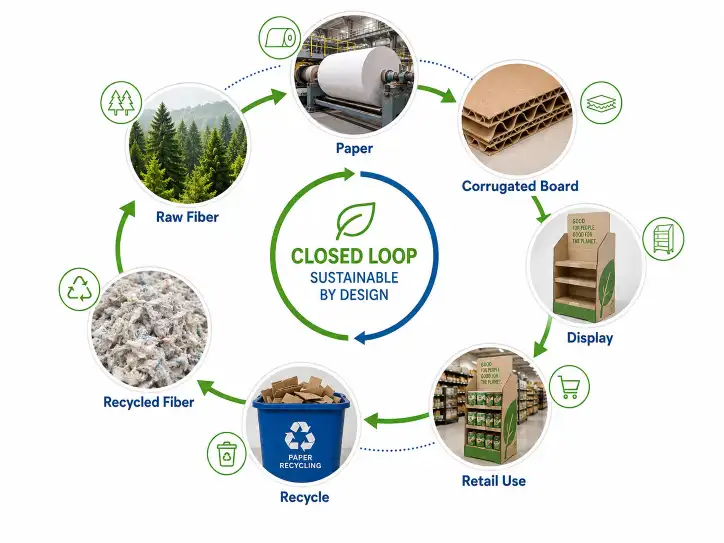
| Improve recyclability | 100% of displays recyclable in standard systems | Mono-material corrugated design |
For more on sustainability requirements, see my GMI and CVS compliance guide.
Labeling, Barcode, and Routing Requirements
Every display shipped to Walgreens must carry specific labels and meet routing guide requirements managed through Walgreens' compliance system on SPS Commerce.
Required Labels on Every Walgreens Display
| Label Type | Location | Information Required |
|---|---|---|
| SSCC-18 pallet label (GS1-128) | Two adjacent sides of pallet | SSCC-18 barcode, PO number, carton count, weight |
| UPC barcode | Display structure — front panel | 12-digit UPC |
| Walgreens item number | Display structure — front panel | Walgreens internal SKU |
| PO number | Display structure — visible | Walgreens purchase order number |
| Tare weight | Pallet — visible | Empty pallet weight |
| Reset date (if applicable) | Display signage | Planned program end date |
| Recyclability label | Bottom or inside panel | Material composition, recycling instructions |
SSCC-18 / GS1-128 Label Specifications
| Requirement | Specification |
|---|---|
| Label size | 4" x 6" thermal transfer |
| Barcode type | GS1-128, minimum 1.25" height |
| Content | SSCC-18, vendor ID, PO number, carton count, weight |
| Placement | Two adjacent sides (short side + long side) |
| Left label | Short side of pallet — facing out |
| Right label | Long side of pallet — facing out |
| Scannability | Must scan at first pass |
RFID Pallet Tagging Pilot
Walgreens is piloting RFID pallet tagging for high-volume SKUs. Vendors should expect RFID compliance labels to become mandatory by late 2025 or early 2026.
| RFID Requirement | Current Status | Expected Timeline |
|---|---|---|
| RFID tagging at pallet level | Pilot program | Late 2025–2026 |
| RFID integration with ASN | Testing | 2026 |
| Full RFID compliance | Not yet required | Expected 2026+ |
Routing Guide Requirements
| Requirement | Standard |
|---|---|
| Shipping window | ± 2–3 days from confirmed appointment |
| Carrier | Walgreens preferred carrier list (via SPS Commerce) |
| Appointment required | Yes — schedule through SPS Commerce |
| ASN (Advanced Ship Notice) | Submit 24–48 hours before shipment |
| PO number | Must match Walgreens purchase order exactly |
| Delivery location | Walgreens DC — verify correct DC per PO |
| Early delivery | Rejected for seasonal displays |
| Late delivery penalty | 3% of invoice value (2025 update, up from 2%) |
Walgreens Display Approval Process
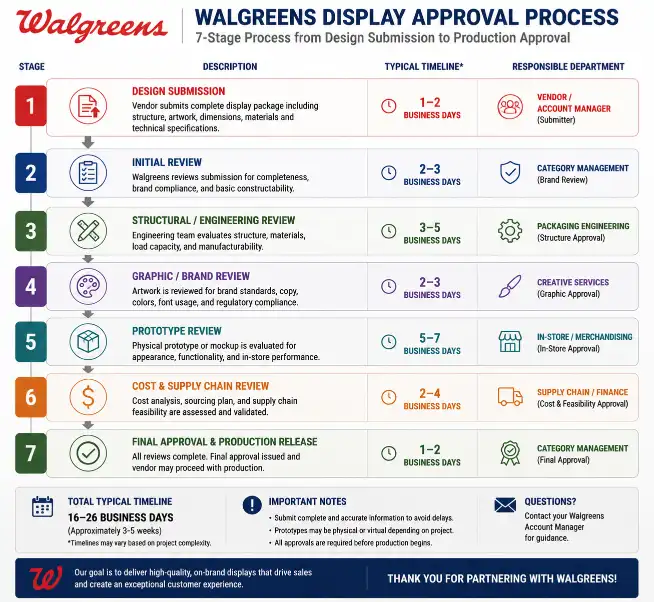
Every display must be pre-approved by Walgreens before production. The approval process is managed through Walgreens' supplier portal and SPS Commerce system.
Approval Stages
| Stage | What Happens | Timeline |
|---|---|---|
| 1. Design submission | Submit display concept with dimensions, materials, and product fit | 8 weeks before launch |
| 2. Planogram review | Walgreens category team reviews against modular planogram | 2–4 weeks |
| 3. Sample request | Walgreens requests physical sample for fit test | If required |
| 4. Fit test (if required) | Sample is shipped to Walgreens Lab in Deerfield, IL | 2 weeks |
| 5. RRP Design Guide review | Walgreens Retail Ready Packaging team reviews design | 2 weeks |
| 6. Compliance approval | Walgreens compliance team reviews against specifications | 1–2 weeks |
| 7. Production approval | Written approval to begin bulk production | On receipt of compliance approval |
Documents Required for Approval
| Document | Details |
|---|---|
| Display specification sheet | Dimensions, materials, weight, pallet type |
| Structural drawing | Die line, fold lines, assembly instructions |
| Setup instruction | Step-by-step — must fit on one page or on display body |
| Material specification | Board grade, flute type, recycled content |
| Product fit diagram | How products sit in the display, per-SKU |
| Weight calculation | Empty weight, loaded weight, per-shelf weight |
| Label artwork | All labels with dimensions and placement |
| Sustainability declaration | Material composition, recyclability certification |
| Setup time test result | Video or documented timing of test setup |
Chargeback Prevention and Compliance Checklist
Walgreens enforces compliance through chargebacks that have increased by 10–15% in 2025. Understanding the chargeback structure is essential for preventing financial losses.
Walgreens Chargeback Codes for Display Violations
| Code | Violation | Fee (2025) | Notes |
|---|---|---|---|
| W-D01 | Non-compliant pallet (damaged, wrong type, missing tare weight) | $150–$500 per pallet | Most common violation |
| W-D02 | Display setup exceeds 3 minutes | $500–$1,000 | Zero-touch failure |
| W-D03 | Missing or incorrect SSCC-18 label | Up to $500 | Label must scan at first pass |
| W-D04 | Display not floor-ready | $500–$1,500 | Additional store labor cost charged to vendor |
| W-D05 | Display damage in transit | Cost of goods + $250 fine | Display must survive transport |
| W-D06 | Late delivery (outside 2–3 day window) | 3% of invoice value | Up from 2% in 2024 |
| W-D07 | Early delivery (seasonal) | Full rejection | Seasonal displays early = rejected |
| W-D08 | Wrong ship-to location | $250–$500 | Verify DC per PO |
| W-D09 | Non-compliant materials (foam, plastic, non-recyclable) | $500–$1,000 | WBA sustainability violation |
| W-D10 | Display not per planogram | $750–$2,000 | Repeat violations higher |
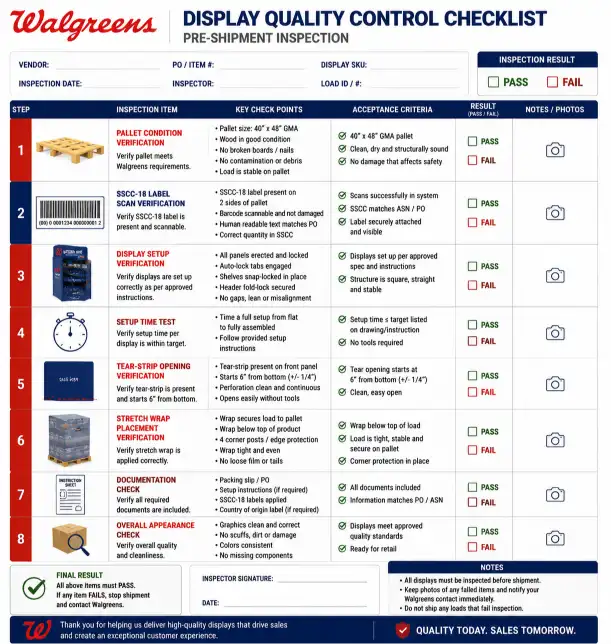
Pre-Shipment Compliance Checklist
| Check | Details | Pass? |
|---|---|---|
| Pallet type confirmed | 40" x 48" GMA block, 4-way entry, no stringer | ☐ |
| Pallet condition inspected | No cracks, broken blocks, nails, splinters, stains | ☐ |
| Tare weight marked | Visible on pallet | ☐ |
| Display height measured | Under 60" (66" with approval) | ☐ |
| Total weight verified | Under 1,500 lbs (800 lbs typical for floor) | ☐ |
| SSCC-18 label applied | Two adjacent sides, scannable | ☐ |
| UPC barcode applied | Front panel, scannable | ☐ |
| Walgreens item number applied | Display structure, visible | ☐ |
| PO number applied | Display structure, visible | ☐ |
| Setup time tested | Under 3 minutes, no tools | ☐ |
| Tear-strip opening verified | Clear, starting 6" from bottom | ☐ |
| No tape on top of display | Automated DC robots will reject | ☐ |
| No loose flaps | All flaps lock in place | ☐ |
| No plastic banding on display body | Only on pallet base | ☐ |
| No foam / EPS materials | Display is mono-material corrugated | ☐ |
| Stretch wrap on base only | Not covering display body | ☐ |
| Sustainability declaration ready | Material composition, recyclability | ☐ |
| ASN submitted | 24–48 hours before shipment | ☐ |
| Ship-to DC verified | Per PO | ☐ |
| Appointment scheduled | Via SPS Commerce | ☐ |
How We Prevent Walgreens Chargebacks
We are fully capable of undertaking printing, packaging and display projects compliant with Walgreens standards. With years of rich practical experience and numerous successful cases, we strictly follow official certification specifications and quality requirements throughout production. Our professional quality control system ensures 100% smooth passing of all third-party authoritative inspections and verifications, delivering fully qualified compliant products for global business cooperation.
| Quality Stage | Our Process | Result |
|---|---|---|
| Pre-production | Spec review, material verification, zero-touch design review | Eliminates setup-time issues |
| Incoming material | Board grade, pallet type, recycled content verified | Material meets spec before production |
| In-process QC | Dimensional check, weight check, label check every 100 units | Defects caught immediately |
| Setup time testing | Full setup test with timer — zero-touch verified | Under 3 minutes confirmed |
| Pre-shipment inspection | 100% of pallets checked for labels, pallet condition, tare weight | No errors reach the container |
| Documentation | Full traceability records for every batch | Audit-ready at any time |
For more on our quality control process and compliance capabilities, see our GMI and CVS compliance guide and Target pallet display requirements.
FAQ
What are the standard dimensions for a Walgreens pallet display?
Standard dimensions are 40" x 48" GMA pallet footprint for floor displays and endcaps. Maximum height is 60" for standard floor displays, 66" with special approval, and 52–54" for endcap displays. Maximum gross weight is 1,500 lbs, with typical floor displays around 800 lbs.
What type of pallet does Walgreens require?
Walgreens requires GMA-style block pallets with four-way entry. Standard size is 40" x 48". Stringer pallets and wing pallets are not accepted. CHEP half-pallets require special pre-approval. All pallets must be free of damage, cracks, broken blocks, and contamination.
What is Walgreens' zero-touch display requirement?
Walgreens requires all displays to be set up in under 3 minutes with no tools, no box cutters, no tape, and no plastic banding on the display body. The display must have a clear tear-strip opening starting 6" from the bottom. If a store associate needs instructions or a knife to set up the display, it fails the zero-touch standard.
Does Walgreens require displays to be pre-approved?
Yes. All displays must be pre-approved through Walgreens' supplier portal and SPS Commerce compliance system at least 8 weeks before launch. The approval process includes planogram review, structural design review, setup time verification, and compliance approval.
What is the weight limit for Walgreens power wing displays?
Walgreens limits power wing displays to 25 lbs total (display + all products). Sidekick displays are limited to 10–15 lbs. Power wing depth is limited to 8 inches max and sidekick depth to 6 inches max to maintain ADA compliance.
What is Walgreens' chargeback for non-compliant pallets?
Walgreens charges $150–$500 per pallet for non-compliant pallets (damaged, wrong type, missing tare weight). Display setup failures (exceeding 3 minutes) carry $500–$1,000 penalties. In 2025, Walgreens increased all display violation chargebacks by 10–15%.
What are Walgreens' sustainability requirements for displays?
Walgreens requires 100% recyclable displays made from mono-material corrugated. No foam (EPS), no mixed plastic components, no wax coatings, and no plastic lamination on the display body. Stretch wrap on the pallet base is the only allowed plastic. Water-based inks are preferred.
What is the Walgreens setup test for displays?
Walgreens tests displays by giving them to an associate who has never seen the design before, providing no instructions, and timing the setup. The pass criteria are: under 3 minutes, no tools, no questions asked, and the display is fully assembled and stable.
What labels are required on a Walgreens pallet display?
SSCC-18 (GS1-128) pallet label on two adjacent sides, UPC barcode, Walgreens item number, PO number, tare weight on pallet, reset date (if applicable), and recyclability label. All labels must be scannable at first pass.
How does Walgreens compare to CVS for display requirements?
Walgreens has stricter setup time requirements (3 minutes vs. no specific time at CVS), a stronger preference for shelf-ready PDQ over floor displays, and the unique zero-touch mandate. CVS allows 60" standard height with 72" for endcaps, while Walgreens caps at 60–66". Both require 40" x 48" GMA pallets, GS1-128 labels, and 100% recyclable materials.

One Response