A buyer needs 500 counter displays for a national retail launch. One manufacturer quotes $8.50 per unit. Another quotes $14.20. A third quotes $6.80 but the quality looks visibly lower. Without understanding the cost structure, the buyer cannot tell which quote is fair, which is overpriced, and which will fail in the store. The difference between the cheapest and most expensive quote is often not profit margin — it is the board grade, printing method, and finishing specification.
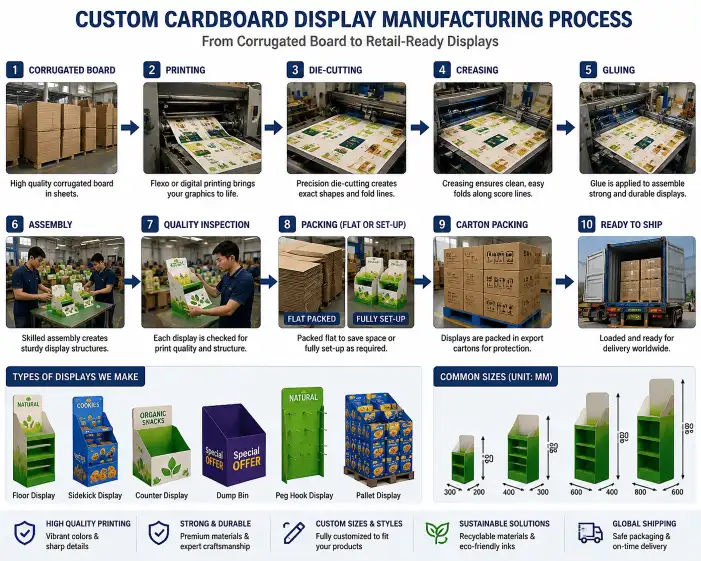
A custom cardboard display costs between $1.50 and $35.00 per unit depending on size, quantity, board grade, printing method, and finishing complexity. The five primary cost drivers are quantity (volume breaks), board grade (single-wall vs. double-wall), print method (flexo vs. litho-lam vs. digital UV), display size and complexity, and finishing options. Understanding these drivers allows buyers to optimize their display design for the best price without sacrificing quality.
I have manufactured and priced custom corrugated displays for over 16 years. I have seen buyers overpay by 40% because they specified a board grade higher than needed. I have also seen buyers lose retail programs because they chose a board grade too low and the display collapsed. This guide breaks down every cost factor in custom display pricing so you can evaluate quotes intelligently, optimize your design for cost, and avoid expensive mistakes.
The Five Primary Cost Drivers for Cardboard Displays
Every custom display price is determined by five factors. Change one factor and the price changes. Understanding these drivers is the key to getting the best value.
| Cost Driver | Impact on Price | Control |
|---|---|---|
| Quantity | 50–70% price reduction from 100 to 10,000 units | Order volume + consolidation |
| Board grade | +10–40% for double-wall vs. single-wall | Match board grade to actual product weight |
| Printing method | +50–200% for litho-lam vs. simple flexo | Select print quality appropriate for retail channel |
| Size and complexity | 2–4× cost increase from counter to pallet display | Optimize footprint, reduce unnecessary panels |
| Finishing and assembly | +10–50% for lamination, pre-assembly, or special finishes | Choose finishing based on display environment |
The single most important cost factor is quantity. Per-unit prices drop dramatically as volume increases because setup costs (die, plates, machine time) are spread across more units. Understanding where your quantity falls on the volume curve is the starting point for every price evaluation.
Cost Driver 1: Quantity and Volume Breaks
How Per-Unit Price Declines with Volume
| Quantity | Counter Display (12"×12"×18") | Floor Display (24"×18"×60") | Pallet Display (40"×48"×60") |
|---|---|---|---|
| 100 | $6.00–$12.00 | $15.00–$30.00 | $25.00–$50.00 |
| 250 | $4.50–$8.00 | $10.00–$20.00 | $18.00–$35.00 |
| 500 | $3.50–$6.00 | $7.00–$14.00 | $12.00–$25.00 |
| 1,000 | $2.50–$4.50 | $5.00–$10.00 | $8.00–$18.00 |
| 2,500 | $1.80–$3.50 | $3.50–$7.00 | $6.00–$12.00 |
| 5,000 | $1.50–$2.50 | $2.50–$5.00 | $4.50–$9.00 |
| 10,000+ | $1.20–$2.00 | $2.00–$3.50 | $3.50–$6.50 |
Typical Volume Break Points
| Volume Range | Price Behavior | Why |
|---|---|---|
| 1–100 units | Highest per-unit cost | Setup amortized over few units, often manual production |
| 100–500 units | Sharp decline (~30–40% drop) | Die and plate costs spread across more units |
| 500–1,000 units | Moderate decline (~15–25% drop) | Production moves to machine speed, material waste drops |
| 1,000–5,000 units | Gradual decline (~10–15% per tier) | Full production efficiency, material bulk pricing |
| 5,000+ units | Minimal decline (~5–10% per tier) | Material cost becomes dominant, labor is already optimized |
Strategy for Best Quantity Pricing
| If Your Need Is… | Strategy |
|---|---|
| Under 200 units | Accept higher per-unit cost. Design for digital UV printing to avoid plate costs entirely. |
| 200–1,000 units | Target the closest break point. If you need 400, see if you can consolidate needs to 500. |
| 1,000–5,000 units | Request pricing at 1,000, 2,500, and 5,000 to find the optimal quantity for your budget. |
| 5,000+ units | Ask about bulk material pricing. Material cost savings can add another 5–10% reduction. |
| Multiple SKUs | Run all SKUs together in one production run to reach a higher volume tier. |
Cost Driver 2: Board Grade and Material
Board grade is the second most significant cost driver. Using a higher grade than necessary adds cost without benefit. Using a grade too low causes failure.
Board Grade Cost Comparison
| Board Grade | Flute | Material Cost Index | Typical Use |
|---|---|---|---|
| #200 single-wall | E-flute | 1.0× (baseline) | Light PDQs, shelf trays, counter displays |
| #200 single-wall | B-flute | 1.1× | Standard counter displays, small sidekicks |
| #200 single-wall | C-flute | 1.2× | Light floor displays, vertical panels |
| #275 double-wall | EB-flute | 1.5× | Premium PDQs needing print + strength |
| #275 double-wall | BC-flute | 1.7× | Standard pallet displays, medium floor displays |
| #350 double-wall | BC-flute | 2.0× | Heavy pallet displays, power aisle displays |
| #440 triple-wall | AAA-flute | 3.0× | Industrial displays, extreme loads |
Board Selection Cost Impact Example
Scenario: 1,000 floor displays, 24" × 18" × 60", flexo 2-color
| Board Grade | Material Cost per Display | Total Display Cost | Difference vs. Baseline |
|---|---|---|---|
| #200 B-flute | $0.80 | $5.50 | Baseline (may be too weak) |
| #275 BC-flute | $1.36 | $7.00 | +$1,500 total (+27%) |
| #350 BC-flute | $1.60 | $8.00 | +$2,500 total (+45%) |
Recommendation: Do not select a board grade without knowing the product weight. A #275 double-wall board is sufficient for most standard retail displays carrying up to 30 lbs per shelf. Only specify #350 or triple-wall when product weight or retail requirements demand it.
Material Surcharges
| Factor | Surcharge | Notes |
|---|---|---|
| White-top / bleached liner | +10–20% | Required for Target's white corrugate aesthetic |
| FSC certified board | +5–10% | Required for sustainability programs |
| Moisture-resistant coating | +10–15% | Beverage displays, refrigerated environments |
| Recycled content (100%) | -5–10% | Usually cheaper than virgin board |
| Small sheet size waste (under 24" × 36") | +5–15% | Inefficient use of standard sheet sizes |
For more detail on board grade selection, see my structural design guide.
Cost Driver 3: Printing Method and Color Count
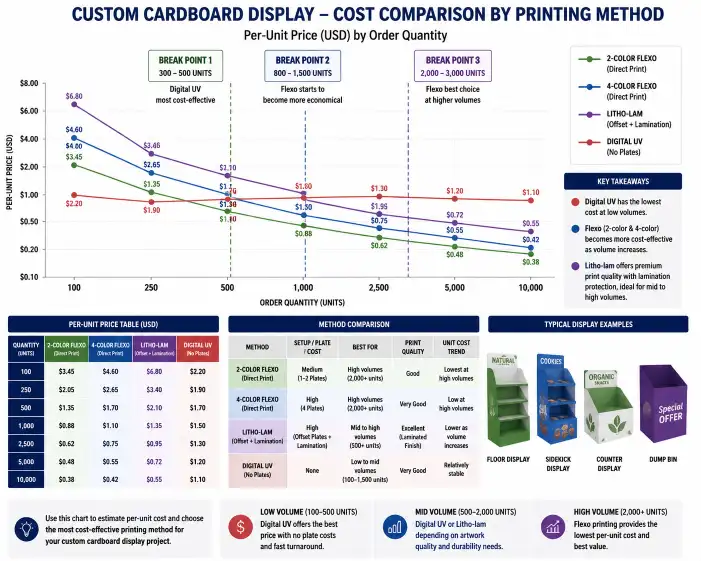
Printing method and color count together can account for 30–50% of total display cost. Choosing the right method for your quality and quantity is critical.
Printing Cost Comparison (Per Unit, Including Setup Amortization)
| Quantity | Flexo 2-Color | Flexo 4-Color | Litho-Lam CMYK | Digital UV CMYK |
|---|---|---|---|---|
| 100 | $4.00–$8.00 | $6.00–$12.00 | $12.00–$25.00 | $6.00–$12.00 |
| 500 | $1.50–$3.00 | $2.50–$4.50 | $4.00–$8.00 | $4.00–$8.00 |
| 1,000 | $1.00–$2.00 | $1.50–$3.00 | $3.00–$6.00 | $3.50–$7.00 |
| 5,000 | $0.60–$1.20 | $1.00–$2.00 | $2.00–$4.00 | $3.00–$6.00 |
| 10,000 | $0.40–$0.80 | $0.70–$1.50 | $1.50–$3.00 | $2.50–$5.00 |
Color Count Impact
| Number of Colors | Flexo Setup Cost | Per-Unit Premium vs. 2-Color | Best Use |
|---|---|---|---|
| 1 color | $150–$300 plates | -15–20% (cheaper) | Simple text, basic logos |
| 2 colors | $300–$600 plates | Baseline | Standard branding, most cost-effective |
| 3 colors | $450–$900 plates | +15–25% | Logo + one accent color |
| 4 colors (CMYK process) | $600–$1,200 plates | +30–50% | Full color imagery on corrugated |
| 4 colors + 1 spot | $750–$1,500 plates | +40–60% | Brand color accuracy + process images |
| 6 colors | $900–$1,800 plates | +60–80% | Premium flexo, brand-critical color |
Print Method Selection for Cost Optimization
| If Your Priority Is… | Choose… | Cost vs. Baseline |
|---|---|---|
| Lowest cost at any volume | Flexo 2-color | Baseline |
| Best quality at 100–500 units | Digital UV CMYK | +50–100% vs. flexo 2-color |
| Best quality at 1,000+ units | Litho-lam CMYK | +100–200% vs. flexo 2-color |
| Good quality at lowest cost for 5,000+ | Flexo 4-color process | +30–50% vs. flexo 2-color |
| Target display (white board, crisp print) | Flexo on white top or litho-lam | +15–35% vs. flexo on kraft |
For detailed print method comparison, see my display printing and finishing guide.
Cost Driver 4: Display Size and Complexity
Larger displays use more material, require larger dies, take more machine time, and cost more to ship. Complexity adds cost through die cut intricacy and assembly difficulty.
Size-Based Cost Multipliers
| Display Type | Typical Dimensions | Material Area (sq ft) | Cost Multiplier (vs. counter display) |
|---|---|---|---|
| Counter display | 12" × 12" × 18" | 5–8 sq ft | 1.0× (baseline) |
| Shelf PDQ | 18" × 14" × 14" | 7–10 sq ft | 1.3–1.5× |
| Sidekick / power wing | 24" × 12" × 48" | 15–22 sq ft | 1.8–2.5× |
| Floor display (small) | 18" × 18" × 48" | 20–30 sq ft | 2.5–3.5× |
| Floor display (large) | 24" × 20" × 60" | 35–50 sq ft | 3.5–5.0× |
| Pallet display (full) | 40" × 48" × 60" | 60–80 sq ft | 5.0–8.0× |
| Pallet display (heavy-duty) | 40" × 48" × 72" | 80–120 sq ft | 6.0–10.0× |
Complexity Cost Factors
| Complexity Factor | Cost Impact | Example |
|---|---|---|
| Die cut shape Basic rectangle | Baseline | Straight cuts, 90° corners |
| Die cut shape Moderate curves | +5–10% | Rounded corners, curved top panels |
| Die cut shape Intricate shape | +15–30% | Brand-shaped display, complex cutouts |
| Number of panels Under 10 | Baseline | Simple box or tray structure |
| Number of panels 10–20 | +10–20% | Multi-shelf display with dividers |
| Number of panels Over 20 | +25–50% | Complex display with many components |
| Score lines Standard | Baseline | Straight fold lines |
| Score lines Multiple angles | +10–15% | Angled shelves, tiered product display |
| Locking mechanism Simple tab | Baseline | Basic tab-and-slot joining |
| Locking mechanism Complex lock | +10–20% | Snap-lock, auto-erect, multi-point lock |
How to Reduce Size and Complexity Cost
| Optimization | Potential Savings | Trade-Off |
|---|---|---|
| Reduce display height by 20% | -15–20% material + shipping | Less visual impact in store |
| Simplify die cut shape | -10–15% die cost + per unit | Less distinctive shape |
| Remove non-structural interior panels | -5–10% material | May reduce product display capacity |
| Standardize to common sheet sizes | -5–10% material waste | Less design flexibility |
| Reduce number of shelves | -10–20% material + assembly | Fewer product facings |
Cost Driver 5: Finishing and Assembly
Finishing and assembly add cost but also add durability, appearance, and store-ready convenience.
Finishing Cost Premiums
| Finish | Cost Premium (vs. uncoated) | Adds to Per-Unit Cost at 1,000 | Best Application |
|---|---|---|---|
| No coating | 0% (baseline) | $0.00 | Short-term displays, warehouse clubs |
| Aqueous coating | +5–10% | $0.15–$0.40 | Standard retail, moderate scuff protection |
| UV coating (full) | +10–20% | $0.30–$0.80 | High-traffic retail, premium feel |
| Spot UV | +15–25% | $0.50–$1.20 | Luxury, logo emphasis |
| Gloss lamination | +20–35% | $0.60–$1.50 | Long-duration, refrigerated environments |
| Matte lamination | +20–35% | $0.60–$1.50 | Premium retail, non-reflective aesthetic |
| Soft-touch coating | +25–40% | $0.80–$2.00 | Luxury brand displays |
| Foil stamping | +20–50% | $0.50–$2.50 | Holiday, premium launches |
Assembly Cost Premiums
| Assembly Type | Cost Premium | Per-Unit Cost at 1,000 | Best Use |
|---|---|---|---|
| Flat ship (knocked down) | 0% (baseline) | $0.00 | Minimizes freight cost, store assembles |
| Partial glue (semi-erected) | +10–20% | $0.50–$1.50 | Reduces store setup time |
| Full glue (auto-erect) | +20–40% | $1.00–$3.00 | Tool-free, fastest store setup |
| Pre-filled with product | +50–150% | $3.00–$10.00 | Club stores, retail-ready programs |
| Banding / strapping | +3–5% | $0.10–$0.30 | Required for pallet displays |
| Individual polybagging | +5–10% | $0.15–$0.50 | Protection for each display unit |
The Assembly Cost Trade-Off
| Shipping Method | Assembly Cost | Shipping Cost | Total Cost |
|---|---|---|---|
| Flat ship | $0.00 | $0.50–$1.00 per display | Lowest total, but store must assemble |
| Partial glue | $0.50–$1.50 | $0.70–$1.50 per display | Moderate, good for most retailers |
| Full auto-erect | $1.00–$3.00 | $1.00–$2.50 per display | Higher cost, minimum store labor |
Complete Price Range Reference by Display Type
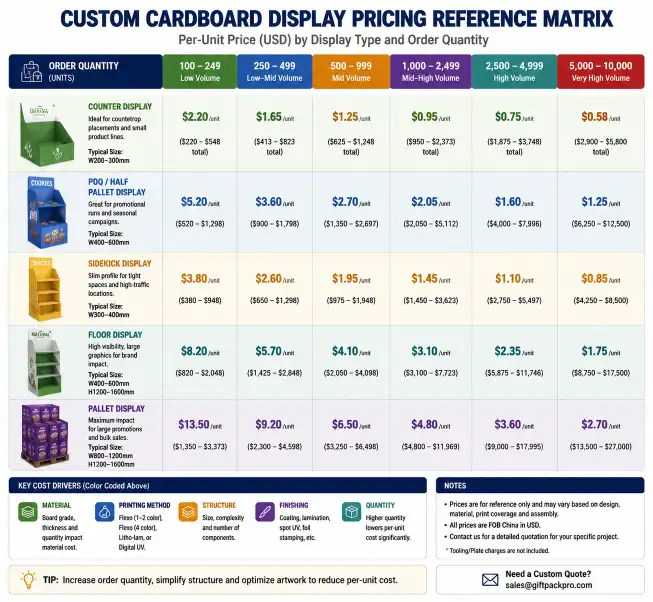
This reference table combines all cost drivers into realistic price ranges for common display types at different quantities.
Price Ranges by Display Type and Volume (USD per Unit)
| Display Type | 100–250 Units | 500–1,000 Units | 2,500–5,000 Units | 10,000+ Units |
|---|---|---|---|---|
| Counter display (12"×12"×18", flexo 2-color, #200 board) | $6.00–$12.00 | $3.00–$5.50 | $1.80–$3.00 | $1.20–$2.00 |
| Counter display (litho-lam, full color) | $10.00–$18.00 | $5.00–$9.00 | $3.00–$5.50 | $2.00–$3.50 |
| Shelf PDQ (18"×14"×14", flexo 4-color, #200 board) | $7.00–$14.00 | $3.50–$6.50 | $2.00–$3.50 | $1.50–$2.50 |
| Sidekick/power wing (24"×12"×48", flexo 4-color, #275 board) | $10.00–$20.00 | $5.00–$10.00 | $3.00–$5.50 | $2.00–$3.50 |
| Floor display (24"×20"×60", flexo 4-color, #275 board) | $15.00–$30.00 | $7.00–$14.00 | $4.00–$8.00 | $2.50–$4.50 |
| Floor display (premium, litho-lam, lamination) | $22.00–$40.00 | $12.00–$22.00 | $7.00–$12.00 | $4.50–$8.00 |
| Pallet display (40"×48"×60", flexo 4-color, #350 board) | $25.00–$50.00 | $12.00–$25.00 | $6.00–$12.00 | $4.00–$7.50 |
| Pallet display (power aisle, litho-lam) | $35.00–$65.00 | $18.00–$35.00 | $10.00–$18.00 | $6.00–$11.00 |
One-Time Tooling and Setup Costs
Every new display design requires one-time tooling and setup costs. These are charged separately from the per-unit price and are incurred only once per design.
Tooling Cost Reference
| Tooling Item | Typical Cost | When It Applies | Notes |
|---|---|---|---|
| Steel rule die | $400–$1,500 | Every new display (first order only) | Price depends on size and complexity |
| Cutting die re-sharpening | $100–$300 | After 50,000–100,000 cuts | Maintenance for repeat orders |
| Flexo printing plates (per color) | $50–$200 | Per color (2–6 plates typical) | For flexo print method only |
| Plate mounting | $20–$50 | Per run, per plate | Labor to mount plates on cylinders |
| Litho-lam offset plates (per color) | $100–$300 | Per color (CMYK = 4 plates) | For litho-lam print method only |
| Structural engineering | $150–$750 | New display design | Board grade calculation, CG analysis, die line design |
| Graphic design (pre-press) | $250–$1,500 | Artwork preparation | Color separation, file formatting, proofing |
| Sample / prototype | $100–$500 | First sample production | Materials + labor for physical approval sample |
| ASTM F1562 stability test | $500–$1,500 | Per display design | Required by most major retailers |
| ISTA transport test | $800–$2,500 | Per display design | Required for pallet displays and larger programs |
How Tooling Costs Affect Per-Unit Price
| Order Quantity | Tooling Amortized | Per-Unit Impact |
|---|---|---|
| 100 units | $1,500 ÷ 100 = $15.00/unit | Significant — can exceed material cost |
| 500 units | $1,500 ÷ 500 = $3.00/unit | Moderate — noticeable in total price |
| 1,000 units | $1,500 ÷ 1,000 = $1.50/unit | Manageable |
| 5,000 units | $1,500 ÷ 5,000 = $0.30/unit | Minimal |
| 10,000 units | $1,500 ÷ 10,000 = $0.15/unit | Negligible |
Important: Tooling costs are typically paid once per design. On repeat orders, only the per-unit production cost applies — no tooling charge. This makes repeat orders significantly cheaper than first orders.
Hidden Costs Buyers Often Miss
Hidden Cost Checklist
| Hidden Cost | Typical Amount | When It Applies | How to Avoid |
|---|---|---|---|
| Freight (domestic) | $500–$3,000 per truckload | All shipments | Factor freight into total program cost |
| Freight (international) | $2,000–$8,000 per container | Overseas manufacturing | Get FOB and CIF quotes to compare |
| Duty and customs | 2–5% of product value | Import from China to US | Include in total landed cost calculation |
| Storage fees | $50–$300 per pallet per month | If displays are produced before retail window | Align production schedule with ship dates |
| Phased delivery | +5–15% on freight | Multiple DC drop-ship locations | Consolidate to fewer DCs when possible |
| Retail compliance labels | $0.10–$0.50 per label | Required by most retailers | Include in spec sheet to manufacturer |
| Sample shipping | $50–$200 per sample | Samples sent for retail approval | Plan sample budget separately |
| Third-party inspection | $300–$800 per inspection | Required by many retailers | Coordinate with manufacturer's quality schedule |
| Chargebacks (non-compliance) | $500–$2,000 per violation | If display fails retailer compliance | Use pre-shipment compliance checklist |
Total Landed Cost Calculation
| Cost Component | Example A (Domestic) | Example B (Import from China) |
|---|---|---|
| Display unit price (1,000 units × $8.00) | $8,000 | $8,000 |
| Tooling amortization (1,000 units × $1.50) | $1,500 | $1,500 |
| Ocean freight (1 pallet × $500) | — | $500 |
| Domestic freight (1 truck) | $500 | $200 |
| Duty (3%) | — | $240 |
| Third-party inspection | $500 | $500 |
| Compliance labels | $200 | $200 |
| Total landed cost | $10,700 | $11,140 |
| Cost per display (landed) | $10.70 | $11.14 |
Key insight: When all costs are included, the landed cost difference between domestic and import manufacturing is often smaller than the unit price difference suggests. Always calculate total landed cost, not just the FOB unit price.
How to Get an Accurate Price Quote
To get accurate, comparable quotes from display manufacturers, provide complete specifications.
Information Required for Accurate Pricing
| Information Required | Why It Matters |
|---|---|
| Display type (counter, floor, pallet, sidekick, PDQ) | Determines size range and structural approach |
| Dimensions (width × depth × height) | Directly affects material usage and freight |
| Estimated product weight per shelf | Determines required board grade — most critical structural input |
| Product dimensions and quantity per display | Determines shelf layout, panel sizing, and structural load |
| Board grade (if known) or let manufacturer recommend | #200, #275, #350 single or double-wall |
| Printing method (flexo, litho-lam, digital UV) | Major cost driver |
| Color count (2-color, 4-color, CMYK, spot colors) | Determines plate costs and print complexity |
| Board color (kraft, white-top, bleached) | White board costs more but is required by some retailers |
| Finishing (uncoated, aqueous, UV, lamination) | Affects durability and cost |
| Assembly (flat ship, partial glue, auto-erect) | Determines labor content |
| Quantity (firm estimate) | Most significant price factor |
| Target per-unit price (if you have one) | Helps manufacturer optimize the design for your budget |
| Retailer (if known) | Compliance requirements affect material and design choices |
| Timeline | Rushed orders may carry premium pricing |
What to Look for in a Quote
When comparing quotes from multiple manufacturers, look beyond the per-unit price:
| Check | What to Verify |
|---|---|
| Board grade specified | Both quotes should reference the same ECT or board grade |
| Print method and color count | Confirm flexo vs. litho-lam vs. digital UV and number of colors |
| Finishing included | Confirm whether coating, lamination, or other finishing is included |
| Assembly level | Flat ship vs. pre-assembled — confirm what each quote includes |
| Tooling costs listed separately | Should show die cost, plate cost, and any engineering fees |
| Payment terms | Typical: 30% deposit, 70% before shipment |
| Delivery terms | FOB (factory), CIF (port), or delivered — know what is included |
| Lead time | From artwork approval to shipment ready date |
| Sample policy | Cost of sample and timeline for approval |
| Warranty | What happens if displays arrive damaged or defective |
For retailer compliance requirements that may affect your display cost, see my Walmart pallet display requirements, Target pallet display requirements, and CVS pallet display requirements.
FAQ
How much does a custom cardboard display cost?
A custom cardboard display costs between $1.50 and $35.00 per unit depending on type, quantity, board grade, printing method, and finishing. Counter displays start at $1.50–$2.00 at high volumes, while premium pallet displays with litho-lam printing can reach $25.00–$35.00 at low volumes.
What is the most important factor in display pricing?
Quantity is the single most important factor. Per-unit prices decrease 50–70% as order volume increases from 100 to 10,000 units because setup and tooling costs are spread across more units.
How does board grade affect display cost?
Upgrading from single-wall (#200) to double-wall (#275 BC-flute) adds approximately 50–70% to material cost and 20–30% to total display cost. Upgrading further to #350 or triple-wall adds more. Select the minimum board grade that safely supports your product weight.
What is the difference between tooling cost and unit price?
Tooling costs are one-time charges for die cutting, printing plates, and engineering that are incurred only on the first order. Unit price covers materials, labor, and overhead for each display produced. Tooling costs typically range from $500 to $2,500 per design.
How does printing method affect display cost?
Flexo 2-color is the cheapest printing method. Upgrading to litho-lam CMYK can increase print cost by 100–200%. Digital UV is cost-effective for short runs under 500 units but more expensive than flexo at higher volumes.
What is the cheapest display type to produce?
Counter displays (12" × 12" × 18") are the cheapest to produce because they use minimal material (5–8 sq ft), require lower board grades, and ship flat. At 1,000 units, a simple counter display costs $2.50–$4.50 per unit.
How can I reduce my display cost?
Increase quantity to reach a higher volume break. Simplify the die cut shape. Reduce the number of colors in your artwork. Use flexo printing instead of litho-lam. Choose aqueous coating instead of lamination. Ship flat instead of pre-assembled.
Do I need to pay for tooling on every order?
No. Tooling (die, printing plates) is charged once on the first order. Repeat orders only pay the per-unit production cost. This is why second and third orders are significantly cheaper than the first order.
What hidden costs should I include in my budget?
Freight, storage fees, third-party inspection, compliance labels, sample shipping, and potential retailer chargebacks. Total landed cost (including all of these) can be 15–30% higher than the unit price alone.
How do I compare quotes from different manufacturers?
Ensure every quote specifies the same board grade, print method, color count, finishing, and assembly level. A cheaper quote using #200 single-wall board is not comparable to a more expensive quote using #275 double-wall. Always compare apples to apples.