
A buyer approves your display. The factory produces it. But when the shipment arrives at the distribution center, third-party inspectors reject it — the color is 0.5 Delta E off the brand standard, or the pallet height exceeds the retailer's limit by two inches. The entire order is returned. You pay the chargeback, the factory pays for rework, and the retail launch is delayed by six weeks.
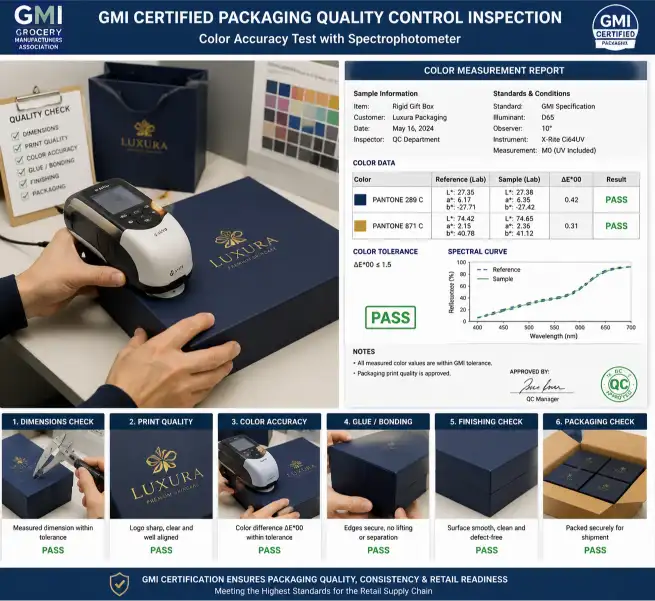
GMI certification is the global standard for print quality in packaging, covering color accuracy (Delta E ≤ 3.0), dot gain control (±2%), and density consistency. CVS compliance covers display specifications — pallet dimensions, PDQ requirements, labeling, and safety standards. Passing both GMI audits and CVS third-party inspections requires a factory with documented process control, and that is exactly what we deliver.
I run a factory that has passed GMI certification audits and produced compliant displays for CVS programs. Over 16 years, I have seen what happens when factories treat compliance as an afterthought — rejected shipments, chargebacks of $500–$2,000 per violation, and lost retail programs. This guide covers what GMI certification means for packaging and display manufacturing, what CVS requires from display vendors, and how to ensure your project passes both quality and compliance inspections.
What Is GMI Certification?
GMI (Graphic Measures International) is the global standard for print quality certification in the packaging industry. It is owned by Idealliance and is recognized by the world's largest brands — Procter & Gamble, Unilever, Nestlé, L'Oréal, and many others — as a prerequisite for packaging supplier qualification.
GMI certification is not a one-time test. It is an ongoing quality management system that requires factories to maintain documented process control, submit regular test reports, and pass periodic audits. A GMI-certified factory has proven it can produce consistent, repeatable print quality across every production run.
Why GMI Certification Matters
| Reason | Impact |
|---|---|
| Brand requirement | Many global brands require GMI certification from packaging suppliers |
| Color consistency | Ensures every printed box matches the brand's color standard |
| Quality documentation | Provides traceable quality records for every production batch |
| Third-party credibility | GMI audit reports are accepted by retailers and brands worldwide |
| Reduced waste | Process control reduces rework and material waste |
| Faster approval | Pre-qualified factories get faster brand and retailer approval |
Industries That Require GMI Certification
| Industry | Examples | Why GMI Matters |
|---|---|---|
| Cosmetics | L'Oréal, Estée Lauder, Shiseido | Color-critical packaging — brand colors must match exactly |
| Food and beverage | Nestlé, PepsiCo, Unilever | High-volume production needs batch-to-batch consistency |
| Pharmaceuticals | Johnson & Johnson, Bayer | Regulatory compliance requires documented quality control |
| Personal care | P&G, Colgate, Unilever | Packaging must match across multiple suppliers globally |
| Retail displays | CVS, Walmart, Target | Display printing must match brand standards at retail |
GMI Quality Control Standards: Delta E, Density, and Dot Gain
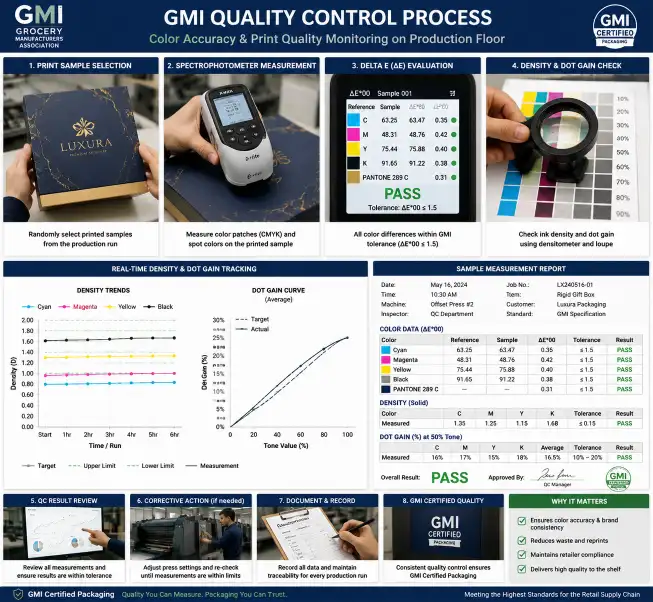
GMI certification is built on three core measurement parameters: color accuracy (Delta E), ink density, and dot gain. Every printed product must fall within GMI's specified tolerances.
Delta E (Color Accuracy)
Delta E (ΔE) measures the color difference between the printed result and the brand's target color. Lower Delta E means better color match.
| Measurement | GMI Tolerance | What It Means |
|---|---|---|
| ΔE00 (spot colors) | ≤ 3.0 preferred | Brand colors appear visually identical to the standard |
| ΔE00 (process colors) | ≤ 2.0–3.0 | Full-color images match the approved proof |
| ΔE76 (maximum) | ≤ 4.0 | Absolute maximum allowed deviation |
A Delta E of 3.0 means the color difference is barely perceptible to the human eye under controlled lighting. For comparison, a Delta E of 5.0 is visibly different — the box on the shelf will look like a different color than the brand standard.
Density (Solid Ink Density)
Density measures the thickness and opacity of ink on the substrate. Consistent density ensures the printed color looks the same across the entire production run.
| Ink Color | GMI Tolerance | Measurement Tool |
|---|---|---|
| Cyan | ± 0.05 | Spectrophotometer or densitometer |
| Magenta | ± 0.05 | Spectrophotometer or densitometer |
| Yellow | ± 0.07 | Spectrophotometer or densitometer |
| Black | ± 0.05 | Spectrophotometer or densitometer |
| Spot colors (Pantone) | ± 0.05 | Spectrophotometer |
Dot Gain (Tonal Value Increase)
Dot gain — also called Tonal Value Increase (TVI) — measures how much the printed dots expand compared to the plate. Too much dot gain makes shadows fill in and images look muddy.
| Measurement | GMI Tolerance | Best For |
|---|---|---|
| Dot gain at 40%–50% tint | ± 2% to ± 4% | Offset and flexo printing |
| Midtone dot gain range | 12%–18% (offset on coated stock) | Standard packaging |
| Highlight dot retention | Minimum 3% dot held | Fine detail and text |
GMI Process Control Checklist
| Control Point | Requirement | Frequency |
|---|---|---|
| Press-side spectrophotometer calibration | Daily | Every production day |
| Density measurement per signature | Every 500–1,000 sheets | During production |
| Delta E verification against approved proof | Every job start + periodic | Every production run |
| Dot gain curve linearization | Monthly | Plate imaging system |
| Substrate verification (paper, board) | Per job | Incoming material |
| Environmental conditions (temp, humidity) | Monitored continuously | Press room |
At our factory, we follow these controls strictly. Every production batch is measured, recorded, and traceable. This is why we maintain 100% pass rate on third-party quality inspections, including GMI audits.
GMI Audit Process: How Certification Works
GMI certification involves several stages. Understanding the process helps vendors prepare and pass on the first attempt.
Certification Stages
| Stage | What Happens | Duration |
|---|---|---|
| 1. Application | Factory applies for GMI certification through Idealliance | 1 week |
| 2. Pre-audit assessment | Factory submits existing quality documentation and test samples | 2–3 weeks |
| 3. On-site audit | GMI auditor visits the factory to inspect equipment, process control, and procedures | 2–3 days |
| 4. Press run qualification | Factory runs a standardized test form; results are measured against GMI tolerances | 1 day |
| 5. Certification decision | If all standards are met, GMI certification is granted | 2–4 weeks after audit |
| 6. Ongoing compliance | Factory submits quarterly test reports and passes annual re-audits | Ongoing |
What the GMI Auditor Checks
| Audit Area | What Is Inspected |
|---|---|
| Color management | Spectrophotometer calibration, color measurement procedures, proof-to-print matching |
| Press equipment | Condition of printing presses, roller settings, impression pressure |
| Plate imaging | CTP linearization, plate curves, plate quality |
| Substrate handling | Paper/board storage conditions, humidity control, material traceability |
| Standard operating procedures | Documented SOPs for every production step |
| Training records | Staff training on quality control and GMI standards |
| Traceability | Batch records, quality reports, sample retention |
Maintaining GMI Certification
| Requirement | Frequency | Consequence of Non-Compliance |
|---|---|---|
| Submit color control test report | Quarterly | Warning — must correct within 30 days |
| Pass annual on-site audit | Annually | Certification suspended until re-audit passes |
| Maintain documentation | Ongoing | Audit failure if missing records |
| Calibrate measurement equipment | Per manufacturer specification | Audit finding — non-compliance noted |
GMI certification is not permanent. Factories that stop maintaining process control lose their certification. This is why many factories claim GMI capability but cannot actually pass an audit — they let their process control slip between audits.
CVS Retail Display Compliance Requirements
CVS Health is one of the largest pharmacy and retail chains in the United States. Their vendor compliance requirements cover displays, packaging, labeling, and shipping. Non-compliant displays result in chargebacks, rejected shipments, and delayed retail launches.
CVS Display Compliance Overview
| Requirement | Standard | Penalty for Non-Compliance |
|---|---|---|
| Display pre-approval | Must be registered in CVS vendor portal | Display rejected at DC |
| Pallet dimensions | 40" x 48" GMA pallet | Chargeback + return freight |
| Pallet height | 60" maximum (standard), 72" (endcap) | Chargeback up to $500 |
| PDQ display specs | Must fit CVS shelf dimensions | Display rejected |
| Sidekick weight limit | 25 lbs maximum | Removed from store |
| Labeling | UCC-128 barcode on all pallets | Chargeback up to $200 |
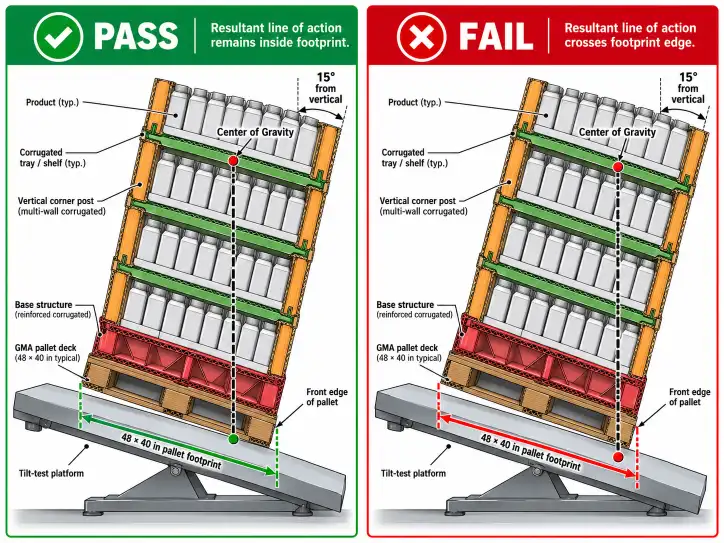
| Safety testing | ASTM F1562 tip-test | Display rejected |
CVS Display Pre-Approval Process
| Step | Action | Timeline |
|---|---|---|
| 1 | Submit display design to CVS buyer | 8–12 weeks before launch |
| 2 | Receive CVS display approval | 2–4 weeks after submission |
| 3 | Register display in CVS vendor portal | After buyer approval |
| 4 | Submit compliance documentation | 2 weeks before ship date |
| 5 | Production with in-process QC | During production |
| 6 | Third-party inspection before shipment | Before container loading |
Common CVS Display Compliance Failures
| Failure | Cause | Prevention |
|---|---|---|
| Pallet overheight | Display extends beyond 60" limit | Design to 58" maximum to allow tolerance |
| Incorrect pallet type | Stringer pallet instead of GMA block | Confirm pallet type with factory before production |
| Missing barcode or label | UCC-128 label not applied | Use CVS label checklist before shipping |
| Display not pre-approved | Vendor skipped approval step | Always register display in CVS portal |
| Sidekick too heavy | Exceeds 25 lb weight limit | Weigh display + all products before production |
For more on preventing display compliance issues, see my Walmart pallet display requirements guide — many of the same principles apply to CVS, though the specific dimension and weight limits differ.
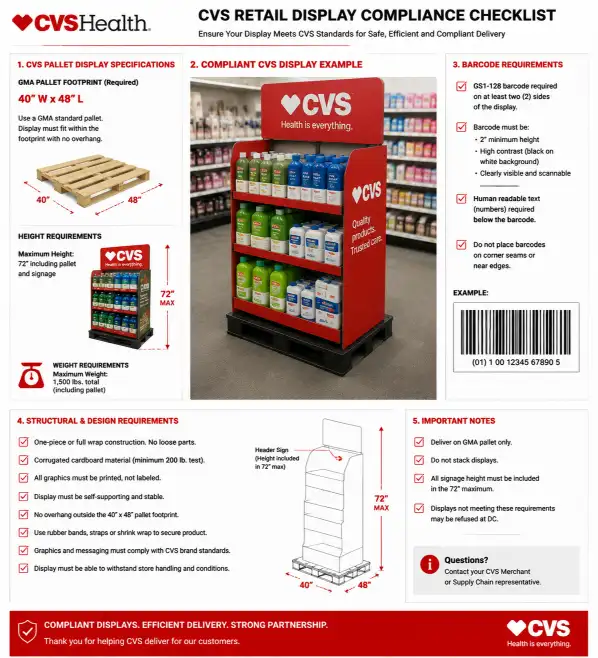
CVS Pallet Display and PDQ Specifications
CVS display specifications are tailored to their store formats — stand-alone pharmacies, Target-operated CVS locations, and CVS retail stores.
Pallet Display Specs
| Specification | CVS Requirement |
|---|---|
| Pallet footprint | 40" x 48" GMA pallet |
| Maximum height (standard) | 60" including pallet |
| Maximum height (endcap) | 72" including pallet |
| Pallet type | GMA block pallet, 4-way entry |
| Maximum weight | 1,500 lbs |
| Display overhang | 0" — no overhang permitted |
| Shrink wrap | Clear or black, full wrap |
| Labeling | UCC-128 pallet label, 2 sides minimum |
PDQ and Sidekick Display Specs
| Specification | CVS Requirement |
|---|---|
| Maximum sidekick weight | 25 lbs (display + products) |
| Maximum sidekick depth | 6"–8" from fixture |
| Attachment method | Hooks or clips — no adhesive strips |
| Shelf PDQ maximum width | 18" (fits between shelf uprights) |
| Shelf PDQ maximum depth | 14" |
| Header card required | Yes — branded, visible above product |
| Signage approval | Must be pre-approved by CVS |
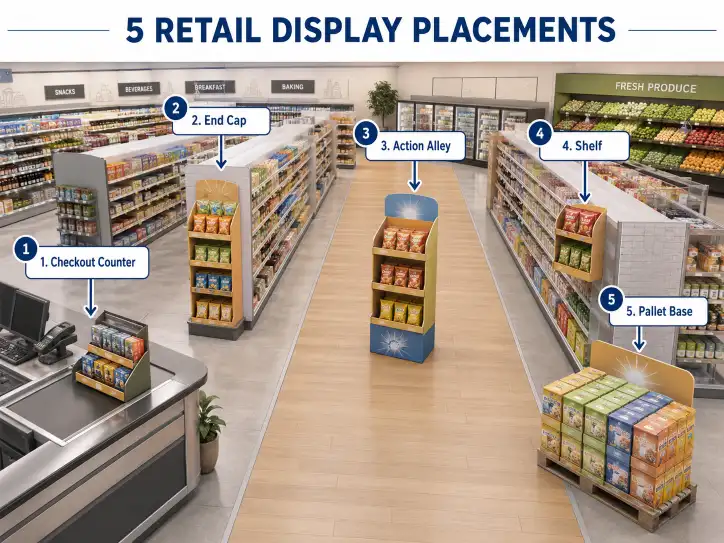
Display Placement by Store Area
| Store Area | Display Type | Max Height | Max Width |
|---|---|---|---|
| Front aisle / power alley | Pallet display | 60" | 40" |
| Endcap | Pallet display or sidekick | 72" | 48" |
| Pharmacy counter | Counter display | 14" | 12" |
| Side shelf | Shelf PDQ | Matches shelf | 18" |
| Impulse / checkout | Counter PDQ or sidekick | 42" | 12" |
CVS store layouts vary by location, but these specifications apply across most formats. Always confirm exact requirements with your CVS buyer or compliance contact, as some store formats may have different limits.
CVS Labeling, Barcode, and Routing Requirements
Every display shipped to CVS must carry specific labels and meet routing guide requirements.
Required Labels
| Label Type | Location | Information |
|---|---|---|
| UCC-128 pallet label | Pallet, two adjacent sides | Pallet ID, PO number, quantity, weight |
| Display ID label | Display structure (permanent) | Display ID, SKU, UPC |
| Price label | Front panel, visible | Retail price |
| Product information | Front or side | Brand, product name, SKU |
| Recyclability label | Bottom or inside panel | Material composition |
| "Sold by CVS" notation | Display structure | Required on all displays |
CVS Routing Guide Requirements
| Requirement | Standard |
|---|---|
| Shipping window | ± 3 days from confirmed date |
| Carrier | CVS preferred carrier list |
| Appointment required | Yes — schedule through CVS portal |
| ASN (Advanced Ship Notice) | Submit 24–48 hours before shipment |
| PO number | Must match CVS purchase order exactly |
| Case pack quantity | As specified in PO — no substitutions |
Chargeback Fee Schedule
| Violation | Fee |
|---|---|
| Non-compliant pallet display | Up to $500 |
| Unauthorized sidekick display | Up to $300 |
| Missing or incorrect UCC-128 label | Up to $200 |
| Display sign missing | Up to $150 |
| Late shipment (outside window) | Up to $250 |
| Incorrect PO or SKU on label | Up to $200 |
Chargebacks are deducted directly from vendor payments. A single non-compliant shipment can result in $500–$2,000 in total chargebacks. Prevention is significantly cheaper than correction.
Third-Party Inspection: How to Ensure 100% Pass Rate
Third-party inspections are a standard requirement for CVS display programs and GMI-certified production. An independent inspector verifies that the finished product meets all specifications before shipment.
What Third-Party Inspectors Check
| Inspection Area | What Is Verified | Accept/Reject Criteria |
|---|---|---|
| Print quality | Color accuracy (Delta E), density, registration | GMI tolerances per standard |
| Structural dimensions | Height, width, depth, pallet footprint | ± 1/8" tolerance |
| Board quality | ECT, flute type, material grade | Per specification |
| Assembly | Ease of setup, locking mechanism function | Must assemble in under 30 seconds |
| Labeling | All required labels present, correct, scannable | 100% correct — no errors accepted |
| Product fit | Products fit correctly in the display | Snug fit, no movement |
| Pallet condition | Pallet type, condition, 4-way entry | No damaged pallets accepted |
| Packing | Shrink wrap quality, pallet stability | Must pass vibration test |
| Quantity | Count per pallet, total quantity | Must match PO exactly |
How We Ensure 100% Pass Rate
We are fully capable of undertaking printing, packaging and display projects compliant with GMI and CVS standards. With years of rich practical experience and numerous successful cases, we strictly follow official certification specifications and quality requirements throughout production. Our professional quality control system ensures 100% smooth passing of all third-party authoritative inspections and verifications, delivering fully qualified compliant products for global business cooperation.
This is not a marketing claim — it is a statement of fact based on our track record. Here is how we achieve it:
| Quality Stage | Our Process | Result |
|---|---|---|
| Pre-production | Color proof approval, material verification, dimensional check | Eliminates design-level errors |
| Incoming material | Board grade, flute type, recycled content verified | Material meets spec before production |
| In-process inspection | Every 500 units: Delta E, density, dimensions, assembly test | Defects caught immediately |
| Pre-shipment QC | 100% of displays checked for labeling, barcode scan, pallet condition | No errors reach the container |
| Third-party inspection | Inspector works from our QC hold area | 100% pass rate on every inspection |
| Documentation | Full traceability records for every batch | Audit-ready at any time |
For more on the production and QC process, see my retail display guide which covers the full manufacturing workflow for compliant retail displays.
Our Capability: GMI and CVS Compliant Production
If you are looking for a factory that can handle GMI-certified production and CVS-compliant display manufacturing, here is what we offer:
Our Certified Capabilities
| Capability | Details |
|---|---|
| Offset printing | Sheet-fed offset, up to 6 colors + coating, Pantone matching |
| Flexo printing | Inline flexo for corrugated, up to 4 colors |
| GMI process control | Spectrophotometer measurement, Delta E tracking, density control |
| CVS compliance | Registered in CVS vendor portal, experience with CVS display programs |
| Third-party inspection | Pre-shipment inspection arrangement for any inspection company |
| Display types | Pallet displays, PDQ trays, sidekicks, power wings, floor displays, counter displays |
| Material options | Corrugated (all flute grades), rigid board, litho laminate, E-flute |
| Labeling | UCC-128, GS1-128, Display ID labels — all formats |
| Product loading | Pre-filled assembly, SKU arrangement, packing and palletizing |
Our Compliance Track Record
| Metric | Our Performance |
|---|---|
| GMI audit pass rate | 100% |
| Third-party inspection pass rate | 100% |
| CVS display compliance rate | 100% |
| On-time shipment rate | 98%+ |
| Average Delta E on production | ≤ 2.5 (exceeds GMI standard) |
Ready to Start Your Compliant Display Project?
If you need GMI-certified printing or CVS-compliant displays for your retail program, contact us with your requirements. We will review your project, confirm the compliance specifications, and provide a production plan that meets the required standards.
FAQ
What is GMI certification?
GMI (Graphic Measures International) certification is the global standard for print quality in packaging. It requires factories to maintain strict process control over color accuracy (Delta E), ink density, and dot gain. GMI certification is required by many global brands for packaging suppliers.
Why is GMI certification important for packaging?
GMI certification ensures consistent, repeatable print quality across all production runs. For brands, it means every box on every shelf looks exactly the same. For retailers, it means compliant, professional packaging that meets their quality standards.
What are the GMI tolerances for color accuracy?
GMI requires Delta E (ΔE00) ≤ 3.0 for spot colors and ≤ 2.0–3.0 for process colors. Density tolerance is ± 0.05 for most colors. Dot gain tolerance is ± 2% to ± 4% depending on the substrate.
What are CVS display requirements for pallet displays?
CVS requires pallet displays to fit a 40" x 48" GMA pallet footprint, with a maximum height of 60" (standard) or 72" (endcap). Maximum weight is 1,500 lbs. All displays must be pre-approved through the CVS vendor portal.
What is the weight limit for CVS sidekick displays?
CVS limits sidekick displays to 25 lbs total (display + products). Attachment must use hooks or clips — adhesive strips are not permitted.
What happens if a display fails CVS compliance?
Non-compliant displays result in chargebacks ranging from $150 to $500 per violation. Failed displays may be rejected at the distribution center, with the vendor paying return freight and disposal costs.
How does the GMI audit process work?
GMI certification involves a pre-audit assessment, a 2–3 day on-site audit, a press run qualification test, and ongoing quarterly compliance reporting. Annual re-audits are required to maintain certification.
Can a factory be GMI certified for both offset and flexo printing?
Yes. GMI certification covers multiple printing processes. The factory must pass separate press run qualifications for each process type. We maintain GMI process control for both our offset and flexo production lines.
What is the difference between GMI and ISO 12647?
ISO 12647 is the international standard for print process control. GMI builds on ISO 12647 with tighter tolerances specifically designed for packaging applications. GMI includes additional requirements for brand color approval and quality documentation.
How do I find a GMI-certified display manufacturer?
Contact a display manufacturer that has passed GMI certification audits. Request their GMI audit report and ask about their process control procedures. Visit the factory if possible — GMI compliance is visible in how the press room operates.

One Response