
One of the most common mistakes in retail display planning is trying to fit too many products into one unit. On paper, that can look efficient. In real stores, it often creates the opposite result. The display becomes harder to understand, harder to refill, and less effective at selling.
So how many SKUs should one cardboard display hold? The honest answer is: fewer than many buyers first expect. The right number depends on product size, shopper behavior, store location, and how quickly customers need to understand what the display is selling. In this guide, we break that decision down in a practical way for brands, retailers, and importers using cardboard displays.
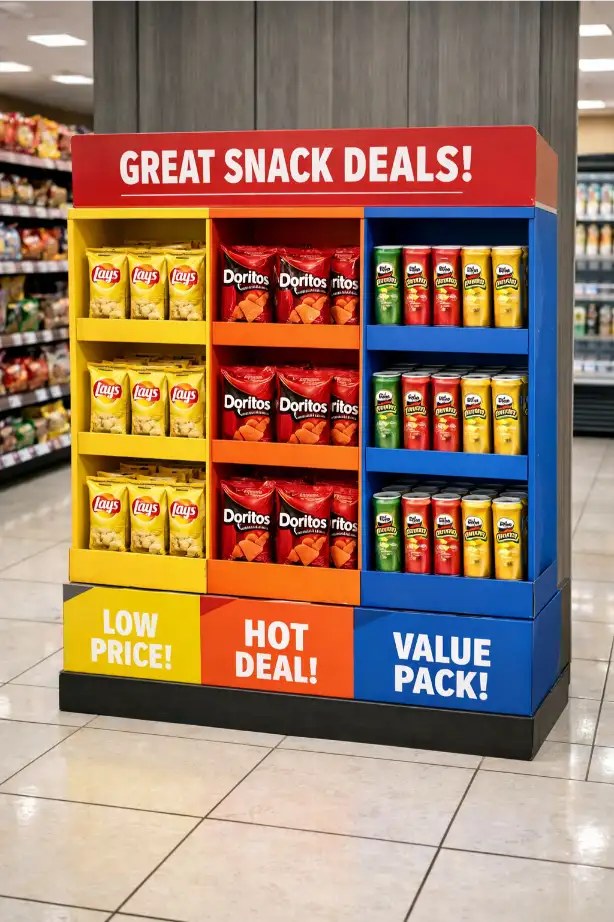
Start With the Real Question: Is the Display for Choice or for Conversion?
Before deciding how many SKUs a display should hold, buyers should decide what the display is actually supposed to do. Some displays are built to show range. Others are built to drive fast sales. Those are not the same thing.
If the goal is fast conversion, the display usually needs fewer SKUs and stronger visual clarity. If the goal is broader product presentation, the display can hold more SKUs, but only if the hierarchy stays easy to understand. Trying to do both at the same time often weakens the result.
The 3-SKU Rule for Fast-Selling Displays
When the display is placed in a high-traffic area, near checkout, or in a quick-decision retail zone, three SKUs is often a very strong number. This is especially true for snacks, cosmetics, travel-size products, pet treats, household accessories, and electronics add-ons. Three options usually give enough variety without creating too much friction.
A 3-SKU display works best when:
- the products are visually similar but have different variants
- the shopper decision needs to be quick
- the display is compact or near checkout
- the campaign is focused on best sellers
The 4–6 SKU Range for Most Standard Retail Displays
For many floor displays and structured counter units, four to six SKUs is often the most balanced range. This gives enough variety to show a category without making the display look crowded. It also helps shoppers compare options without slowing them down too much.
This range is often useful for:
- beverage flavor assortments
- snack multipack promotions
- beauty and skincare selections
- electronics accessories by function
- household items with small format variations
If the display uses shelves, this range is often easier to manage than a larger assortment. If the display uses hooks, the same rule usually still applies, because visual overload appears even faster with hanging products.
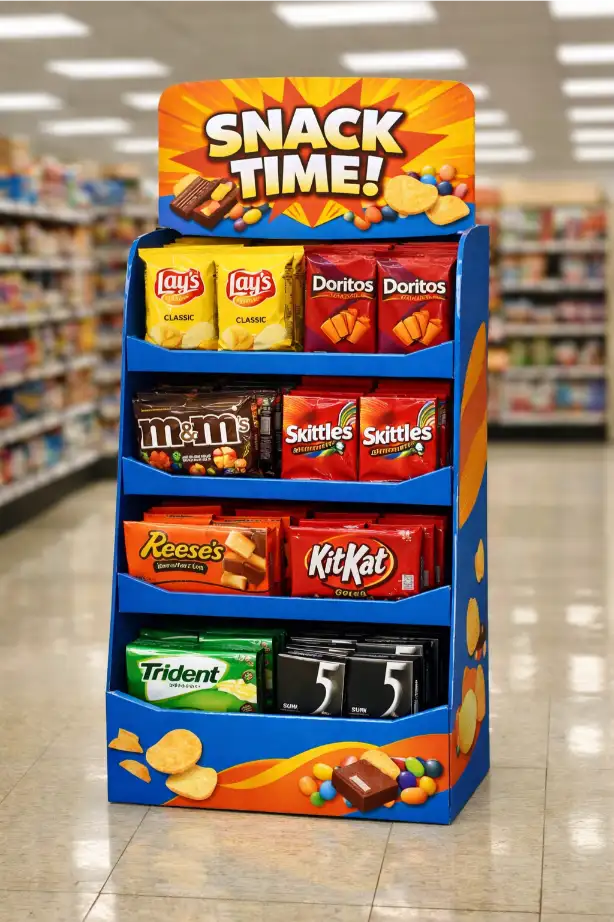
When 7+ SKUs Can Work — and When They Usually Fail
A display can hold seven or more SKUs, but it should only do so under the right conditions. The structure needs enough width, the products need clear segmentation, and the shopper should still understand the assortment quickly. If the display is narrow, if the products are visually similar, or if the pack sizes vary too much, seven or more SKUs often become too much.
Displays with too many SKUs usually fail in three ways:
- the shopper cannot identify the main products quickly
- store staff refill the wrong areas or create visual mess
- the display loses premium appearance and looks crowded
This is one reason corrugated shelf-ready and retail-ready formats are often designed around clear identification and easy shopper access rather than maximum assortment density. FEFCO’s retail guidance stresses both clear product visibility and easier replenishment as key requirements. (FEFCO Shelf Ready Packaging)
SKU Decision Table
| SKU Count | Best Use Case | Main Advantage | Main Risk |
|---|---|---|---|
| 1–3 SKUs | Impulse, checkout, hero-product campaigns | High clarity and fast decision-making | Less assortment variety |
| 4–6 SKUs | Most standard retail displays | Good balance of choice and clarity | Needs disciplined layout |
| 7–10 SKUs | Wider category displays with strong segmentation | Broader product presentation | Can look cluttered quickly |
| 10+ SKUs | Only for very large or highly structured units | Maximum assortment | Higher risk of shopper confusion and weak conversion |
Product Size Changes the SKU Answer
SKU count should never be decided without looking at pack size. Ten sachets are not the same as ten boxed skincare items. Four bottled products may already be enough for one display, while six lightweight accessories may still feel very clean. Buyers should evaluate not only SKU count but also physical density and front-facing visibility.
This is why the better question is often not “How many SKUs can we fit?” but “How many SKUs can we fit while keeping the display easy to shop?”
Store Location Changes the SKU Answer Too
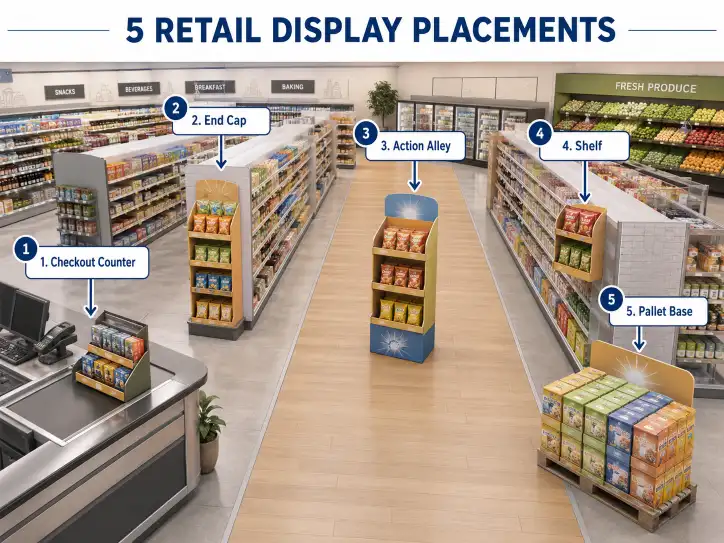
The same display can support a different SKU count depending on where it is placed. Checkout and impulse zones usually benefit from fewer SKUs. Wider aisle displays can support more variety. End-cap displays may allow a stronger category story, but only if the assortment is structured clearly.
That means SKU planning should happen after retail placement is known, not before. If you are still comparing structure types, our retail display solutions page can help match layout decisions to display format.
How Too Many SKUs Hurt Sales
Too many SKUs often reduce conversion in ways that are easy to miss. The display may still look “full,” but shoppers may take longer to decide, overlook hero products, or fail to understand the display’s purpose quickly. Store staff may also struggle to keep the display tidy, especially when products have different pack depths or sell at different speeds.
In retail, a display is not a catalog. It is a selling tool. If the display is trying to do too much, it often sells less effectively.
How Buyers Should Decide SKU Count Before Sampling
A practical way to decide is to build the display around the strongest-selling part of the assortment first. Identify which SKUs are most important, which ones must be visible, and which ones could be secondary. Then decide whether the unit is primarily a range display or a conversion display.
Before sampling, buyers should confirm:
- the number of SKUs the campaign truly needs
- the relative sales priority of each SKU
- whether some items should be excluded from the display
- whether all SKUs can be faced clearly at retail distance
- whether refilling will stay simple after launch
If you are balancing SKU variety against budget and order planning, our cost guide and MOQ guide can help you compare the commercial side more realistically.

Buyer Checklist Before Finalizing SKU Count
- Decide whether the display is for range or for conversion
- Check product size, not just SKU number
- Keep checkout and impulse displays simpler
- Use stronger hierarchy if the range is wider
- Test real product facing in the sample stage
- Make sure the display stays refill-friendly
Useful External References
FEFCO’s shelf-ready guidance emphasizes easy identification, easy replenishment, and easy shopper access, all of which support keeping the assortment clear rather than overcrowded. See FEFCO Shelf Ready Packaging. For corrugated basics and why it works well in retail display and product communication, the Fibre Box Association overview of corrugated is also useful.
Conclusion
So, how many SKUs should one cardboard display hold? In many retail situations, fewer SKUs perform better. Three SKUs often work well for fast conversion, four to six is a strong range for many standard displays, and higher SKU counts only work when the structure and product hierarchy are carefully controlled. The best display is not the one that holds the most. It is the one that helps shoppers understand and buy the products more easily.
If you want help planning the right SKU layout for your next display project, feel free to contact us.
FAQ
How many SKUs is too many for one cardboard display?
That depends on pack size and retail placement, but many displays start to look cluttered once the assortment becomes too dense to browse clearly.
Is 3 SKUs enough for a display?
Yes. For many impulse and checkout displays, three SKUs is a very effective number because it keeps the decision simple.
What is the safest SKU range for most displays?
Four to six SKUs is often the most balanced range for standard retail displays.
Can one display hold 10 or more SKUs?
It can, but only if the structure is large enough and the assortment is organized very clearly.
Why do too many SKUs reduce performance?
Because shoppers take longer to understand the display, and the unit often becomes visually cluttered and harder to refill neatly.
Should SKU count be decided before or after choosing the display type?
It should be decided together with display type, product size, and retail placement, not in isolation.


12 Responses