
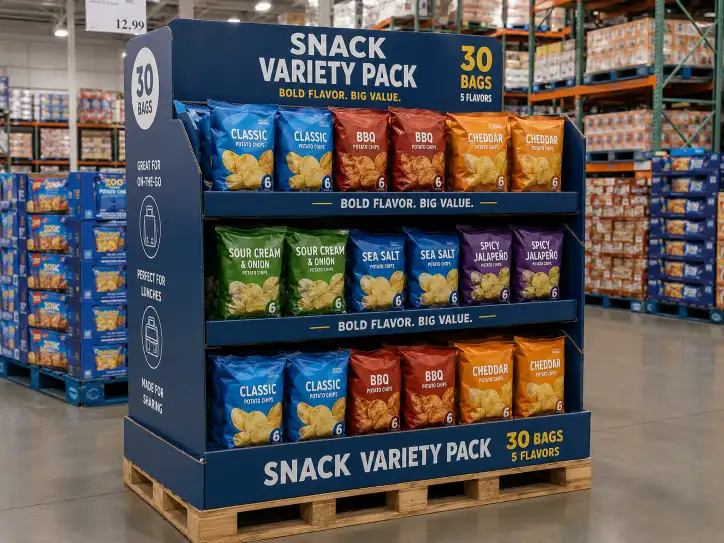
Getting a product onto a Costco shelf starts with one thing: a compliant pallet display. Costco operates on a pallet-based retail model — most products are sold directly from the pallet, not from individual shelves. If your display does not meet Costco's specific requirements, it will be rejected at the receiving dock, and your product will not reach the sales floor.
Costco's pallet display requirements cover every detail: the exact GMA pallet dimensions, height limits including the pallet base, label format and placement, structural testing standards, and packing methods. Missing any one of these can result in chargebacks or rejection.
This guide covers the complete Costco pallet display specifications every vendor needs to know before production.
Costco Pallet Display Overview
A Costco pallet display is a corrugated display unit built on a standard GMA pallet base, design for Costco's warehouse club environment. Unlike standard retail displays, Costco displays must be retail-ready — meaning they arrive at the store pre-assembled and pre-loaded with product, ready to be moved directly to the sales floor.
Key Requirements at a Glance
| Specification | Standard |
|---|---|
| Pallet size | 48 × 40 inches (GMA standard) |
| Maximum height | 72–84 inches (including pallet base) |
| Maximum weight | Up to 2,500 lbs per pallet |
| Pallet entry | Four-way forklift/pallet jack access |
| Packing method | Pre-filled (factory loaded) preferred |
| Label format | GS1-128 pallet label |
| Structural testing | ECT, vibration, drop, tilt required |
Costco's requirements are not guidelines — they are mandatory. Every display that enters a Costco warehouse must pass the same set of checks. If you are new to Costco, read our article on Costco-style club store displays for an overview of the format before diving into specs.
GMA Pallet Dimensions and Footprint
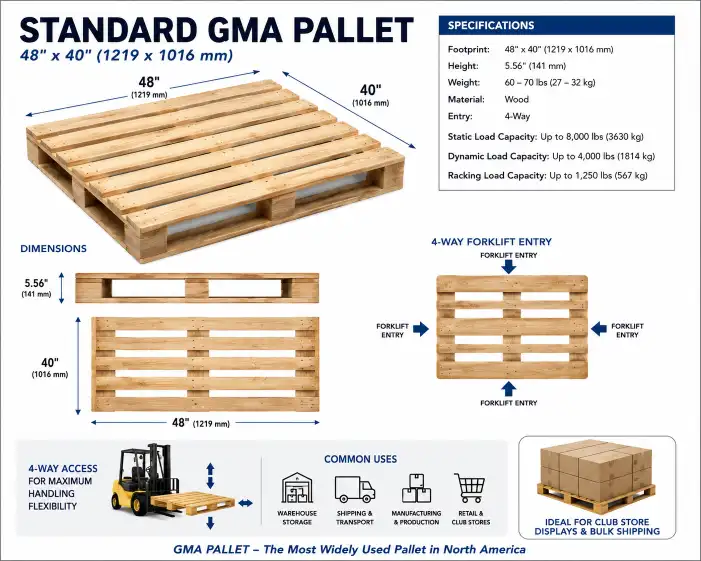
The foundation of every Costco pallet display is the GMA (Grocery Manufacturers Association) pallet. Costco does not accept custom pallet sizes. The display must fit the GMA standard exactly.
Standard GMA Pallet Specs
| Dimension | Measurement |
|---|---|
| Length | 48 inches (1219 mm) |
| Width | 40 inches (1016 mm) |
| Pallet height | 5–6 inches (13–15 cm) |
| Forklift entry height | 3.5 inches (89 mm) |
| Entry direction | Four-way (all sides) |
Critical Rules
- Zero overhang — No part of the display may extend beyond the pallet edge. Even a 1-inch overhang can cause racking issues and rejection.
- No underhang — The display should cover the full pallet surface. Gaps between the display and pallet edge create instability.
- Stringer alignment — The display must be aligned with the pallet stringer direction to ensure proper weight distribution.
Half Pallet Options
For smaller products or endcap positions, Costco also accepts half-pallet displays:
| Half Pallet Size | Configuration | Common Use |
|---|---|---|
| 48 × 20 inches | Half-length | Narrow floor positions |
| 24 × 40 inches | Half-width | Side positions, smaller promotions |
For more on Costco's specific display formats, see our COSTCO DISPLAYS product page.
Costco Display Height Limits
Costco enforces strict height limits for pallet displays. The height is measured from the floor to the top of the display, including the pallet base.
Standard Height Limits
| Location | Maximum Height | Notes |
|---|---|---|
| Standard floor position | 72 inches (183 cm) | Most common |
| Some club locations | Up to 84 inches (213 cm) | Confirm with buyer |
| Endcap position | 60–72 inches (152–183 cm) | Varies by store |
The pallet base itself is typically 5–6 inches tall. This means the actual product display area starts about 6 inches above the floor. Factor this into your design — a display that is 72 inches tall has approximately 66 inches of usable product space above the pallet.
Why Height Limits Matter
- Pallet racking — Costco uses standard pallet rack systems. Displays over the height limit cannot be placed in the rack.
- Forklift visibility — Drivers need to see over pallets during movement. Excessive height creates safety risks.
- Ceiling clearance — Some older Costco locations have lower ceiling heights.
Always confirm the exact height limit with your Costco buyer before production. Limits can vary by club location and product category.
Weight Capacity and Structural Requirements
Costco pallet displays carry significantly more weight than standard retail displays. A typical display holds 500–1,500 lbs (225–680 kg) of product.
Maximum Load Limits
| Component | Maximum Load |
|---|---|
| Full pallet display | Up to 2,500 lbs (1,134 kg) |
| Per tray (B-flute) | Up to 15 lbs (7 kg) |
| Reinforced tray (double-wall) | Up to 30 lbs (14 kg) |
| Pallet base layer | Up to 100+ lbs (45+ kg) |
Board Grade Requirements
| Board Type | Minimum ECT Rating | Application |
|---|---|---|
| Single-wall B-flute | 28–32 lbs/inch | Standard floor displays |
| Single-wall C-flute | 32–38 lbs/inch | Medium displays |
| Double-wall BC-flute | 48–55 lbs/inch | Heavy pallet displays |
Weight Distribution Rules
- Heaviest products at the bottom layers, closest to the pallet
- Lighter products on top layers to maintain stability
- Even distribution across the full pallet surface, not concentrated in the center
- Partial sell-through stability — the display must remain stable after 30–50% of product is removed
For structural material guidance, see our PRODUCTION page which covers board grades and ECT requirements.
Labeling Requirements for Costco Displays
Incorrect labeling is the most common reason for Costco receiving dock rejections. Costco requires specific labels in specific positions.
Required Labels
| Label Type | Information | Purpose |
|---|---|---|
| GS1-128 pallet label | SSCC-18, PO number, supplier code, quantity, weight | Receiving and tracking |
| Carton content label | SKU, product name, quantity per display | Warehouse identification |
| Retail price label | Unit price, member price, effective date | Shelf-ready pricing |
| Handling label | "This Side Up," stack limit, fragile icons | Transit protection |
| Country of origin | "Made in China" or applicable origin | Customs compliance |
| UPC/GTIN barcode | 12-digit or 14-digit barcode per SKU | Checkout scanning |
| Pallet display ID | Item number, description, supplier number | Costco receiving |
Label Placement Standards
- Minimum two sides — Labels on the front and one adjacent side of the pallet
- No overlay on perforations — Labels must not cover tear strips or opening panels
- Readable after wrapping — Labels must remain scannable through stretch wrap
- Buyer pre-approval — Always send label artwork to the Costco buyer for approval before production
Common Label Mistakes
- Missing GS1-128 barcode or incorrect SSCC-18 format
- Label placed on only one side of the pallet
- Barcode covered by stretch wrap in a way that prevents scanning
- Missing country of origin label
- Retail price label with incorrect member pricing
Label approval should be part of your sample approval process. See our SAMPLING page for details.
Structural Testing for Costco Approval
Costco typically requires structural test reports for new display designs. These tests verify that the display can survive transit, handling, and the retail environment.
Required Tests
| Test | Purpose | Passing Criteria |
|---|---|---|
| ECT (Edge Crush Test) | Measures stacking strength of corrugated board | Min 32 lbs/in (single-wall), 48+ (double-wall) |
| Vibration test | Simulates truck transit vibration | No structural failure, no product damage |
| Drop test | Simulates handling during loading/unloading | No damage from 6–12 inch drops |
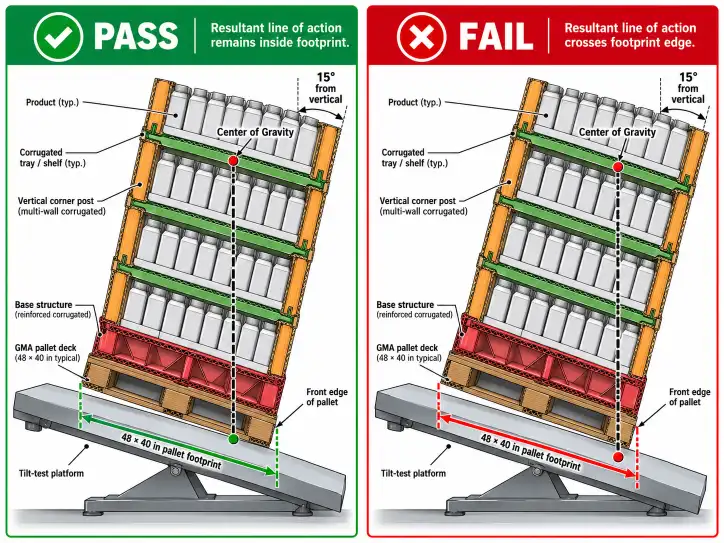
| Tilt test | Measures stability when tilted | Display must not tip at 15–20 degrees |
When Testing Is Required
- New display designs — Always required
- Material changes — Required if board grade or flute type changes
- Product weight changes — Required if product weight exceeds the original test load
- Annual requalification — Some buyers request updated test reports annually
For detailed testing procedures, see our article on club store display requirements which covers testing for both Costco and Sam's Club.
Packing Methods for Costco Pallet Displays
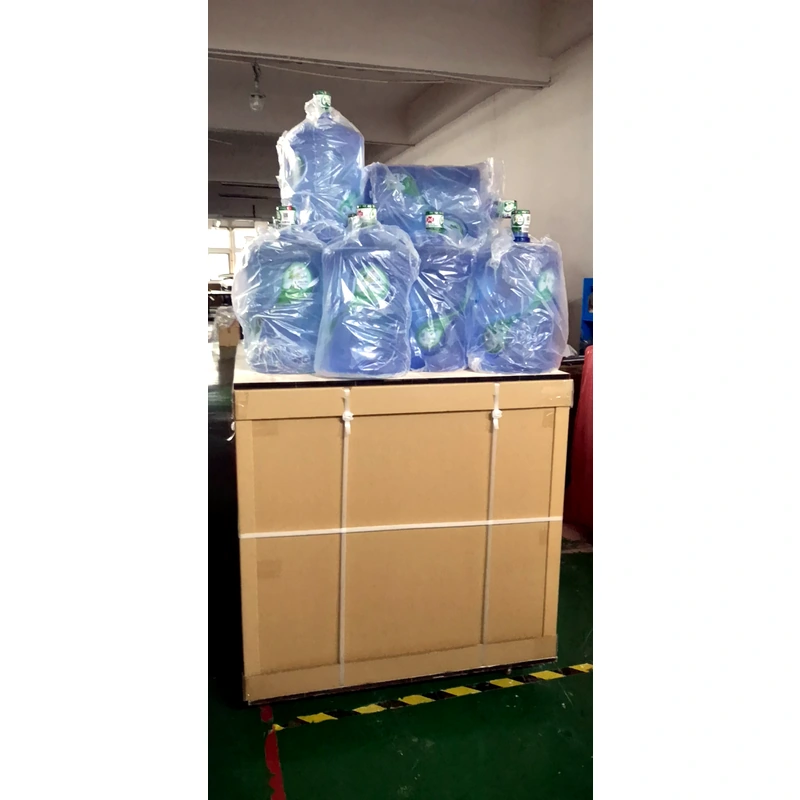
Costco has a strong preference for pre-filled (pre-packed) displays. The display must arrive at the store ready to sell with minimal handling.
Packing Methods Accepted
| Method | Description | Costco Preference |
|---|---|---|
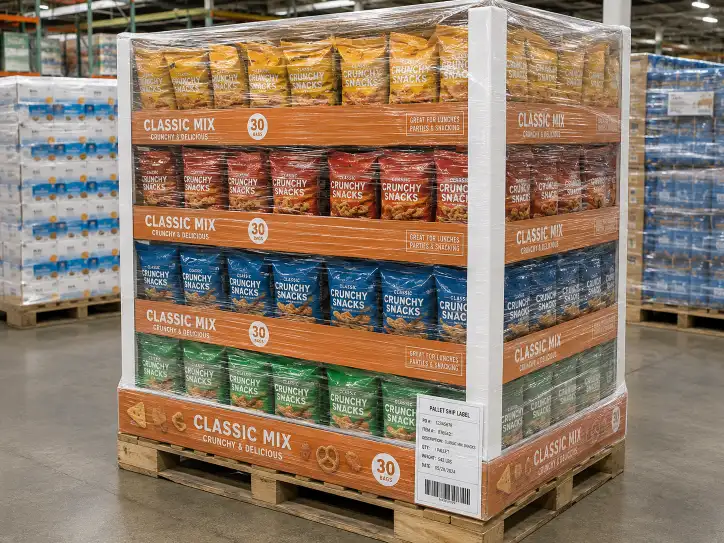
| Pre-filled (pre-packed) | Products loaded at factory, unit wrapped for transit | Most preferred |
| Semi-assembled | Main structure pre-assembled, trays and inserts separate | Acceptable |
| Flat-pack (KD) | Ships flat, assembled in store | Least preferred |
Packing Requirements
- Stretch wrap — Minimum 3–5 layers, applied evenly from bottom to top
- Corner boards — L-shaped cardboard protectors on all four pallet corners
- Layer pads — Corrugated sheets between product layers for weight distribution
- Edge protectors — Placed under straps to prevent compression damage
- Pallet skirt — Printed corrugated or paper skirt around the pallet base for branding
Container Loading
A standard 40-ft container holds approximately 20–22 GMA pallets. Request a loading diagram from your factory showing:
- Number of units per pallet
- Number of pallets per container
- Layer pattern for each pallet
- Total weight per pallet and per container
For packing and shipping specifications, see our SHIPPING page.
Costco Pallet Display Compliance Checklist
| Check Item | Status | Notes |
|---|---|---|
| GMA pallet 48×40 in | ☐ | Confirm exact dimensions, zero overhang |
| Height within limit | ☐ | Include pallet base height |
| Four-way forklift entry | ☐ | 3.5-inch clearance on all sides |
| Board grade meets ECT | ☐ | Min 32 lbs/in for single-wall |
| Weight distribution plan | ☐ | Heaviest at bottom |
| Pre-filled packing | ☐ | Factory loaded, ready to sell |
| GS1-128 labels on 2 sides | ☐ | Approved by buyer |
| Structural test reports ready | ☐ | ECT, vibration, drop, tilt |
| Corner boards and edge protectors | ☐ | All four corners |
| Stretch wrap 3–5 layers | ☐ | Even coverage |
| Pallet skirt printed | ☐ | Branding and product info |
| Sample approved with real product | ☐ | Test with actual product weight |
| Partial sell-through test | ☐ | Stable at 30–50% depletion |
| Container loading diagram | ☐ | Provided by factory |
Conclusion
Meeting Costco pallet display requirements is not optional. Every dimension, label, and test specification is enforced at the receiving dock. The most common failures — wrong pallet size, missing labels, insufficient structural testing, and incorrect packing method — are all preventable with proper planning.
For vendors new to Costco, the most important step is to confirm the specifications with your Costco buyer before you brief your factory. Use the checklist above to review every requirement before production starts. A compliant display moves from the receiving dock to the sales floor in hours. A non-compliant display sits in the warehouse while you arrange corrections.
If you are planning a Costco display project, start by reviewing the COSTCO DISPLAYS product page and our guide to Costco-style club store displays for additional context. For a comparison of requirements across retailers, read our club store display requirements article.
FAQ
What are the pallet display requirements for Costco?
Costco requires standard GMA pallets (48×40 inches), pre-filled displays, GS1-128 labels on two sides, structural testing (ECT, vibration, drop, tilt), and maximum height of 72–84 inches including the pallet base.
What size pallet does Costco use for displays?
Costco uses standard GMA pallets — 48 × 40 inches (1219 × 1016 mm). Half-pallet options (48×20 in or 24×40 in) are also accepted in some positions.
Does Costco require pre-filled displays?
Yes. Costco strongly prefers pre-filled (pre-packed) displays where products are loaded at the factory. The display must be retail-ready — unwrap and place on the sales floor.
What labels are required on Costco pallet displays?
Costco requires GS1-128 pallet labels (with SSCC-18, PO number, supplier code, quantity), carton content labels, retail price labels, handling labels, country of origin, and UPC/GTIN barcodes.
What structural testing does Costco require?
Costco typically requires ECT (compression), vibration, drop, and tilt test reports for new display designs. Testing must be completed before the display is approved for production.
What happens if my display does not meet Costco requirements?
Non-compliant displays may be rejected at the receiving dock, returned to the supplier, or charged a non-compliance fee. Common violations include incorrect pallet size, missing labels, and improper packing.
What is the height limit for Costco pallet displays?
The standard height limit is 72 inches (183 cm) including the pallet base. Some club locations allow up to 84 inches. Always confirm with your Costco buyer.
Can I use the same pallet display for Costco and Sam's Club?
The structural requirements are similar, but labeling, pricing, and specific compliance rules differ. Each retailer has its own supplier requirements and should be checked separately.

6 Responses