There are many types of cardboard displays — floor displays, counter displays, PDQ trays, dump bins, and pallet displays — and each type has a different minimum order quantity. For a buyer placing a first order, MOQ is often the first question. But MOQ is not a fixed number. It depends on the display design, the printing method, the material, and the factory's production setup. Some factories quote 500 units as the minimum. Others quote 5,000 for the same display. So with so much variation between factories and display types, how do you know what MOQ to expect — and how do you negotiate a lower MOQ when your budget or test market requires a smaller run?
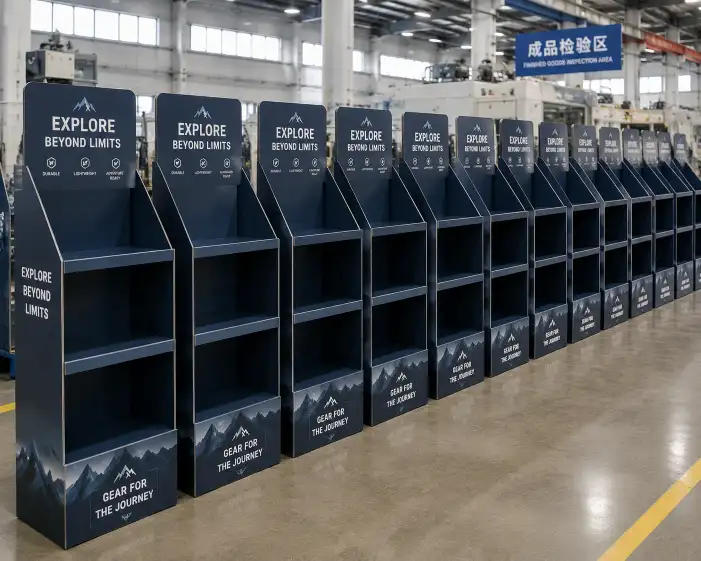
A minimum order quantity is the smallest number of units a factory will produce in a single production run. For cardboard displays, MOQ is driven by the cost of setup — die-cutting tooling, printing plate preparation, machine calibration, and material minimums. A factory needs to spread these fixed costs across enough units to make the run profitable. At Leader Display, I have worked with buyers who order 200 units for a test launch and buyers who order 50,000 units for a national rollout. The MOQ strategy is different for each, and this guide covers everything you need to know about MOQ for cardboard displays — by display type, by printing method, and by factory type — plus practical strategies for reducing MOQ without overpaying per unit.
What Drives MOQ for Cardboard Displays
MOQ is not an arbitrary number. It is the factory's calculation of the minimum quantity needed to cover setup costs and still make a profit. Understanding the cost components helps you evaluate whether a factory's MOQ is reasonable.
| Cost Component | What It Covers | Typical Cost | Impact on MOQ |
|---|---|---|---|
| Die-cutting tooling | Steel rule die to cut the display shape | $200–$800 | High — one-time cost per design |
| Printing plates | Flexo printing plates per color | $50–$150 per color | High — more colors = higher MOQ |
| Machine setup | Time to calibrate die-cutter, printer, folder-gluer | $100–$300 per run | High — fixed per production run |
| Material minimum | Minimum paper order from mill or supplier | Varies by board grade | Medium — factories buy in bulk |
| Color matching | Ink mixing and proofing for custom colors | $50–$200 per color | Medium — more significant for PMS colors |
| Quality control | First article inspection, in-line checks | $50–$150 per run | Low — per-run cost, not per-unit |
| Packaging materials | Boxes, polybags, pallets for shipping | Varies | Low — scales with quantity |
Fixed Costs vs Variable Costs
| Cost Type | Definition | Examples | How It Affects MOQ |
|---|---|---|---|
| Fixed costs | Costs that do not change with quantity | Tooling, plates, machine setup | Spread across all units — higher MOQ = lower cost per unit |
| Variable costs | Costs that change with quantity | Paper, ink, labor, packaging | Relatively constant per unit, regardless of MOQ |
The key insight: fixed costs are the reason MOQ exists. A factory needs to produce enough units so that the fixed cost per unit is small enough to keep the unit price competitive. For a display with $500 in tooling costs, producing 100 units adds $5.00 per unit in tooling alone. Producing 1,000 units reduces the tooling cost to $0.50 per unit.
MOQ by Display Type
Different display types have different MOQ ranges because they require different tooling, materials, and production complexity.
| Display Type | Typical MOQ Range | Tooling Complexity | Key MOQ Driver |
|---|---|---|---|
| PDQ tray / one-second display | 500–2,000 units | Low — simple die-cut | Printing plate cost |
| Counter display | 300–1,000 units | Low to medium | Die tooling + printing |
| Dump bin | 200–500 units | Low — simple shape | Material minimum |
| Floor display (simple, 1–2 shelves) | 300–1,000 units | Medium | Die tooling + assembly |
| Floor display (complex, 3+ shelves) | 500–2,000 units | High — multiple die-cuts | Multiple tooling + assembly |
| Sidekick / power wing display | 500–1,500 units | Low to medium | Printing + hardware |
| Peg display | 500–2,000 units | Low | Printing plate cost |
| Standee / cutout display | 200–500 units | Low | Material + printing |
| Pallet display (pre-filled) | 500–2,000 units | Medium | Tooling + product filling |
| Pallet display (bulk, no product) | 300–1,000 units | Medium | Tooling + material |
MOQ Range by Display Type — Factory Perspective
| Display Type | Small Factory MOQ | Medium Factory MOQ | Large Factory MOQ |
|---|---|---|---|
| PDQ tray | 300–500 | 500–1,000 | 1,000–3,000 |
| Counter display | 200–500 | 500–1,000 | 1,000–2,000 |
| Dump bin | 200–300 | 300–500 | 500–1,000 |
| Floor display (simple) | 200–500 | 500–1,000 | 1,000–2,000 |
| Floor display (complex) | 300–500 | 500–1,500 | 1,500–3,000 |
| Pallet display | 200–500 | 500–1,000 | 1,000–2,500 |
| Standee display | 100–300 | 200–500 | 500–1,000 |
MOQ by Printing Method
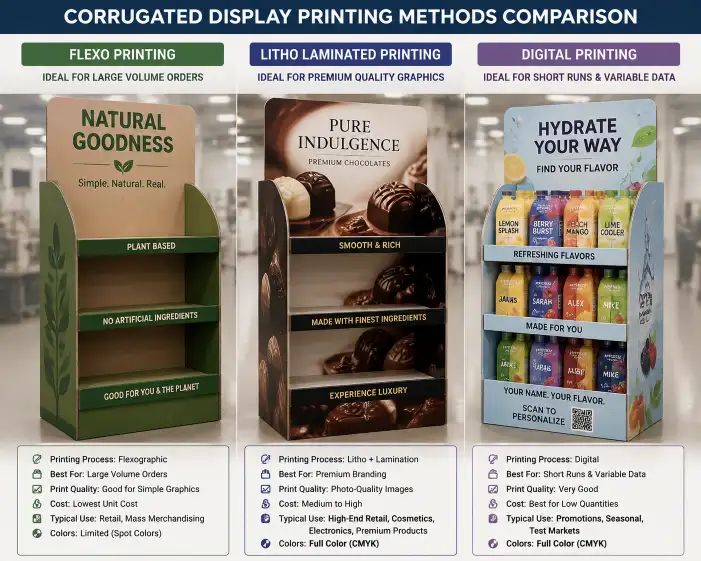
The printing method has a significant impact on MOQ because each method requires different setup and plate costs.
| Printing Method | Typical MOQ | Setup Cost | Per-Unit Cost at Low Volume | Per-Unit Cost at High Volume |
|---|---|---|---|---|
| Flexo (1–2 colors) | 500–1,000 units | $50–$150 per color | $0.30–$0.60 | $0.15–$0.30 |
| Flexo (3–4 colors) | 1,000–2,000 units | $50–$150 per color | $0.60–$1.20 | $0.30–$0.60 |
| Litho laminated | 500–1,500 units | $200–$500 | $0.80–$1.50 | $0.40–$0.80 |
| Digital printing | 50–300 units | $0–$50 | $1.00–$3.00 | $0.60–$1.50 |
| Screen printing | 200–500 units | $100–$300 per color | $0.50–$1.00 | $0.30–$0.60 |
When to Choose Each Printing Method Based on MOQ
| Your Order Quantity | Recommended Printing Method | Why |
|---|---|---|
| 50–200 units | Digital printing | No plate cost, low MOQ, higher per-unit cost |
| 200–500 units | Flexo (1–2 colors) or digital | Flexo if simple colors; digital if full-color |
| 500–1,500 units | Flexo (1–4 colors) or litho laminated | Flexo for simple, litho for photo-quality |
| 1,500–5,000 units | Flexo or litho laminated | Best price-to-quality balance |
| 5,000+ units | Flexo or litho laminated | Lowest per-unit cost, highest setup cost |
For more on printing methods and their cost implications, see our custom display printing and finishing methods guide.
MOQ by Material and Complexity
Board Grade and MOQ
| Material | Typical MOQ | Reason |
|---|---|---|
| E flute (single-wall) | 500–1,000 units | Common board, widely available |
| B flute (single-wall) | 500–1,000 units | Common board, widely available |
| C flute (single-wall) | 300–1,000 units | Most common, lowest material MOQ |
| BC flute (double-wall) | 500–1,500 units | Less common, higher material minimum |
| ECT 23–29 (light-duty) | 300–1,000 units | Standard grades, readily available |
| ECT 32–44 (heavy-duty) | 500–1,500 units | Specialty grades, larger paper orders |
| ECT 48+ (extra heavy-duty) | 1,000–2,000 units | Limited availability, high material minimum |
| SBS liner (premium print surface) | 1,000–2,000 units | Premium material, higher minimum order from mill |
Design Complexity and MOQ
| Complexity Factor | Low Complexity | High Complexity | MOQ Impact |
|---|---|---|---|
| Number of die-cut pieces | 1–2 pieces | 5–10+ pieces | +20–50% MOQ |
| Number of colors | 1–2 flexo colors | 4-color process + PMS | +30–100% MOQ |
| Number of shelves | 0–1 shelves | 3–5 shelves | +20–40% MOQ |
| Special finishes | None | Lamination, spot UV, foil stamping | +20–50% MOQ |
| Hardware requirements | None | Metal brackets, plastic clips, rivets | +10–30% MOQ |
| Assembly complexity | Flat pack, no assembly | Pre-assembled, glued | +20–40% MOQ |
MOQ by Factory Type
| Factory Type | Typical MOQ Range | Per-Unit Cost at Low MOQ | Per-Unit Cost at High MOQ | Best For |
|---|---|---|---|---|
| Small workshop | 100–500 units | Higher (premium for small runs) | Competitive | Low volume, simple designs |
| Medium factory | 300–1,000 units | Moderate | Very competitive | Standard volumes, balanced pricing |
| Large factory | 1,000–5,000 units | High (disadvantaged at low volume) | Best pricing | High volume, complex designs |
| Export-focused | 500–2,000 units | Moderate | Competitive | International buyers, mid-volume |
| Digital-print specialist | 50–300 units | Premium per unit | N/A (limited to small runs) | Prototypes, test markets, small brands |
Volume Pricing Tiers
Understanding how pricing changes with volume helps you make cost-effective decisions about order quantity.
Typical Pricing Curve by Display Type
| Display Type | 200 units | 500 units | 1,000 units | 2,500 units | 5,000 units |
|---|---|---|---|---|---|
| Simple PDQ tray | $2.50–$4.00 | $1.50–$2.50 | $1.00–$1.80 | $0.80–$1.40 | $0.60–$1.00 |
| Counter display | $4.00–$7.00 | $2.50–$4.50 | $1.80–$3.50 | $1.40–$2.50 | $1.00–$2.00 |
| Floor display (2 shelves) | $8.00–$14.00 | $5.00–$9.00 | $3.50–$6.50 | $2.80–$5.00 | $2.00–$4.00 |
| Floor display (4 shelves) | $12.00–$20.00 | $7.00–$13.00 | $5.00–$9.00 | $4.00–$7.00 | $3.00–$5.50 |
| Dump bin | $3.00–$5.00 | $2.00–$3.50 | $1.50–$2.50 | $1.20–$2.00 | $0.90–$1.50 |
| Pallet display (no product) | $8.00–$15.00 | $5.00–$10.00 | $3.50–$7.00 | $2.50–$5.00 | $2.00–$4.00 |
| Standee / cutout | $3.00–$6.00 | $2.00–$4.00 | $1.50–$3.00 | $1.00–$2.00 | $0.80–$1.50 |
Price Breakpoints: Where the Biggest Savings Occur
| Quantity Range | Typical Price Reduction | Why |
|---|---|---|
| 200 → 500 units | 30–40% reduction | Tooling cost spread over more units |
| 500 → 1,000 units | 20–30% reduction | Material buying power improves |
| 1,000 → 2,500 units | 15–25% reduction | Production efficiency, less setup time per unit |
| 2,500 → 5,000 units | 10–20% reduction | Bulk material pricing, optimized production scheduling |
| 5,000+ units | 5–15% per doubling | Marginal improvements only |
The biggest price drop happens between 200 and 500 units, where the tooling cost per unit decreases significantly. If your budget allows, ordering at least 500 units gives you the best value per dollar.
Strategies for Reducing MOQ
If a factory's MOQ is higher than your budget allows, several strategies can help you reduce it.
| Strategy | How It Works | Typical MOQ Reduction | Trade-off |
|---|---|---|---|
| Accept digital printing | No plate cost, lower setup | 500 → 100 units | Higher per-unit cost, lower print quality |
| Simplify the design | Fewer die-cut pieces, fewer colors | 1,000 → 500 units | Less complex display structure |
| Use standard board grade | Avoid specialty ECT or SBS liner | 1,500 → 500 units | May not suit premium products |
| Combine multiple SKUs in one run | Share tooling across similar designs | 1,000 per SKU → 500 per SKU | Designs must be similar |
| Order flat pack instead of assembled | Less labor, lower setup cost | 1,000 → 500 units | Retail staff must assemble |
| Accept longer lead time | Factory can fit your order into slack production | 1,000 → 500 units | 2–4 weeks longer wait |
| Pay a small-run surcharge | Factory adds a fee to cover setup | 1,000 → 300 units | 20–40% higher per-unit cost |
Negotiation Script: Asking for a Lower MOQ
When negotiating MOQ with a factory, use this approach:
- Acknowledge the standard MOQ: "I understand your standard MOQ is 1,000 units."
- Explain your situation: "This is a test launch for a new product, and we need to start with 300 units to validate the market."
- Offer a compromise: "We are willing to pay a 25% surcharge on the per-unit price to cover the lower quantity."
- Commit to future orders: "If the test performs well, we will order 2,000+ units for the next round."
- Confirm in writing: "Can you confirm the 300-unit MOQ at $X.XX per unit with the surcharge included?"
Most factories will accept a lower MOQ with a surcharge if the buyer is transparent about the situation and commits to future volume.
Low MOQ Options for Small Brands
For small brands, startups, and test-market launches, several options exist for ordering displays at low minimum quantities.
| Option | MOQ | Per-Unit Cost | Lead Time | Best For |
|---|---|---|---|---|
| Digital-print specialist | 50–200 units | $2.00–$5.00 | 2–3 weeks | Prototypes, very small runs |
| Small workshop (China) | 200–500 units | $1.50–$4.00 | 3–5 weeks | Simple displays, budget-friendly |
| Medium factory with surcharge | 300–500 units | $2.00–$6.00 | 4–6 weeks | Medium complexity, test launch |
| Local printer (US/Europe) | 50–200 units | $5.00–$15.00 | 1–2 weeks | Urgent orders, domestic sourcing |
| Template-based display | 100–300 units | $1.00–$3.00 | 2–4 weeks | Standard sizes, no custom die |
Best Low-MOQ Display Types for Small Brands
| Display Type | Low MOQ? | Typical Cost at 300 Units | Why It Works for Small Brands |
|---|---|---|---|
| Dump bin | Yes | $1.50–$3.00 per unit | Simple design, no shelves, low tooling cost |
| PDQ tray | Yes | $1.00–$2.50 per unit | Small footprint, simple die-cut |
| Counter display | Yes | $2.50–$5.00 per unit | Small size, lower material cost |
| Standee / cutout | Yes | $1.50–$3.50 per unit | Single-piece, no assembly |
| Simple floor display | Moderate | $4.00–$8.00 per unit | Higher cost but more impact |
| Complex floor display | No | Not cost-effective at low volume | High tooling cost per unit |
| Pre-filled pallet display | No | Not available at low MOQ | Requires product filling setup |
FAQ
What is the typical MOQ for a custom cardboard display?
The typical MOQ for custom cardboard displays ranges from 200 to 2,000 units, depending on the display type, printing method, and factory. Simple displays like dump bins and PDQ trays have the lowest MOQ (200–500 units). Complex floor displays with multiple shelves and full-color litho lamination have higher MOQ (500–2,000 units).
Can I order 100 units of a custom cardboard display?
Yes, but you will need to use a digital printing specialist or a small workshop that accepts low-MOQ orders. Expect to pay 30–50% more per unit compared to a 500-unit order. For a simple dump bin or counter display, 100 units is feasible at $3.00–$6.00 per unit.
Why do some factories have higher MOQ than others?
Larger factories have higher fixed costs per production run — more expensive equipment, larger material minimums, and more overhead. They need higher quantities to make the run profitable. Small workshops have lower overhead and can accept smaller runs, but they may lack the equipment for complex displays or consistent quality.
Does MOQ apply per design or per SKU?
MOQ applies per design. If you have three different display designs, each design has its own MOQ. However, if the designs are similar (same size, same material, same printing method), some factories will allow you to combine them in one production run with a shared MOQ.
How can I lower the MOQ for my display order?
The most effective strategies are: accept digital printing instead of flexo, simplify the design to reduce tooling pieces, use standard board grades, and offer to pay a small-run surcharge. Committing to a larger follow-up order also helps factories justify a lower initial MOQ.
What is the MOQ for a pre-filled pallet display?
Pre-filled pallet displays typically have the highest MOQ — 500–2,000 units minimum. This is because the display must be filled with product at the factory, which requires additional labor and coordination. For small brands, pre-filled pallet displays are usually not cost-effective below 1,000 units.
Does the MOQ include the tooling cost?
No — tooling cost is typically quoted separately as a one-time fee. The MOQ applies to the printed and assembled display units. Tooling costs $200–$800 depending on complexity and is paid once per design, regardless of how many reorders you place.
Can I reorder the same display at a lower MOQ?
Yes — once the tooling is paid for, the MOQ for reorders is usually lower because the setup cost is reduced. A typical reorder MOQ is 50–70% of the initial MOQ. For example, if the initial MOQ was 1,000 units, the reorder MOQ might be 500–700 units.
What is the MOQ for a prototype or sample?
Most factories charge a sample fee of $50–$300 for a prototype, which is separate from the production MOQ. Samples are typically produced using digital printing or manual die-cutting, so they do not count toward the production MOQ. The sample fee is usually deducted from the tooling cost if you proceed with a production order.
Should I order at the MOQ or above it?
Ordering at or slightly above the MOQ is the most cost-effective option for most buyers. The per-unit price drops significantly between 200 and 500 units, but the savings diminish beyond 1,000 units. The Corrugated Packaging Alliance publishes industry data on corrugated production economics that can help you understand the relationship between volume and unit cost.