Food and snack products dominate Costco's sales floor. From bulk snack packs to specialty food items, most food products at Costco are displayed on pallet-based displays. For vendors supplying food products to Costco, understanding how to design a Costco food pallet display that meets both structural requirements and food-specific retail needs is essential.
A food pallet display for Costco must handle higher weight loads than standard displays, accommodate different packaging formats (bags, boxes, pouches), maintain stability as customers remove products, and comply with Costco's strict GMA pallet and labeling standards.
This guide covers everything food vendors need to know about designing Costco-compliant pallet displays for snack, food, and edible products.
Why Food Displays Are Different at Costco
Costco operates on a pallet-based retail model. Most food products are sold directly from the pallet display, not from shelves. This creates specific challenges for food vendors:
- Higher weight — Food products are dense. A single pallet display can hold 500–1,500 lbs of product
- Mixed packaging — Bags, boxes, pouches, and jars each require different tray and slot designs
- Partial sell-through — Customers remove products unevenly. The display must remain stable and attractive as it empties
- Expiry management — Food displays must support FIFO (first-in, first-out) loading
- Moisture and hygiene — Corrugated displays in food environments need moisture-resistant materials and clean construction
For an overview of how Costco displays work, see our guide to Costco-style club store displays. For detailed Costco specifications, read Costco Pallet Display Requirements: Complete Specs for Vendors.
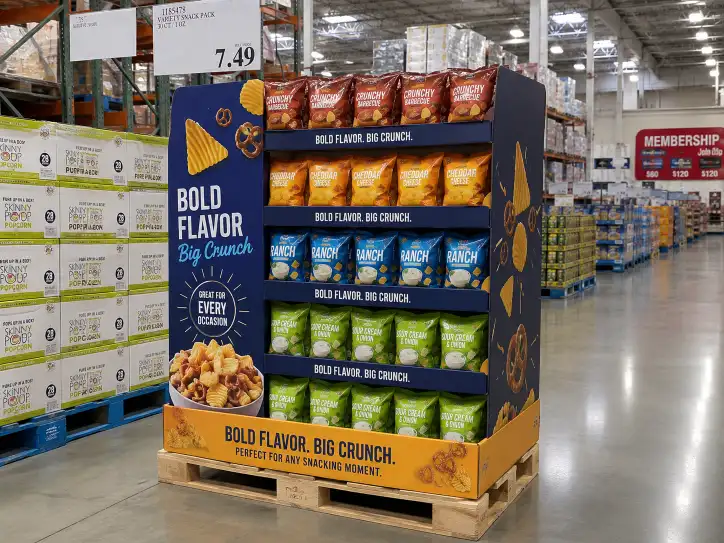
GMA Pallet Requirements for Food Displays
Every Costco food pallet display must be built on a standard GMA pallet. Costco does not accept custom pallet sizes for food products.
| Specification | Requirement |
|---|---|
| Pallet size | 48 × 40 inches (1219 × 1016 mm) |
| Forklift entry | 3.5 inches (89 mm), four-way access |
| Overhang | Zero — no product or display beyond pallet edge |
| Pallet base height | 5–6 inches (13–15 cm) — included in total display height |
| Maximum display height | 72–84 inches (183–213 cm), confirmed with buyer |
Half Pallet Options for Food
For smaller food product lines or endcap positions, Costco accepts half pallet displays:
- 48 × 20 inches — half-length GMA
- 24 × 40 inches — half-width GMA
Half pallet displays are commonly used for specialty foods, new product trials, and seasonal snack promotions.
For the full GMA pallet specification, see our Costco Pallet Display Requirements guide.
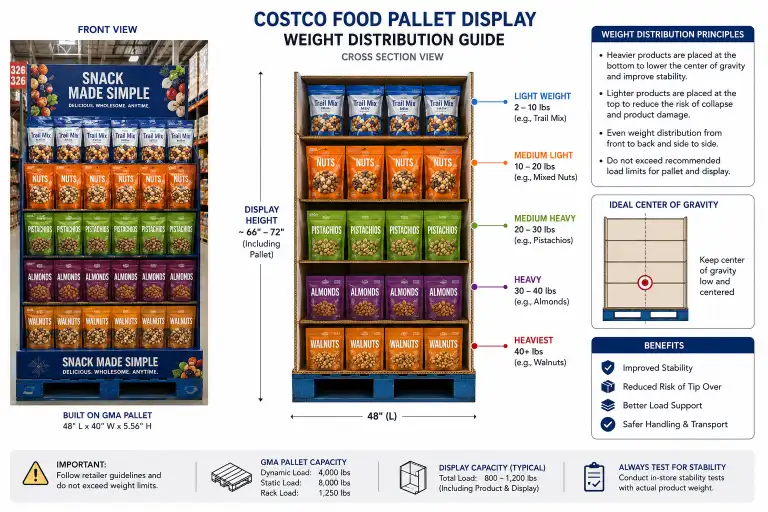
Weight and Structural Design for Food Pallet Displays
Food products are heavy. A Costco snack display loaded with bulk chip bags or multi-pack snacks can weigh several hundred pounds. The structural design must account for this from the start.
Weight Guidelines
| Product Type | Typical Weight per Display | Recommended Board Grade |
|---|---|---|
| Light snacks (chips, popcorn, crackers) | 300–600 lbs | B-flute, ECT 28–32 lbs/in |
| Medium food (cereal, granola bars, coffee) | 600–900 lbs | B-flute or C-flute, ECT 32+ |
| Heavy food (pet food, beverage multipacks) | 900–1,500 lbs | BC-flute double-wall, ECT 48+ |
| Bulk liquid (oil, sauce, drinks) | 1,200–2,500 lbs | Double-wall or triple-wall |
Weight Distribution Rules
- Heaviest items at the bottom — The lowest trays should hold the heaviest products
- Layer pads between tiers — Corrugated sheets between product layers distribute weight evenly
- Even pallet loading — Weight must be spread across the full 48×40 inch pallet surface
- Tray reinforcement — Trays holding heavy food products may need double-wall reinforcement
For material selection and structural testing, see our PRODUCTION page.
Tray Design for Snack and Food Products
The tray design determines how well food products fit, how easy they are to remove, and how stable the display remains as products sell.
Tray Types for Food Displays
| Tray Type | Best For | Considerations |
|---|---|---|
| Standard corrugated tray | Boxed foods, multipacks | Cost-effective, recyclable |
| Reinforced double-wall tray | Heavy bagged products | Prevents sag between refills |
| Divided tray | Multiple SKUs in one display | Separates product varieties |
| Slanted front tray | Self-serve snacks, grab-and-go | Improves product visibility |
| Full-depth tray | Tall packages, pouches | Maximum product per tier |
Food Packaging Fit
Different food packaging formats require different tray dimensions:
- Bags (chips, snacks) — Wide, shallow trays that allow easy grabbing. Bag height determines tray depth
- Boxes (cereal, crackers) — Tight fit trays that keep boxes upright. Minimum 1/3 of box height above tray edge
- Pouches (coffee, dried fruit) — Narrow slot trays that prevent pouches from falling over
- Jars (salsa, sauce) — Reinforced trays with individual compartments to prevent glass-to-glass contact
Tray Load Limits
| Tray Configuration | Maximum Load |
|---|---|
| Standard B-flute tray | 15 lbs (7 kg) |
| Reinforced double-wall tray | 30 lbs (14 kg) |
| Heavy-duty tray with support | 50+ lbs (23 kg) |
For tray design and structural options, see our PALLET DISPLAY product page.
Popular Snack and Food Categories for Costco Displays
Costco carries a wide range of food categories, each with specific display requirements. Understanding these helps vendors design displays that match Costco's expectations.
Snacks
Snack products are the most common category on Costco pallet displays. Chip bags, popcorn tins, nut containers, and cracker boxes all need different tray configurations.
- Design tip: Use shallow, wide trays for bagged snacks. Customers need to see and grab individual bags easily
- Weight consideration: Chip bags are lightweight but bulky. Focus on tray depth and display stability
Beverages
Beverage displays at Costco are among the heaviest. Water bottles, soft drinks, energy drinks, and coffee multipacks require reinforced structures.
- Design tip: Bottom tiers must use double-wall board. Distribute weight evenly across the pallet
- Moisture protection: Use moisture-resistant adhesive for beverage displays
Coffee and Tea
Coffee and tea products are frequently displayed at Costco in pallet displays. Bagged coffee, pod multipacks, and tea variety boxes each have different packaging shapes.
- Design tip: Pouch-style coffee needs narrow slot trays. Boxed coffee pods work well in standard tray configurations
Candy and Confectionery
Candy displays at Costco are popular for seasonal promotions. Gift packs, variety boxes, and bulk candy bags are common.
- Design tip: Seasonal candy displays benefit from printed pallet skirts and header cards for visual impact
Health Foods and Supplements
Protein bars, vitamin packs, and health food products are growing categories at Costco. These products are typically boxed and uniform in size.
- Design tip: Standard tray configurations work well. Focus on clear product visibility and easy restocking
For a full range of display options for food products, see our COSTCO DISPLAYS page.
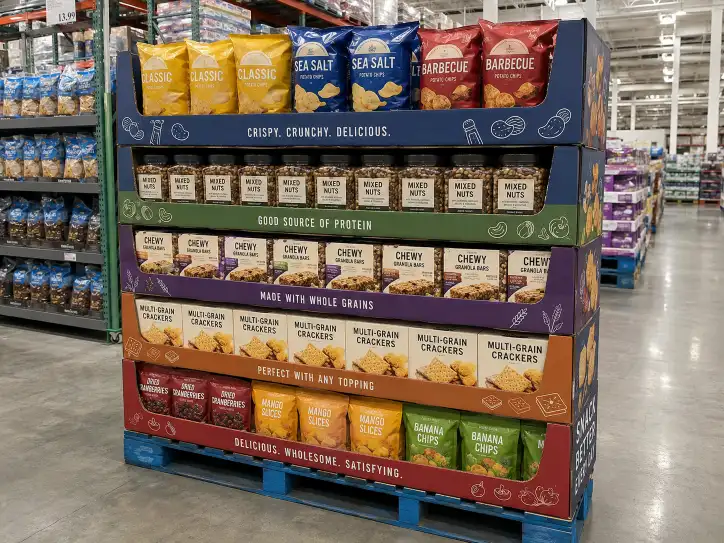
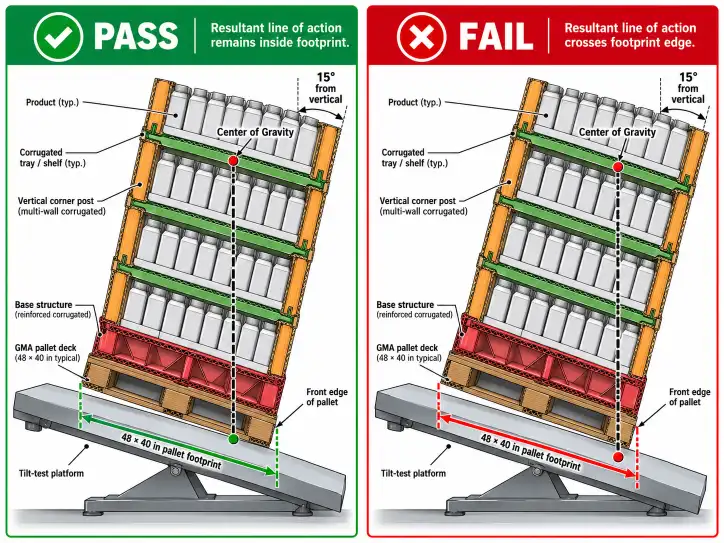
Partial Sell-Through: Keeping Food Displays Stable
Food displays at Costco experience uneven product removal. A display that looks stable when full can become unstable after 30% of the product is sold.
Why Partial Sell-Through Matters for Food
- Lightweight packaging — Chip bags and cereal boxes weigh very little individually. As products are removed, the display becomes top-heavy
- Irregular removal — Customers take products from the front and top first, creating uneven weight distribution
- Visual appearance — A half-empty display that looks messy discourages further purchases
Design Strategies
| Strategy | How It Works |
|---|---|
| Tiered product removal | Design trays so products at the front sell first, keeping the back rows full |
| Gravity feed trays | Products slide forward as front items are removed |
| Dividers between SKUs | Prevents mixing and keeps each section organized |
| Lower center of gravity | Place heavier products lower, lighter products on top |
| Test at 30%, 50%, 70% depletion | Always test the display at partial fill levels before production |
Labeling and Compliance for Food Displays
Food displays at Costco require the same labels as any Costco pallet display, plus additional food-specific considerations.
Required Labels
| Label | Purpose | Food-Specific Note |
|---|---|---|
| GS1-128 pallet label | Receiving and tracking | Include lot/batch number |
| Carton content label | SKU and quantity | Include expiry date range |
| Retail price label | Shelf-ready pricing | Member price required |
| Nutrition label | Consumer information | Required on individual product, not display |
| Country of origin | Customs compliance | "Made in China" or applicable |
| Handling labels | Transit protection | "Keep Dry" for moisture-sensitive food |
Food-Specific Compliance
- FIFO loading — Products with earlier expiry dates must be loaded first (closest to customer)
- Barcode verification — Scan each product barcode during co-packing to confirm correct SKU
- Moisture protection — Use moisture-resistant adhesives on trays holding beverages or refrigerated items
- Desiccant packs — Include in sealed containers for high-humidity sea freight routes
For labeling standards, see our SAMPLING page and confirm label artwork with your Costco buyer before production.
Buyer Checklist for Costco Food Pallet Displays
| Check Item | Status | Notes |
|---|---|---|
| GMA pallet 48×40 in | ☐ | Confirm exact dimensions |
| Height within Costco limit | ☐ | Include pallet base |
| Board grade meets ECT | ☐ | Based on total product weight |
| Tray type matches product format | ☐ | Bags, boxes, pouches, or jars? |
| Tray reinforcement for heavy items | ☐ | Double-wall where needed |
| Partial sell-through test done | ☐ | Test at 30%, 50%, 70% |
| Weight distribution plan | ☐ | Heaviest at bottom |
| Pre-filled packing confirmed | ☐ | Preferred by Costco |
| FIFO loading plan | ☐ | For products with expiry dates |
| GS1-128 labels on 2 sides | ☐ | Approved by buyer |
| Moisture protection | ☐ | For beverage or sea freight |
| Sample approved with real product | ☐ | Test with actual food packaging |
Conclusion
Designing a Costco food pallet display requires more than just meeting GMA pallet dimensions. Food products have unique weight, packaging, and stability requirements that affect every part of the display design — from board grade selection to tray configuration to partial sell-through testing.
For food vendors entering Costco, the most important steps are: confirm the product weight and packaging format before designing the tray layout, test the display at partial fill levels, and ensure labeling includes food-specific information like batch numbers and expiry dates.
If you are planning a food display project for Costco, start with the COSTCO DISPLAYS product page and review the Costco Pallet Display Requirements guide for complete specifications. For a comparison of display requirements across club stores, read our club store display requirements article.
FAQ
What is a Costco food pallet display?
A Costco food pallet display is a corrugated display unit built on a standard GMA pallet base (48×40 inches), designed to hold food and snack products for sale at Costco warehouse clubs.
What size pallet does Costco use for food displays?
Costco uses standard GMA pallets — 48 × 40 inches. Half-pallet options (48×20 in or 24×40 in) are accepted for smaller food product lines and endcap positions.
What board grade is needed for food pallet displays?
It depends on product weight. Light snacks need B-flute with ECT 28–32. Heavy food products need BC-flute double-wall with ECT 48+. Always confirm board grade with your factory based on total product weight.
How do I design trays for bagged snacks?
Use wide, shallow trays that allow customers to easily see and grab individual bags. Tray depth should match bag height. Test the tray with actual product before production.
Do food displays need special labeling at Costco?
Food displays need the same GS1-128 labels as all Costco pallet displays, plus lot/batch numbers and expiry date information on carton content labels. FIFO loading is required for products with expiry dates.
What is partial sell-through testing?
Partial sell-through testing means checking that the display remains stable and visually acceptable when 30%, 50%, and 70% of the product has been removed. This is critical for food displays where products are removed unevenly.
Can the same food display work for Costco and Sam's Club?
The structural requirements are similar, but labeling, pricing, and compliance rules differ. Always check each retailer's requirements separately, especially for food products with expiry date management.
What food categories are most common on Costco pallet displays?
Snacks, beverages, coffee, candy, health foods, and pet food are the most common food categories displayed on Costco pallet displays. Each has specific tray and structural requirements.