If you are preparing a club-store retail program, the pallet display is not only a display. It is a shipping unit, a warehouse unit, and a selling unit at the same time. That is why club-store projects go wrong in a different way from standard retail displays. The first visible problem may show up on the sales floor, but the real mistake often starts much earlier, when the team approves graphics before it locks footprint, load pattern, pack-out, and transit logic.
That is the real reason a Sams Club and Costco pallet display deserves its own buying guide. Costco and Sam’s Club both use warehouse-club logic, but they do not evaluate every display in exactly the same way. Both expect strong structural discipline, good shopability, and efficient handling. Both also put pressure on the display long before members start picking products off the front. If the footprint is wrong, the load is unstable, or the display depends on unrealistic store labor, a good-looking concept can still become an expensive rollout.
This guide is written for brand managers, retail buyers, and procurement teams who need a practical path from concept to approval. It covers footprint, pallet direction, materials, tray strategy, testing, shipping, and the most common mistakes that slow down club-store projects.
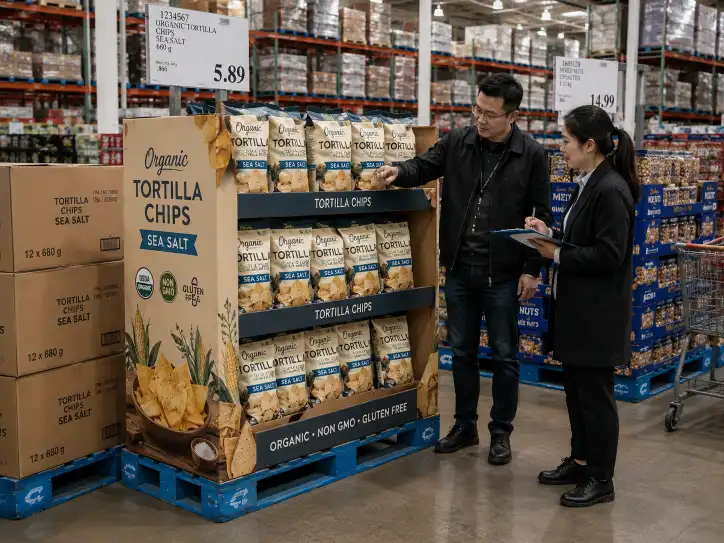
Why Club-Store Pallet Displays Need a Different Buying Mindset
A supermarket floor display and a club-store pallet display may look similar from a distance. In practice, they live in different operating systems. A standard floor display often has more room for store-level correction. A club-store pallet display has less tolerance. It has to survive factory packing, transportation, distribution center handling, possible double stacking, and fast in-store deployment without losing its structure or its selling face.
That is why the first question should not be, “Can we make it look more premium?” The first question should be, “What does this unit need to survive before it starts selling?” Once you ask that, the order of decisions changes. Footprint comes before artwork. Product weight comes before decorative features. Pack-out logic comes before photography.
If you are still comparing structures, start with our pallet display solutions page first. It gives the right structural context before you narrow the conversation to Costco or Sam’s Club execution.
Costco and Sam’s Club Start From Similar Footprints, but the Operational Details Are Not Identical
On the surface, both retailers work from the same basic pallet language: 48 inch by 40 inch club-store style pallet footprints, no casual overhang, and a strong focus on handling integrity. Publicly available Costco packaging specifications and Sam’s Club structural packaging standards both point buyers back to the same operational truth: if the display footprint, total height, or load behavior is weak, the entire project becomes harder to approve and harder to execute.
Costco’s public packaging and handling guidance, together with public mirrors of its structural packaging specifications, emphasizes a 48 by 40 pallet system, a recommended display-ready footprint slightly inside that limit, no overhang, and a total load height that typically should not exceed 58 inches including pallet height. The same public Costco material also reinforces the need for display-ready handling, stable unitization, and proper packaging graphics for large-item programs.
Sam’s Club’s published structural packaging standards are more explicit about multiple club-store operating scenarios. Its public documentation covers full 48 by 40 nine-block pallets, underhang limits, different zone heights, double-stack expectations in the supply chain, and style-based packaging routes such as stacking trays and full-layer tray systems. In practical terms, Sam’s Club tends to expose more of the engineering logic directly in its public PDF.
| Checkpoint | Costco | Sam’s Club | Why Buyers Should Care |
|---|---|---|---|
| Base footprint | 48" x 40" max, with public guidance recommending a slightly reduced working footprint | 48" x 40" full 9-block pallet for standard club programs | Footprint errors create problems before artwork matters |
| Overhang | No overhang | No overhang | Overhang turns into handling risk fast |
| Height logic | Public structural guidance commonly references a 58" total height limit including pallet | Public standards vary by placement zone | The right height depends on the actual retail position |
| Handling pressure | Strong emphasis on transport, warehouse handling, and display-ready integrity | Strong emphasis on double stacking, tray performance, and club-ready execution | Good-looking designs still fail if handling logic is weak |
| Structure style guidance | More generalized in public documents | More style-specific in public documents | Sam’s Club often gives buyers a more explicit engineering checklist |
Start Every Project by Deciding How the Display Will Actually Sell
One of the biggest planning mistakes is using “pallet display” as if it describes only one retail behavior. It does not. In club-store work, you usually need to choose between three execution models before the sample stage means anything:
- sell directly from the pallet after outer protection is removed
- arrive semi-staged, with light in-store preparation
- use the pallet only as a transport base and rebuild the selling face in store
That choice changes the whole project. A direct sell-from-pallet unit must look correct the moment the wrap, cap, and protection are removed. A semi-staged unit can accept some retail handling, but not much confusion. A rebuild-in-store unit gives more structural flexibility, but it transfers complexity to the store team. In club-store environments, that trade-off needs to be very intentional.
If your buyer conversation is already moving toward channel-specific requirements, link this article naturally to our Costco display projects and Sam’s Club display programs pages. Those pages should act as the next step once the reader knows which club channel they are serving.
Structure Comes Before Decoration in Club-Store Engineering
A warehouse-club display may be visually simple, but structurally it is rarely casual. The pallet base, tray walls, dividers, front lips, corner supports, top protection, and any load-bearing fillers all need clearly assigned jobs. When a project fails, it is often because one part was asked to do the wrong work.
For example, a divider should not quietly become a compression member unless it was designed for that job. A decorative filler should not carry structural responsibility just because it fills visual space. A front lip that looks fine in a rendering may collapse after repeated refill if it was sized only for appearance instead of product pressure.
Sam’s Club’s public style-based packaging guidance is useful here because it shows this division of responsibility more clearly. Public versions of its standards for stacking tray systems and full-layer tray systems point buyers toward minimum board performance, lip behavior, shoppability, and tray style logic for products that cannot self-support well.
Costco’s public material is different in tone, but it points to the same conclusion. Its public structural guidance puts real weight on top caps, layer sheets, rigid corner protection, stretch-wrap discipline, and display-ready integrity. That means the retailer is looking past the printed shell and into the way the unit behaves under load.
For a buyer, the right question is not, “Can you make this stronger?” The better question is, “Which part is carrying which risk?” That question gets more useful answers.
Pack-Out Is Where Many Club-Store Projects Win or Lose Margin
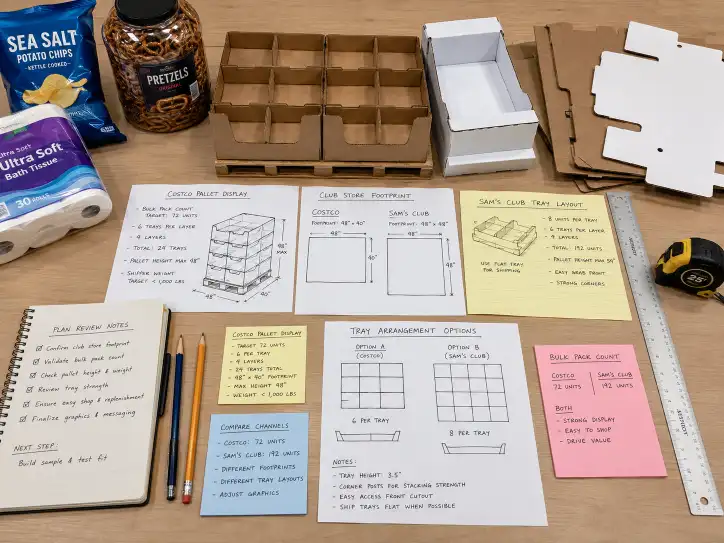
Once the footprint is fixed, the next high-value decision is pack-out. This is the part teams often delay because it feels secondary. It is not secondary. It is where freight cost, setup logic, warehouse handling, and in-store recovery start to connect.
At a minimum, you should define:
- units per display
- trays per layer
- layers per pallet
- whether the product is self-supporting or tray-dependent
- whether the display is flat-pack, semi-assembled, or pre-filled
- whether the store will sell directly from the tray system
Buyers often want to skip ahead to the quotation. That usually makes the quotation less useful. A factory can give more accurate structural advice when the project is described in real pallet terms, not only in brand terms.
Our sampling process page already supports three practical sample packing routes, while our shipping support page helps connect those decisions to the export side. That is the exact internal-link path this article should create.
Transit Testing Is Not a Formality for Club-Store Programs
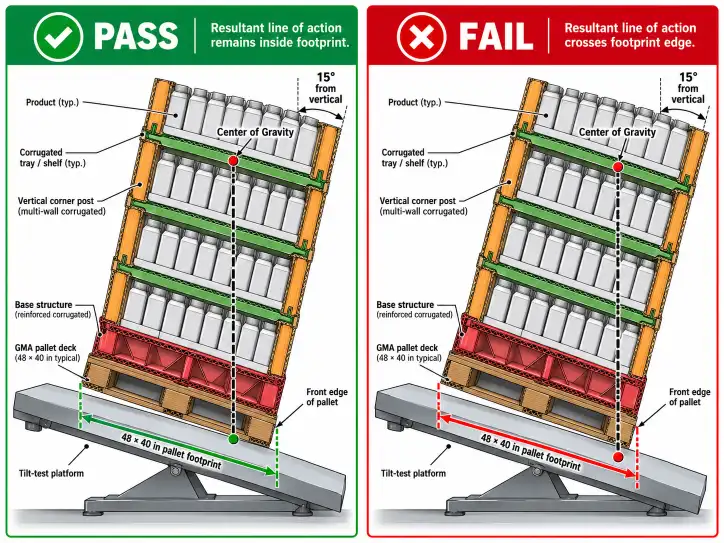
In standard retail work, some teams treat transit testing like a late-stage comfort check. In club-store work, that is too casual. Public Sam’s Club packaging guidance is clear that structural packaging changes, new programs, and high-risk packaging formats should be validated through formal transit testing, including ISTA-based routes, with production-equivalent components. The standards also point buyers toward stability and decay-style testing logic, which is exactly what club-store projects need.
Costco’s public structural guidance uses a different documentation style, but it is still pushing the same engineering direction. The public material references warehouse handling, long-distance transit, humidity exposure, dynamic loading, and unitization controls such as stretch wrap, layer sheets, and rigid corner protection. In other words, Costco is not evaluating only whether the display can be built. It is evaluating whether it can survive the real supply chain.
That is why your sample should never prove only one moment. It should prove the whole route.
A proper club-store sample review should include:
- real product load, not empty mock packs
- real tray counts and pallet height
- real protective components
- a clear unpack sequence
- sell-through simulation
- some form of stability or decay verification before mass production
Good samples tell the truth early. That is their job.
Design for Week Two, Not Only for Launch Day
This is where many pallet displays look impressive in the sample room and disappointing in the store. On day one, everything is full. The tray fronts are aligned. The best-selling SKU has not disappeared yet. The retailer has not refilled one side faster than the other. Nothing has sagged. That version is not the real test.
The real test comes later.
Sam’s Club’s publicly described stability and decay testing logic is valuable because it mirrors what happens in real retail after the first selling cycle. Products are depleted unevenly. Lower trays carry odd loads. A front lip sees repeated pressure. A corner takes damage during ordinary handling. A system that looked stable when full may start leaning or opening once the product rhythm changes.
That is why buyers should review a club-store display under partial sell-through conditions before final approval. Remove product. Refill it imperfectly. Look at the display from normal member distance. If it still looks sellable, the engineering is closer to right. If it already looks tired, the structure needs to change before production begins.
Materials, Board Grades, and Flute Choices Should Be Discussed by Component
One of the most common weak points in factory-buyer communication is the phrase “we will use stronger material.” That sounds helpful, but it is too broad to manage a club-store project properly.
What matters is which material goes where.
Tray walls, dividers, lips, layer sheets, top caps, wraps, filler parts, and outer shrouds do not all carry the same risk. Sam’s Club’s public style-based guidance is helpful again here because it points buyers toward specific corrugated expectations by structural style instead of treating the whole display as one board choice. Public references to 44 ECT and related structure-level expectations appear in those style-based materials for certain tray systems.
Costco’s public general guidance is less style-specific, but it reinforces the same discipline by specifying when layer sheets, caps, corner protection, and unitization details matter. So the practical lesson is the same for both retailers: do not ask your supplier for a stronger display. Ask which component needs a higher board performance and why.
For broader corrugated background and standardization language, the FEFCO shelf-ready packaging guidance, the FEFCO code reference, and the Fibre Box Association corrugated overview are useful external references for technical discussions.
What Club-Store Buyers Should Ask Before Approving the Quote
Before the quotation moves forward, ask your supplier these questions in clear operational language:
- Is this design meant to sell directly from the pallet, or does it assume store rebuilding?
- What is the final working footprint after safety margin is applied?
- Which component carries the highest structural risk during transport?
- What part of the display is most likely to fail after partial sell-through?
- Which sample configuration will be used for testing, and will it match production components?
- What shipping format is assumed: flat-pack, semi-assembled, or pre-filled?
Those questions are better than “Can you make it cheaper?” because they tell you whether the supplier understands the actual project.
Common Mistakes That Slow Down Costco and Sam’s Club Projects
- Starting with artwork instead of footprint and load
- Using a standard retail floor-display mindset for a club-store pallet unit
- Approving a sample without real product load
- Ignoring partial sell-through behavior
- Assuming stretch wrap will solve structural weakness
- Leaving pack-out undefined until late in the project
- Failing to document unpack sequence and in-store setup clearly
- Quoting “stronger material” without identifying which component needs reinforcement
None of these look dramatic at the start. That is why they are expensive.

How to Choose the Right Supplier for a Club-Store Pallet Display
Not every display supplier is set up for club-store work. The right partner needs to talk comfortably about footprint, tray logic, pre-fill options, export packing, unitization, and testing. If the conversation stays at the level of print finish and general customization, you may be speaking to a supplier that can build displays, but not necessarily one that can manage club-store risk well.
For this kind of program, a reliable supplier should be able to support:
- structural proposal based on retailer path
- clear sample stages
- board and component recommendations by risk area
- pre-production review
- shipping and palletization planning
- approval photos and execution documents before shipment
That is also why this article should naturally feed readers toward our custom cardboard displays, production workflow, and shipping support pages instead of acting like a dead-end blog post.
FAQ
Are Costco and Sam’s Club pallet display requirements exactly the same?
No. They share the same warehouse-club mindset and similar footprint logic, but their public documentation is not written the same way, and Sam’s Club exposes more style-based structural detail in its current public standards.
Can I use a normal supermarket floor display design for a club-store pallet project?
Sometimes as a visual starting point, yes. As an engineering shortcut, no. Club-store displays face heavier handling pressure and stricter pallet logic.
Should I choose flat-pack, semi-assembled, or pre-filled for club-store displays?
That depends on the rollout model. Use the format that fits the retailer workflow, product behavior, freight sensitivity, and setup reality.
Do I need transit testing?
For many club-store programs, yes. Public Sam’s Club guidance explicitly points buyers toward formal testing for relevant packaging changes and new programs, and Costco public guidance also emphasizes real handling and transport performance.
What should my factory provide before final approval?
A useful approval package should include footprint, height, gross weight, units per display, pack-out method, packing photos, and sample confirmation details. Our assembly instructions page is also relevant when setup logic needs to be shown clearly.
Final Buying Direction
A strong Sams Club and Costco pallet display is not defined by how good it looks when it is full. It is defined by how well it survives the full route from factory to distribution center to store to week-two sell-through. That is why the right order of decisions matters so much. Lock the footprint. Define the selling model. Confirm the load behavior. Decide the pack-out. Test the sample honestly. Then move into production.
If your team is still deciding how to structure a club-store project, the next useful step is to prepare a one-page brief with product dimensions, unit weight, target retailer, units per display, preferred shipping format, and whether the display must sell directly from the pallet. That will give your supplier enough real information to build a useful proposal instead of a generic one.
And if the project is already moving, the smartest path is to connect this guide with our Costco display projects, Sam’s Club display programs, sampling process, production workflow, and shipping support pages so the buyer moves forward instead of circling around the same questions.