A brand manager has a product to launch. Before they call the factory, they need to answer one question: what type of display does this product need?
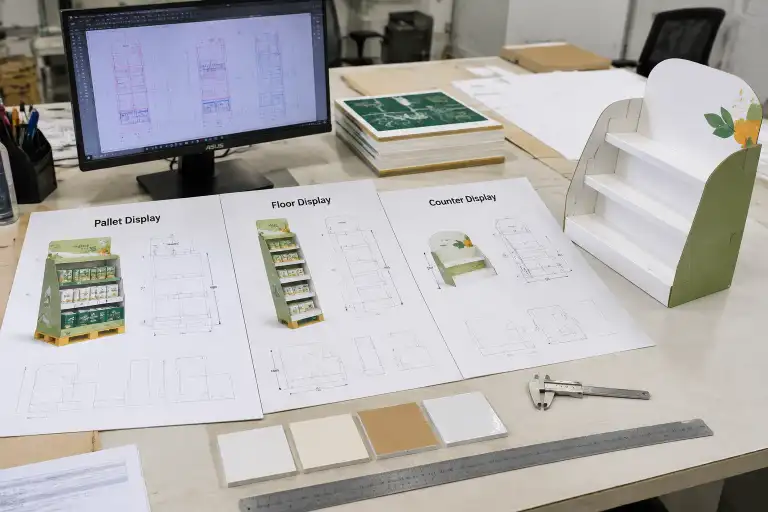
Three formats cover 90% of retail display projects: the pallet display, the floor display, and the counter display. Each solves a different merchandising problem. Each has a different cost profile, retail placement, and product capacity. Choosing the wrong one means either over-spending on capacity you do not need, or under-sizing a display that cannot carry the product volume the retailer expects.
This guide compares the three display types on the factors that matter when you are sourcing from a factory unit cost, retail placement, product capacity, assembly complexity, and program duration. It is written for brand and procurement teams who need to select the right format before they approach a manufacturer. For a broader selection guide covering all display types including sidekicks, dump bins, and pegboard displays, see our cardboard display overview page.
01 The Three Display Formats at a Glance
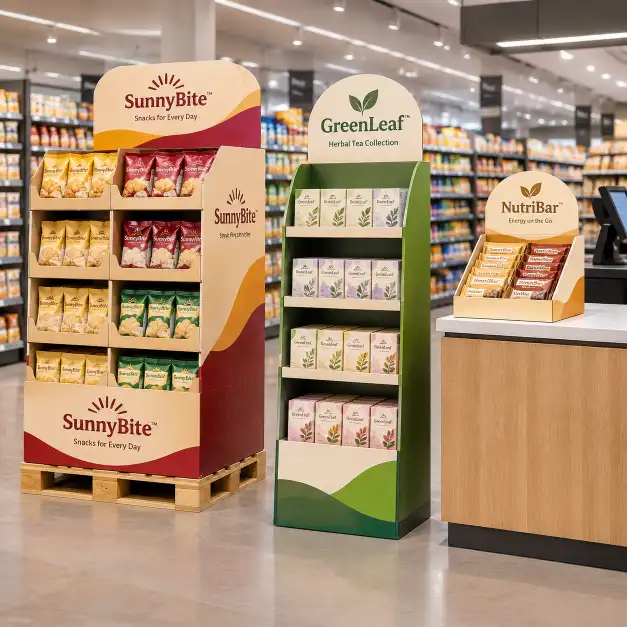
Before comparing the details, it helps to understand what each format is designed to do.
| Display Type | What It Is | Typical Product Capacity | Typical Retail Placement |
|---|---|---|---|
| Pallet Display | A high-capacity display built on or around a pallet footprint, combining a corrugated structure with a pallet base | 100–300+ units per display | Club stores, supermarket power aisles, center floor, endcaps |
| Floor Display | A free-standing corrugated display designed for aisle or endcap placement, not on a pallet base | 20–100 units per display | Aisle endcaps, high-traffic floor areas, promotional zones |
| Counter Display | A compact display placed on a counter, shelf, or checkout area, typically holding a small product assortment | 6–30 units per display | Checkout counters, service counters, shelf tops, impulse zones |
The Core Difference
The pallet display handles the highest volume and sits on the floor. The floor display handles medium volume and also sits on the floor but takes a smaller footprint. The counter display handles small volume and sits on an elevated surface. Each format is designed for a different retail placement, and the retail placement determines which format is right for your product.
02 Unit Cost Comparison
Unit cost is the first question most buyers ask, but the per-unit cost only makes sense when compared against the product volume per display. A lower per-unit cost on a display that holds 200 units is not always the right choice if the retailer only wants 30 units per store.
Cost per Display (Estimated, at 1,000–5,000 Units)
| Cost Factor | Pallet Display | Floor Display | Counter Display |
|---|---|---|---|
| Board cost | $3.00–$8.00 | $1.50–$4.00 | $0.30–$1.50 |
| Print cost (flexo) | $0.80–$2.00 | $0.50–$1.50 | $0.20–$1.00 |
| Structure & assembly | $1.50–$4.00 | $1.00–$3.00 | $0.30–$1.50 |
| Labels & compliance | $0.50–$1.20 | $0.30–$0.80 | $0.10–$0.50 |
| Packing | $1.00–$3.00 | $0.50–$2.00 | $0.20–$0.80 |
| Total (estimate per unit) | $7–$18 | $4–$11 | $1–$5 |
Cost per Product Facing
A more useful comparison is the cost per product facing (the number of products the display presents to shoppers):
| Metric | Pallet Display | Floor Display | Counter Display |
|---|---|---|---|
| Typical product facings | 20–60+ | 10–30 | 4–12 |
| Cost per facing (approx.) | $0.20–$0.50 | $0.30–$0.70 | $0.20–$0.50 |
The pallet display and counter display are surprisingly similar in cost per facing. The floor display is slightly higher because it carries fewer units for its structural cost. But this metric shifts significantly based on product size, weight, and the specific display structure.
For a detailed breakdown of how board grade, print method, and structural complexity affect the cost, see our pallet display cost guide and our club store display cost guide.
03 Retail Placement Comparison
The retail placement determines which display format the retailer will accept. Most retailers have specific requirements for each area of the store.
| Placement | Pallet Display | Floor Display | Counter Display |
|---|---|---|---|
| Club store center aisle | Yes — primary format | Rare — usually too small for club store floor space | No — too small for club store environment |
| Supermarket power aisle | Yes — standard format | Yes — for mid-volume promotions | No |
| Endcap | Half pallet works | Yes — common format | No |
| Side aisle / gondola | No — too wide for side aisles | Yes — smaller footprint formats | No |
| Checkout counter | No | No | Yes — primary format |
| Service counter | No | No | Yes |
| Shelf top | No | No | Yes — if shelf height permits |
| Seasonal / promotional zone | Yes — full pallet for high volume | Yes — for mid-volume promotions | Yes — for small impulse items |
What This Means for Your Program
| If Your Product Goes To | Choose |
|---|---|
| Costco, Sam's Club, BJ's | Pallet display (full, half, or quarter pallet format) |
| Walmart Supercenter power aisle | Pallet display |
| Walmart grocery aisle | Pallet display or floor display depending on product volume |
| Supermarket endcap | Floor display or half pallet display |
| Drug store / convenience store | Floor display or counter display |
| Checkout area in any store | Counter display |
| Retail chain with limited floor space | Floor display (compact format) or counter display |
04 Product Capacity and Load Comparison
The product capacity of each display type depends on product size, but the general ranges are clear.
| Product Size | Pallet Display | Floor Display | Counter Display |
|---|---|---|---|
| Small (snack bars, lipsticks, cables) | 200–500+ units | 50–150 units | 10–40 units |
| Medium (cereal boxes, pet food bags, cleaning bottles) | 80–250 units | 20–80 units | 4–15 units |
| Large (bulk packs, beverage multi-packs) | 30–100 units | 8–30 units | Not suitable |
| Heavy (pet food, bottled water, bulk household) | Yes — reinforced base | Limited — floor displays have weight limits | Not suitable |
Weight Limits
| Display Type | Typical Max Total Load | Notes |
|---|---|---|
| Pallet display | 500–2,000 lbs depending on structure | Built with double-wall BC or triple-wall for heavy loads |
| Floor display | 100–500 lbs depending on board grade and structure | Single-wall C or double-wall BC for medium loads |
| Counter display | 10–50 lbs | Single-wall B or C — not designed for heavy products |
05 Assembly Complexity and Store Labor
Store labor time is a real cost that buyers often overlook when comparing display formats. A display that takes 30 minutes to assemble costs the retailer money.
| Display Type | Typical Assembly Time | Assembly Complexity | Store Labor Cost (Estimate) |
|---|---|---|---|
| Pallet display (flat-pack) | 5–15 minutes | Moderate — multiple panels, shelf installation, header attachment | $2–$5 per display |
| Pallet display (pre-filled) | 0–5 minutes | Low — remove wrap, place on floor, attach header if separate | $0–$2 per display |
| Floor display | 3–10 minutes | Low to moderate — fewer panels than a pallet display, simpler structure | $1–$3 per display |
| Counter display | 1–5 minutes | Low — typically a single unit with a fold-out or drop-in structure | $0.50–$2 per display |
The Assembly Trade-off
Pallet displays have the highest potential assembly time (flat-pack) but can be ordered pre-filled to eliminate assembly entirely. Floor displays are simpler but rarely available pre-filled. Counter displays are the simplest to assemble but have the lowest product capacity.
For how the assembly method affects the sourcing decision, see our pre-filled pallet displays guide and our shelf-ready packaging guide.
06 Shipping and Packing Comparison
The way each display type ships affects both the freight cost and the in-store setup process.
| Shipping Factor | Pallet Display | Floor Display | Counter Display |
|---|---|---|---|
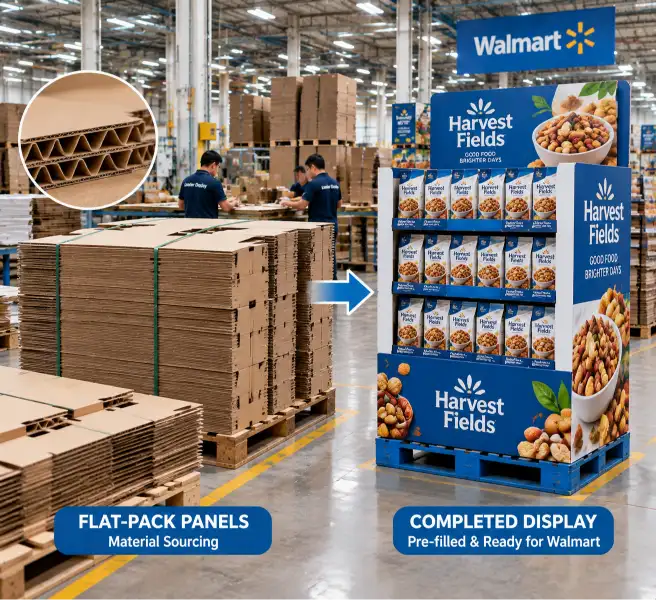
| Flat-pack (KD) shipping | Yes — panels ship flat, assembled at destination | Yes — most floor displays ship flat | Yes — most counter displays ship flat or pre-glued |
| Pre-filled shipping | Yes — common for club store programs | Rare — floor displays are not typically pre-filled | Yes — for compact programs |
| Typical shipping volume per display (flat-pack) | 3–8 cubic feet | 1–4 cubic feet | 0.2–1 cubic foot |
| Units per 40ft container (flat-pack, estimate) | 200–600 displays | 500–1,500 displays | 2,000–8,000 displays |
| Pallet required | Yes — display uses a pallet base | No — ships in cartons without a pallet | No — ships in cartons or bundles |
The Freight Cost Difference
Because floor displays and counter displays do not require a pallet base, they ship more efficiently per unit of product capacity. A floor display may ship 4 display units in the same volume that a pallet display takes for 1 unit. For international shipments, the freight cost per display is significantly lower for floor and counter displays.
But the total cost of goods sold calculation must include the store-level labor and the product volume. A pallet display that costs $8 more to ship than a floor display may still be the better choice if it moves 3x more product per store.
07 Program Duration and Display Lifespan
The display format affects how long the display can run before it needs replacement.
| Display Type | Typical Program Duration | Lifespan in Store | Notes |
|---|---|---|---|
| Pallet display | 4–12 weeks | Single program — displays are usually disposable after the promotion | High volume sells through quickly; the display is typically not restocked after the initial fill |
| Floor display | 4–16 weeks | Single program — some formats can be restocked | Lower volume per display means the display lasts longer; may be restocked for extended promotions |
| Counter display | 4–26 weeks | Multi-cycle — counter displays can be restocked multiple times | Compact size allows store teams to restock easily; used for ongoing impulse programs |
What This Means for Your Decision
- Short-term high-volume promotion (4–8 weeks) — Pallet display is the best fit. The high product capacity matches the fast sell-through rate
- Mid-term promotion (8–16 weeks) — Floor display can work well if the product volume per store is moderate
- Long-term impulse program (12+ weeks) — Counter display is often the best choice. It sits in a fixed location (checkout) and can be restocked repeatedly
08 Decision Framework: How to Choose
Use this decision framework to match the display format to your program requirements. Start from the top and work through each question.
Step 1: Where Will the Display Be Placed?
| Retail Placement | Recommended Format |
|---|---|
| Club store (Costco, Sam's Club, BJ's) | Pallet display (full, half, or quarter) |
| Walmart power aisle or center floor | Pallet display (full or half) |
| Supermarket endcap | Floor display or half pallet display |
| Checkout counter | Counter display |
| Drug store or convenience store | Floor display or counter display |
| Retail chain with limited floor space | Floor display (compact) or counter display |
Step 2: How Many Units Per Store?
| Product Quantity Per Display | Recommended Format |
|---|---|
| 100+ units per display | Pallet display |
| 30–100 units per display | Floor display (or quarter pallet display) |
| Under 30 units per display | Counter display or small floor display |
Step 3: What Is the Product Weight?
| Product Weight | Recommended Format |
|---|---|
| Under 1 lb per unit | Pallet, floor, or counter display — all suitable |
| 1–5 lbs per unit | Pallet or floor display — counter display may be too small |
| 5+ lbs per unit | Pallet display with reinforced base — floor display may be used for lower quantities |
Step 4: How Long Will the Program Run?
| Program Duration | Recommended Format |
|---|---|
| 4–8 weeks (high-volume) | Pallet display |
| 8–16 weeks (moderate volume) | Floor display |
| 12+ weeks (ongoing impulse) | Counter display |
Decision Matrix
| Product Volume | Light Product | Heavy Product | Long Program | Checkout Placement |
|---|---|---|---|---|
| High (100+ units) | Pallet display | Pallet display (reinforced) | Pallet display (initial), then restock with floor display | Counter display for checkout, pallet display for floor |
| Medium (30–100 units) | Floor display | Floor display (reinforced) or half pallet | Floor display | Counter display |
| Low (under 30 units) | Counter display | Counter display (small quantities) or floor display | Counter display | Counter display |
09 How the Factory Approaches Each Format
A factory builds all three formats, but the engineering focus is different for each one.
| Engineering Focus | Pallet Display | Floor Display | Counter Display |
|---|---|---|---|
| Primary structural concern | Load distribution through the pallet base and stacking strength | Stability and tip-over resistance for a free-standing unit | Product fit and visibility in a small footprint |
| Board grade selection | Double-wall BC is the workhorse; triple-wall for heavy loads | Single-wall C or double-wall BC depending on product weight | Single-wall B, C, or E flute — lightweight enough for counter placement |
| Reinforcement approach | Base reinforcement, corner posts, top cap for mixed stacking | Base width for stability, shelf supports for load distribution | Insert fit, front lip strength, divider rigidity |
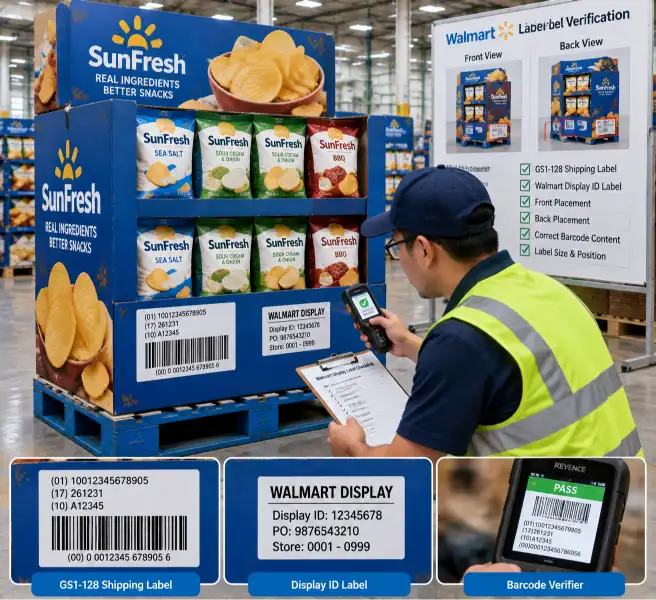
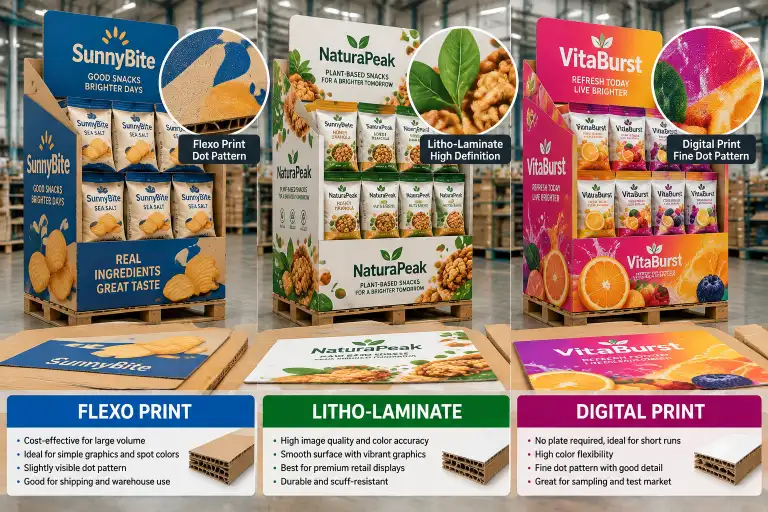
| Print method (typical) | Flexo (pre-print) for volume; litho-lam for premium | Flexo or litho-lam depending on placement (endcap vs. floor) | Flexo or digital for smaller runs; litho-lam for premium |
| Packing approach | Flat-pack or pre-filled; palletized for shipment | Flat-pack in cartons; no pallet base | Flat-pack or pre-glued; bundled or carton-packed |
For the full engineering details behind each format, see our structural engineering guides for club store displays and Walmart pallet displays.
FAQ
Q: What is the difference between a pallet display and a floor display?
A: The main difference is the base. A pallet display sits on a pallet (typically 48" x 40" GMA standard) and is designed for large product volumes. A floor display is a free-standing corrugated unit without a pallet base, designed for smaller volumes and typically used in aisles or endcaps. Pallet displays can hold 100–500+ units; floor displays hold 20–100 units.
Q: Which display format costs less per unit?
A: Counter displays cost the least per unit ($1–$5), followed by floor displays ($4–$11), then pallet displays ($7–$18). But the cost per product facing is similar for pallet and counter displays. The right comparison is total cost per store, not cost per display unit.
Q: Can a floor display be used in a club store?
A: Rarely. Club stores like Costco and Sam's Club typically require pallet displays because the floor space is designed for large-format merchandising. Floor displays are more common in supermarkets, drug stores, and convenience stores.
Q: When should I choose a counter display over a pallet display?
A: When the product is small, the quantity per store is low (under 30 units), and the placement is a checkout counter or service counter. Counter displays are ideal for impulse purchases and long-term programs where the display sits in a fixed location.
Q: Which display format is best for heavy products?
A: Pallet displays with reinforced base structures are the best choice for heavy products (pet food, beverages, bulk household). Floor displays can handle moderate weights if the board grade and structure are selected correctly. Counter displays are not suitable for heavy products.
Q: Are floor displays easier to assemble than pallet displays?
A: Generally, yes. Floor displays have fewer panels and simpler structures, so assembly time is typically 3–10 minutes vs. 5–15 minutes for a flat-pack pallet display. But pallet displays can be ordered pre-filled to eliminate assembly entirely.
Q: Which display format is best for retail chain rollouts with many stores?
A: It depends on the product volume per store. For high-volume programs (100+ units per store), pallet displays are the most efficient. For moderate volumes, floor displays offer better shipping efficiency and lower per-display cost. For checkout programs, counter displays are the obvious choice.
Q: Can I combine different display formats in one program?
A: Yes. Some programs use pallet displays for high-volume stores, floor displays for mid-volume stores, and counter displays for low-volume or checkout placements. The factory can produce multiple formats from the same artwork, with the same branding and print specifications.