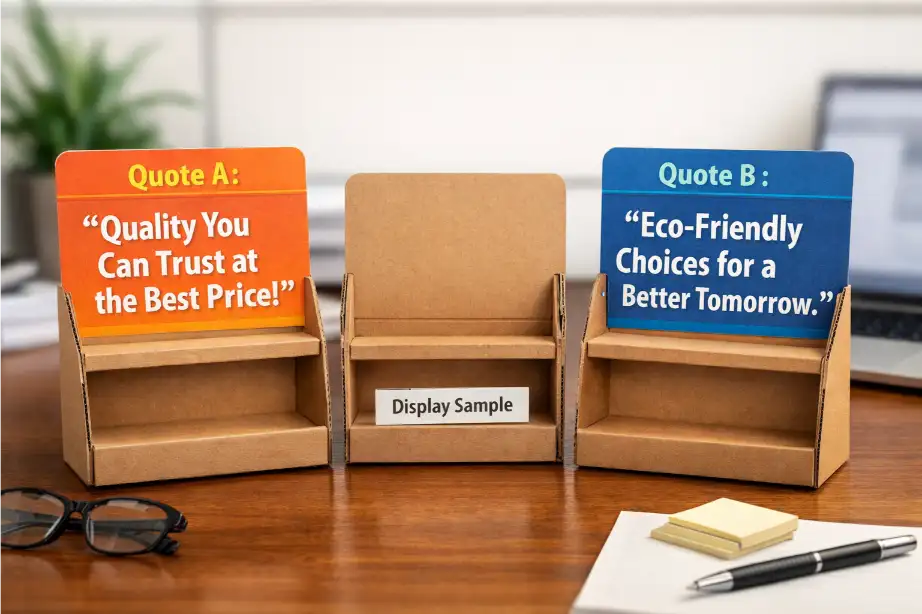
Two cardboard display quotes can look similar at first glance and still represent two very different projects. One may look cheaper only because key details are missing. Another may seem more expensive but include stronger structure, more practical packing, and fewer production risks. This is why comparing quotes based only on the final number is one of the biggest mistakes buyers make.
For brands, retailers, and importers, the smarter approach is to compare what each quote is actually offering. A good quote should help you understand structure, material, quantity, printing, packing, and production logic clearly. In this guide, we explain how to compare cardboard display quotes without choosing the wrong supplier for the wrong reason.
First, Do Not Ask Which Quote Is Lower. Ask Which Quote Is More Complete.
The most common error is to compare quotes line by line only by price. That sounds logical, but it often hides the real issue. If one supplier quoted based on a rough reference image and another quoted based on full product details, those two quotations are not equally reliable even if they look similar on paper.
A lower quote can simply mean that the supplier assumed less material, weaker structure, lower print requirements, or less protective shipping. That is why the first question should always be: are these two quotes based on the same project definition?
Before You Compare Prices, Check Whether the Inputs Match
Two quotes can only be compared fairly if they are based on the same information. Buyers should first confirm that both suppliers received the same product dimensions, product weight, quantity, display type, print requirements, and shipping assumptions. If one supplier quoted using incomplete information, the quote may look attractive now but change later.
This is also why clear briefing matters so much. If you need to improve the way you ask for pricing, our quote request guide is a useful starting point.
Quote Comparison Table: What to Check Before Looking at the Final Price
| Quote Factor | What a Strong Quote Usually Shows | What Should Make Buyers Careful |
|---|---|---|
| Display structure | Clear mention of shelves, hooks, or layout logic | Only a generic “display unit” description |
| Board / material | Material or board strength is identified | No clue what material level is included |
| MOQ and quantity breaks | Several quantity levels or clear MOQ logic | One number only with no scale view |
| Printing and finishing | Color/finish assumptions are stated clearly | Print quality is left unclear |
| Packing method | Flat-pack, export carton, or packing notes included | No packing details at all |
| Sample and lead time | Sample timing and production timing are separated | Timing is vague or missing |
Rule 1: Compare Structure, Not Just Appearance
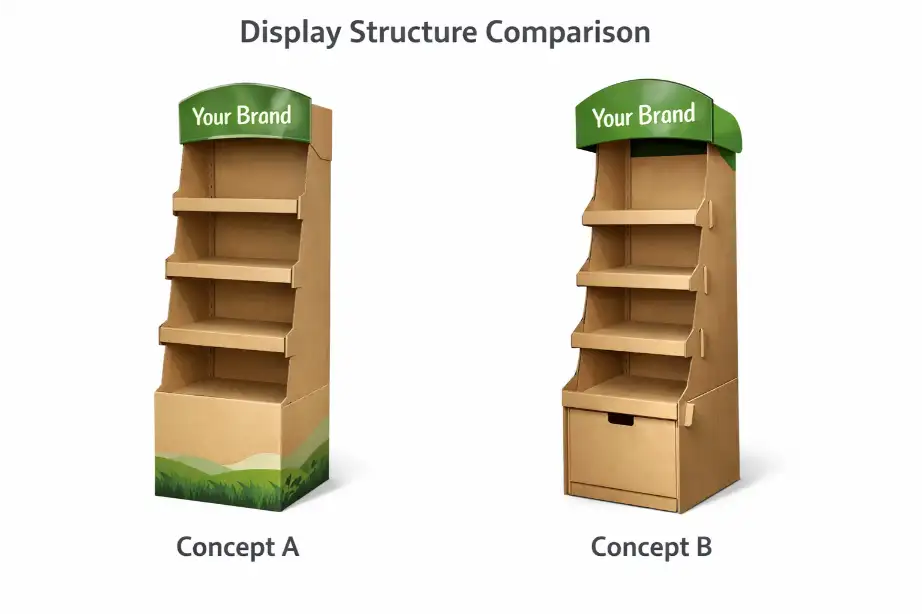
Two displays may look similar in a sketch or mockup, but the structure behind them may be very different. One supplier may be quoting a simpler structure with less shelf support. Another may be quoting a stronger base, more practical locking system, or a layout that is easier for retailers to assemble and refill.
If the products are heavy, mixed, or rolled out across many stores, structure quality matters more than the visual similarity. This is where a “higher” quote may actually be the safer and cheaper business choice over time.
Rule 2: Check the Material Assumption
Material is one of the easiest places for quotes to look cheaper than they really are. If one supplier is assuming a lighter corrugated grade and another is assuming a stronger one, the price difference is not necessarily a pricing difference. It may simply be a performance difference.
This matters especially for heavier categories, wider shelf spans, and more demanding retail conditions. If you want a better background on board choice, our corrugated grades guide can help you compare material logic more confidently.
Rule 3: Compare MOQ and Quantity Breaks Properly
Buyers often make decisions too quickly on one quoted quantity. A more useful comparison is to ask both suppliers for the same quantity levels, such as 500, 1,000, and 3,000 units. This helps you see how the price behaves as volume changes.
Sometimes a supplier with a slightly higher first quote becomes much more competitive at the actual order level you plan to use. That is why quote comparison should always include MOQ and quantity breaks, not just a single number. Our MOQ guide can help if you are reviewing this part now.
Rule 4: Watch for Hidden Cost Areas
Some of the most expensive quote differences are not obvious at the top of the page. They hide in finishing assumptions, sample cost, shipping protection, or transport efficiency. If one quote includes a cleaner flat-pack solution, stronger export cartons, or a more practical assembly design, it may protect the campaign better even if the unit price is not the lowest.
In other words, buyers should compare total project cost, not just production cost.
Rule 5: Shipping Logic Can Change the “Cheapest” Quote Completely
Shipping is where many buyers discover that the lowest unit quote was not the lowest real option. If the display is harder to pack, takes more carton volume, or ships less efficiently, the landed cost can rise fast. This is especially important for export projects and multi-store retail rollouts.
That is why the quote should be checked together with the packing plan. If this matters for your project, our export packaging guide and our article on flat-pack cardboard displays are worth reviewing before you make a final decision.
Rule 6: Lead Time and Sample Logic Matter Too
A quote is not only about money. It is also about how the supplier plans to move the project from idea to production. Good suppliers usually separate sample lead time from mass production timing and can explain what they need from you to keep the project moving.
If one supplier gives a very vague schedule while another gives a structured timeline, that difference should be taken seriously. Our lead time guide can help you judge this part more clearly.
Red Flags That a Quote Should Not Be Trusted Too Quickly
- The quote is much cheaper but does not explain material or structure.
- The supplier did not ask for product weight, but the display is load-sensitive.
- The quote has no packing or shipping assumptions.
- There is only one price and no MOQ or quantity logic behind it.
- The lead time is vague or unrealistically short without sample discussion.
- The supplier cannot explain what is included in the quoted display design.
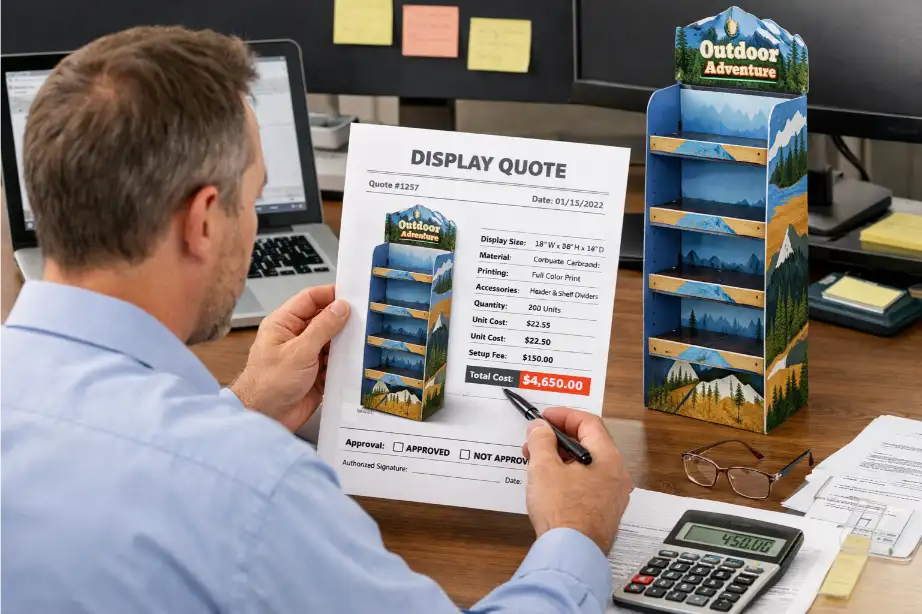
Cheap is not the same as clear. Buyers should always prefer a quote that explains the project properly over one that simply looks lower at first glance.
Buyer Checklist Before Choosing Between Two Quotes
- Confirm both suppliers quoted the same product and quantity assumptions
- Check the structure description, not just the rendering
- Verify the corrugated material level or board logic
- Compare MOQ and quantity breaks at the same volumes
- Ask what is included in sampling, printing, and packing
- Review landed cost, not only unit price
- Look for clarity, not only the cheapest number
Useful External References
Corrugated projects are often strongest when buyers compare not only appearance and price, but also how the solution supports transport, retail handling, and sales impact. The Fibre Box Association overview of corrugated is useful for understanding why corrugated performs well in transport and merchandising. For corrugated structure terminology, the FEFCO code reference is also useful when reviewing structure more precisely.
Conclusion
Comparing two cardboard display quotes correctly is not about choosing the lowest number. It is about choosing the quote that reflects the right structure, the right material, the right quantity logic, and the right shipping plan for your project. Buyers who compare quotes this way usually avoid expensive surprises later and make better supplier decisions.
If you want help reviewing display quotations before placing an order, feel free to contact us.
FAQ
Can two similar display quotes still be very different?
Yes. They can differ in structure, board strength, packing assumptions, sample logic, and quantity planning even if the display looks similar in a mockup.
Should I always choose the cheapest quote?
No. The cheapest quote can become more expensive later if it is based on weaker assumptions or incomplete project details.
What is the most important thing to compare first?
The most important thing is whether both suppliers quoted based on the same product, quantity, and structure assumptions.
Why does shipping matter when comparing quotes?
Because a lower production price can be offset by higher carton volume, weaker packing efficiency, or higher landed cost.
Should I ask for multiple quantity breaks?
Yes. It is usually much smarter to compare several quantity levels than to judge the project on one number only.
What makes a quote more trustworthy?
A trustworthy quote is usually clearer about structure, materials, MOQ, timing, and packing rather than just giving one low headline price.