A cheap cardboard display quote can look attractive at first, but low pricing often raises a more important question: what is missing? In many sourcing projects, the problem is not that the supplier is magically cheaper. The problem is that the quote is based on fewer assumptions, weaker materials, incomplete shipping logic, or missing production details.
For brands, retailers, and importers, this matters because the “cheap” quote may only stay cheap until the project moves into sampling, production, or export packing. In this guide, we explain what information is usually missing when a cardboard display quote looks unusually low, and how buyers can compare quotations more safely before making the wrong decision.
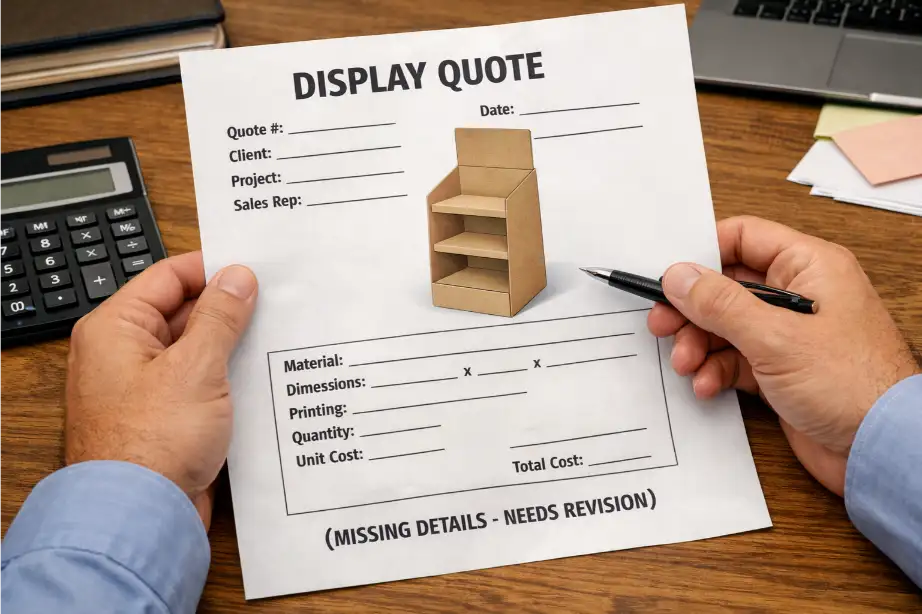
The Warning Sign Is Not the Price. It Is the Lack of Clarity.
A low price is not automatically a bad sign. The real warning sign is when the quote does not clearly explain what is included. If the supplier has not described structure, board grade, quantity logic, packing method, or sample conditions, then the quote may not be complete enough to trust.
In other words, buyers should not ask only, “Why is this quote cheaper?” They should also ask, “What has this quote not yet priced in?”
Missing Item 1: Structure Assumptions
One of the most common gaps in a cheap quote is structure detail. A supplier may quote a display as if it were a simpler unit than the one the buyer actually needs. The rendering or concept may look similar, but the real structure may require stronger shelves, a better base, or a different locking system once the project is engineered properly.
This is especially important for multi-shelf displays, mixed-SKU units, and projects with real retail loading requirements. If the structure description is vague, the quote is not truly complete.
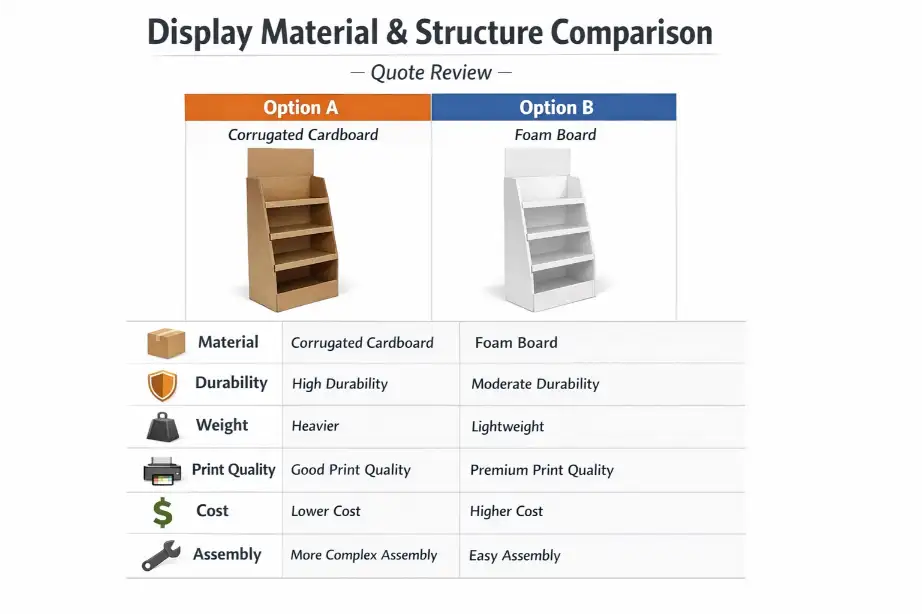
Missing Item 2: Board Grade or Material Level
Material is another area where a low quote can hide risk. If the supplier has not clearly stated the board level, flute type, or strength logic, the display may be priced using a lighter material assumption than the project really needs. That makes the quote look competitive now, but can create a performance problem later.
If you need a better background for reviewing this, our corrugated grades guide helps explain why two similar displays may not be built to the same strength level.
Missing Item 3: Real Quantity Logic
Some cheap quotes are based on a quantity that is not realistic for the actual project. Others only show one number and do not explain how the unit price changes at different volume levels. This makes it hard for buyers to understand whether the supplier is genuinely competitive or simply pricing around an artificial assumption.
A stronger quote usually shows MOQ or multiple quantity levels so the buyer can judge the cost curve more clearly. If you are reviewing this part now, our MOQ guide and cost guide are useful next reads.
Missing Item 4: Sampling Scope
A quote may also look cheap because the sample stage has not really been included. Buyers should check whether the price assumes a white sample, a color sample, or later sample adjustments. If sample work is still unclear, the low quote may simply be incomplete rather than efficient.
This matters because many corrections are discovered during sampling, not before. A supplier who quotes cheaply but leaves sample logic vague may create more back-and-forth later. Our article on what a display sample should prove can help you judge that stage more carefully.
Missing Item 5: Printing and Finishing Detail
Printing quality, lamination, surface finish, and artwork handling can all change the cost significantly. If one quote assumes basic print and another assumes stronger finish quality, they are not directly comparable. This is one of the easiest places for a cheap quote to hide a weaker retail result.
For buyers, the key question is not whether finish has been “mentioned.” It is whether the quotation clearly reflects the print level the retail project really requires. Our printing and finishing guide can help you compare that more accurately.
Missing Item 6: Packing and Shipping Logic
Shipping is often where a cheap quote stops being cheap. If carton size, export packing, flat-pack method, inner protection, or transport efficiency have not been discussed, then the quote may only reflect production cost and not total landed cost.
This is particularly important for export projects and multi-store rollouts. A supplier can quote a low unit price but still create a more expensive overall project if the display packs badly or uses shipping space inefficiently. Our export packaging guide and flat-pack shipping guide help explain why this matters so much.

Cheap Quote Risk Table
| Possible Missing Information | Why It Makes the Quote Look Lower | What Buyers Should Ask |
|---|---|---|
| Structure detail | Simpler assumed design costs less | What exact display structure is included? |
| Board grade | Lighter material reduces price | What board or flute level is being used? |
| MOQ logic | Price may be based on unrealistic quantity | Can you show price at several quantity levels? |
| Sample scope | Sample work may not be included yet | Does this price include sample development? |
| Print/finish level | Basic print assumption looks cheaper | What print and finish standard is included? |
| Packing/shipping | Landed cost is not yet visible | How will the display be packed and shipped? |
How to Tell Whether the Quote Is Efficient or Just Incomplete
A genuinely efficient quote usually looks clear, not vague. It may still be competitive, but it explains what is included, what assumptions were used, and what may still change. A weak quote often looks attractive because it says less, not because it solves more.
That is why buyers should pay attention to how the supplier communicates. Good suppliers usually ask more questions before quoting, not fewer. In many cases, that extra clarity is a sign of professionalism rather than complexity.
Questions Buyers Should Ask When a Quote Looks Too Low
- What exact structure is included in this price?
- What board level or material assumption was used?
- Does the quote include sample work?
- What quantity does this unit price assume?
- What print and finish standard is included?
- How will the display be packed for shipping?
- What part of the price is most likely to change later?
These questions usually reveal very quickly whether the quote is strong, incomplete, or simply too vague to compare fairly.
Why “More Detailed” Quotes Often Save More Money
Many buyers assume that a detailed quote must be more expensive. In reality, detailed quotes often save money because they reduce misunderstanding, sample revision, and shipping surprises later. A buyer who understands the full picture is much less likely to approve the wrong supplier for the wrong reason.
If you want the broader decision framework, our article on how to compare cardboard display quotes is the natural next step.
Useful External References
Corrugated is widely valued because it supports transport efficiency, retail graphics, and product protection at the same time. That is one reason why quote comparison should never stop at unit price alone. For broader corrugated background, see the Fibre Box Association overview of corrugated. For technical structure language, the FEFCO code reference is also useful.
Conclusion
When a cardboard display quote looks too cheap, the most important question is not whether the supplier is generous. The real question is what information has been left unclear or unpriced. Buyers who compare structure, material, sample scope, quantity logic, finishing, and shipping assumptions usually make safer decisions and avoid more expensive surprises later.
If you want help reviewing a display quote before making a final decision, feel free to contact us.
FAQ
Is a cheap cardboard display quote always risky?
No. A quote can be competitive for good reasons, but buyers should still check whether important details are missing before trusting it.
What is the most common thing missing from a low quote?
Structure detail and material assumptions are among the most common missing areas.
Can shipping make a cheap quote more expensive later?
Yes. If the packing and transport logic are weak, the landed cost can rise quickly.
Why should buyers ask about samples in the quote stage?
Because sample development may not always be fully included in the first price, and that can affect the real project cost later.
How can I compare two quotes fairly?
You should compare them based on the same structure, material, quantity, sample logic, and shipping assumptions rather than on the final price alone.
What makes a display quote more trustworthy?
A trustworthy quote usually explains more clearly what is included and what assumptions the supplier used to calculate the price.