Pet food is one of the heaviest product categories sold at Costco and Sam's Club. A single club store pet product display loaded with 30–40 lb bags of dog food can weigh over 1,500 lbs — as heavy as a beverage display. But unlike beverage displays, pet food comes in bags that are flexible, irregularly shaped, and difficult to stack neatly on standard trays.
For pet brands supplying Costco and Sam's Club, the display design must account for the physical properties of bagged pet food: shifting weight as bags settle, uneven bag sizes across SKUs, and the challenge of partial sell-through when customers remove heavy bags from the top or front.
This guide covers how to design pallet displays for pet food and pet products at club stores — bagged food trays, heavy load reinforcement, slot sizing for different bag sizes, and maintaining display stability as product sells.
Why Pet Product Displays Need Different Design
Pet food displays face challenges that other product categories do not. Understanding these from the start prevents structural failures that can cost thousands in damaged product and rejected shipments.
What Makes Pet Products Different
| Challenge | Why It Matters |
|---|---|
| Bagged food is heavy | A single 40 lb bag creates concentrated weight on a small tray area |
| Bags are flexible | Unlike boxes, bags shift and settle during transit, changing weight distribution |
| Bag sizes vary | A 15 lb bag and a 40 lb bag of the same brand may have very different footprints |
| Customers pull from the top | Heavy bags removed from the top tier can destabilize the entire display |
| Partial sell-through is extreme | A display with 10 bags remaining looks nothing like a full display |
| Treat bags are light | Pet treat displays need completely different tray design than pet food displays |
What Works for Snacks Does Not Work for Pet Food
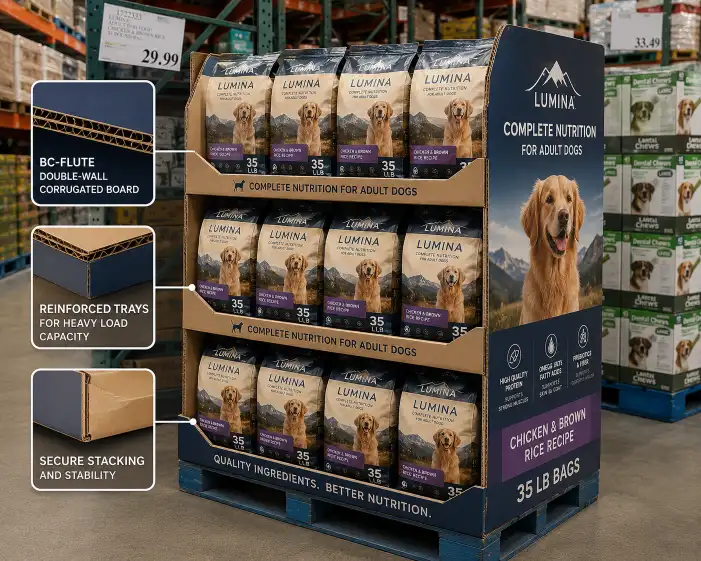
A snack display uses B-flute board and shallow trays. A pet food display carrying 30–40 lb bags needs BC-flute double-wall board, deep reinforced trays, and a pallet base designed for concentrated point loads. The same display structure that works for potato chips will collapse under 40 lb dog food bags.
For an overview of pallet display structural options, see our PALLET DISPLAY product page.
Weight and Structural Requirements for Pet Food Displays
The weight of pet food drives every structural decision. A full pallet display of bagged dog food can weigh 1,000–1,800 lbs depending on bag size and tier count.
Weight Guidelines
| Product Type | Typical Weight per Display | Recommended Board Grade |
|---|---|---|
| Dry dog food (30–40 lb bags) | 1,000–1,800 lbs | BC-flute double-wall, ECT 48+ |
| Dry cat food (15–20 lb bags) | 600–1,000 lbs | C-flute or BC-flute, ECT 38+ |
| Pet treat variety packs | 300–600 lbs | B-flute or C-flute, ECT 28–32 |
| Canned wet food (multipacks) | 800–1,200 lbs | BC-flute double-wall, ECT 48+ |
| Pet supplies (litter, accessories) | 400–800 lbs | C-flute, ECT 32+ |
| Mixed SKU (food + treats) | 500–1,200 lbs | Varies — design for the heaviest item |
Structural Rules for Pet Food
- Double-wall board for ALL product tiers — Pet food bags create point loads. Standard single-wall board can puncture or collapse under a 40 lb bag concentrated on a small area
- Reinforced tray bottoms — Add an extra corrugated layer to the tray bottom for bagged food. This prevents bag corners from pushing through the tray floor
- Support panels between bags — Vertical support panels between bag slots prevent sidewall bulging
- Layer pads between tiers — Required for every tier. Use double-wall layer pads for bagged food
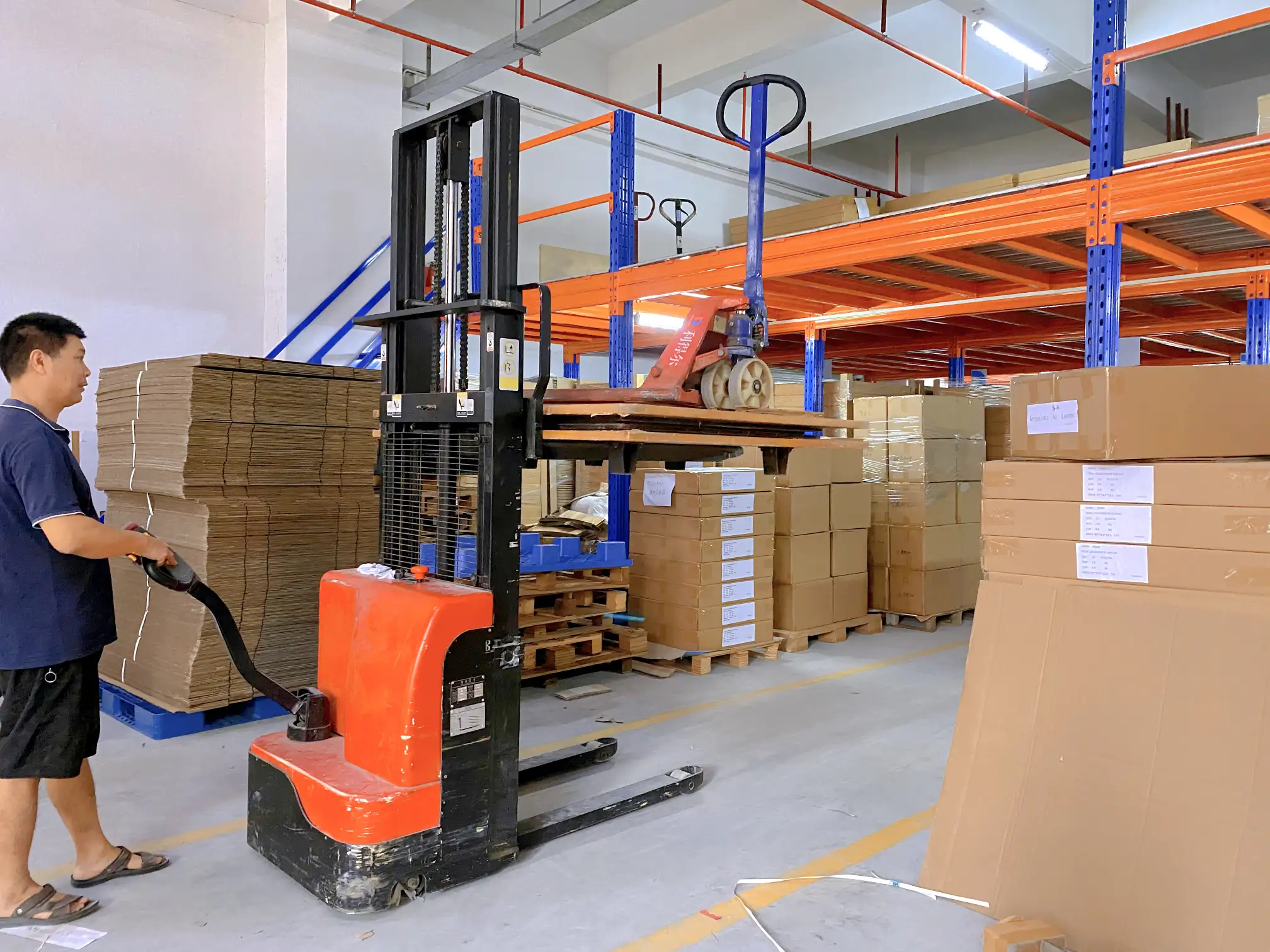
- Pallet base reinforcement — The pallet must support the full weight. For displays over 1,200 lbs, add a corrugated base support sheet between the display and the pallet
ECT Requirements
| Display Section | Minimum ECT | Board Type |
|---|---|---|
| Bottom tier trays | 48–55 lbs/in | BC-flute double-wall |
| Middle tier trays | 44–48 lbs/in | BC-flute or heavy C-flute |
| Top tier trays | 38–44 lbs/in | C-flute or BC-flute |
| Pallet base support | 55+ lbs/in | BC-flute double-wall |
For board grade specifications and material selection, see our PRODUCTION page.
Tray Design for Bagged Pet Food
Bagged pet food is the most challenging product to design trays for. The bag shape, size, and weight distribution all affect tray performance.
Bag Size and Tray Fit
| Bag Size | Typical Dimensions | Recommended Tray Size | Tray Depth |
|---|---|---|---|
| 4–6 lb (small breed, cat) | 12×6×4 in | 12.5×6.5 in slot | 4–5 in |
| 15–20 lb (mid-size) | 18×10×5 in | 18.5×10.5 in slot | 5–6 in |
| 30–40 lb (large breed) | 24×14×6 in | 24.5×14.5 in slot | 6–7 in |
| 50+ lb (bulk bags) | 30×18×7 in | 30.5×18.5 in slot | 7–8 in |
Tray Configuration Options
| Configuration | How It Works | Best For |
|---|---|---|
| Single bag per slot | One bag per compartment | Large bags (30–40 lb) — prevents shifting |
| Double bag per slot | Two bags side by side | Medium bags (15–20 lb) — efficient use of space |
| Open tray with dividers | Removable corrugated dividers | Mixed bag sizes within one display |
| Full-width open tray | No dividers, bags packed tightly | Same-size bags packed in a block |
Critical Design Rules for Bagged Food Trays
- Bag corners must be supported — The bottom corners of a filled bag concentrate the weight into small points. If the tray floor is not reinforced, bag corners punch through
- Tray walls must be reinforced — Bags push outward against tray walls. Use double-wall board for tray sidewalls on any tray holding bags over 15 lbs
- One bag size per tray configuration — Mixing 40 lb bags and 5 lb bags in the same tray type causes fit problems. Design separate trays for different bag sizes
- Test with filled bags — Empty bags are not a valid test. The weight and shape of a filled bag are completely different
Tray Design for Pet Treats and Supplies
Pet treats and supplies are lighter than pet food but have their own design considerations.
Pet Treats
Treat bags are small, lightweight, and often packaged in stand-up pouches or small bags.
- Tray type: PDQ trays with full front opening
- Tray depth: 4–6 in — match the pouch height
- Dividers: Recommended for mixed variety packs
- Board grade: B-flute (ECT 28) is sufficient
Canned Wet Food
Canned pet food is sold in multipacks or individual cans. The weight is moderate but the packaging is rigid.
- Tray type: Standard trays for multipacks. Divided tray with individual compartments for loose cans
- Tray reinforcement: Double-wall bottom for tray holding 12+ cans
- Board grade: C-flute (ECT 32+)
Pet Supplies
Litter, bedding, bowls, and accessories vary widely in size and weight.
- Litter (heavy): Reinforced tray with BC-flute. Treat like bagged food
- Accessories (light): Standard B-flute tray. Focus on product visibility
- Mixed displays: Design for the heaviest item in the display
Design Tip
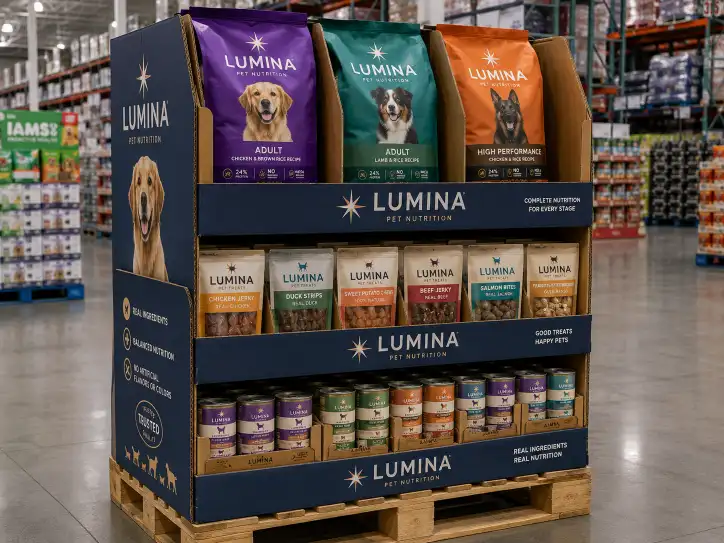
For mixed pet product displays (food + treats + supplies in one display), use separate tray sections for each product type. Do not put 40 lb bags next to treat pouches in the same tray — the weight difference creates instability.
For food display design principles, see our Costco Food & Snack Pallet Displays guide.
Bag Shift and Partial Sell-Through
Pet food displays experience more aggressive weight shifts than any other product category. As bags are removed, the remaining bags shift, changing the display's center of gravity.
Why Bag Shift Matters
- Bags settle during transit — A display that is packed tight at the factory may have gaps after vibration loosens the bags
- Customers remove top bags first — The heaviest bags are often at the bottom, but customers take accessible bags from the middle or top
- Uneven weight distribution — Removing one 40 lb bag from one side of a tier creates an imbalance that can tip the display
- Visual appearance — After 30% depletion, remaining bags may lean, tilt, or fall over, making the display look messy
Design Strategies for Bag Shift
| Strategy | How It Works |
|---|---|
| Tight bag fit | Design trays so bags fit snugly — no more than 0.5 in gap on any side |
| Vertical dividers | Corrugated dividers between bag columns prevent bags from leaning into each other |
| Tray wall height | Tray walls should be at least 60% of the bag height to keep bags upright |
| Staggered stacking | Offset bag placement between tiers to create a more stable weight distribution |
| Bag orientation | All bags should face the same direction (standing, not lying flat) |
Partial Sell-Through Testing for Pet Food
Test the pet food display at three critical points:
- Full display — Check for bag fit and tray integrity at full weight
- Top tier removed — The most common customer pattern. Remove the top tier and check stability
- One side depleted — Remove bags from the front-left section. This simulates uneven customer removal
- Bottom tier exposed — After upper tiers are depleted, check that the bottom tier bags are still accessible and stable
A pet food display must pass all four test conditions. If the display tips or bags fall over at any test point, the design needs revision.
Multi-SKU Pet Product Displays
Many pet brands offer multiple products — different formulas, bag sizes, or treat varieties. Multi-SKU pet displays are common at club stores.
Multi-SKU Design Rules
| Rule | Why |
|---|---|
| Group by weight | Put all heavy bags together, all light bags together |
| Heaviest SKU at the bottom | Do not mix heavy and light SKUs on the same tier |
| Use tray dividers | Dividers between different SKUs prevent mixing and keep each section organized |
| Clear labeling per section | Each SKU section should be clearly marked on the tray |
| Color-code by SKU | If possible, use different printed tray colors for different product lines |
Common Multi-SKU Configurations
- Two formulas, same bag size — Split the display vertically: left half one formula, right half the other
- Three bag sizes — Largest at the bottom, medium in the middle, smallest on top
- Food + treats combo — Food bags on the bottom 2 tiers, treat PDQ trays on the top tier
- Multi-flavor treat variety — Divided PDQ trays with each compartment holding a different flavor
Transit Testing for Heavy Pet Displays
Pet food displays require the same transit tests as other club store displays, plus additional testing specific to bagged products.
Required Tests
| Test | Purpose | Passing Criteria |
|---|---|---|
| ECT (compression) | Stacking strength | Min 48 lbs/in for double-wall |
| Vibration | Transit simulation | No structural failure, no bag shift exceeding 1 in |
| Drop | Handling | No damage from 6–12 in drops |
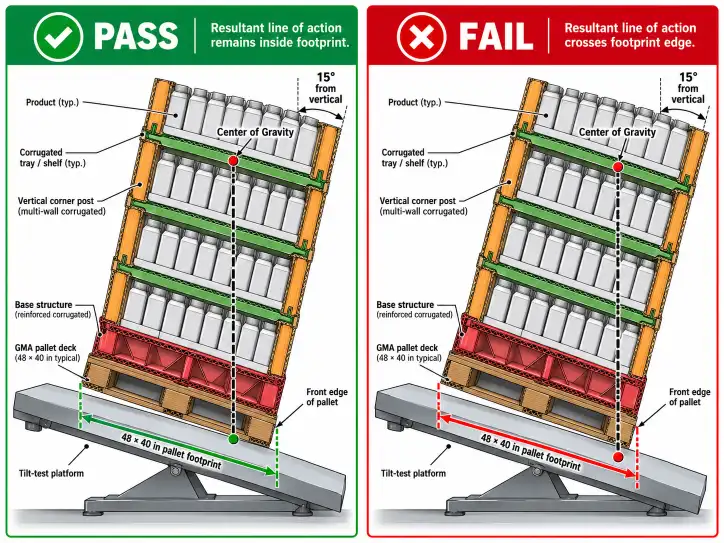
| Tilt | Stability | Display must not tip at 15–20 degrees |
| Bag shift test | Product movement | Bags must not shift out of their tray slots |
Pet Food Specific Tests
- Bag corner puncture test — Load filled bags into trays. Apply vibration. Check tray floors for punctures
- Settling test — After vibration, measure how much the bags have settled. If bags have dropped more than 1 in below the tray wall, the tray depth is insufficient
- Top-heavy test — Remove 50% of the product from the top tier and check if the display remains stable
- Uneven removal test — Remove bags from one side only and check for tipping
For detailed testing procedures, see our SAMPLING page.
Buyer Checklist for Pet Product Displays
| Check Item | Status | Notes |
|---|---|---|
| Product weight confirmed per bag | ☐ | Design for the heaviest bag |
| Board grade matches weight | ☐ | BC-flute double-wall for bagged food |
| Tray type matches bag size | ☐ | Single bag per slot for large bags |
| Tray walls at least 60% of bag height | ☐ | Prevents bags from falling over |
| Tray bottom reinforced | ☐ | Extra corrugated layer for bag corners |
| Layer pads between tiers | ☐ | Double-wall for bagged food |
| Pallet base reinforcement | ☐ | For displays over 1,200 lbs |
| Bag shift test passed | ☐ | Vibration test with filled bags |
| Partial sell-through test | ☐ | Test at top tier removed, one side depleted |
| Multi-SKU separation | ☐ | Dividers between different products |
| Stretch wrap 5+ layers | ☐ | Extra at base for heavy displays |
| Pallet skirt included | ☐ | Printed branding on base |
| Sample approved with filled bags | ☐ | Use actual filled product, not empty bags |
Conclusion
Designing a club store pet product display requires understanding the specific challenges of bagged pet food — concentrated weight, bag shift, and aggressive partial sell-through. A display designed for boxed snacks will fail with 40 lb dog food bags. The key is to start with the bag dimensions and weight, then design the tray and structural reinforcement around the bag — not the other way around.
For B2B buyers in the pet industry, the most important investment is in structural testing with real product. An empty bag test tells you nothing about how the display will perform. Always test with filled bags at retail weight, and always test the partial sell-through scenarios.
If you are planning a pet product display for Costco or Sam's Club, start with the COSTCO DISPLAYS product page or the PALLET DISPLAY product page. For heavy load structural specifications, see our PRODUCTION page.
FAQ
What is a club store pet product display?
A club store pet product display is a reinforced corrugated pallet display designed for pet food, treats, and supplies at Costco, Sam's Club, and other warehouse retailers. It is typically built with BC-flute double-wall board to handle the weight of bagged pet food.
What board grade is needed for pet food displays?
For bagged dry pet food (15–40 lb bags), use BC-flute double-wall board with ECT 48+ lbs/in. For lighter pet treats and accessories, B-flute or C-flute (ECT 28–38) may be sufficient.
What tray design works best for bagged pet food?
Use single-bag compartments with reinforced tray bottoms. The tray walls should be at least 60% of the bag height to keep bags upright. Double-wall board is recommended for all tray sidewalls holding bags over 15 lbs.
How do I prevent bags from shifting during transit?
Design trays with a snug fit (no more than 0.5 in gap) and use vertical dividers between bag columns. Layer pads between tiers also help prevent bags from settling and shifting.
Can I put different bag sizes in the same display?
Yes, but group bags by size on separate tiers — largest at the bottom, medium in the middle, smallest on top. Do not mix different bag sizes in the same tray.
Do pet food displays need special transit testing?
Yes. In addition to standard ECT, vibration, drop, and tilt tests, pet food displays should undergo bag corner puncture testing, settling testing, and top-heavy testing after partial product removal.
Can the same display work for pet food and pet treats?
Not in the same tray. Pet food bags are too heavy to mix with lightweight treat pouches. Use separate tray sections for food and treats, with food on the bottom tiers and treats on the top.
How many tiers should a pet food display have?
For bagged food, limit to 2–3 tiers maximum due to weight. Treats and supplies can use 3–4 tiers. The total display height should still stay within the club store limit (72–84 in).