A pallet display costs more per unit than a floor display — and it should, because it includes a wood pallet, a much larger corrugated structure, and usually factory-loaded product. The per-unit price is not the useful number. What matters is cost per sell-through: a full pallet display holds several times the product of a counter display, so a higher unit price can still be the cheapest way to move volume. Buyers who compare only unit prices miss the math that makes pallet displays economical.
This guide gives the 2026 price ranges buyers actually see for pallet displays, the six levers that drive the number, how retailer compliance specs add cost, the pre-filled vs flat-pack trade-off, and the information to send a factory so the first quote is close to final. It is written for brands and procurement teams sourcing pallet displays for grocery, mass, club, and home improvement retail.
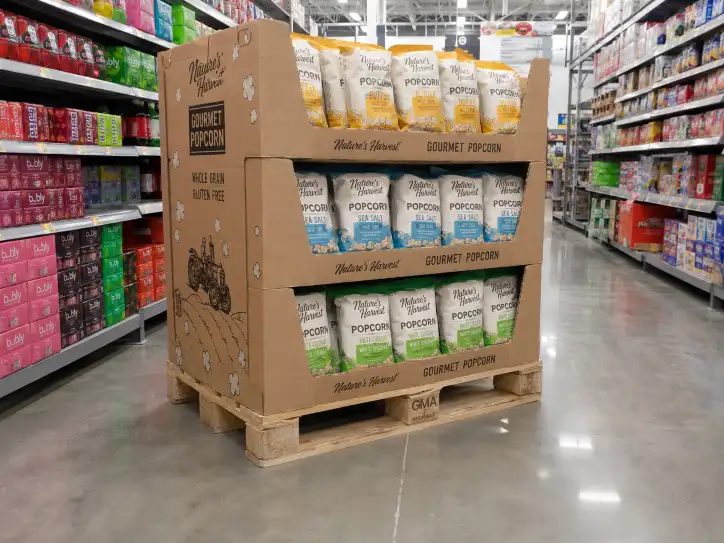
The Short Answer: Pallet Display Cost Ranges
At typical order volumes of 300–1,000 units, here are the price ranges buyers see for corrugated pallet displays built on a GMA pallet base. These are indicative ranges — the exact number depends on size, board, print, and whether the unit is factory-loaded.
| Pallet display type | Typical cost per unit | What is included |
|---|---|---|
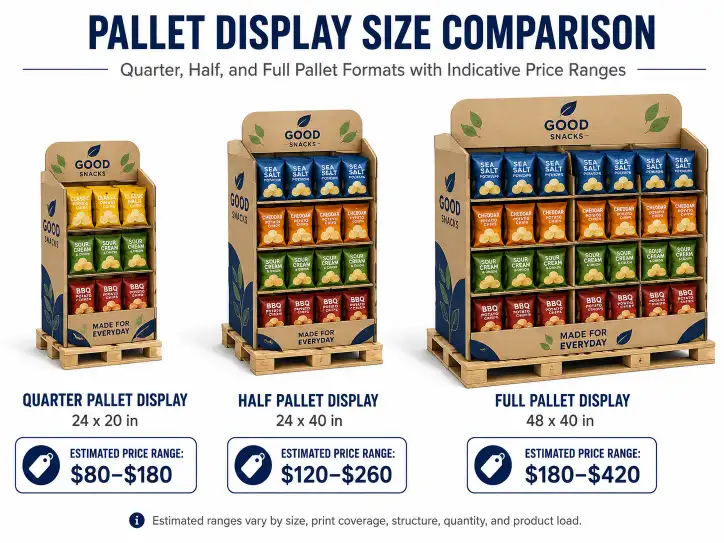
| Quarter pallet (24 × 20 in) | $12–$30 | Small corrugated structure on a mini or quarter pallet |
| Half pallet (48 × 20 or 24 × 40 in) | $18–$45 | Endcap-size display on a half pallet |
| Full pallet, standard (48 × 40 in) | $28–$60 | Single-wall corrugated tiers, basic print |
| Full pallet, premium (48 × 40 in) | $60–$110 | Double-wall board, full-color print, pallet skirt, reinforced trays |
The ranges widen with volume: a 300-unit order sits at the high end, a 1,000-unit order at the low end, and a 2,000+ unit program can price well below the range. Pre-filling the display at the factory adds labor on top of these figures. For the full cost picture of custom cardboard displays across all formats, the custom cardboard display cost guide is the companion reference.
What Drives the Price: Six Cost Levers
Six inputs set the price of a pallet display. Change any one and the quote moves.
| Cost lever | How it affects price | Cost direction |
|---|---|---|
| Pallet base | Wood GMA pallet, half pallet, or mini pallet; pallet grade | Larger base = higher cost |
| Board grade | Single-wall vs double-wall (BC-flute); ECT rating | Stronger board = higher cost |
| Structure | Number of tiers, trays, dividers, and a pallet skirt | More parts = higher cost |
| Printing | 1–2 color flexo vs full-color litho/digital | More coverage = higher cost |
| Pre-fill labor | Factory loads the product into the display | Loaded = added labor |
| Retailer compliance | Labels, structural testing, wrapping, corner boards | More compliance = higher cost |
The pallet base and the board grade usually dominate the price, because they are the physical cost of the unit. Printing is a smaller share than most buyers expect — going from a plain two-color box to full-color litho print adds a fraction of the base cost, not multiples of it. The two levers that surprise buyers are pre-fill labor and retailer compliance, both of which add cost that is easy to underestimate until the quote arrives.
Pallet Display Cost by Size and Configuration
Sizing a pallet display up has a bigger effect on cost than most buyers expect, because volume grows faster than footprint. A half pallet is half the surface area of a full pallet but often less than half the price — the fixed costs (the die, the setup, the pallet base tooling) are spread over a smaller structure.
| Configuration | Typical range (300–1,000 units) | Cost drivers |
|---|---|---|
| Quarter pallet, single-wall, 2-color | $12–$25 | Small footprint, few tiers |
| Half pallet, single-wall, full print | $22–$40 | Endcap size, moderate volume |
| Full pallet, single-wall, full print | $35–$60 | Full footprint, 4–6 tiers |
| Full pallet, double-wall, full print, pallet skirt | $60–$100 | Heavy product, club-store spec |
| Full pallet, pre-filled, double-wall | $75–$120 | Factory loading adds labor |
Two rules of thumb: double-wall board roughly adds 20–35% over single-wall, and pre-fill adds a per-unit labor cost that scales with pack count — the more units per display, the more time to load them. If your product is heavy or the retailer requires a high ECT rating, the double-wall range applies. The display fixture structural design guide explains when double-wall is actually required versus when a well-designed single-wall structure is enough.
How Retailer Specs Change the Price
The retailer you are shipping to is a cost lever by itself, because each chain's compliance requirements add line items to the quote. A display for Costco is not the same product as a display for Aldi.
| Retailer | Spec that adds cost |
|---|---|
| Costco | Structural test reports, pre-filled preference, GS1-128 labels |
| Walmart | GMA block pallet, sustainability requirements, Retail Link compliance |
| Aldi | Grade A display pallet, display-ready cases, 60 in height cap |
| Lowe's | Two pallet standards, slip sheets, thermal-transfer labels |
| Home Depot | ±0.25 in overhang tolerance, corner boards, heavy-load board |
Every requirement above — a higher pallet grade, a structural test, a specific label format, corner boards, a slip sheet — is a line item on the factory quote. This is why the most important cost question is not "how much is a pallet display" but "which retailer's pallet display." The pallet display sizes hub links the full requirement guides for each chain, and the Costco, Walmart, Aldi, and Lowe's guides show the exact specs that drive cost.
Pre-Filled vs Flat-Pack: Where the Labor Goes
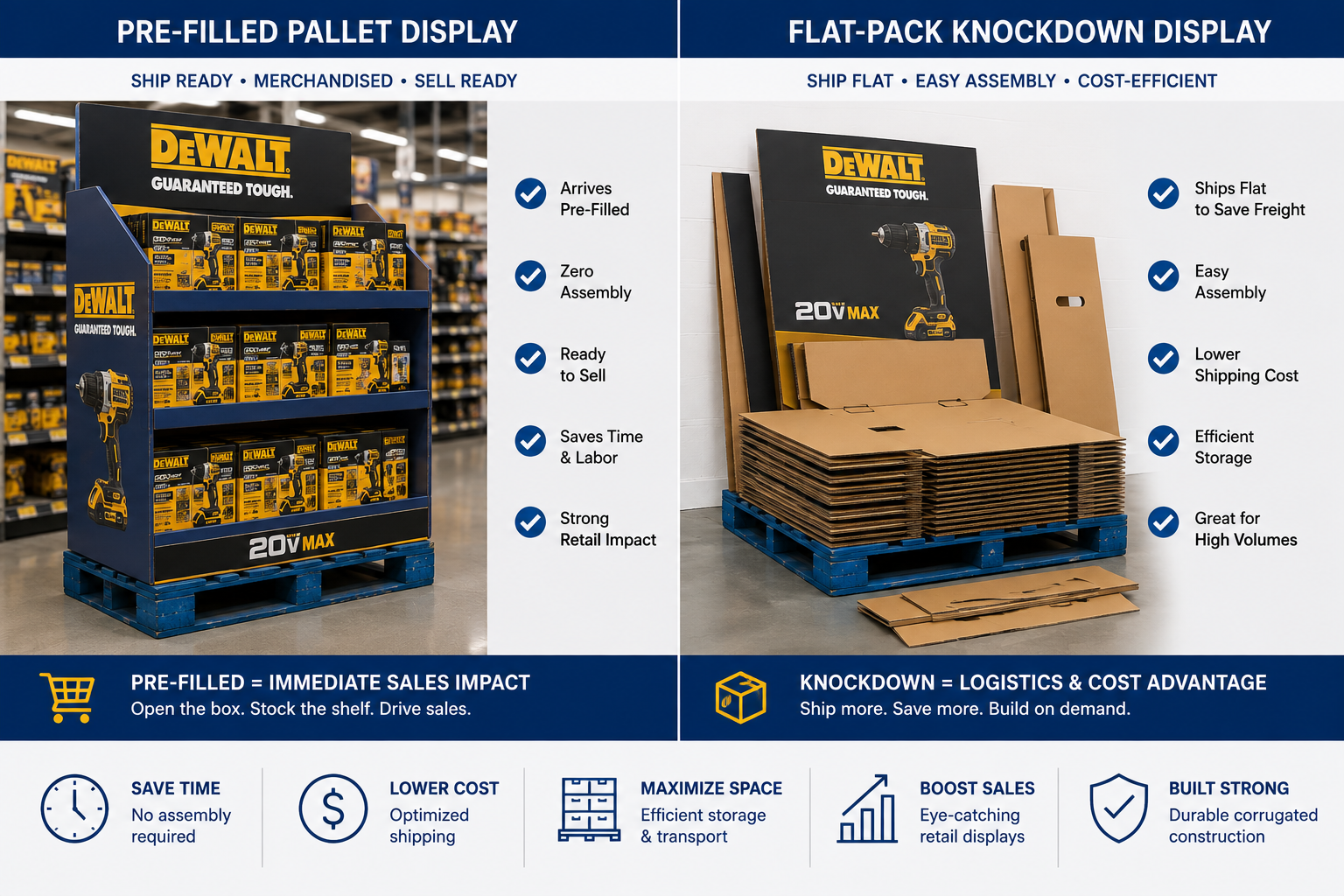
A pallet display can be shipped two ways, and the choice moves cost between the factory and the store.
| Factor | Pre-filled | Flat-pack (KD) |
|---|---|---|
| Where the display is assembled | At the factory | At the store or DC |
| Where the product is loaded | At the factory | At the store |
| Unit cost | Higher (labor included) | Lower (labor at retail) |
| Retailer preference | Preferred by club stores | Acceptable for many programs |
| Risk | No retail labor errors, but more freight space | Cheaper, but store labor and error risk |
Club stores such as Costco and Sam's Club strongly prefer pre-filled displays because they move from pallet to floor with no handling — which is why the pre-filled option is the norm there. Traditional grocery accepts flat-pack where the retailer's own team assembles the display. The pre-filled route adds per-unit labor cost but eliminates the retail labor and the risk of a poorly assembled display; the pre-filled pallet display guide breaks down the trade-off in detail. Flat-pack is also the more economical shipping choice — a knockdown display packs far more units per container, which matters for imported programs.
Hidden Costs That Catch Buyers
Beyond the unit price, five costs routinely catch first-time pallet display buyers:
- Die and tooling — a one-time steel-rule die for the corrugated blank, and pallet tooling for a custom display pallet (Lowe's-style 42–48 in pallets, for example). These are spread over the order, so they matter most at low volume. The MOQ guide explains how minimums interact with tooling.
- Samples — a physical sample with real product is non-negotiable for a pallet display, and the sampling cost is a small line item that prevents a large mistake.
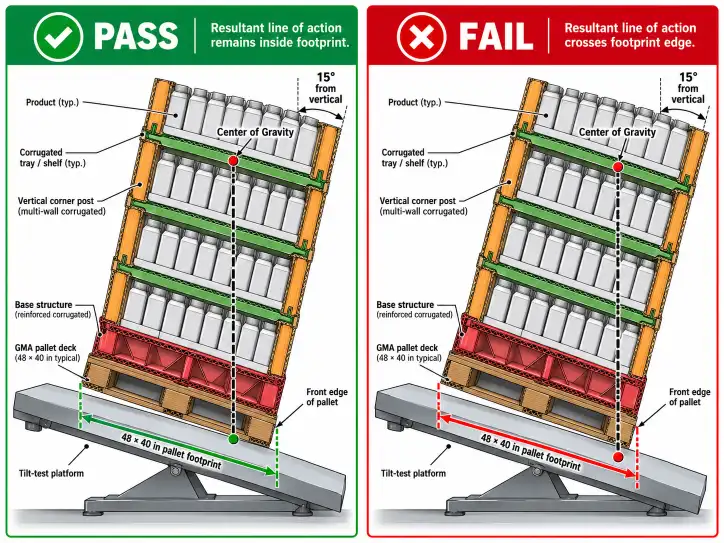
- Structural testing — club and mass retailers often require ECT, vibration, drop, or tilt test reports for new designs, and the test fee is real.
- Freight by volume — pre-filled pallet displays occupy far more container space than flat-pack; freight can exceed the display cost for imported programs.
- Chargebacks — a non-compliant display (wrong label, wrong height, overhang) generates a retailer chargeback that can erase the margin on the entire order.
None of these are hidden from an experienced factory — they are just easy to miss when comparing unit prices. The most reliable way to see them is to ask for a quote that includes tooling, samples, and freight separately rather than blended into one number.
How to Get an Accurate Quote
The fastest way to a correct pallet display quote is to give the factory the same information the retailer's receiving team will check. Send all of these:
- Target retailer and channel — which chain, and whether the display ships RDC, cross-dock, or in-store display. This sets the compliance spec and is the single biggest cost driver.
- Loaded product dimensions — the product's outer carton size, not the product alone, so the tray and tier pattern can be calculated.
- Case count and weight — units per display and total loaded weight, which sets the board grade and structure.
- Order quantity — target volume and whether it is one program or repeat orders; volume shifts the per-unit price substantially.
- Print requirement — how many colors and how much surface coverage; full-color litho vs 1–2 color flexo is a big swing.
- Pre-filled or flat-pack — which fulfillment model, since it changes the quote and the freight.
A factory that quotes accurately from this brief is quoting the same specification the retailer will enforce. For the exact details to include on any packaging and display inquiry, the custom cardboard display cost guide lists what suppliers need, and the pallet display sizes reference covers the dimensional side of the brief.
Conclusion
A pallet display is not expensive because it is a large box — it is priced by the pallet base, the board grade, the structure, the printing, the pre-fill labor, and the retailer's compliance spec. At 300–1,000 units, full pallet displays typically run $28–$110, half pallets $18–$45, and the honest way to read those ranges is through cost per sell-through, not unit price. The cheapest quote is rarely the cheapest program once freight, testing, and chargeback risk are included.
For the structural and board standards behind these prices, the FEFCO code defines the corrugated constructions, and the GMA pallet standard underpins the pallet base every major US retailer builds on. When you are ready for a quote, send your retailer, loaded product dimensions, case count, target volume, and whether you need pre-fill to our team — we will size the display, recommend the board grade, and return a breakdown that separates tooling, samples, and freight so you can compare like for like.
FAQ
How much does a pallet display cost?
A full pallet display typically costs $28–$110 per unit at 300–1,000 units, depending on board grade, printing, and whether it is pre-filled. Half pallet displays run $18–$45, and quarter pallets $12–$30. Volume, retailer specs, and freight move the number.
What affects the cost of a pallet display?
The six main cost levers are the pallet base, board grade, structure (tiers, trays, dividers), printing coverage, pre-fill labor, and retailer compliance requirements. The pallet base and board grade usually dominate.
Why is a pallet display more expensive than a floor display?
A pallet display includes a wood pallet, a much larger corrugated structure, and usually factory-loaded product. The higher unit price buys a much larger sell-through per display, so cost per unit of product moved is often lower.
Does pre-filling a pallet display cost more?
Yes. Pre-filling adds factory labor that scales with the number of units per display. It also increases freight volume. The trade-off is that the display arrives retail-ready, which club stores prefer and which removes retail labor and assembly errors.
How can I reduce the cost of a pallet display?
Choose the smallest pallet footprint the position allows, use single-wall board where the load allows, limit print coverage, order at higher volume, and ship flat-pack instead of pre-filled where the retailer accepts it. Confirming the retailer spec before quoting avoids chargeback-driven cost.
How much does a half pallet display cost?
Half pallet displays typically run $18–$45 per unit at 300–1,000 units. The range depends on single- or double-wall board, print coverage, and whether the display is pre-filled.