Aldi does not stock shelves the way most grocery chains do. In an Aldi store, most products are merchandised directly from the pallet — the pallet and its display-ready case are the fixture shoppers see. That makes Aldi's pallet display requirements more than a receiving checklist: the display itself is the product presentation, and a pallet that fails inspection never reaches the sales floor. For vendors, this means Aldi enforces some of the strictest pallet and packaging standards in grocery, with little tolerance for a damaged board, a wrong grade, or a missing label.
This guide covers the current Aldi pallet display requirements every vendor should know: pallet size, type, and grade; height and weight limits; the display-ready case (DRC) standard; labeling and EDI compliance; structural and packing rules; and how Aldi compares with Costco, Walmart, and Sam's Club.
Why Aldi Is Different for Display Vendors
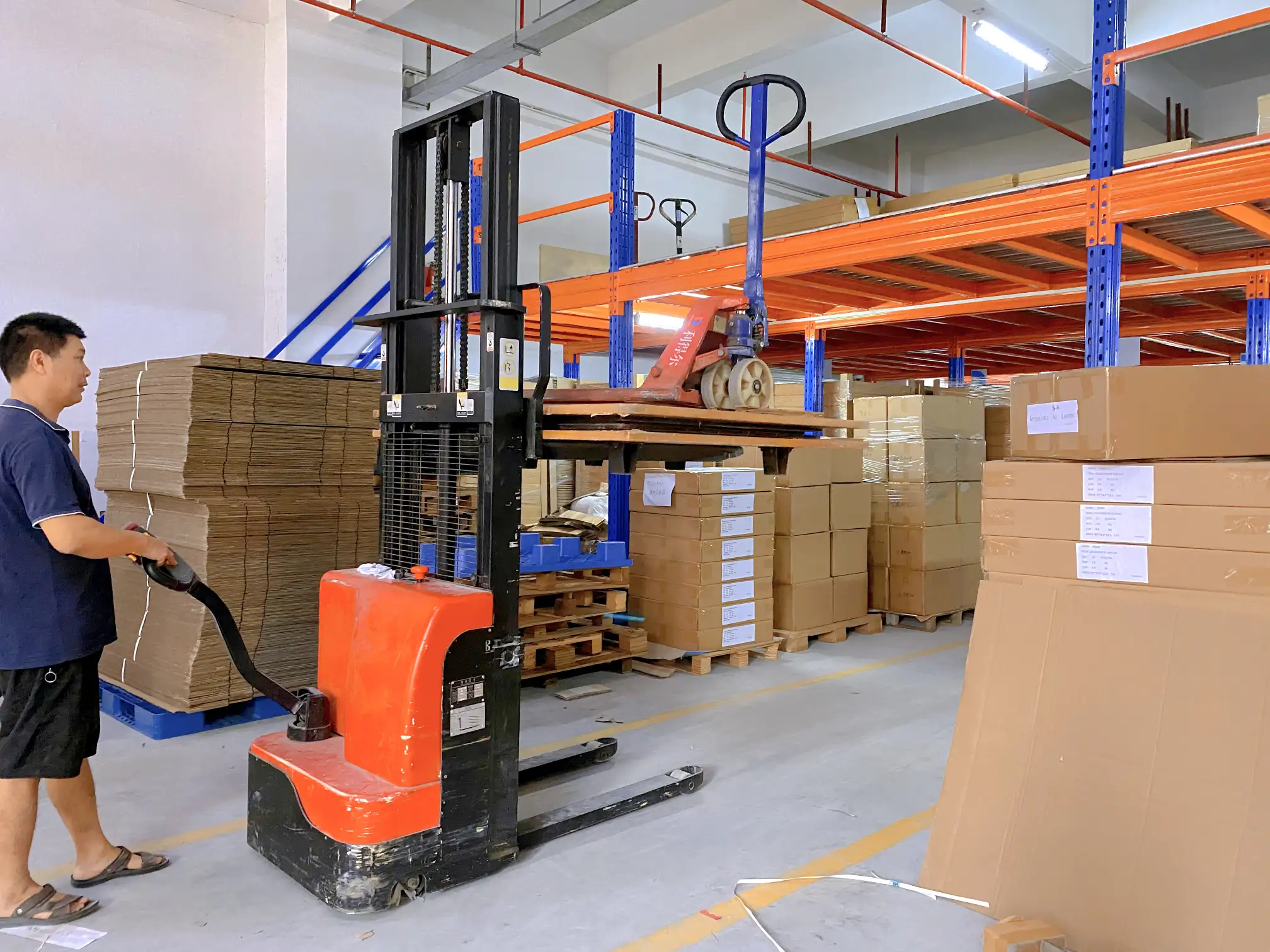
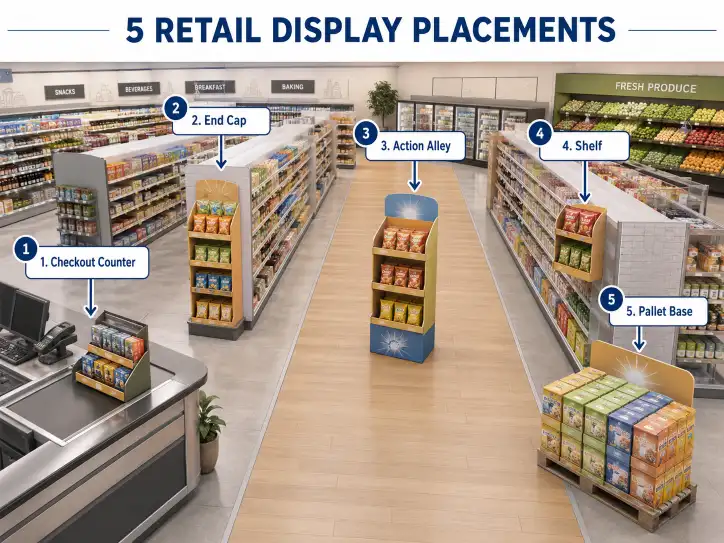
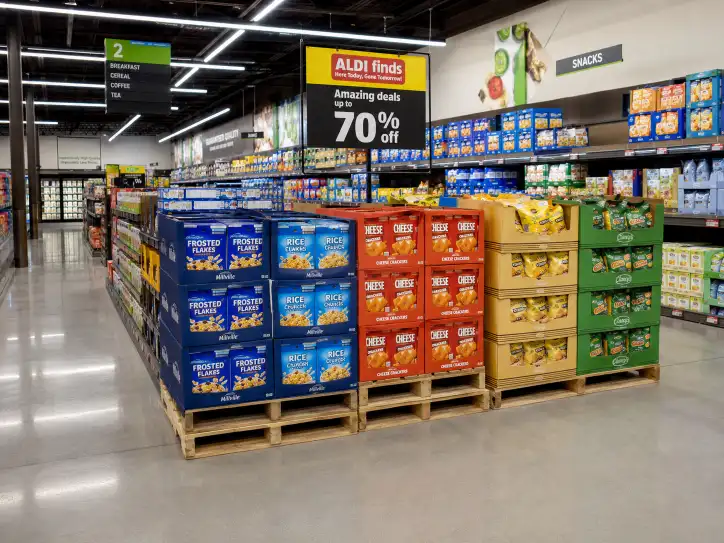
Aldi's store model is built around speed and efficiency: compact stores, a limited assortment, and products that move from pallet to floor without individual shelf stocking. This is why Aldi uses island displays — pallets placed directly on the sales floor in the aisles, presenting the product in its shipping unit. Because the pallet is visible to shoppers, its appearance matters as much as its strength.
Three consequences follow for vendors:
- The pallet is part of the brand presentation. Aldi requires clean, undamaged wood on display pallets because the shopper sees it. A stained, broken, or discolored pallet is rejected even if it is structurally sound.
- Display-ready packaging is mandatory, not optional. Aldi's Display Ready Case (DRC) standard requires the outer case to merchandise with no repacking — the corrugated tray or case becomes the shelf-ready unit.
- Compliance is enforced across the whole supply chain. Aldi pairs physical pallet and packaging standards with EDI requirements, so a vendor must be compliant on paperwork and on the dock.
For an overview of the pallet display format itself, see our pallet display range; this guide covers the Aldi-specific rules that apply on top of it.
Aldi Pallet Requirements: Size, Type, and Grade
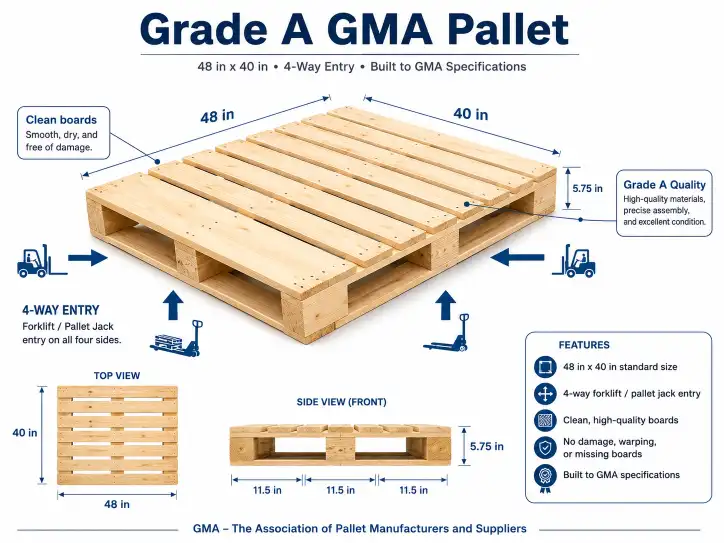
Aldi's pallet standard is the same GMA footprint used across US retail, but the grade and appearance requirements are stricter than most chains because the pallet is on display.
| Requirement | Aldi Standard |
|---|---|
| Pallet size | GMA 48 × 40 inches (primary); 40 × 40 in for some CPG programs |
| Entry type | 4-way entry required |
| Preferred grade | Grade A (new or recycled) |
| Acceptable grade | Grade B for back-dock use only |
| Appearance | Clean wood, no visible damage or discoloration |
| Stringer condition | No broken or cracked stringers on display pallets |
| Methyl bromide (MB) stamp | Not accepted on pallets used for food contact |
| CHEP pallets | Not required from suppliers; Aldi manages its own pool |
The key difference from other retailers: Aldi separates pallets by display use and back-dock use. A Grade A pallet is expected wherever the shopper will see the wood — the sales floor. A Grade B pallet may pass for storage and handling behind the dock but is not acceptable as a display pallet. If you are deciding between new and recycled Grade A pallets, recycled Grade A passes inspection at a lower cost, provided every board is graded against the same criteria — no splits, no protruding nails, no water staining.
For the full picture of standard pallet footprints and how they compare across retailers, our pallet display sizes guide is the reference hub.
Aldi Display Height and Weight Limits
Aldi enforces tight height limits because its stores are compact and its aisles are narrow. The loaded display height is measured from the floor to the top of the load, including the pallet.
| Display format | Max loaded height | Notes |
|---|---|---|
| Full pallet display | 60 inches | Standard for island floor displays |
| Half pallet display | 36–40 inches | Used for endcap and smaller floor positions |
| Display-ready case stack | Fits within the above | DRCs stack within the pallet height |
The 60-inch full-pallet ceiling is lower than the 72-inch standard at Costco and Walmart, which is the first spec most vendors miss when adapting an existing display for Aldi. A display built for a 72-inch club-store program will not pass Aldi receiving without a redesign. On the weight side, Aldi operates within the standard GMA dynamic rating — up to roughly 2,800 lb per pallet — so the constraint is usually height and footprint rather than raw capacity.
For half-pallet positioning rules, the half pallet display guide for club stores covers the 48 × 20 and 24 × 40 footprints Aldi also works with, and the club store display requirements guide explains how the same footprint is specified at Costco and Sam's Club.
Display-Ready Cases: Aldi's Retail-Ready Packaging Standard
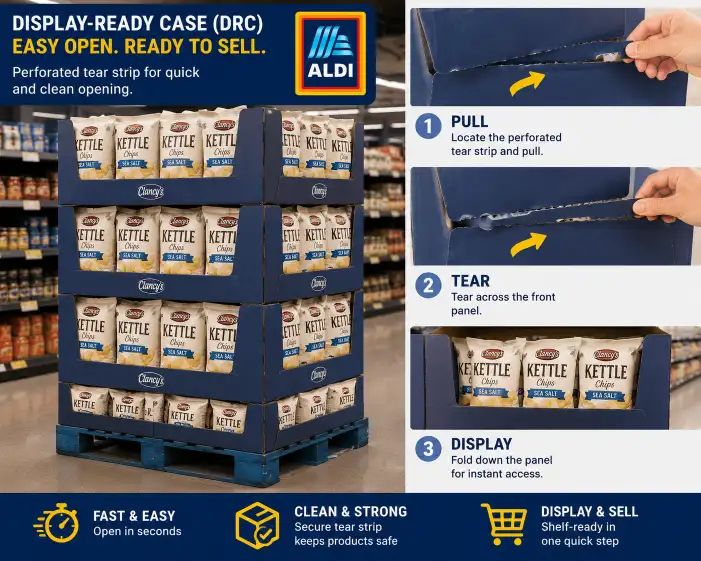
Aldi's Display Ready Case (DRC) is the outer shipping case that must be ready to merchandise with no repacking. It is required for private label and national brand food items and most non-food categories. A compliant DRC must be:
- Fully printed — the case carries the branding, not a plain brown box
- Easy to open and display — a tear strip or perforation that opens cleanly without tools
- Easy to shop — products visible and reachable once the case is opened
- Stable and protective — strong enough to survive transit and to hold product through sell-through
The DRC is Aldi's version of retail-ready packaging (RRP): the corrugated tray or case sits on the pallet, and the pallet becomes the display fixture. This is why DRC design is a corrugated-structure exercise — board grade, perforation quality, and stacking strength all matter. Our retail-ready pallet display guide covers what buyers expect from the finished unit, and the pre-filled pallet display guide explains the factory-loading model Aldi relies on.
Labeling and EDI Compliance for Aldi
Aldi's compliance extends beyond the physical display into the administrative layer. Warehouse-delivered suppliers are expected to meet Aldi's EDI requirements, which the receiving team validates against the physical shipment:
| EDI document | Purpose |
|---|---|
| EDI 850 | Purchase order |
| EDI 856 | Advance ship notice (ASN) with case and pallet detail before delivery |
| EDI 810 | Invoice |
| EDI 997 | Functional acknowledgment |
In practice, this means the pallet labels, case labels, and the ASN must all agree before the truck arrives. A pallet that arrives with a GS1-128 label that does not match the ASN detail is a receiving failure even if the product is correct. Vendors new to Aldi should confirm the label format and EDI requirements with their Aldi buyer or broker before the first shipment, and include the label artwork in the sample approval step. For the label and barcode standards that apply across multiple retailers, the Walmart pallet display requirements and Costco pallet display requirements guides show the GS1-128 label conventions used across the industry.
Structural and Packing Requirements
Because the pallet and its display-ready cases travel as one unit and sell from the floor, the structural requirements focus on transit survival and sell-through stability:
- Corrugated board grade — the DRC tray or case must be specified for the loaded weight and stacking height, typically starting at B-flute and moving to double-wall for heavier loads. The display fixture structural design guide covers ECT ratings and flute selection.
- Stretch wrap — full, even coverage around the display, tight enough to hold cases through transit but easy to remove at the store.
- Corner protection — corner boards on the pallet protect the display and keep the load square.
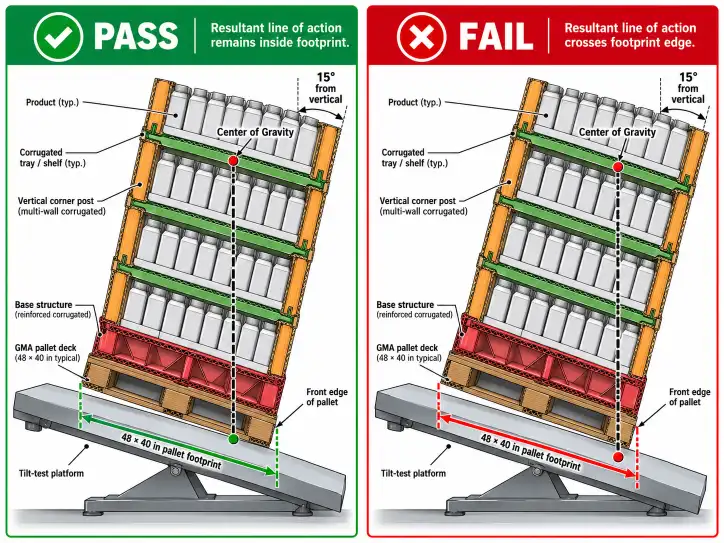
- Partial sell-through stability — the display must stand on its own after shoppers remove 30–50% of the product; a display that collapses half-empty fails in the aisle.
- No overhang — product and cases must sit fully inside the pallet footprint so the load is square and rackable.
The cleanest way to de-risk all of this is a physical sample: load the real product, wrap it to the Aldi spec, and verify the dimensions against the 60-inch height limit before production. Our sampling process covers what to check at that stage.
Aldi vs Costco vs Walmart: How the Specs Compare
Aldi is frequently grouped with club stores because it merchandises from pallets, but its specs sit between club-store and traditional grocery standards.
| Requirement | Aldi | Costco | Walmart |
|---|---|---|---|
| Pallet footprint | GMA 48 × 40 | GMA 48 × 40 | GMA 48 × 40 block |
| Pallet grade | Grade A (display) | GMA standard | GMA block, certified |
| Max loaded height | 60 in (full) | 72–84 in | 72 in |
| Half-pallet height | 36–40 in | Varies | Varies |
| Display format | Display-ready cases on pallet | Pre-filled preferred | Full/half/quarter |
| Max weight | ~2,800 lb | up to 2,500 lb | 2,000 lb |
| Primary compliance | DRC + EDI | Structural tests + labels | Sustainability + Retail Link |
The practical takeaway: an Aldi display is shorter, cleaner, and more packaging-dependent than a club-store display. The 60-inch ceiling forces a lower, wider profile, and the DRC standard means the corrugated case does more of the merchandising work. Vendors who sell to both Aldi and club stores typically maintain separate specs rather than adapting one display to both.
Aldi Display Compliance Checklist
| Check item | Status | Notes |
|---|---|---|
| GMA 48 × 40 pallet, measured | ☐ | Confirm exact dimensions |
| 4-way entry | ☐ | Required |
| Grade A wood, clean appearance | ☐ | No stains, splits, or protruding nails |
| No methyl bromide (MB) stamp | ☐ | For food-contact pallets |
| Loaded height within 60 in | ☐ | Measure from floor, including pallet |
| Half-pallet within 36–40 in | ☐ | If using half pallets |
| DRC fully printed and easy to open | ☐ | Tear strip verified on sample |
| GS1-128 labels match ASN | ☐ | EDI 856 sent before delivery |
| Corner boards and stretch wrap | ☐ | Full coverage |
| Partial sell-through stability | ☐ | Test at 30–50% depletion |
| Sample approved with real product | ☐ | Confirm dimensions and wrap |
Conclusion
Aldi's pallet display requirements are strict because its store model depends on them: the pallet is the shelf, and the display-ready case is the packaging. Vendors who meet the GMA 48 × 40 footprint, the Grade A display-pallet standard, the 60-inch loaded height limit, and the DRC packaging rules will move from the receiving dock to the sales floor without friction. Vendors who adapt a taller club-store display or ship an unprinted case will be rejected — not because the product is wrong, but because the display does not fit how Aldi sells.
Because Aldi's standards change, the authoritative source is Aldi's own supplier documentation: the Aldi supplier FAQ publishes the current DRC and packaging requirements, and GS1 defines the label and EDI standards Aldi validates against. When you are ready to spec an Aldi display, send your product dimensions, target case count, and projected loaded weight to our team — we will size the footprint, set the height under 60 inches, specify the DRC board grade, and produce a sample you can load, wrap, and measure before the bulk run.
FAQ
What size pallet does Aldi require for displays?
Aldi requires GMA 48 × 40 inch pallets as the primary standard, with 40 × 40 inch pallets for some CPG programs. All pallets must have 4-way entry.
What is the height limit for Aldi pallet displays?
Full pallet displays must not exceed 60 inches loaded, measured from the floor including the pallet. Half pallet displays are limited to 36–40 inches.
What pallet grade does Aldi accept?
Aldi prefers Grade A pallets for display use — clean wood with no visible damage, stains, or broken stringers. Grade B pallets are acceptable for back-dock use only.
What is a Display Ready Case (DRC) at Aldi?
A Display Ready Case is the outer shipping case that must merchandise on the sales floor with no repacking. It must be fully printed, easy to open, easy to shop, and stable through transit and sell-through.
Does Aldi require EDI compliance?
Yes. Warehouse-delivered suppliers must meet Aldi's EDI requirements, including EDI 850 (PO), 856 (ASN with case and pallet detail), 810 (invoice), and 997 (functional acknowledgment).
Can I use the same display for Aldi and Costco?
No. Aldi's 60-inch loaded height limit is lower than Costco's 72–84 inch standard, and Aldi's DRC packaging requirement differs from Costco's pre-filled model. Each retailer needs a separately confirmed spec.