
A brand orders a cardboard floor display for a heavy promotional campaign. The design looks right. The artwork is approved. The display arrives at retail, is loaded with product, and within 24 hours the shelves begin to bow. Within a week, the structure collapses. The cause was not the design — it was the material. The display used single-wall corrugation for a product that required double-wall.
The material you choose for a cardboard display determines its strength, durability, print quality, cost, and recyclability. Using the wrong corrugated grade or board type is the most common cause of display failure in retail. Choosing the right material requires understanding flute types, wall structures, ECT ratings, paperboard grades, and how each option performs under real retail conditions.
I have spent 16 years selecting and specifying materials for custom cardboard displays. The material decision is the first and most important engineering choice in any display project. In this guide, I will cover every material option available for cardboard displays — from corrugated grades and flute types to paperboard, specialty papers, and eco-friendly alternatives — and explain how to choose the right one for your specific product and retail environment.
Understanding Corrugated Board Structure
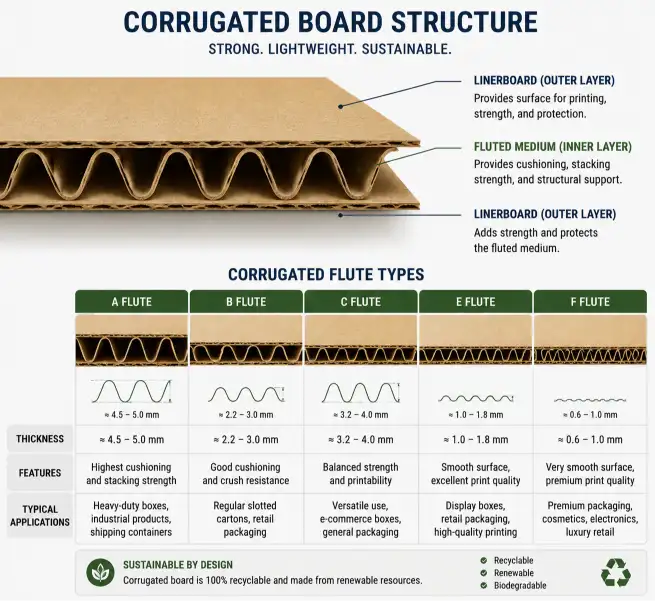
Corrugated board is the primary material used for cardboard displays. It consists of three layers: two flat outer layers called linerboard and a wavy inner layer called the flute. This structure gives corrugated board its strength-to-weight ratio.
The Three Layers
| Layer | Function | Typical Material | Thickness |
|---|---|---|---|
| Outer linerboard | Printing surface, first layer of strength | Kraft paper, test liner, white-top kraft | 0.008–0.016 inch (measured in points) |
| Fluted medium | Provides crush resistance and cushioning | Semi-chemical medium, recycled medium | Varies by flute type |
| Inner linerboard | Structural support, may be printed | Kraft or recycled liner | 0.008–0.016 inch |
How Corrugated Board Is Measured
| Measurement | What It Means | Typical Range | Why It Matters |
|---|---|---|---|
| Basis weight (lb/MSF) | Weight per 1,000 square feet | 26–90 lb | Heavier = stronger, more expensive |
| Caliper | Total board thickness | 1/16" to 1/2" | Determines flute grade |
| ECT (Edge Crush Test) | Vertical compression strength | 23–61+ lbs per inch | Critical for stacking strength |
| Mullen (Burst Test) | Resistance to puncturing | 125–350+ psi | Important for heavy/abrasive products |
| Points | Linerboard thickness (1 point = 0.001") | 20–47 point | Thicker liner = better print surface |
Flute Types and Their Applications
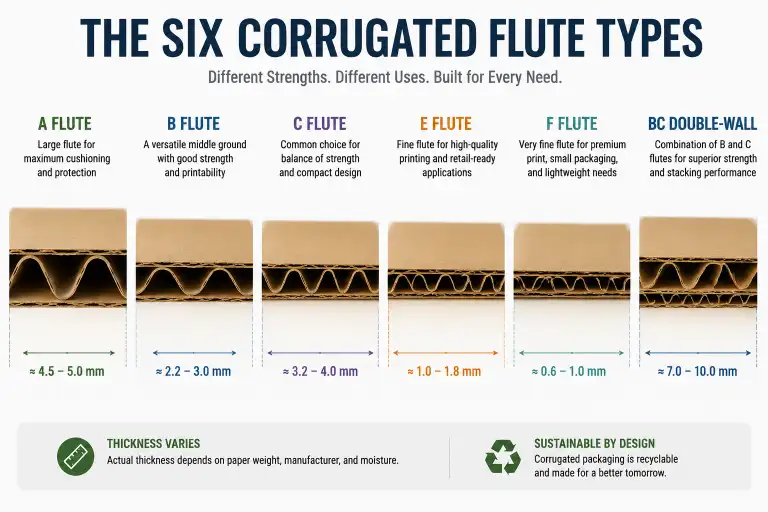
The flute is the wavy middle layer that gives corrugated board its strength. Different flute sizes provide different properties.
Flute Comparison
| Flute Type | Thickness | Flutes Per Foot | Crush Resistance | Flat Crush | Print Surface | Best For |
|---|---|---|---|---|---|---|
| A flute | 1/4" (5mm) | 33–36 | Very high | High | Poor | Heavy products, protective packaging, pallet displays |
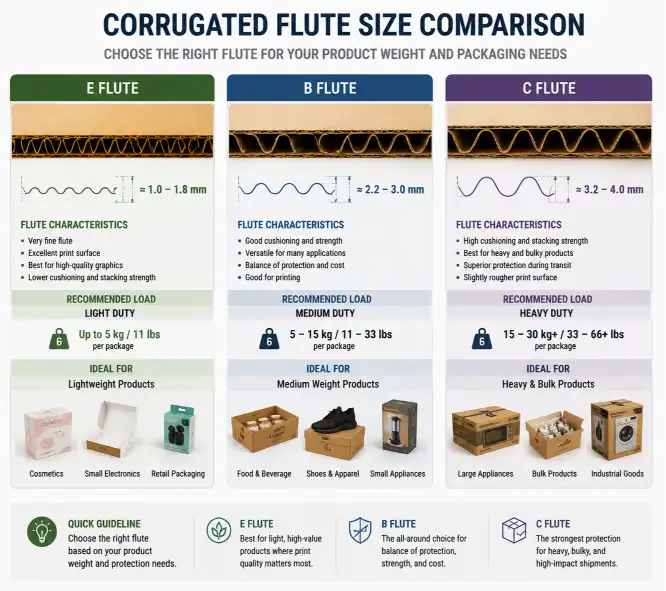
| B flute | 1/8" (3mm) | 47–53 | High | Medium | Good | Retail displays, die-cutting, shelf-ready packaging |
| C flute | 3/16" (4mm) | 39–43 | High | Medium | Good | Most common display flute, balanced strength and print |
| E flute | 1/16" (1.5mm) | 90–96 | Medium | Low | Very good | Folding cartons, precision printing, cosmetic displays |
| F flute | 1/32" (0.8mm) | 125+ | Low | Low | Excellent | Small consumer goods, premium folding cartons |
| BC flute (double-wall) | 5/16" (8mm) | B + C combined | Very high | Very high | Fair | Heavy displays, double-wall structural components |
| EB flute (double-wall) | 1/4" (6mm) | E + B combined | High | High | Good | Displays needing strength and good print surface |
Flute Selection Guide
| Display Type | Recommended Flute | Why |
|---|---|---|
| Lightweight floor display (< 20 lbs product) | B flute | Good strength, good print surface, cost-effective |
| Standard floor display (20–50 lbs product) | C flute | Best balance of strength, print quality, and cost |
| Heavy floor display (50–100 lbs product) | BC double-wall | Maximum strength for heavy product loads |
| Counter display | E flute | Thin profile, excellent print quality, small size |
| PDQ display | B flute or E flute | Good structure, easy die-cutting, clean folds |
| Peg display | B flute | Stiff enough to hold hooks, good print surface |
| Dump bin display | C flute or BC flute | High volume needs wall strength to prevent bulging |
| Pallet display | BC double-wall or triple-wall | Maximum weight capacity, stacking strength |
| Shelf-ready shipper | B flute or E flute | Thin, clean folds, fits standard shelf spacing |
| Standee display | B flute | Lightweight, good print surface for graphics |
Wall Structures: Single, Double, and Triple Wall
Most cardboard displays use one of three wall structures. The wall structure determines how much weight the display can hold and how rigid it is.
Wall Structure Comparison
| Wall Type | Layers | Total Thickness | Weight Capacity | Stiffness | Cost Index | Best For |
|---|---|---|---|---|---|---|
| Single-wall | 2 liner + 1 flute | 1/16"–1/4" | Light to medium | Moderate | 1.0× (baseline) | Most standard displays |
| Double-wall | 3 liner + 2 flutes | 1/4"–3/8" | Heavy | High | 1.5–2.0× | Heavy displays, structural supports |
| Triple-wall | 4 liner + 3 flutes | 3/8"–1/2" | Very heavy | Very high | 2.5–3.5× | Industrial displays, extreme loads |
When to Upgrade Wall Structure
| Display Scenario | Recommend Wall | Why |
|---|---|---|
| Product weight under 30 lbs total | Single-wall | Sufficient strength, lowest cost |
| Product weight 30–80 lbs total | Double-wall | Prevents bowing, ensures stability |
| Product weight 80+ lbs total | Double-wall or triple-wall | Required for structural integrity |
| Display height over 60" | Double-wall | Tall displays need extra rigidity |
| Multiple tiers/shelves | Double-wall | Each shelf needs independent support |
| Shipping in mixed pallet loads | Double-wall | Protects display from compression during transit |
| One-time short-term promotion (< 2 weeks) | Single-wall | Acceptable for short durations |
| Long-term campaign (8+ weeks) | Double-wall | Must withstand repeated restocking and shopper handling |
ECT Ratings and Board Strength
ECT (Edge Crush Test) measures the vertical compression strength of corrugated board. It is the most important specification for display structural integrity.
Standard ECT Ratings
| ECT Rating | Typical Board | Wall Type | Max Vertical Load (per linear foot) | Best For |
|---|---|---|---|---|
| 23 ECT | Lightweight single-wall | Single | 276 lbs | Very light products, small counter displays |
| 26 ECT | Standard single-wall | Single | 312 lbs | General retail displays, light products |
| 29 ECT | Heavy single-wall | Single | 348 lbs | Medium-weight products, standard floor displays |
| 32 ECT | Strong single-wall or light double-wall | Single/Double | 384 lbs | Heavier products, larger floor displays |
| 44 ECT | Standard double-wall | Double | 528 lbs | Heavy displays, pallet displays, structural supports |
| 48 ECT | Heavy double-wall | Double | 576 lbs | Very heavy products, club store displays |
| 61 ECT | Ultra-heavy double-wall or triple-wall | Double/Triple | 732 lbs | Industrial displays, maximum weight capacity |
How to Choose the Right ECT Rating
| Step | Calculation | Example |
|---|---|---|
| 1 | Calculate total product weight | 48 bottles × 2.5 lbs = 120 lbs |
| 2 | Add display dead weight | +5 lbs = 125 lbs total |
| 3 | Calculate shelf area per shelf | 4 shelves × 20" width × 12" depth = 960 sq in |
| 4 | Convert to linear feet | 960 ÷ 12 = 80 linear inches = 6.67 linear feet |
| 5 | Divide total weight by linear feet | 125 ÷ 6.67 = 18.7 lbs per linear foot |
| 6 | Apply safety factor (3× minimum) | 18.7 × 3 = 56.1 lbs per linear foot |
| 7 | Select ECT rating that exceeds required load | 61 ECT (732 lbs max) — sufficient for 56.1 lbs requirement |
Rule of thumb: Always apply a 3× safety factor. The display must support three times the actual product weight to account for stacking during shipping, shoppers leaning on the display, and long-term fatigue.
Paperboard Types for Displays
Beyond corrugated board, several paperboard types are used for specific display components.
Paperboard Grades
| Type | Thickness | Print Quality | Cost Index | Best For |
|---|---|---|---|---|
| Kraft liner (unbleached) | 0.008–0.016" | Poor — brown, rough | 1.0× | Unprinted interior panels, eco-friendly displays |
| White-top kraft | 0.008–0.016" | Good — white surface, brown back | 1.2× | Most standard displays, good print surface |
| Bleached white (SBS) | 0.008–0.024" | Excellent — bright white, smooth | 1.6× | Premium displays, high-quality printing, cosmetic displays |
| Clay-coated news (CCN) | 0.012–0.030" | Very good — smooth coated surface | 1.3× | Folding cartons, smaller displays, retail packaging |
| Recycled liner | 0.008–0.016" | Poor — gray/brown, inconsistent | 0.8× | Budget displays, interior components, eco-friendly |
| Chipboard (solid board) | 0.020–0.120" | Good — smooth, dense | 1.4–2.0× | Rigid boxes, premium inserts, book-style boxes |
Linerboard Selection by Print Requirement
| Print Quality Needed | Recommended Liner | Why |
|---|---|---|
| No printing (kraft interior) | Kraft liner | Lowest cost, natural look |
| 1–2 color flexographic print | White-top kraft | Clean white surface, affordable |
| 4-color process print | White-top kraft or SBS | Bright surface for accurate color reproduction |
| Photo-realistic litho lamination | SBS or high-quality white-top | Smoothest surface for laminated print |
| Premium brand display | SBS bleached white | Brightest white, best contrast, premium feel |
| Eco-friendly natural look | Kraft liner (unbleached) | Natural brown reinforces sustainability message |
Specialty Materials for Displays
Coated and Treated Boards
| Material | Treatment | Property | Best For | Cost Premium |
|---|---|---|---|---|
| Wax-coated board | Wax impregnation | Moisture resistant | Beverage displays, refrigerated sections, ice displays | +30–50% |
| Water-resistant board | Chemical treatment | Water repellant | Outdoor displays, produce sections, humid environments | +20–40% |
| Anti-static board | Carbon treatment | Static dissipative | Electronics displays, clean rooms | +25–40% |
| Fire-retardant board | Chemical treatment | Fire resistant | Retailers with strict fire codes, large displays | +40–80% |
| Food-safe board | FDA-compliant materials | Safe for food contact | Food displays, produce, bakery | +10–25% |
Alternative Display Materials
| Material | Strength | Print Quality | Recyclability | Cost | Best For |
|---|---|---|---|---|---|
| Corrugated plastic (Coroplast) | Very high | Good | Limited | High | Reusable displays, outdoor, long-term |
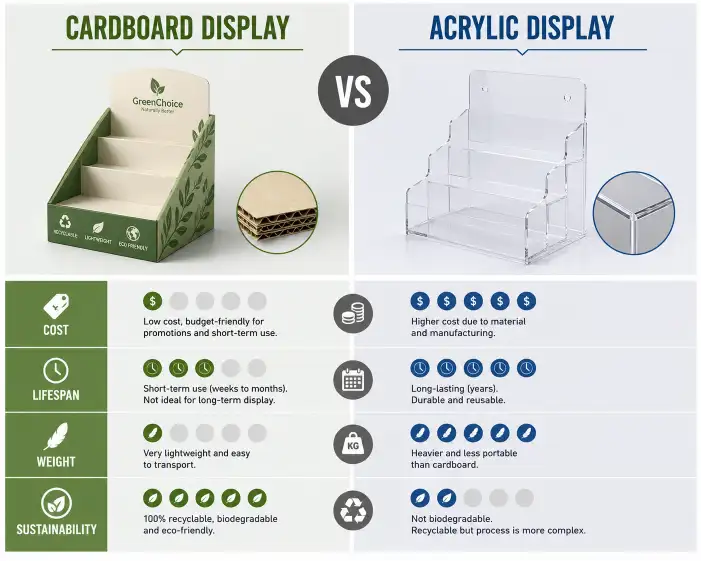
| Acrylic | Very high | Excellent | Limited | Very high | Premium counter displays, sign holders |
| Metal wire | High | N/A | High | Medium | Peg hooks, display racks, shelving supports |
| Foam board | Low | Excellent | Limited | Medium | Standees, event displays, short-term |
| E-flute micro-flute | Medium | Excellent | Full | Medium | Premium retail packaging, small counter displays |
Material Selection by Display Type
Quick Reference Table
| Display Type | Recommended Flute | Recommended Wall | Recommended Liner | Minimum ECT |
|---|---|---|---|---|
| Counter display | E or B | Single | White-top or SBS | 26 ECT |
| PDQ display | B | Single | White-top | 26 ECT |
| Sidekick display | B | Single | White-top | 26 ECT |
| Peg display | B | Single | White-top | 29 ECT |
| Floor display (light, < 30 lbs) | C | Single | White-top | 29 ECT |
| Floor display (medium, 30–80 lbs) | C or BC | Single or Double | White-top or SBS | 32 ECT |
| Floor display (heavy, 80+ lbs) | BC | Double | White-top or SBS | 44 ECT |
| Dump bin (light, < 30 lbs) | C | Single | Kraft or white-top | 26 ECT |
| Dump bin (medium, 30–60 lbs) | C or BC | Single or Double | White-top | 32 ECT |
| Dump bin (heavy, 60+ lbs) | BC | Double | White-top | 44 ECT |
| Pallet display (standard) | BC | Double | White-top | 44 ECT |
| Pallet display (heavy duty) | BC or triple | Double or Triple | White-top | 48–61 ECT |
| Standee display | B | Single | White-top or SBS | 26 ECT |
| Shelf-ready shipper | B or E | Single | White-top | 26 ECT |
Component Material Guide
| Component | Recommended Material | Why |
|---|---|---|
| Display main body | C flute single-wall (standard) | Best balance of strength, print, and cost |
| Heavy-duty shelves | BC double-wall | Must support product weight without bowing |
| Dividers and inserts | E or B flute single-wall | Thin enough to save space, strong enough to separate products |
| Header cards | E flute or SBS paperboard | Excellent print surface, lightweight |
| Base reinforcement | BC double-wall or chipboard | Must support total display weight |
| Pallet base | BC or triple-wall | Must survive forklift handling and shipping compression |
| Window panels | Clear PET plastic or E flute cutout | Product visibility, cost varies by material |
| Sign holders | Acrylic or polycarbonate | Clear, durable, reusable across campaigns |
For more on structural design, see our display fixture structural design guide.
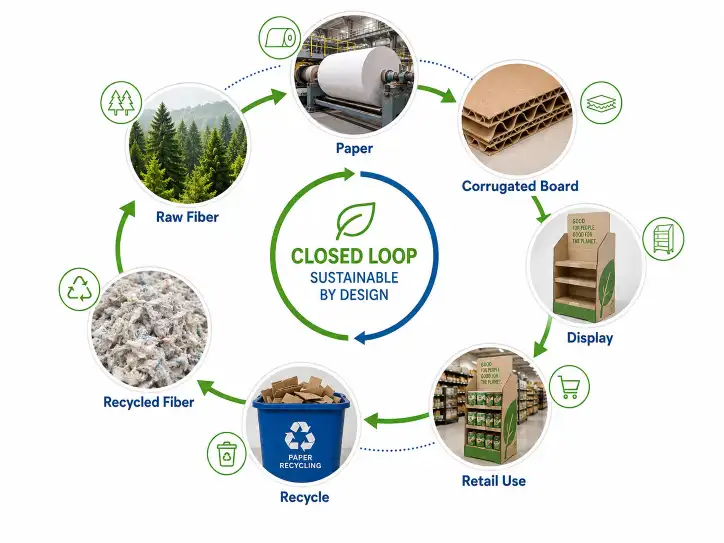
Eco-Friendly and Sustainable Material Options
Recycled Content Options
| Material | Recycled Content | Strength vs Virgin | Print Quality | Cost vs Virgin |
|---|---|---|---|---|
| 100% recycled corrugated | 100% | 70–85% | Lower | 80–90% |
| High-recycled content (70–80%) | 70–80% | 80–90% | Medium | 85–95% |
| Mixed recycled/virgin | 30–50% | 90–95% | Good | 95–100% |
| Virgin kraft | 0% | 100% | Best | 100% (baseline) |
Eco-Friendly Certifications
| Certification | What It Means | Why It Matters for Displays |
|---|---|---|
| FSC (Forest Stewardship Council) | Paper sourced from responsibly managed forests | Required by many major retailers for sustainability compliance |
| SFI (Sustainable Forestry Initiative) | Sustainable forest management certification | Accepted alternative to FSC for North American markets |
| PEFC (Programme for the Endorsement of Forest Certification) | International sustainable forestry standard | Required by some European retailers |
| Recyclable symbol | Display can be recycled after use | Standard for most corrugated displays — confirm coating compatibility |
Reducing Material Usage
| Strategy | Material Savings | Cost Impact | How to Apply |
|---|---|---|---|
| Reduce flute size | 10–20% less material | -10–15% cost | Use B flute instead of C flute where strength allows |
| Eliminate unnecessary panels | 5–15% less material | -5–10% cost | Simplify internal structure, reduce double-wall where not needed |
| Optimize die layout | 3–8% less waste | -3–5% cost | Work with supplier to nest die patterns efficiently |
| Use recycled content | Varies | -10–20% cost | Specify high-recycled-content board for non-printed components |
| Remove lamination | 0% material saved | -15–25% cost | Skip lamination on hidden panels and short-term displays |
Cost Comparison of Display Materials
Material Cost Index (per square foot, 1,000 sq ft order)
| Material | Cost per sq ft (1,000 sq ft) | Cost Index |
|---|---|---|
| Single-wall B flute, kraft liner | $0.25–$0.35 | 1.0× (baseline) |
| Single-wall B flute, white-top | $0.30–$0.42 | 1.2× |
| Single-wall C flute, white-top | $0.32–$0.45 | 1.3× |
| Single-wall E flute, white-top | $0.28–$0.40 | 1.1× |
| Single-wall E flute, SBS | $0.50–$0.70 | 2.0× |
| Double-wall BC flute, white-top | $0.45–$0.65 | 1.8× |
| Double-wall BC flute, kraft | $0.38–$0.55 | 1.5× |
| Triple-wall, kraft | $0.65–$0.95 | 2.6× |
| Chipboard (0.060") | $0.35–$0.55 | 1.4× |
| Litho laminated (E flute + print) | $0.60–$0.90 | 2.4× |
Cost-Saving Material Strategies
| Strategy | Potential Savings | Risk | Best Application |
|---|---|---|---|
| Use B flute instead of C flute | 10–15% | Lower strength | Light products only |
| Use kraft instead of white-top for interior | 15–20% | Interior looks brown | Hidden panels, dividers, inserts |
| Use single-wall instead of double-wall | 35–45% | Structural failure if wrong | Only for products under 30 lbs total |
| Use recycled instead of virgin | 10–20% | Lower print quality | Unprinted components, eco-friendly brands |
| Reduce board basis weight | 5–10% | Lower strength | Test with supplier before approving |
| Remove lamination from interior | 15–25% | Hidden surfaces unprotected | Short-term displays only |
For more on pricing, see our custom cardboard display cost guide.
FAQ
What is the best material for a cardboard display?
The best material depends on the product weight, display size, and retail environment. For most standard floor displays, C flute single-wall with white-top kraft liner is the best balance of strength, print quality, and cost. For heavy products or large displays, upgrade to double-wall BC flute. For small counter or PDQ displays, B flute or E flute works well.
What is the difference between B flute and C flute?
B flute is 1/8" thick with 47–53 flutes per foot. It is thinner, stiffer, and provides a better printing surface. C flute is 3/16" thick with 39–43 flutes per foot. It is thicker, provides more cushioning, and has higher crush resistance. C flute is the standard for most floor displays. B flute is preferred for counter displays, PDQ displays, and die-cut components.
What does ECT mean in corrugated board?
ECT stands for Edge Crush Test. It measures the vertical compression strength of corrugated board in pounds per inch. Higher ECT ratings mean stronger board. For most retail displays, 26–32 ECT single-wall is standard. Heavy displays need 44+ ECT double-wall. Always apply a 3× safety factor when selecting ECT ratings.
What corrugated grade do I need for a heavy product display?
For displays holding over 50 lbs of product, use double-wall BC flute with a minimum 44 ECT rating. For 30–50 lbs, heavy single-wall C flute at 32 ECT may be sufficient. Always calculate the total product weight, divide by the shelf area, and apply a 3× safety factor before selecting the material grade.
Can I use recycled corrugated for my display?
Yes — recycled corrugated is a viable option for many displays. High-recycled-content board (70–80%) works well for interior components, dividers, and unprinted panels. For printed exterior surfaces, use virgin or mixed-content board with a white-top liner for better print quality. Recycled board has 10–20% lower strength than virgin board — factor this into your structural calculations.
What is the most eco-friendly material for a cardboard display?
The most eco-friendly option is recycled corrugated board with no lamination or coating, printed with water-based inks. This combination is 100% recyclable after use. FSC-certified virgin board is the next best option. Avoid plastic coatings, wax treatments, and lamination on components that do not need them — these reduce recyclability.
What material is used for the printing surface of a display?
The printing surface is the outer linerboard of the corrugated sheet. White-top kraft is the standard for most printed displays. SBS (Solid Bleached Sulfate) is used for premium printing where the brightest white surface and highest detail reproduction are needed. Kraft (brown) is used for unprinted or eco-friendly displays.
How do I choose between single-wall and double-wall?
Use single-wall for displays with less than 30 lbs total product weight, under 48" height, and short-term promotions. Use double-wall for displays with 30–80 lbs product weight, over 48" height, multiple shelves, or long-term campaigns. For heavy displays (80+ lbs), use double-wall or triple-wall exclusively.
Do I need special materials for displays in refrigerated sections?
Yes. Standard corrugated board absorbs moisture in refrigerated environments and will delaminate or collapse. Use water-resistant treated board or wax-coated board for refrigerated, frozen, or high-humidity displays. Also use full lamination (not just aqueous coating) to protect printed surfaces from condensation.
What is litho lamination and when should I use it?
Litho lamination is a process where a high-quality printed paper sheet is laminated onto corrugated board. It provides the highest print quality — photo-realistic images, fine text, and vibrant colors. Use litho lamination for premium brand displays, cosmetic displays, gift sets, and any display where image quality is critical. It adds 20–35% to the material cost.

One Response