
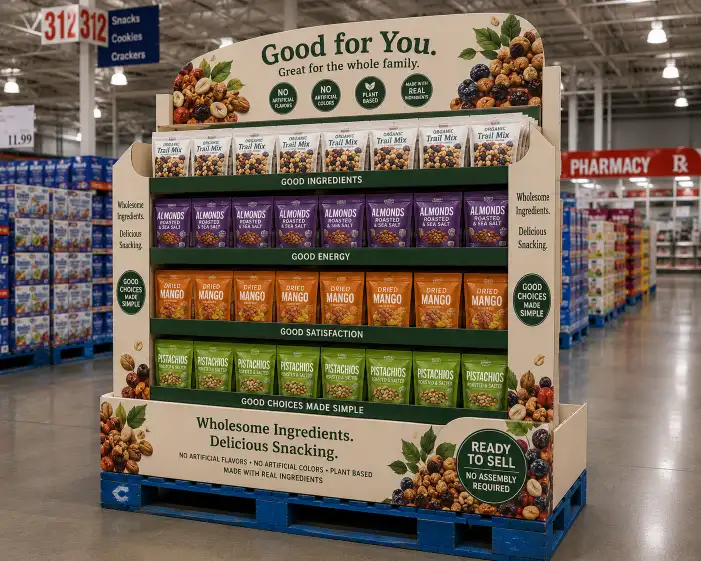
Club stores like Costco and Sam's Club do not have staff in the back room assembling displays or loading products onto shelves. When a pallet arrives at a club store, it must be ready to go directly to the sales floor. This is what the industry calls a retail-ready pallet display — a pre-built, pre-loaded display unit that requires nothing more than removing the stretch wrap.
For B2B buyers, understanding what makes a display retail-ready is essential. A display that looks good in the design stage but requires in-store assembly, has missing labels, or is packed incorrectly will be rejected at the receiving dock.
This guide explains what retail-ready pallet displays are, what club store buyers expect, and how to ensure your display meets the standard.
What Is a Retail-Ready Pallet Display?
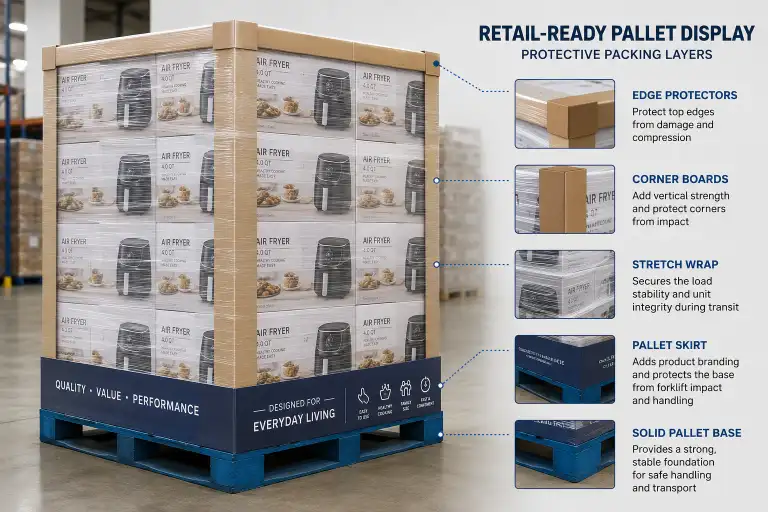
A retail-ready pallet display is a corrugated display unit that arrives at the store fully assembled and pre-loaded with product. The store staff does not need to open cartons, assemble components, or load products. They remove the outer packaging — stretch wrap, corner boards, and any protective materials — and the display is ready for the sales floor.
Key Characteristics
| Feature | Requirement | Why It Matters |
|---|---|---|
| Pre-assembled | Display structure is fully assembled at factory | No in-store assembly needed |
| Pre-loaded | Products are loaded into display at factory | No product handling in store |
| Pallet-mounted | Display is built on a standard GMA pallet | Forklift moves it directly to floor |
| Wrapped for transit | Stretch wrap, corner boards, edge protectors | Survives shipping without damage |
| Labeled | GS1-128 labels on minimum 2 sides | Receiving dock acceptance |
| Branded | Printed pallet skirt, header card | Ready to sell immediately |
The "One Touch" Rule
Club stores operate on a "one touch" principle: the display should be touched once — when it is moved from the truck to the sales floor. Any additional handling (assembly, product loading, label correction) defeats the purpose of retail-ready.
For an overview of club store display formats, see our guide to Costco-style club store displays.
Why Club Stores Require Retail-Ready Displays
Costco, Sam's Club, and other warehouse club retailers require retail-ready displays for three reasons:
1. Labor Efficiency
Club stores operate with minimal staff. There is no dedicated team for display assembly or product stocking. A display that requires in-store assembly forces store staff away from customer-facing tasks. Pre-filled pallet displays reduce in-store labor by over 80% compared to flat-pack alternatives.
2. Speed to Floor
Club stores move inventory fast. A truck arrives, pallets are unloaded, and products must be on the sales floor within hours. A retail-ready display goes from receiving dock to sales floor in minutes. A flat-pack display might sit in the back room for days waiting for assembly.
3. Consistency
Retail-ready displays ensure that every store presents the product in the same way. The display looks exactly as the brand and buyer approved — same tray layout, same product arrangement, same signage. There is no variation caused by different store staff assembling the display differently.
Costco-Specific: The No-Touch Policy
Costco's "no-touch" policy means that pallet displays must be self-contained units that go from truck to sales floor without any intervention. This is not a preference — it is a compliance requirement. Displays that require assembly or product loading in store are not accepted.
For complete Costco specifications, see our Costco Pallet Display Requirements guide.
Pre-Filled Pallet Displays: The Core of Retail-Ready
A pre-filled pallet display is the most common format for retail-ready club store displays. Products are loaded into the display at the factory, the unit is wrapped for transit, and it arrives at the store ready to sell.
Pre-Filled Process
Product Receipt → Display Assembly → Product Loading →
Barcode Verification → Packing → Palletizing → Labeling → Shipment
What Happens at the Factory
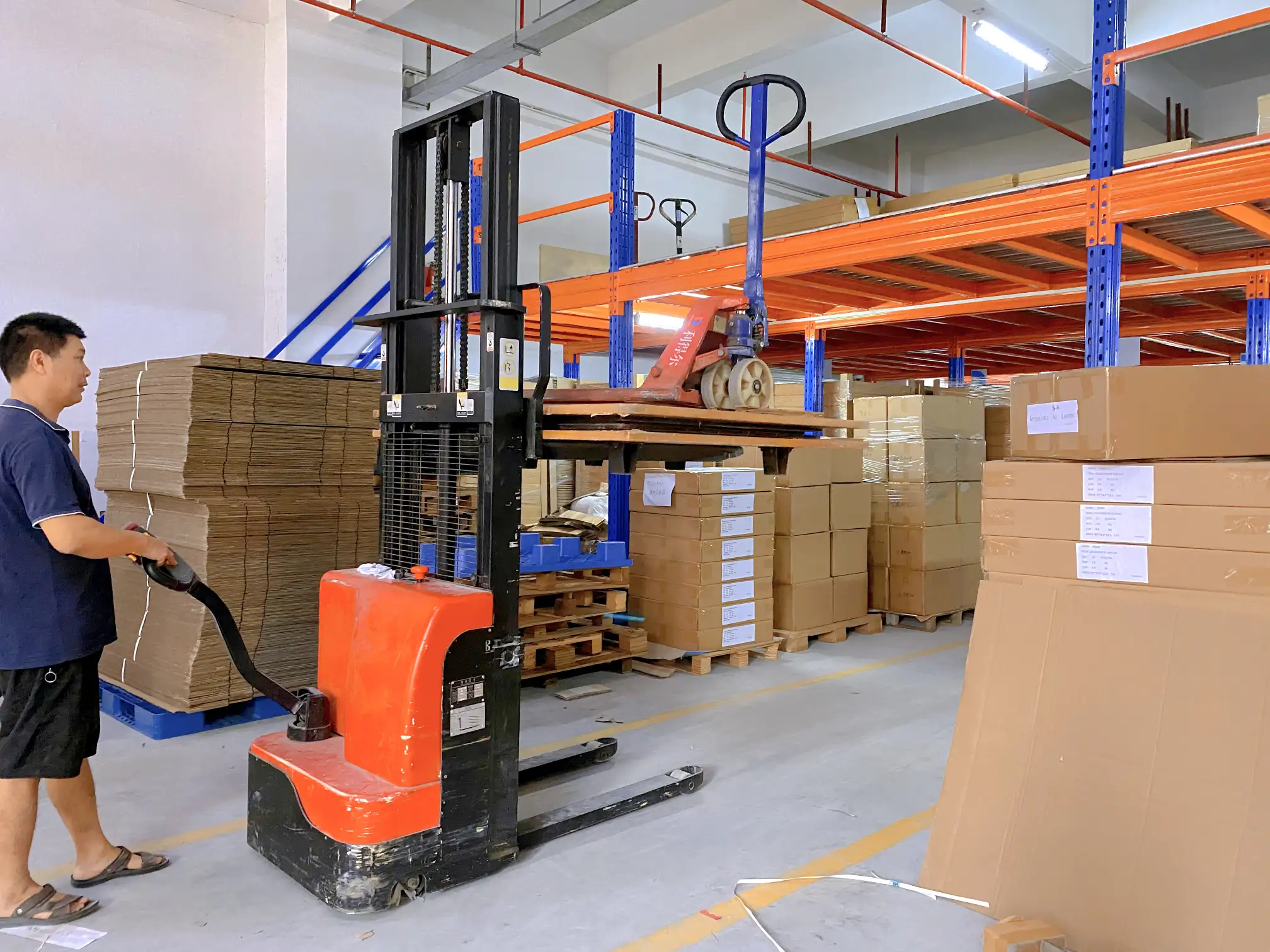
- Product receipt — Products arrive at the factory warehouse from the brand or a third-party supplier
- Inspection — Products are checked for quantity, condition, and expiry dates
- Display assembly — The corrugated display structure is assembled to the specified configuration
- Product loading — Products are placed into the display according to the planogram
- Barcode scanning — Each product barcode is scanned to confirm correct SKU and quantity
- Packing — The filled display is wrapped with stretch wrap, corner boards, and edge protectors
- Palletizing — The unit is placed on a GMA pallet (if not already integrated)
- Labeling — All required labels are applied to the pallet
- Staging — Finished pallets are staged for container loading
Co-Packing vs Pre-Filled
| Term | Meaning |
|---|---|
| Pre-filled display | Products loaded into the display at the factory |
| Co-packing | The service of loading products into displays (same concept, different term) |
| Factory loaded | Same as pre-filled — loaded at the factory |
| Retail-ready | Pre-filled + properly labeled + transit-ready |
For details on the co-packing and fulfillment process, see our Display Fulfillment and Palletizing article.
Packing Standards for Retail-Ready Displays
The packing method determines whether a display survives transit and arrives in sellable condition.
Packing Components
| Component | Purpose | Specification |
|---|---|---|
| Stretch wrap | Secures the load, protects from moisture | 3–5 layers minimum, applied evenly |
| Corner boards | Protects pallet corners from strap damage | L-shaped corrugated, all 4 corners |
| Edge protectors | Prevents compression at strap contact points | Placed under all straps |
| Layer pads | Distributes weight between product tiers | Corrugated sheets between layers |
| Pallet skirt | Printed branding around the pallet base | Corrugated or heavy paper |
| Pallet base | Foundation for the display | GMA standard 48×40 in |
Wrap Requirements
- Full wrap — Stretch wrap must cover the entire display from base to top
- Base reinforcement — Additional 2–3 wraps at the bottom where the display meets the pallet
- Vented wrap — For perishable products requiring airflow
- No loose ends — All wrap ends must be sealed and secured
Moisture Protection
For sea freight and humid environments, additional moisture protection is needed:
- Moisture-resistant adhesive on all glue joints
- Desiccant packs in sealed containers for routes exceeding 15 days
- Vented stretch wrap for condensation-prone products (beverages, chilled items)
For packing specifications, see our SHIPPING page.
Labeling for Retail-Ready Club Store Displays
Incorrect labeling is the leading cause of receiving dock rejection for retail-ready displays. Club stores use automated receiving systems that scan pallet labels. If the label is missing, incorrect, or unreadable, the pallet is rejected.
Required Labels for Retail-Ready Displays
| Label Type | Information | Required By |
|---|---|---|
| GS1-128 pallet label | SSCC-18, PO number, supplier code, quantity, weight | Costco, Sam's Club |
| Carton content label | SKU, product name, quantity per display | All club stores |
| Retail price label | Unit price, member price, effective date | Costco, Sam's Club |
| Handling labels | "This Side Up," stack limit, fragile | All club stores |
| Country of origin | "Made in China" or applicable | Customs requirement |
| UPC/GTIN barcode | 12-digit or 14-digit barcode per SKU | All club stores |
Label Placement
- Minimum two sides — Front and one adjacent side of the pallet
- No overlay on perforations — Labels must not cover tear strips or opening panels
- Readable after wrapping — Labels must scan through stretch wrap
- Buyer pre-approval — Always send label artwork to the buyer before production
For label approval procedures, see our SAMPLING page.
Retail-Ready vs Flat Pack vs Semi-Assembled
Understanding the difference between packing methods helps buyers choose the right approach for their club store project.
| Factor | Retail-Ready (Pre-Filled) | Semi-Assembled | Flat Pack (KD) |
|---|---|---|---|
| Assembly at factory | Full assembly | Partial assembly | None (flat) |
| Product loaded at factory | Yes | No | No |
| Store labor required | Minimal (unwrap only) | Medium (final assembly) | High (full assembly + loading) |
| Shipping volume | Highest | Medium | Lowest |
| Freight cost per unit | Highest | Medium | Lowest |
| Club store preference | Most preferred | Acceptable | Least preferred |
| Transit protection | Full (wrapped unit) | Partial | Minimal |
| Time to floor | Minutes | 15–30 minutes | 30–60+ minutes |
When Flat Pack Makes Sense
Flat-pack displays are occasionally accepted for:
- New product trials with very low volume
- Products that cannot be pre-loaded due to packaging constraints
- Clubs with dedicated merchandising teams
- International shipments where freight cost is the primary concern
However, for Costco and Sam's Club, retail-ready (pre-filled) is the standard. Flat-pack is rarely accepted.
For a detailed comparison, see our Display Fulfillment and Palletizing article.
Transit Testing for Retail-Ready Displays
Retail-ready displays must survive the journey from factory to store without damage. Transit testing verifies that the packed display can withstand shipping conditions.
Required Tests
| Test | What It Simulates | Passing Criteria |
|---|---|---|
| Compression (ECT) | Stacking during storage and transit | Min 32 lbs/in (single-wall), 48+ (double-wall) |
| Vibration | Truck transit vibration | No structural failure, no product damage |
| Drop | Forklift and handling impacts | No damage from 6–12 inch drops |
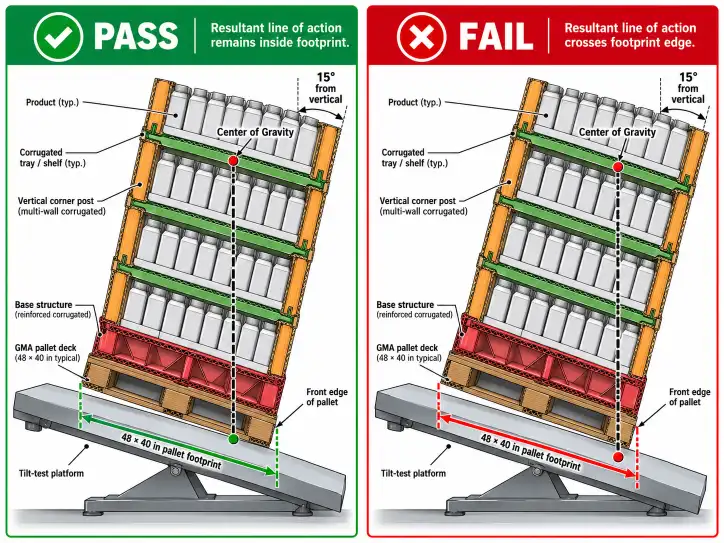
| Tilt | Stability during movement | Display must not tip at 15–20 degrees |
| Pallet jack test | Movement by pallet jack | Display must remain stable during movement |
Testing Frequency
- New display designs — Full test battery required
- Board grade changes — New compression and vibration tests
- Product weight changes over 10% — New structural testing
- Annual requalification — Some club stores require updated reports
For detailed testing procedures, see our club store display requirements article.
Buyer Checklist for Retail-Ready Pallet Displays
| Check Item | Status | Notes |
|---|---|---|
| Display is pre-assembled at factory | ☐ | No assembly required in store |
| Products are pre-loaded at factory | ☐ | Co-packing arranged |
| GMA pallet 48×40 in | ☐ | Confirm exact dimensions |
| Stretch wrap 3–5 layers | ☐ | Full coverage, base reinforced |
| Corner boards all 4 corners | ☐ | L-shaped protectors |
| Pallet skirt printed | ☐ | Branding on all sides |
| GS1-128 labels on 2 sides | ☐ | Approved by buyer |
| Retail price labels applied | ☐ | Member price visible |
| Structural test reports ready | ☐ | ECT, vibration, drop, tilt |
| Transit test passed | ☐ | No damage in testing |
| Sample approved with real product | ☐ | Test with actual product weight |
| Container loading plan confirmed | ☐ | Loading diagram provided |
| Buyer confirmed retail-ready spec | ☐ | Written confirmation received |
Conclusion
A retail-ready pallet display is the standard for club store retail. It saves store labor, speeds up product placement, ensures consistent presentation, and meets the compliance requirements of Costco and Sam's Club.
For B2B buyers, the key to success is planning the retail-ready features at the design stage — not adding them after production has started. Confirm the packing method, labeling requirements, and transit testing with your buyer before the factory begins production.
If you are planning a club store display project, start with the COSTCO DISPLAYS product page or the PALLET DISPLAY product page. For a complete overview of display fulfillment, read our Display Fulfillment and Palletizing guide.
FAQ
What is a retail-ready pallet display?
A retail-ready pallet display is a pre-assembled, pre-loaded display unit on a GMA pallet that arrives at the store ready to sell. Store staff only need to remove the stretch wrap and place it on the sales floor.
What is the difference between retail-ready and pre-filled?
They are closely related. Pre-filled means products are loaded at the factory. Retail-ready means pre-filled plus properly labeled, wrapped, and transit-tested. All retail-ready displays are pre-filled, but not all pre-filled displays meet retail-ready standards.
Why do club stores require retail-ready displays?
Club stores operate with minimal staff and move inventory fast. Retail-ready displays eliminate in-store assembly and product loading, reducing labor cost and speeding up time to floor.
What packing is needed for a retail-ready display?
The display needs stretch wrap (3–5 layers), corner boards on all four pallet corners, edge protectors under straps, layer pads between product tiers, and a printed pallet skirt.
What labels are required on a retail-ready display?
GS1-128 pallet labels, carton content labels, retail price labels, handling labels, country of origin, and UPC/GTIN barcodes. Labels must be on at least two sides of the pallet.
Is flat-pack accepted at club stores?
Flat-pack is the least preferred packing method at Costco and Sam's Club. Most club store buyers require pre-filled (retail-ready) displays because store labor for assembly is not available.
How do I test a retail-ready display for transit?
Required tests include compression (ECT), vibration, drop, and tilt testing. These simulate the conditions the display will face during truck and container shipping.

One Response