
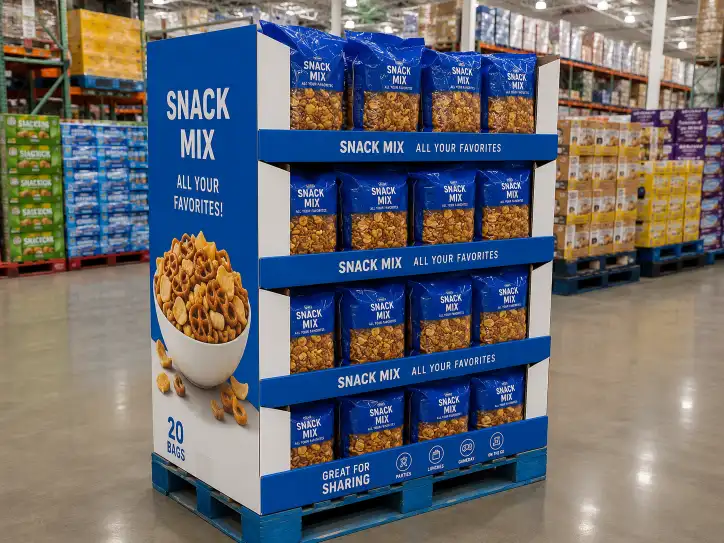
If you have walked into a Costco, Sam's Club, or BJ's Wholesale Club, you have seen them — large corrugated displays sitting on pallets, stacked with products, often with a printed skirt wrapping the base. These are commonly called Costco-style displays, but the format extends far beyond one retailer. The proper term is warehouse club displays, and they represent a distinct category of retail merchandising with specific design, packing, and logistics rules.
For B2B buyers and suppliers, understanding what Costco-style club store displays are — and how they differ from standard retail displays — is essential for getting products onto club store floors. This guide explains the display types, the terminology, and what you need to know before ordering.
What Are Costco-Style Club Store Displays?
Costco-style club store displays are corrugated display units built on a pallet base, designed for warehouse club retail environments. They are called "Costco-style" because Costco popularized the format, but the same display type is used across all major warehouse club retailers.
A true Costco-style display has three defining characteristics:
- Pallet-based footprint — The display is built on a standard GMA pallet (48 × 40 inches) or a half-pallet base. It ships, handles, and sells from this pallet.
- Retail-ready presentation — The display is designed to be moved from the truck to the sales floor without re-packing. Store staff unwrap it and it is ready to sell.
- Bulk product capacity — Club store displays hold significantly more product than standard retail displays. A typical unit carries 500–1,500 lbs of product.
Common Names for Costco-Style Displays
| Term | What It Means |
|---|---|
| Costco-style display | Display designed for Costco's pallet and packing standards |
| Warehouse club display | General term for displays used at Costco, Sam's Club, BJ's |
| Club store pallet display | Pallet-based display for any club channel |
| PDQ pallet display | Pre-packed pallet display, ready-to-sell on arrival |
| Retail-ready pallet display | Display that ships pre-assembled and pre-loaded |
| Pre-filled pallet display | Products loaded into the display at the factory |
| Half pallet display | Smaller footprint (48×20 or 24×40 in) for club endcaps |
| Pallet skirt display | Display with a printed wrap-around skirt on the base |
For a full range of pallet-based display options, see our PALLET DISPLAY product page.
Warehouse Club Displays vs Standard Retail Displays
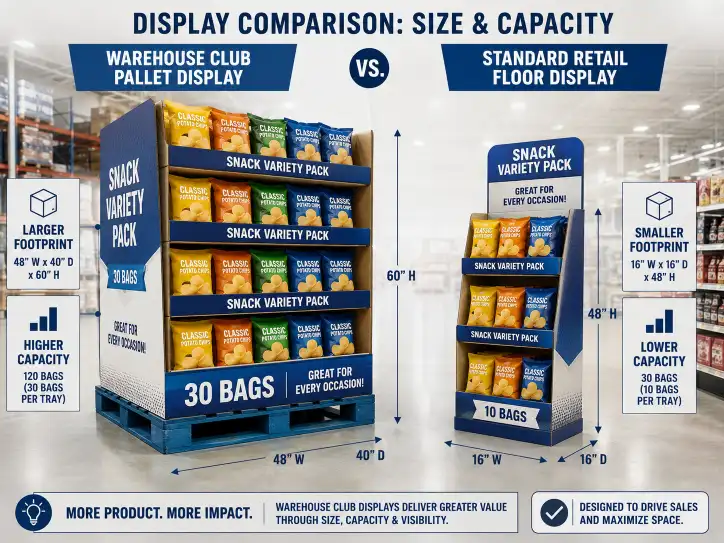
The difference between a warehouse club display and a standard retail display is not just size. The entire design philosophy is different.
| Factor | Warehouse Club Display | Standard Retail Display |
|---|---|---|
| Base | GMA pallet (48×40 in) or half-pallet | Corrugated base or small footprint |
| Product volume | 500–1,500 lbs per unit | 50–200 lbs per unit |
| Retail model | Sell from pallet, bulk purchases | Shelf or endcap, single units |
| Packing method | Pre-filled preferred | Flat-pack or semi-assembled |
| Handling | Forklift and pallet jack | Hand-carried |
| Store labor | Minimal (unwrap and sell) | Assembly required |
| Shelf life | Higher turnover, shorter campaigns | Longer display periods |
| Labeling | GS1-128 pallet labels required | Standard carton labels |
Why This Matters for Buyers
Ordering a standard retail display for a club store project is a common mistake. The display may look correct in the design stage but fail at the receiving dock because:
- The footprint does not match the GMA pallet standard
- The display cannot support the weight of bulk product
- The packing method requires in-store assembly that club staff will not perform
- Labels are missing or do not meet the retailer's GS1-128 format
For channel-specific display solutions, see our Costco displays and Sam's Club displays pages.
PDQ Pallet Displays: The Club Store Workhorse
PDQ pallet displays are the most common format for club store promotions. The term "PDQ" stands for "Pretty Damn Quick" — referring to how fast the display can be set up in store.
What Is a PDQ Pallet Display?
A PDQ pallet display is a pre-packed display unit that sits on a pallet base and arrives at the store already loaded with products. Store staff remove the outer wrap, and the display is ready for the sales floor. No assembly, no product loading, no re-packing.
Characteristics of PDQ Pallet Displays
- Factory loaded — Products are loaded into the display at the factory
- Pallet integrated — The display is permanently attached to or designed for a GMA pallet
- Printed skirt — A corrugated or paper skirt wraps around the pallet base for branding
- Tiered trays — Multiple levels of trays or shelves for product organization
- Header card — Brand signage at the top for visibility across the warehouse floor
- Stretch wrapped — The entire unit is wrapped for transit protection
When to Use a PDQ Pallet Display
PDQ pallet displays are best for:
- Product launches — New products need maximum visibility and fast placement
- Seasonal promotions — Holiday, summer, and event-driven campaigns
- Bulk items — Snacks, beverages, household goods, pet food
- Club store programs — Costco, Sam's Club, and BJ's all accept this format
PDQ Pallet Display vs Standard PDQ Display
| Feature | PDQ Pallet Display | Standard PDQ Display |
|---|---|---|
| Size | Pallet-based, 48×40 in | Countertop, small footprint |
| Product capacity | 500+ lbs | 10–50 lbs |
| Location | Floor, club store aisle | Counter, shelf, register |
| Assembly | Pre-filled at factory | Flat-pack, store assembles |
| Best for | Bulk promotions, club stores | Impulse buys, small items |
For smaller display needs, our COUNTER DISPLAY range covers standard PDQ and countertop units.
Pallet Displays: Full-Size Club Store Units
Full-size pallet displays are the largest format in the club store environment. They occupy a full pallet position (48 × 40 inches) and can reach up to 84 inches in height, including the pallet base.
Types of Club Store Pallet Displays
| Type | Description | Typical Use |
|---|---|---|
| Full pallet display | Single unit on one GMA pallet | Primary product display |
| Stackable pallet display | Multiple units stacked during transit | High-volume promotions |
| Half pallet display | Smaller footprint (48×20 or 24×40 in) | Endcap positions, lighter products |
| Quarter pallet display | Compact unit for limited floor space | Trial sizes, smaller SKUs |
| Modular pallet display | Multiple units that connect or arrange together | Multi-SKU brand displays |
| Pallet display with shelves | Tiered shelving built into the pallet structure | Products that need horizontal display |
Structural Requirements
Club store pallet displays must meet specific structural standards:
- ECT rating: Minimum 32 lbs/inch for single-wall, 48+ for double-wall
- Stacking strength: Must support 2–3 units stacked during transit
- Forklift clearance: Standard 3.5-inch openings on two opposite sides
- Weight distribution: Heaviest products at the bottom, even load across the pallet
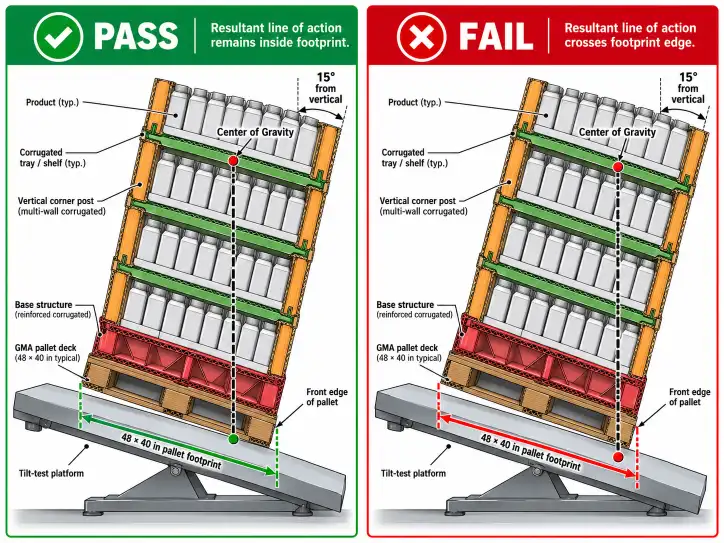
- Partial sell-through stability: Must remain stable after 30–50% of product is sold
For structural testing and material guidance, see our PRODUCTION page.
Half Pallet Displays for Club Stores
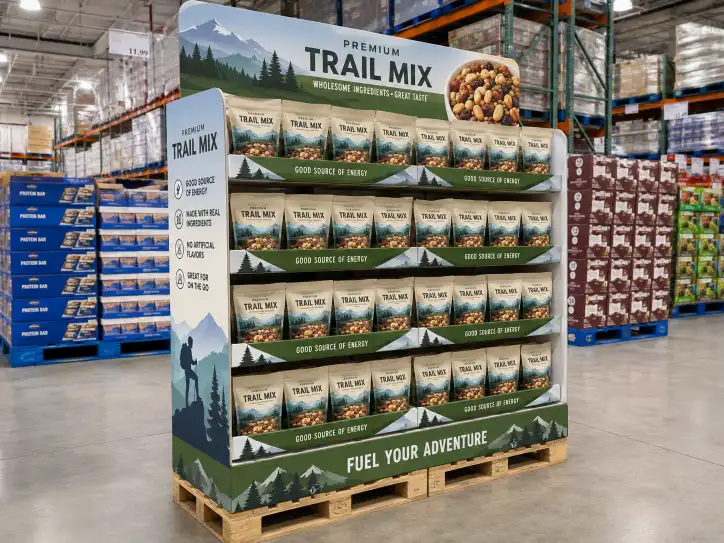
Half pallet displays are an important subcategory of Costco-style displays. They are commonly used for endcap positions, smaller promotions, and products that do not need a full pallet footprint.
Half Pallet Sizes
| Size | Dimensions | Best For |
|---|---|---|
| 48 × 20 in | Half-length GMA | Endcaps, narrow floor positions |
| 24 × 40 in | Half-width GMA | Side positions, smaller clubs |
Half pallet displays follow the same design rules as full pallet displays — pallet base, pre-filled product, printed skirt, stretch wrap — but at a smaller scale. They are popular for:
- New product trials (lower volume commitment)
- Seasonal items with limited promotion windows
- Higher-value products where fewer units per display make sense
- Stores with limited floor space
Key Requirements for Costco-Style Displays
GMA Pallet Specification
Every Costco-style display must match the GMA (Grocery Manufacturers Association) pallet standard:
- Dimensions: 48 × 40 inches (1219 × 1016 mm)
- Entry height: 3.5 inches (89 mm) for forklift and pallet jack
- Orientation: Display must align with the pallet stringer direction
- Overhang: Zero — no part of the display may extend beyond the pallet edge
Packing Methods
| Method | Description | Club Store Preference |
|---|---|---|
| Pre-filled (pre-packed) | Products loaded at factory, ready to sell | Most preferred |
| Semi-assembled | Main structure assembled, trays separate | Acceptable |
| Flat-pack (KD) | Ships flat, assembled in store | Least preferred |
Most club stores strongly prefer pre-filled displays because their labor model does not include in-store display assembly.
Height Limits
| Store | Display Height Limit (includes pallet) |
|---|---|
| Costco | 72–84 inches (183–213 cm) |
| Sam's Club | 72–80 inches (183–203 cm) |
| BJ's Wholesale | 72–78 inches (183–198 cm) |
Always confirm height limits with the specific buyer, as limits vary by club location and building configuration.
For detailed pallet and packaging specifications, see our SHIPPING page.
Club Store Labeling and Compliance
Warehouse club displays require specific labeling that differs from standard retail. Incorrect labeling is the leading cause of receiving dock rejections.
Required Labels for Club Store Displays
| Label Type | Information Required | Purpose |
|---|---|---|
| GS1-128 pallet label | SSCC-18, PO number, supplier code, quantity | Receiving and inventory tracking |
| Carton content label | SKU, product name, quantity per display | Warehouse identification |
| Retail price label | Unit price, member price, effective date | Shelf-ready pricing |
| Handling labels | "This Side Up," stack limit, fragile | Transit protection |
| Country of origin | "Made in China" or applicable | Customs compliance |
| UPC/GTIN barcode | 12-digit or 14-digit barcode per SKU | Checkout scanning |
Label Placement Rules
- Minimum two sides: Labels must be visible from the front and one side of the pallet
- No overlay on perforations: Do not cover tear strips or opening panels
- Readable after wrapping: Labels must scan through stretch wrap
- Buyer pre-approval: Always send label artwork to the buyer for approval before production
For labeling requirements, see our SAMPLING page — label approval should be part of the sample approval process.
Costco vs Sam's Club vs BJ's: Display Differences
While Costco, Sam's Club, and BJ's Wholesale Club all use the same basic display format, there are important differences that affect display design and compliance.
| Requirement | Costco | Sam's Club | BJ's Wholesale |
|---|---|---|---|
| Pallet size | 48×40 in GMA | 48×40 in GMA | 48×40 in GMA |
| Height limit | 72–84 in | 72–80 in | 72–78 in |
| Pre-filled required | Strongly preferred | Strongly preferred | Preferred |
| Pallet label format | GS1-128 | GS1-128 | GS1-128 or retailer-specific |
| Structural testing | ECT, vibration, drop, tilt | ECT, vibration, drop | Varies by buyer |
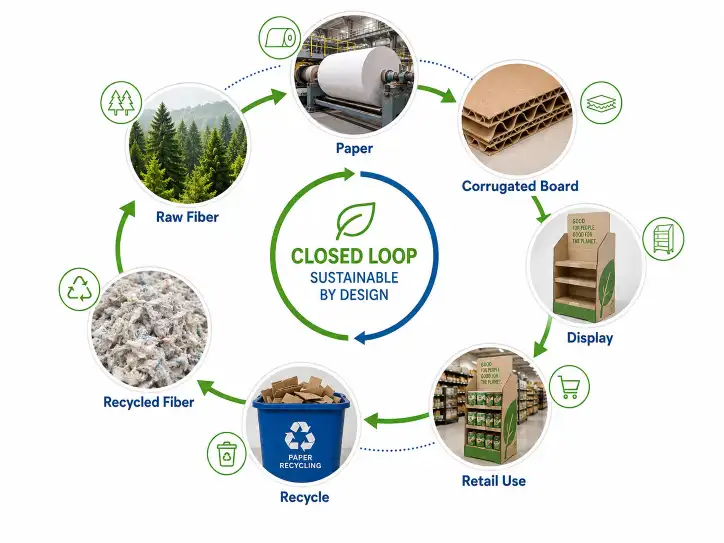
| FSC certification | Preferred | Preferred | Not required |
| Price label | Member price required | Member price required | Club price required |
| Tilt test | Required for new displays | Required for new displays | Recommended |
What This Means for Buyers
- A Costco display cannot be assumed to pass at Sam's Club or BJ's — each retailer has specific rules
- Structural testing requirements vary — Costco and Sam's Club typically require formal test reports; BJ's may be less strict
- Labeling formats differ — Always confirm with each buyer individually
- The same structural design can work across all three, but packing and labeling must be tailored
For Costco-specific designs, see our COSTCO DISPLAYS page. For Sam's Club, see our SAM'S CLUB DISPLAYS page.
Buyer Checklist for Club Store Displays
| Check Item | What to Confirm |
|---|---|
| Display type | Costco-style, warehouse club, PDQ pallet, or half pallet? |
| Target retailer | Costco, Sam's Club, BJ's, or all three? |
| Pallet footprint | Full GMA (48×40) or half pallet? |
| Height limit | Including pallet base — confirmed with buyer? |
| Packing method | Pre-filled, semi-assembled, or flat-pack? |
| Product weight | Total load per display? Per tray? |
| ECT rating | Minimum 32 lbs/in for single-wall? |
| Forklift clearance | 3.5-inch openings on two sides? |
| Label format | GS1-128 or retailer-specific? |
| Structural tests | ECT, vibration, drop, tilt reports ready? |
| FSC certification | Required by buyer? |
| Sample with real product | Tested with actual product weight and fit? |
| Partial sell-through | Stable at 30–50% depletion? |
| Loading diagram | Container utilization plan confirmed? |
Conclusion
Costco-style club store displays are a specialized category of retail merchandising that goes beyond one retailer. Whether you call them warehouse club displays, PDQ pallet displays, or club store pallet displays, the core requirements are the same: pallet-based footprint, retail-ready presentation, and bulk product capacity designed for the club store environment.
For B2B buyers, the key to success is understanding that club store displays are fundamentally different from standard retail displays. Start with the pallet footprint, confirm the packing and labeling requirements with the buyer, and design for the weight and stability demands of the club channel.
If you are planning a club store display project, review the specific requirements for your target retailer before briefing your factory. Costco, Sam's Club, and BJ's share the same basic format, but the differences in labeling, testing, and compliance require separate attention.
For custom club store display projects, our RETAIL DISPLAY page covers the full range of formats, or contact us with your product specifications and target stores.
FAQ
What are Costco-style club store displays?
Costco-style club store displays are corrugated display units built on a standard GMA pallet base (48×40 inches), designed for warehouse club retailers. They are typically pre-filled with products at the factory and arrive at the store ready to sell.
What is the difference between a PDQ pallet display and a standard PDQ display?
A PDQ pallet display is a full-size pallet-based unit designed for club stores, holding 500+ lbs of product. A standard PDQ display is a small countertop unit for impulse items near the register.
What is a warehouse club display?
A warehouse club display is any display unit designed for club store retailers like Costco, Sam's Club, and BJ's Wholesale. These displays are built on pallet bases, hold bulk quantities, and ship as retail-ready units.
What size pallet do Costco displays use?
Costco displays use standard GMA pallets — 48 × 40 inches (1219 × 1016 mm). Half-pallet options (48×20 in or 24×40 in) are also accepted in some positions.
Do Sam's Club and Costco use the same display requirements?
The structural requirements are similar (GMA pallet, pre-filled preferred, GS1-128 labels), but height limits, testing requirements, and labeling rules differ. Always check each retailer's specific requirements separately.
What is a PDQ pallet display?
A PDQ pallet display is a pre-packed, ready-to-sell display unit on a pallet base. Products are loaded at the factory, and the display arrives at the club store wrapped and ready for floor placement.
Can the same display work for Costco, Sam's Club, and BJ's?
The same structural design can often work for all three, but packing methods, label formats, and compliance documentation must be customized to each retailer. Always confirm requirements with each buyer individually.
What structural testing do club store displays need?
Club store displays typically require ECT (compression) testing, vibration testing, drop testing, and tilt testing. Costco and Sam's Club usually require formal test reports for new display designs.

3 Responses