Club store display projects fail in two ways. Some never make it past the buyer's desk because the dimensions or packing method do not match the retailer's requirements. Others arrive in store looking different from the approved sample because nobody checked the pallet loading, labeling, or handling rules early enough.
Costco and Sam's Club are not ordinary retail channels. They operate on higher volume, tighter floor space rules, and stricter logistics standards. A display that passes a supermarket buyer's review can still be rejected at a club store receiving dock. For B2B buyers, understanding these requirements before you brief your factory saves time, freight cost, and approval delays.
This guide covers the practical club store display requirements that every supplier and buyer should check before production.
What Makes Club Store Displays Different?
Club stores operate on a different model than supermarkets. Customers buy in bulk. Products move on pallets, not individual shelves. Floor space is measured in pallet positions, not linear shelf feet.
Three factors make club store display requirements unique:
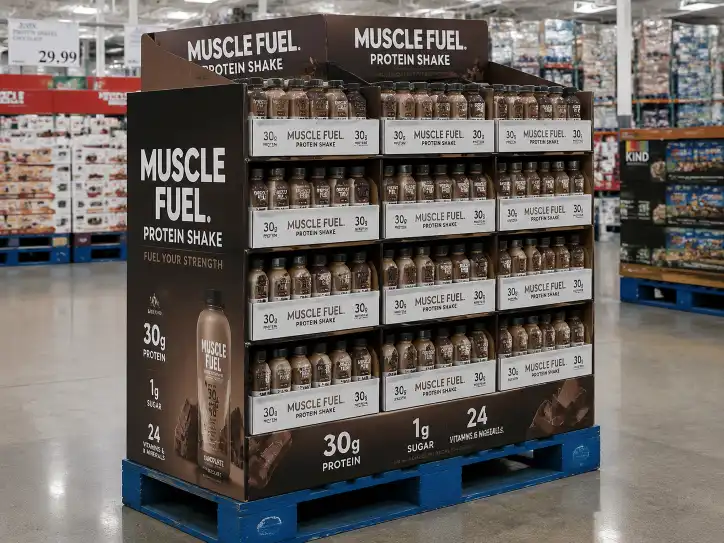
- Pallet-based retailing — Most products sell directly from a pallet or from a display built on a pallet base. The display must work as a shipping unit, a handling unit, and a selling unit without reconfiguration.
- Forklift and pallet jack handling — Every unit must survive movement from the truck to the warehouse to the sales floor. The base must support stacking and movement without collapse.
- Higher volume per SKU — Club stores carry fewer SKUs but more volume per SKU. The display must hold enough product to justify the floor space, typically 3–5 times the volume of a supermarket floor display.
For B2B buyers, this means the display design starts with the pallet footprint, not with the artwork.
Footprint and Pallet Base Requirements
Standard Pallet Sizes
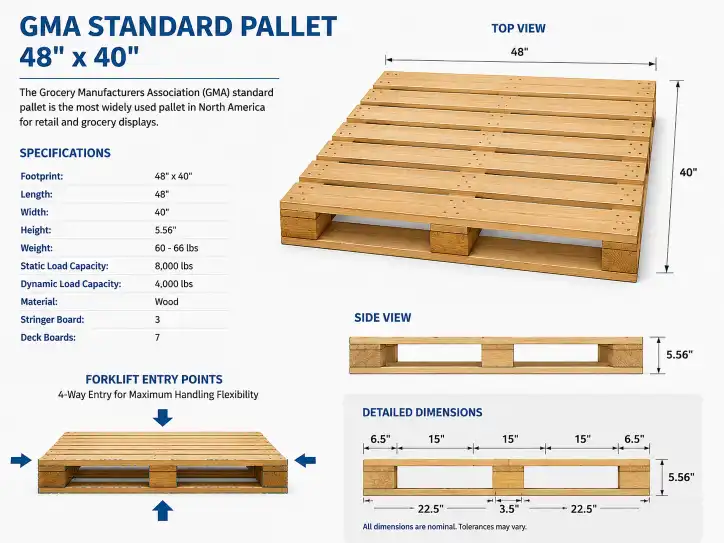
Club stores in North America use standard GMA pallets: 48 × 40 inches (1219 × 1016 mm). Half-pallet options are also common, typically 48 × 20 inches or 24 × 40 inches.
The display base must match these dimensions exactly. Even a 1-inch overhang can cause problems with pallet racking, forklift access, and floor placement.
Height Limits
Club store displays typically have height limits based on the retail environment:
| Store | Standard Height | Notes |
|---|---|---|
| Costco | 72–84 inches (183–213 cm) | Varies by club location; check with buyer |
| Sam's Club | 72–80 inches (183–203 cm) | Pallet rack height varies by building |
| General club | 60–72 inches (152–183 cm) | Endcap and floor position limits |
Height includes the pallet base (typically 5–6 inches or 13–15 cm). Factor this into your display design — the product display area starts above the pallet.
Clearance for Forklift Access
The pallet base must have clear openings on two opposite sides for forklift or pallet jack entry. Standard GMA pallet openings are approximately 3.5 inches (9 cm) high. If the display has a custom base, ensure the forklift openings match standard dimensions.
Our Costco display and Sam's Club display pages provide store-specific details for each channel.
Product Load and Stacking Rules
Weight Distribution
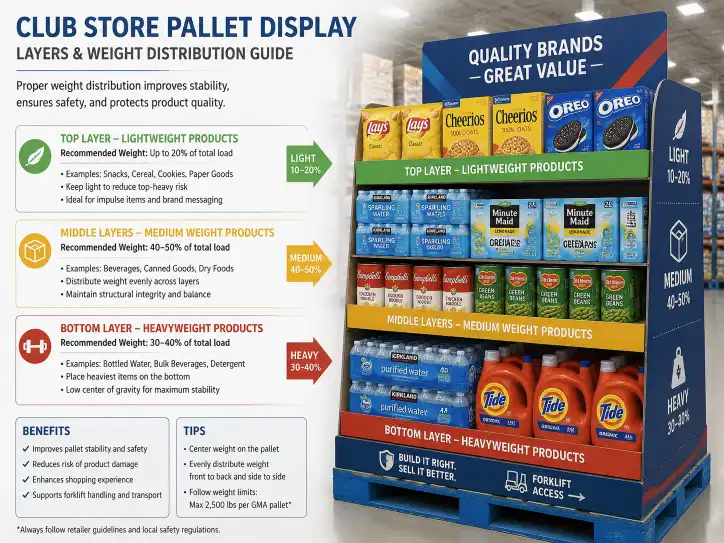
Club store displays carry heavy loads. A typical pallet display may hold 500–1,500 lbs (225–680 kg) of product. The structural design must distribute this weight evenly across the pallet base.
Key rules:
- Heaviest products at the bottom layers
- Lighter products on top layers
- Weight must be distributed across the pallet surface, not concentrated in the center
- The base must support the full load without bowing or collapsing
Stacking During Transit
Pallet displays are stacked during shipping — typically 2–3 units high depending on weight. The bottom display must support the weight of the units above it.
Partial Sell-Through Stability
Club store displays lose impact fast when products are removed unevenly. A display that looks strong when full can become unstable after 30% of the product is sold. The structure must remain stable and visually acceptable throughout the sell-through cycle.
Load Per Tray
Each tray or shelf tier has a maximum load rating. For corrugated displays:
- Standard B-flute tray: Up to 15 lbs (7 kg) per tray
- Reinforced double-wall tray: Up to 30 lbs (14 kg) per tray
- Pallet base with support: Up to 100+ lbs (45+ kg) per layer
For display projects requiring heavy load planning, our PRODUCTION page covers material selection and structural testing.
Packing Methods for Club Store Displays
Club stores accept three main packing methods. Each has different requirements.
Flat-Pack
The display ships flat in bundles. Store staff assemble it on site. Best for lower-volume clubs with dedicated staff.
- Lower shipping volume, lower freight cost
- Requires assembly time in store
- Must include clear assembly instructions
Semi-Assembled
Key structural components are pre-assembled at the factory. Staff complete final assembly in store.
- Balanced shipping volume and assembly time
- Common for medium-complexity designs
- Reduces assembly errors
Pre-Filled (Pre-Packed)
Products are loaded into the display at the factory. The entire unit ships as a ready-to-sell display.
- Fastest store setup (unwrap and place)
- Highest shipping volume and freight cost
- Requires transit testing to prevent product damage
Most club store buyers prefer pre-filled or semi-assembled displays. Flat-pack is less common because store labor is limited.
Our shipping page explains the packing options in more detail with transit considerations.
Labeling and Identification Requirements
Club stores have specific labeling rules for pallet displays. Missing labels can cause rejection at the receiving dock.
Required Labels
| Label Type | Information | Purpose |
|---|---|---|
| Pallet ID label | Supplier code, PO number, item number | Receiving and inventory tracking |
| Carton content label | Product name, SKU, quantity per display | Warehouse identification |
| Handling label | "This Side Up," fragile icons, stack limit | Transit protection |
| Retail price label | Unit price, member price, effective date | Shelf-ready pricing |
| Country of origin | "Made in China" or applicable origin | Customs and compliance |
| Barcode (UPC/GTIN) | 12-digit or 14-digit barcode per SKU | Checkout scanning |
Label Placement
- At least two sides — Labels must be visible from the front and one side
- No overlay on perforations — Labels should not interfere with tear strips or opening panels
- Readable after pallet wrap removal — Ensure labels are applied under the stretch wrap or visible after removal
Structural Testing for Club Store Approval
Club stores often require structural test reports before approving a new display. The most common tests are:
Compression Test (Edge Crush Test / ECT)
Measures the stacking strength of the corrugated board. Club stores typically require:
- Minimum ECT: 32 lbs/inch for single-wall, 48+ for double-wall
- Test method: TAPPI T-811 or equivalent
Vibration Test
Simulates the vibration during truck transit. The display with product load is vibrated at specified frequencies for a set duration. Passing criteria: no structural failure, no product damage.
Drop Test
The packed display is dropped from specified heights (typically 6–12 inches) to simulate handling during loading and unloading.
Tilt Test
The loaded display is tilted to a specified angle (typically 15–20 degrees) to test stability. The display should not tip over.
For detailed testing information, see our SAMPLING page and ask your factory for test reports before approval.
Common Club Store Display Mistakes
| Mistake | Consequence | How to Avoid |
|---|---|---|
| Wrong pallet footprint | Display does not fit floor position | Confirm 48×40 GMA dimensions before design |
| Missing forklift clearance | Cannot be moved in warehouse | Include standard pallet openings in base design |
| Overweight per tray | Trays sag or collapse | Test each tier with full product load |
| Incorrect labeling | Rejected at receiving dock | Send label artwork to buyer for approval |
| No partial sell-through test | Display looks empty after first week | Test appearance at 30%, 50%, 70% depletion |
| Ignoring stack height limit | Display is too tall for rack | Confirm max height with buyer before production |
| Wrong packing method | Higher freight cost or more store labor | Choose pre-filled or semi-assembled for club stores |
Club Store Display Checklist
| Check Item | Done? | Notes |
|---|---|---|
| Footprint matches 48×40 GMA pallet | ☐ | Confirm exact dimensions |
| Height within store limit | ☐ | Include pallet height |
| Forklift clearance on two sides | ☐ | Standard 3.5-inch openings |
| Weight distribution plan | ☐ | Heaviest at bottom |
| Stacking strength tested | ☐ | For transit stacking |
| Partial sell-through stable | ☐ | Test at 30% depletion |
| Packing method confirmed | ☐ | Pre-filled / Semi / Flat |
| Labels approved by buyer | ☐ | All required labels verified |
| Structural test reports ready | ☐ | ECT, vibration, drop, tilt |
| Sample approved with real product | ☐ | Not just empty structure |
Conclusion
Club store display requirements are not optional guidelines. They are the minimum standard for getting your display approved, shipped, and placed on the sales floor. The most important rule: start with the pallet footprint, not the graphics. A beautifully printed display with the wrong dimensions will be rejected before it reaches the store.
For B2B buyers, preparation before the factory brief makes the difference between a smooth rollout and costly revisions. Confirm the dimensions, packing method, labeling, and testing requirements before you ask for a quote. That small investment in planning saves weeks of delay and thousands in freight corrections.
For custom club store display projects, review our Costco display and Sam's Club display pages, or contact us with your product dimensions and target store.
FAQ
What is a club store display?
A club store display is a corrugated display unit designed for warehouse club retailers like Costco and Sam's Club. It is typically built on a standard GMA pallet base (48×40 inches) and designed for bulk product presentation.
What size pallet do Costco displays use?
Costco uses standard GMA pallets: 48 × 40 inches (1219 × 1016 mm). Half-pallet options are also accepted in some locations.
Does Sam's Club use the same pallet size as Costco?
Yes. Both Costco and Sam's Club use the standard 48×40 GMA pallet footprint for floor displays. Individual store height limits may vary.
What packing method do club stores prefer?
Most club stores prefer pre-filled (pre-packed) displays or semi-assembled units. Flat-pack is less common because store labor is limited.
Do club stores require structural testing?
Yes. Many club store buyers require compression, vibration, drop, and tilt test reports before approving a new display design. Always confirm testing requirements with the buyer.
What happens if my display does not meet club store requirements?
The display may be rejected at the receiving dock, returned to the supplier, or charged a non-compliance fee. Always confirm requirements before production.
Can the same display work for Costco and Sam's Club?
The structural requirements are similar, but labeling, pricing, and packaging rules differ. Check each retailer's specific supplier requirements separately.