Many B2B buyers think "shelf ready packaging" is just another name for a cardboard display. In practice, SRP is a distinct category with specific retail requirements. Ordering an SRP tray when you need a POP display — or the other way around — can mean packaging that does not fit the retailer's shelf, slows down restocking, or fails to meet planogram requirements.
This guide explains what shelf ready packaging is, how it differs from standard cardboard displays, and what B2B buyers should check before sourcing SRP from a factory.
What Is Shelf Ready Packaging (SRP)?
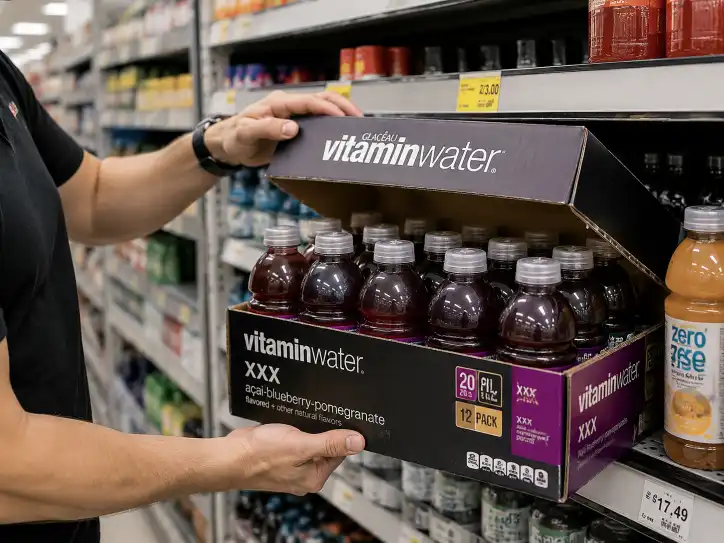
Shelf ready packaging (SRP), also called retail-ready packaging (RRP), is a corrugated package that functions as both a shipping container and a shelf display unit. It is designed so retail staff can open it, place it on a shelf, and have products ready to sell — without unpacking individual items.
The European FEFCO organization defines SRP as packaging that "can go directly from the pallet to the shelf without the need to individually handle the products." This is the key principle: SRP eliminates the labor-intensive step of removing products from a shipping box and arranging them one by one on a shelf.
Key Characteristics of SRP
- Dual function — Works as a shipping case and a shelf display unit
- Easy open — Perforated tear strips or cut-out handles for quick opening
- Shelf-ready format — The top portion is removed or folded back to reveal products
- Branded exterior — Outer surface carries product branding and identification
- Standard dimensions — Designed to fit standard retail shelf depths (typically 40–45 cm)
SRP vs Cardboard Display: What Is the Difference?
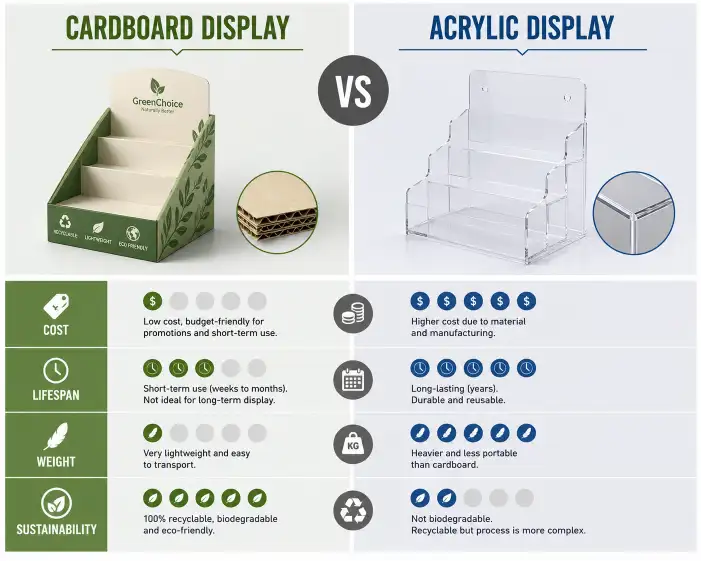
Many buyers confuse SRP with standard cardboard displays. They serve different purposes in retail.
| Feature | Shelf Ready Packaging (SRP) | Cardboard Display (POP) |
|---|---|---|
| Primary Function | Shipping unit that becomes a shelf tray | Marketing display for brand promotion |
| Placement | On existing retail shelves | Anywhere in store (aisle, endcap, floor) |
| Design Goal | Fast restocking, labor efficiency | Visibility, impulse conversion |
| Branding | Product-level identification | Campaign-level messaging |
| Shelf Life | Until products sell through (often replaced weekly) | 4–8 weeks per campaign |
| Print Coverage | Typically 2–4 sides printed | Full 4-side print with header |
| Typical User | Grocery, mass-market CPG brands | Brand marketers, seasonal promotions |
The most practical difference: SRP sits on the shelf where the product normally lives. A cardboard display can sit anywhere in the store.
If you need a marketing display for brand visibility, see our cardboard display range. If you need efficient shelf restocking, SRP is the right category.
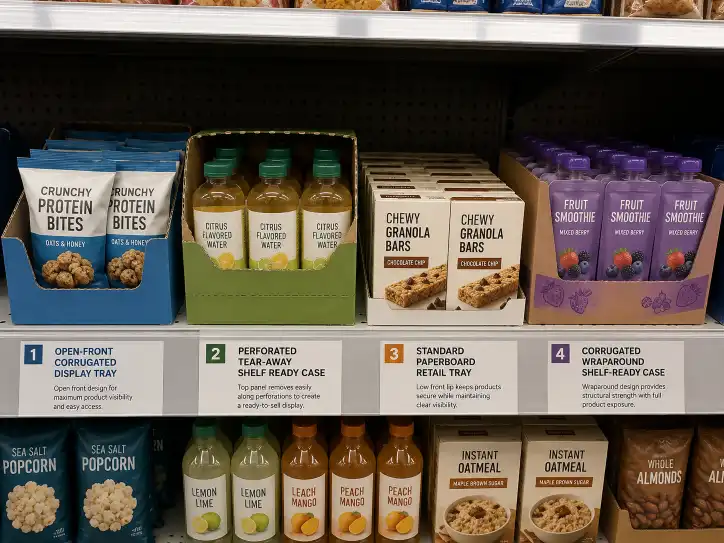
Common Types of Shelf Ready Packaging
1. SRP Trays
The most common format. A corrugated tray with low walls that holds products in place. Retail staff remove the outer shipping case and place the tray directly on the shelf.
- Best for: Canned goods, jars, bottles, multipacks
- Board grade: B-flute or E-flute corrugated
- Typical dimensions: 40×30 cm or fitting standard shelf depth
2. Perforated SRP Cases
A standard shipping case with perforated tear lines. Staff tear off the top section to expose products while the bottom remains intact for shelf stability.
- Best for: Snack bags, cereal boxes, pet food pouches
- Board grade: B-flute corrugated
- Key feature: Clean tear perforation that does not leave sharp edges
3. Self-Dispensing SRP
A tray or case with a cut-out front panel that lets shoppers pull products from the front while the tray holds the rest in place.
- Best for: Sachets, single-serve packs, small accessories
- Board grade: E-flute or heavy paperboard
- Key feature: Front-facing product visibility with gravity feed option
4. Branded SRP Sleeves
A printed sleeve or wrap applied around a standard shipping case. The sleeve adds branding while the inner case provides structural strength.
- Best for: Seasonal promotions, limited editions
- Board grade: Lightweight paperboard sleeve over standard corrugated case
- Key feature: Lower cost than full custom print on the case
When Should You Use Shelf Ready Packaging?
SRP is the right choice when the following conditions are true:
- Your product is sold through grocery, mass-market, or convenience stores where shelf restocking labor is a major cost
- The retailer requires SRP as part of their distribution agreement (increasingly common for major chains)
- Your product is shelf-stable and sold in predictable volumes
- You want to reduce in-store labor time for your retail partners
- Standard shelf depth (40–45 cm) is sufficient for your product display
SRP is usually not the right choice when:
- You need a standalone marketing display with custom structure (use a floor display or counter display instead)
- The product requires a large brand story or campaign messaging
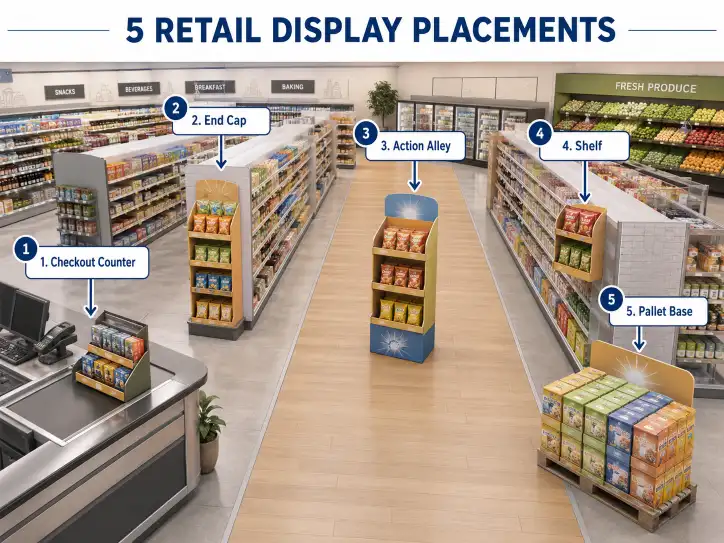
- The display will sit in a non-shelf location (endcap, aisle, checkout)
- You need a display that can stand independently on the sales floor
For standalone retail displays, our retail display page covers options for endcaps, floor units, and promotional zones.
How Manufacturers Produce SRP
From a factory perspective, SRP production follows a different process than custom POP display manufacturing.
Structure Design
SRP must fit standard shelf dimensions. The factory needs to know the retailer's shelf depth, product dimensions, and pack pattern. Unlike POP displays, SRP does not need a header card or base stand — it relies on the shelf for support.
Board Selection
| SRP Type | Recommended Board | Why |
|---|---|---|
| Lightweight SRP tray | E-flute (single-wall) | Good print surface, sufficient for light products |
| Standard SRP case | B-flute (single-wall) | Stronger stacking, better for shipping |
| Heavy-duty SRP | BC-flute (double-wall) | For glass jars, canned goods, heavy loads |
Print and Finishing
SRP print requirements are simpler than POP displays. Most SRP uses flexographic printing for cost efficiency, with 1–3 colors. Premium SRP uses digital or litho printing for full-color branding.
Perforation Quality
The perforation line is the most critical quality factor in SRP. A poorly designed perforation tears unevenly, leaves jagged edges, or fails to open cleanly. Factories should test the tear strength during the sample stage.
Packing for Transit
SRP units are packed on pallets in layers, with the outer case serving as the shipping container. The stacking strength must support pallet loads during transport without crushing the inner trays.
Our packaging page provides more detail on corrugated package options for SRP projects.
B2B Buyer Checklist for SRP
| Check Item | What to Confirm |
|---|---|
| Shelf depth | Standard 40–45 cm or custom? |
| Product dimensions | Length × width × height per unit |
| Pack pattern | How many units per tray/row/layer? |
| Perforation type | Center tear, top tear, or full removal? |
| Board grade | E-flute, B-flute, or double-wall? |
| Print coverage | 2-side, 4-side, or full wrap? |
| Print method | Flexo (1–3 colors) or digital (full CMYK)? |
| Stacking strength | Does the case hold pallet load without crushing? |
| Retailer approval | Does the retailer require specific SRP specs? |
| Sample test | Does the tear strip open cleanly without tools? |
SRP vs Other Retail Display Formats
| Factor | SRP Tray | Cardboard Floor Display | Counter Display | Pallet Display |
|---|---|---|---|---|
| Retail Location | Shelf | Aisle/Endcap | Counter | Floor/Pallet base |
| Primary Use | Restocking efficiency | Brand promotion | Impulse add-on | Volume sales |
| Shipping Function | Yes (dual use) | No (separate shipping) | No | Yes (pallet as base) |
| Setup Time | Under 10 seconds | 2–5 minutes | Under 30 seconds | Minimal (unwrap only) |
| Unit Cost | Low | Medium-High | Low-Medium | Medium-High |
| MOQ | 1,000–5,000+ units | 500–1,000 units | 1,000–3,000 units | 200–500 units |
| Print Complexity | Simple (1–4 sides) | Full (4 sides + header) | Full | Full |
Conclusion
Shelf ready packaging is not the same as a cardboard display. SRP is a logistics-first solution designed to reduce retail labor and speed up shelf restocking. Cardboard displays are marketing-first solutions designed for brand visibility and impulse conversion.
For B2B buyers, the choice comes down to where the product sits in the store. If it lives on a standard shelf and moves quickly, SRP is usually the better investment. If it needs dedicated space and campaign-level promotion, a cardboard display is the right format.
Many projects benefit from both: SRP trays for everyday shelf replenishment, plus a seasonal display for promotional periods. Discuss both options with your factory to find the right balance for your category.
For custom quotes and sample requests, see our sampling and concept to design processes.
FAQ
Is shelf ready packaging the same as a cardboard display?
No. SRP is a shipping unit that converts into a shelf tray. A cardboard display is a standalone marketing unit for brand promotion. They serve different retail functions.
What does SRP stand for?
SRP stands for Shelf Ready Packaging. It is also called retail-ready packaging (RRP). Both terms refer to corrugated packaging that goes from pallet to shelf without individual product handling.
What products work best with SRP?
SRP works best for fast-moving consumer goods (FMCG) sold on standard retail shelves: canned goods, snacks, beverages, pet food, cereal, and personal care products.
Does SRP cost more than standard shipping cases?
SRP costs slightly more than a plain shipping case because of the printed surface, perforation, and structural design. But the savings in retail labor costs usually offset the packaging cost increase.
Can SRP be recycled?
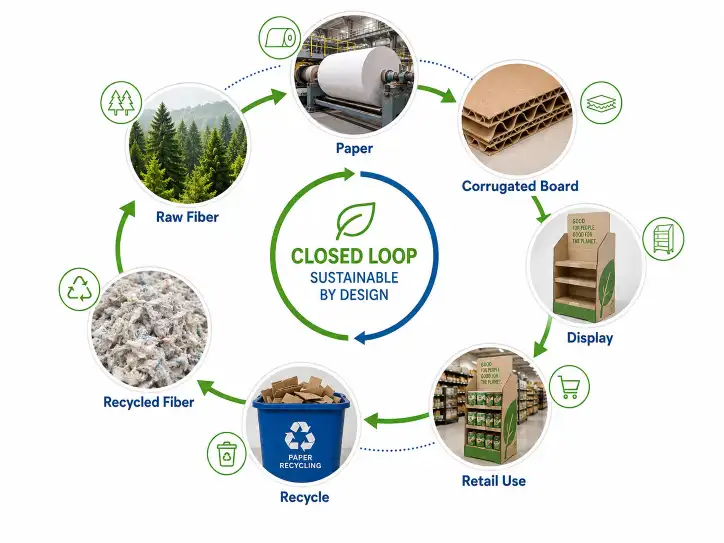
Yes. SRP is made from corrugated cardboard, which is widely recyclable through standard retail and municipal recycling programs.
Do retailers require SRP?
Many major retailers now require SRP for certain product categories. Check with the retailer's supplier requirements before designing your packaging.
What is the difference between SRP and a PDQ display?
SRP is a shelf-ready tray for restocking efficiency. A PDQ (Pretty Darn Quick) display is a small promotional display, often used as a sidekick for impulse sales. They serve different retail purposes.