
Struggling to make your products stand out in a crowded retail floor? A weak display gets ignored, and your sales suffer. You need a solution that grabs attention and holds products securely.
A custom floor display is the most effective way to showcase products at eye level in high-traffic retail areas. Also known as an FSDU (Free Standing Display Unit), it is designed to stand on the floor, hold significant product volume, and attract customers with branded graphics — making it a powerful tool for driving in-store sales.
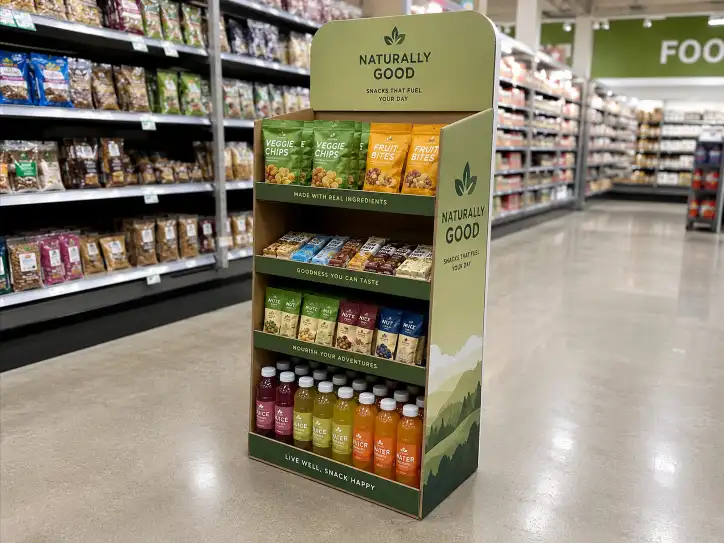
I've spent 16 years designing and manufacturing cardboard displays, and I've seen firsthand how a well-built floor display can transform a product's performance in store. The right display doesn't just hold products — it sells them. In this guide, I'll walk you through everything you need to know about choosing a custom floor display, from types and materials to sizing and cost factors.
What Is a Floor Display and How Does It Work?
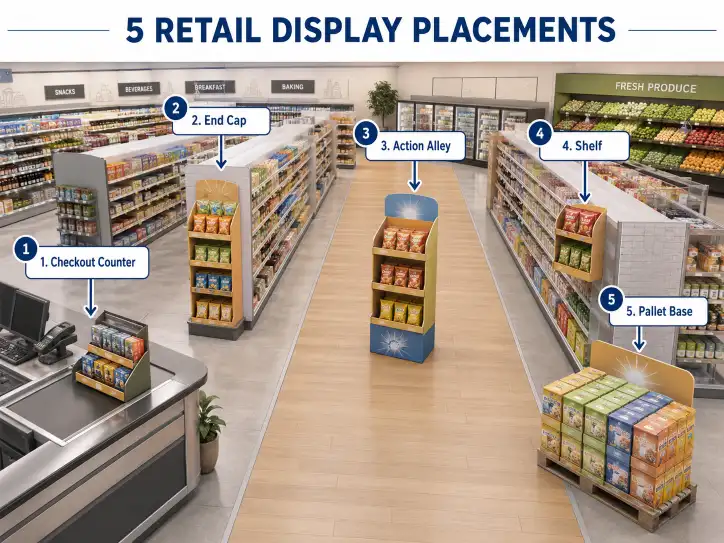
A floor display, also called a floor standing display or FSDU, is a freestanding retail display unit placed directly on the store floor. Unlike counter displays that sit on a countertop, floor displays are larger, hold more product, and are positioned in high-traffic areas like main aisles, store entrances, and endcaps.
The way a floor display works is simple: it uses structural engineering — typically corrugated cardboard — to create a stable, self-supporting unit that can hold anywhere from 20 to 200+ products. The outer surface is printed with brand graphics that catch the shopper's eye from several meters away.

For brands launching new products or running promotions, a floor display is one of the most cost-effective ways to get maximum visibility. I've worked on projects where a well-placed FSDU increased product sales by over 300% during the campaign period.
What Are the Main Types of Floor Displays?
Not all floor displays are the same. The right type depends on your product, your quantity, and where in the store the display will be placed.
| Type | Best For | Typical Height | Product Capacity |
|---|---|---|---|
| Multi-shelf FSDU | Everyday products, snacks, beverages | 120–180 cm | 50–200 units |
| Single-shelf floor display | Promotional items, new launches | 100–150 cm | 20–60 units |
| Dump bin floor display | Bulk items, discounted products | 80–120 cm | 100–300+ units |
| Tiered floor display | Multiple product variants | 120–160 cm | 40–120 units |
| Round floor display | 360° visibility, center aisle placement | 100–150 cm | 60–150 units |
| Pallet-style floor display | Club stores, high-volume retail | 90–140 cm | 100–400+ units |
Multi-Shelf FSDU
This is the most common type. It has 2–5 shelves and holds a large quantity of product. The shelves can be angled or flat, depending on the product type. I recommend this for brands running ongoing promotions in grocery chains and supermarkets.
Dump Bin
A dump bin is a deep, open-top container that holds products in bulk. It is the fastest display to set up — just open it and pour the products in. It works best for promotional, discounted, or seasonal items where presentation is less important than volume.
Round Floor Display
A round display offers 360° visibility, meaning shoppers can approach it from any direction. It is ideal for center-aisle placements and products that benefit from high visibility on all sides.
What Materials Are Used for Floor Displays?
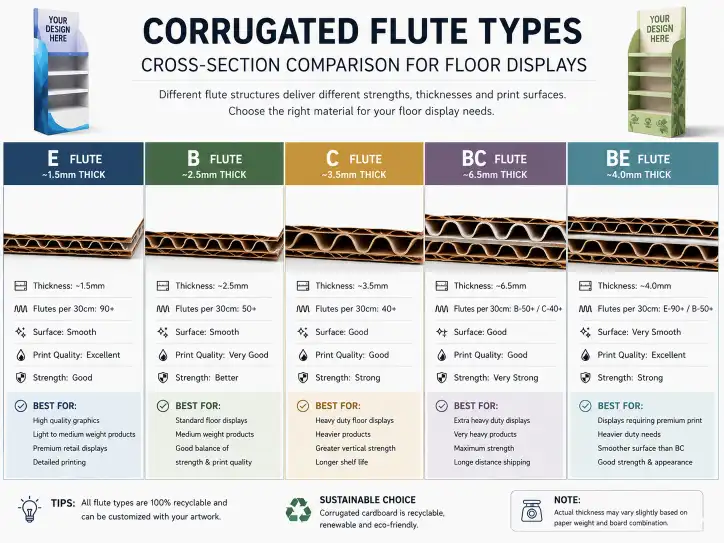
The material you choose affects the display's strength, print quality, and cost. Most floor displays are made from corrugated cardboard, but the grade varies by application.
| Material | Strength | Print Quality | Best For | Cost |
|---|---|---|---|---|
| E-flute corrugated | Moderate | Very good | Light products, small displays | Low |
| B-flute corrugated | Good | Good | Standard floor displays | Low–Moderate |
| C-flute corrugated | Strong | Moderate | Heavy products, large displays | Moderate |
| Double wall (BC) | Very strong | Limited | Very heavy loads, high stacking | Higher |
| Litho laminate | Strong | Excellent | Premium branded displays | Higher |
In my experience, B-flute or C-flute corrugated board is the right choice for most floor displays. It offers the best balance of strength and print quality. If your display needs to hold heavy products like beverage bottles or large snack bags, double wall is worth the extra cost.
For premium branding, litho laminate — where a full-color printed sheet is laminated onto the corrugated board — gives you retail-shelf print quality with floor display strength.
How to Choose the Right Size for a Floor Display
Size matters for floor displays. Too small and the display gets lost in the aisle. Too large and it may not fit in the allocated retail space.
Standard Floor Display Dimensions
| Display Size | Width × Depth × Height | Typical Shelf Count | Retail Space Needed |
|---|---|---|---|
| Small | 40 × 30 × 100 cm | 2 shelves | Endcap, small aisle |
| Medium | 50 × 40 × 140 cm | 3–4 shelves | Standard aisle |
| Large | 60 × 45 × 160 cm | 4–5 shelves | Wide aisle, club store |
| Extra Large | 80 × 60 × 180 cm | 5–6 shelves | Warehouse, club store |
Size Rules to Follow
- Keep it under 180 cm — Most retailers have a height limit for floor displays. Above 180 cm, the display may block sightlines or require special approval.
- Width should not exceed 100 cm — Most retail aisles are 120–150 cm wide. A display wider than 100 cm creates a bottleneck.
- Depth should match the product — A display that is too deep wastes space. A display that is too shallow causes products to fall off.
- Check with the retailer first — Every retailer has display size guidelines. Costco, Walmart, and Target all have specific requirements for floor displays.
What Printing Options Are Available for Floor Displays?
Print quality on a floor display directly affects how customers perceive your brand. A high-quality print makes the display look professional and trustworthy. A poor print makes your product look cheap.
| Printing Method | Color Quality | MOQ | Cost | Best For |
|---|---|---|---|---|
| Flexographic | Good, 1–4 spot colors | 500+ | Low | Simple logos, basic branding |
| Litho laminate | Excellent, full CMYK | 1,000+ | Moderate | Premium branding, retail shelves |
| Digital direct | Very good, CMYK | 100+ | Moderate | Small runs, test campaigns |
| Screen print | Good, thick ink | 300+ | Moderate | Bold text, simple graphics |
For most retail floor displays, I recommend litho laminate. Yes, it costs more than flexo, but the print quality difference is immediately visible on the retail floor. The display is competing with dozens of other brands for the shopper's attention — high-quality print is not a luxury, it is a necessity.
How Much Does a Custom Floor Display Cost?
Cost is always the first question buyers ask. The answer depends on size, complexity, print method, and quantity.
| Display Type | 500 Units | 1,000 Units | 2,500 Units | 5,000 Units |
|---|---|---|---|---|
| Simple FSDU, 2 shelves | $8–$12 | $6–$9 | $4.50–$7 | $3.50–$5.50 |
| Standard FSDU, 3–4 shelves | $12–$18 | $9–$14 | $7–$11 | $5.50–$8.50 |
| Large FSDU, 5+ shelves | $18–$28 | $14–$22 | $11–$17 | $8.50–$13 |
| Dump bin, large | $6–$10 | $4.50–$7.50 | $3.50–$5.50 | $2.50–$4.50 |
| Premium litho laminate FSDU | $20–$35 | $15–$28 | $12–$22 | $9–$17 |
What Drives the Cost Up
| Factor | Cost Impact |
|---|---|
| Custom die-cut shape | $100–$300 one-time die cost |
| Litho laminate vs flexo print | +30–50% per unit |
| Double wall vs single wall | +20–40% per unit |
| Added shelves or compartments | +10–20% per shelf |
| Custom inserts or trays | +$1–$3 per unit |
| Quick turnaround (expedited) | +15–25% |
For an accurate estimate on your specific display, contact a floor display manufacturer with your product dimensions, target quantity, and retail environment details.
What Is the MOQ for Custom Floor Displays?
Minimum order quantities for floor displays vary by complexity and printing method.
| Display Type | Typical MOQ | Notes |
|---|---|---|
| Simple flexo-printed FSDU | 500 units | Lowest cost option |
| Litho laminate FSDU | 1,000 units | Better print quality, higher minimum |
| Digital print FSDU | 100–300 units | Good for test runs, higher per-unit cost |
| Dump bin, flexo print | 500 units | Simple structure, lower MOQ |
| Custom die-cut shape | 1,000+ units | Die cost needs to be spread across volume |
If your first order is smaller than the MOQ, ask about:
- A setup surcharge to cover the die and plate costs
- Combining multiple display designs in one production run
- Starting with a digital print pilot run before committing to flexo or litho
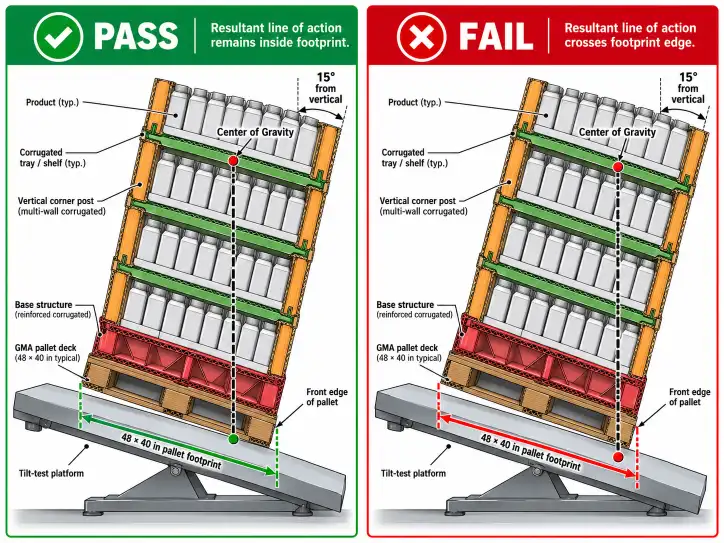
How to Ensure Your Floor Display Survives Shipping
A great design means nothing if the display arrives damaged. Over the years, I've seen too many campaigns ruined by displays that were crushed, bent, or moisture-damaged during shipping.
Flat Pack Shipping
Most floor displays ship flat (knocked down) and are assembled in store. Flat packing reduces shipping volume by 70–80% compared to pre-assembled displays. This significantly lowers freight costs.
Protection Measures
| Protection Method | What It Prevents |
|---|---|
| Corner guards | Crushing and impact damage |
| Stretch wrap | Moisture, dirt, and loose components |
| Pallet stacking guidelines | Crushing from over-stacking |
| Desiccant packs | Humidity damage in containers |
| Export-grade carton | Rough handling during international shipping |
Assembly Considerations
A floor display that is difficult to assemble will not be set up correctly — or at all. I've walked into stores and seen displays sitting in the back room because store staff could not figure out how to assemble them.
Design for assembly:
- Use clear instructions with pictures, not text-only
- Eliminate small loose parts — they get lost
- Design components that snap together without glue or tape
- Test the assembly time — if it takes more than 5 minutes for a single person, simplify it
FAQ
What is the difference between a floor display and a counter display?
A floor display sits on the ground and holds larger quantities of product. A counter display sits on a countertop or checkout desk and holds smaller items. Floor displays are for high-traffic aisles; counter displays are for impulse purchases at the point of sale.
What is an FSDU?
FSDU stands for Free Standing Display Unit. It is a self-supporting floor display that does not need to be attached to a wall or fixture. Most cardboard floor displays in retail are FSDUs.
How much weight can a floor display hold?
A standard B-flute corrugated floor display can hold 15–30 kg per shelf. A double-wall display can hold 30–60 kg per shelf. The total weight capacity depends on the board grade, display height, and product distribution.
Can floor displays be reused?
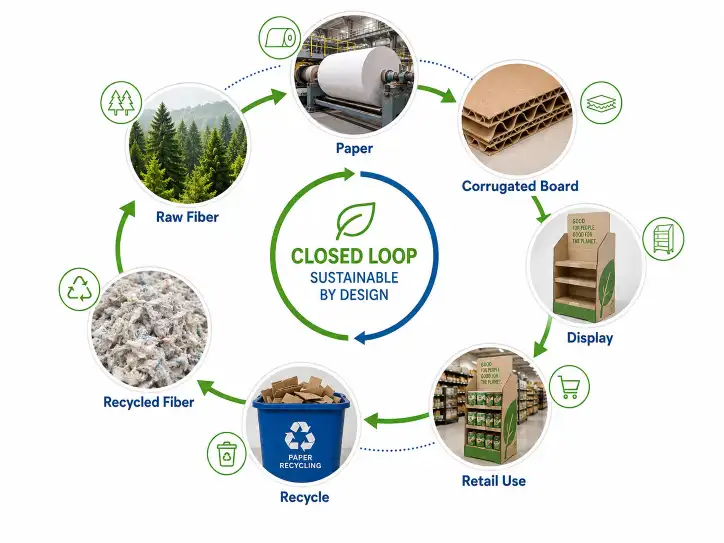
Most cardboard floor displays are designed for single use. They are recyclable after the campaign ends. For reusable displays, consider a modular design with replaceable graphics, but this adds cost and complexity.
What is the lead time for custom floor displays?
Standard lead time is 15–25 business days from artwork approval. Digital print runs can ship in 10–15 business days. Large orders with litho laminate may take 20–30 business days.
How do I get a quote for a custom floor display?
Contact a floor display manufacturer with your product dimensions, target quantity, desired print quality, and retail environment. A detailed brief gets you a more accurate quote.
What is litho laminate?
Litho laminate is a process where a full-color printed paper sheet is laminated onto corrugated board. It produces retail-shelf print quality on a floor display structure. It costs more than direct flexo printing but looks significantly better.
Are cardboard floor displays eco-friendly?
Yes. Corrugated cardboard is made from renewable paper fiber and is widely recycled. Most floor displays contain 30–70% recycled content and are fully recyclable after use.
What size floor display does Costco accept?
Costco typically accepts pallet-sized displays that fit within 100 × 120 cm footprint with a height under 180 cm (including pallet). Specific requirements vary by warehouse. Always confirm with your Costco buyer before production.
Can I get a sample before ordering?
Yes. Most manufacturers offer pre-production samples before the full order. Sample lead time is 5–10 business days. A sample fee applies and is usually deducted from the production order.

One Response