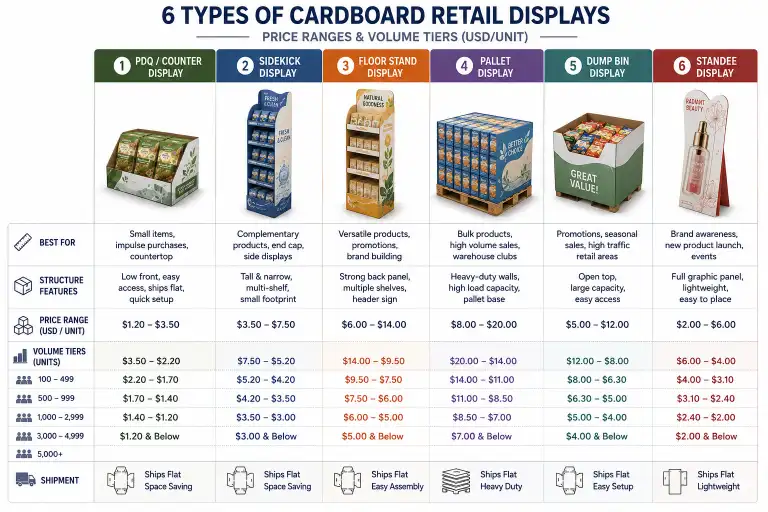
Most buyers ask the same question first: "How much does a cardboard display cost?" The answer depends entirely on what type of display you need, how many you order, and what the product requires. A counter display and a pallet display share the same material — corrugated cardboard — but their costs differ by 10× or more.
This guide gives the 2026 price ranges for six common display types: counter display, PDQ display, sidekick display, floor display, pallet display, and dump bin. Each section breaks down what drives the cost, what you get at each price level, and what to ask the factory so your first quote is close to the final number.
01 Counter Display
Best for: Lightweight products at checkout counters
Typical size: 8" × 10" × 12" to 12" × 12" × 18"
Board grade: E-flute or B-flute single-wall
Price ranges (2026)
| Quantity | Simple (no print) | Full print (litho-laminate) |
|---|---|---|
| 100 units | $3.50–$5.00/unit | $5.00–$8.00/unit |
| 500 units | $2.00–$3.00/unit | $3.00–$4.50/unit |
| 1,000 units | $1.50–$2.50/unit | $2.50–$3.50/unit |
| 5,000 units | $1.00–$1.50/unit | $1.80–$2.50/unit |
What drives the cost
- Board grade — E-flute is cheapest; B-flute adds ~15% to material cost
- Print coverage — Full 4-color litho-laminate adds $1.00–$2.50/unit over unprinted at low volumes
- Die-cut complexity — A simple rectangular box costs less than a shaped counter display with windows and locks
- Anti-slip treatment — Rubberized base pads add $0.30–$0.60/unit
What buyers miss
Counter displays look simple, but the die-cut tooling (steel rule die) is a fixed cost that hits hard at low volumes. At 100 units, the tooling amortization can be $1.50–$2.00 per unit. At 5,000 units, it is $0.03–$0.05 per unit. If your first order is small, ask the supplier whether the die becomes your property — it can be used for reorders without paying again.
For a detailed guide on counter display structural design, see [[Counter Display Guide - Custom Countertop Display for Retail|Custom Counter Display Guide]].
02 PDQ Display
Best for: Shelf-ready packaging, single-SKU promotions
Typical size: 6" × 4" × 8" to 12" × 8" × 14"
Board grade: B-flute single-wall, sometimes E-flute
Price ranges (2026)
| Quantity | Simple PDQ | PDQ with print + divider |
|---|---|---|
| 200 units | $2.00–$3.50/unit | $3.50–$5.50/unit |
| 500 units | $1.50–$2.50/unit | $2.50–$4.00/unit |
| 1,000 units | $1.00–$1.80/unit | $1.80–$3.00/unit |
| 5,000 units | $0.70–$1.20/unit | $1.20–$2.00/unit |
What drives the cost
- Internal dividers — Adding a divider or compartment separator adds $0.50–$1.50/unit depending on complexity
- Print method — Flexo printing is standard for PDQs; litho-laminate can double the unit cost
- Flat vs pre-glued — Pre-glued PDQs (folded and glued at factory) cost more but save store assembly time
- Retailer-specific labeling — Walmart or Target barcode labels add $0.10–$0.25/unit
What buyers miss
PDQ displays are the most cost-efficient display type per unit of shelf space — they fit directly on existing retail shelves and require no additional floor footprint. The cost per product exposed is often lower than a floor display because the PDQ uses less corrugated board. If you have one SKU and a shelf placement, a PDQ is almost always the cheapest way to get product in front of shoppers.
For Walmart-specific PDQ requirements, see [[Walmart PDQ Display & Shelf-Ready Packaging Guide|Walmart PDQ & SRP Guide]].
03 Sidekick Display
Best for: Add-on products on shelf wings or end-cap side panels
Typical size: 6" × 4" × 18" to 12" × 6" × 24"
Board grade: B-flute or C-flute single-wall
Price ranges (2026)
| Quantity | Sidekick (peg hooks) | Sidekick (shelf + print) |
|---|---|---|
| 200 units | $4.00–$6.00/unit | $6.00–$9.00/unit |
| 500 units | $3.00–$4.50/unit | $4.50–$6.50/unit |
| 1,000 units | $2.00–$3.50/unit | $3.50–$5.00/unit |
| 5,000 units | $1.50–$2.50/unit | $2.50–$3.50/unit |
What drives the cost
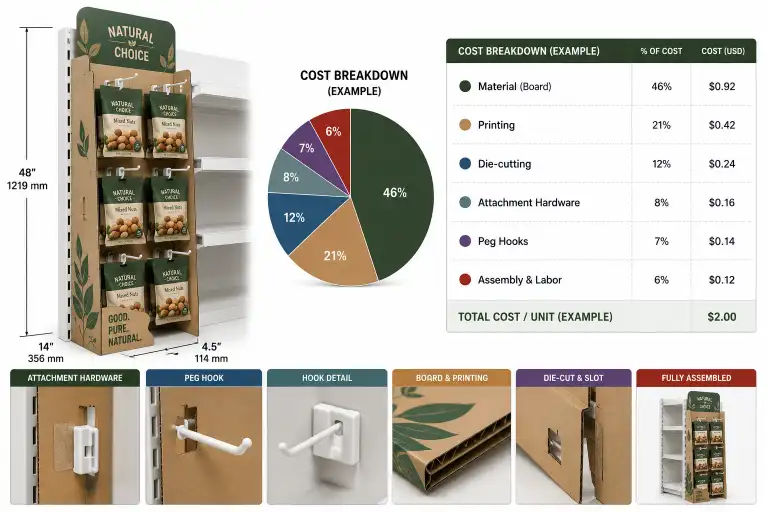
- Peg hooks — Each metal peg hook adds $0.50–$1.00. A sidekick with 8 pegs adds $4–$8 in hardware alone
- Attachment hardware — Zip ties, hook-and-loop straps, or bracket clips add $0.25–$1.00/unit
- Reinforcement — Sidekicks holding heavy products need double-wall board at the attachment points, adding ~20% to material cost
What buyers miss
Sidekicks have hidden hardware costs that can double the per-unit price. The corrugated structure is cheap; the metal peg hooks, attachment straps, and plastic fittings are not. When comparing quotes, ask for a hardware line-item breakdown — some suppliers include hooks in the unit price, others list them separately.
For sidekick compliance and attachment specifications, see [[Guide to Target, Walgreens, Kroger, Publix, Home Depot, Lowe's Display Compliance|Major Retailer Display Compliance Guide]].
04 Floor Display (FSDU)
Best for: End-cap and aisle placements, multi-SKU displays
Typical size: 18" × 18" × 60" to 36" × 24" × 72"
Board grade: C-flute single-wall, BC-flute double-wall for heavier loads
Price ranges (2026)
| Quantity | Single-wall, 1–2 shelves | Double-wall, 3+ shelves, print |
|---|---|---|
| 100 units | $8.00–$14.00/unit | $14.00–$22.00/unit |
| 500 units | $5.00–$9.00/unit | $9.00–$15.00/unit |
| 1,000 units | $3.50–$6.50/unit | $6.50–$11.00/unit |
| 5,000 units | $2.50–$4.50/unit | $4.50–$8.00/unit |
What drives the cost
- Board grade — Upgrading from single-wall to double-wall adds 30–50% to material cost
- Shelves — Each additional shelf adds $1.00–$3.00/unit in board cost plus assembly labor
- Litho-laminate printing — For floor displays sized 24" × 18" × 60", the litho-laminate alone can be $3.00–$6.00/unit at low volumes
- Reinforcement — Extra corner supports, back panels, and base locks add 10–20% to total cost
What buyers miss
Floor displays are where structural engineering matters most. A $10 floor display that collapses after 2 weeks in a store costs more than a $16 floor display that lasts the entire promotion. The cheapest quote on a floor display is often the most expensive in the long run — especially if the retailer charges back the brand for lost product or cleanup.
For a detailed structural design guide with board grade selection and load testing, see [[Display Fixture Structural Design Guide|Display Fixture Structural Design Guide: Load Capacity, Stability, and Transport Testing]].
05 Pallet Display
Best for: Warehouse clubs, bulk promotions, high-volume programs
Typical size: Full pallet (48" × 40" × 72"), half pallet (36" × 24" × 60")
Board grade: BC-flute double-wall minimum
Price ranges (2026)
| Quantity | Half pallet, basic | Full pallet, double-wall, litho |
|---|---|---|
| 200 units | $15.00–$25.00/unit | $25.00–$40.00/unit |
| 500 units | $10.00–$18.00/unit | $18.00–$30.00/unit |
| 1,000 units | $8.00–$14.00/unit | $14.00–$22.00/unit |
| 5,000 units | $6.00–$10.00/unit | $10.00–$16.00/unit |
What drives the cost
- Wood pallet — The GMA pallet alone adds $3.00–$6.00/unit depending on grade (new vs recycled)
- Board grade — BC-flute double-wall is standard; upgrading to triple-wall for heavy loads adds 40–60% to board cost
- Pre-filled labor — Factory loading of product adds $2.00–$5.00/unit in labor cost
- Shrink wrap and banding — Securing the display and product for transit adds $1.00–$2.00/unit
- ISTA testing — Transport vibration testing adds a one-time cost of $1,500–$3,000 per display design
What buyers miss
Pallet displays have the highest unit cost of any display type, but the cost per product sold is often the lowest. A full pallet display holding 200 units of product at $25/unit cost for the display itself adds only $0.13 per product — cheaper than any other display format per unit of product exposed. The mistake buyers make is comparing pallet display unit cost to floor display unit cost without accounting for the product capacity difference.
For a full pallet display pricing breakdown including pre-filled vs flat-pack trade-offs, see [[How Much Does a Pallet Display Cost- 2026 Pricing Guide for Buyers|Pallet Display Cost Guide 2026]].
06 Dump Bin
Best for: Loose products, seasonal promotions, bulk items
Typical size: 18" × 18" × 24" to 24" × 24" × 36"
Board grade: B-flute or C-flute single-wall
Price ranges (2026)
| Quantity | Basic (no print) | Full print (litho-laminate) |
|---|---|---|
| 100 units | $4.00–$7.00/unit | $7.00–$12.00/unit |
| 500 units | $2.50–$4.50/unit | $4.50–$7.50/unit |
| 1,000 units | $1.80–$3.00/unit | $3.00–$5.50/unit |
| 5,000 units | $1.20–$2.00/unit | $2.00–$3.50/unit |
What drives the cost
- Size — A 24" × 24" bin uses 4× the board of an 18" × 18" bin, so cost scales with footprint
- Print coverage — Dump bins are often ordered unprinted or with minimal print (1-color flexo) because they are used for seasonal promotions and replaced frequently
- Reinforced top edge — A rolled or wire-reinforced top edge adds $0.50–$1.50/unit but prevents the bin from collapsing when overfilled
What buyers miss
Dump bins look like the cheapest display option after counter displays, but the cost per unit of product sold depends entirely on the product value. A dump bin holding $2 candy bars has very different ROI than one holding $20 toys. For low-margin products, the display cost per unit can eat 5–10% of the product margin.
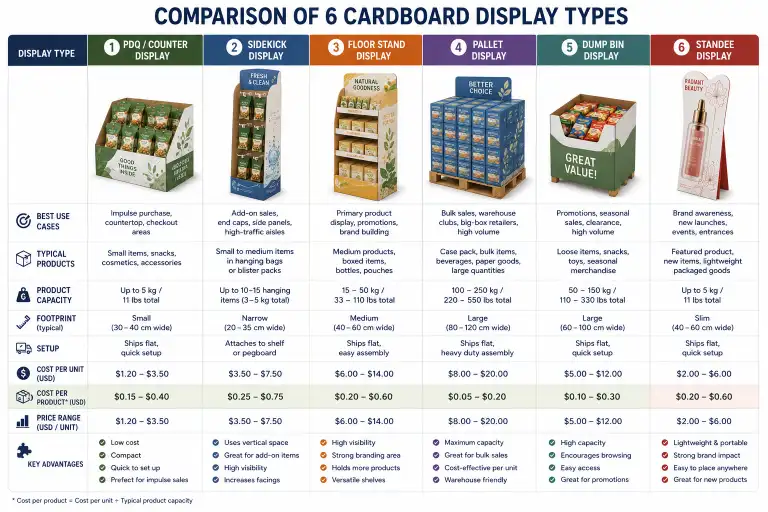
Cost Comparison Summary
| Display Type | Typical Unit Cost (1,000 qty) | Product Capacity | Cost per Product | Best Use Case |
|---|---|---|---|---|
| Counter Display | $2.50–$3.50 | 12–24 units | $0.15–$0.29 | Checkout impulse buys |
| PDQ Display | $1.00–$1.80 | 12–24 units | $0.08–$0.15 | Shelf-ready single SKU |
| Sidekick Display | $3.50–$5.00 | 24–48 units | $0.10–$0.15 | Add-on products |
| Floor Display | $6.50–$11.00 | 48–120 units | $0.07–$0.14 | End-cap promotions |
| Dump Bin | $3.00–$5.50 | 50–100 units | $0.04–$0.07 | Seasonal bulk items |
| Pallet Display | $14.00–$22.00 | 100–300 units | $0.07–$0.14 | Warehouse clubs, high volume |
The table above shows the cost per product (display cost divided by product capacity) — this is the number that actually matters for your P&L.
What Actually Drives Display Cost (Beyond Display Type)
Regardless of which display type you choose, six variables determine the final price:
| Variable | Impact on Cost | How to Control It |
|---|---|---|
| Order quantity | 40–60% of total price | Order in standard production batches; avoid odd quantities |
| Board grade | 15–25% of unit cost | Use the heaviest grade the product needs; do not over-spec |
| Print method | 10–30% of unit cost | Use flexo for large orders, litho-laminate for premium, digital for small runs |
| Die-cut complexity | 5–15% of unit cost | Simple rectangles are cheapest; avoid complex curves |
| Hardware (hooks, straps, etc.) | 5–20% of unit cost | Request standard hardware where possible |
| Assembly (flat vs pre-assembled) | 5–15% of unit cost | Flat-packed saves 20–30% on shipping but adds store labor |
For a detailed guide on how board grade and flute type affect pricing, see [[Corrugated Grades Explained- How to Choose the Right Material for Displays|Corrugated Grades Explained: How to Choose the Right Material for Displays]].
How to Get an Accurate Quote (Every Time)
A supplier's first quote is only as good as the information you provide. If you send "I need a cardboard display" without product details, the quote will include 20–30% contingency padding. The supplier does not know if the product weighs 1 kg or 10 kg, so they quote high to protect themselves.
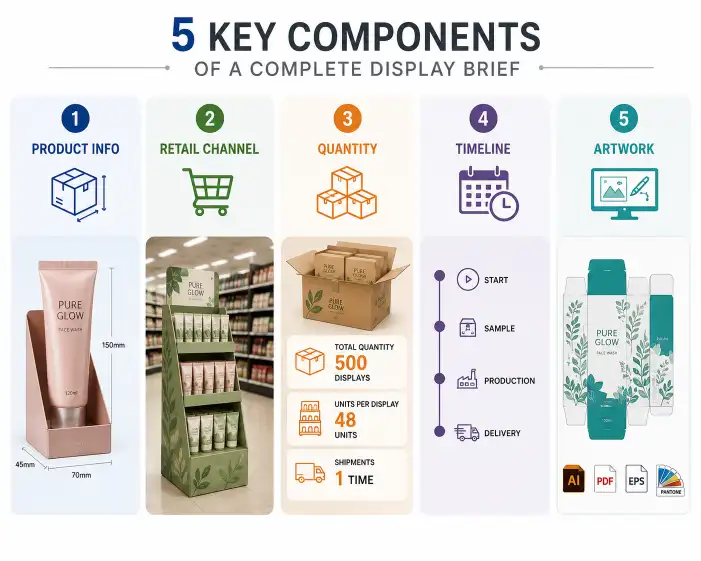
To get a quote that is close to the final price, provide:
- Product weight per unit — Without this, no quote is reliable
- Product dimensions — Including packaging, not just the product
- SKU count — Single SKU or multi-SKU? Each SKU changes the design
- Target retailer — Walmart, Costco, and Target have different compliance specs that affect cost
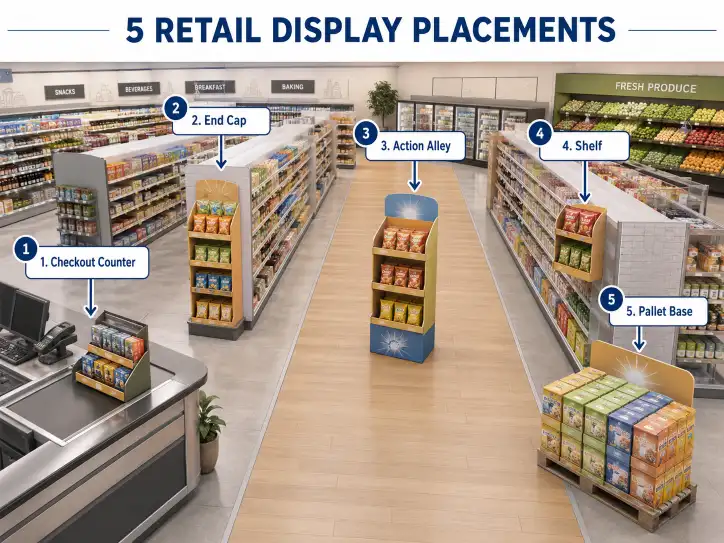
- Display location — Shelf, end cap, counter, or pallet base
- Order quantity — The single biggest driver of per-unit price
- Shipping method — Flat pack (cheaper freight) or pre-assembled (higher cost)
- Artwork status — Ready files cost less than projects requiring design work
For a complete project preparation checklist to use before contacting any factory, see [[Cardboard Display Selection Guide - Decision Framework for Buyers|Cardboard Display Selection Guide: A Decision Framework for Buyers]].