Every Walmart pallet display starts as raw corrugated board, and the material sourcing decisions that work for a club store program do not always fit a Walmart program. Walmart's shorter transit routes, higher handling frequency, mixed pallet stacking, and broader range of accepted pallet footprints change the board selection criteria. A board grade that passes a Costco program may be over-specified for Walmart's regional transit, or under-specified for Walmart's multi-cycle handling environment.
This guide covers Walmart display material sourcing from the factory floor: how board grades are selected for Walmart's specific supply chain, how material cost compares to club store programs, how lead times are planned around Walmart's launch schedule, and how moisture and handling protection are sourced for Walmart's distribution network. It is the material sourcing companion to our Walmart pallet display structural engineering guide — that guide covers how the structure is designed; this guide covers how the materials are sourced to build it.
01 How Walmart Display Programs Affect Material Decisions
Walmart's supply chain puts different demands on corrugated board than a club store program. Before selecting a board grade, the factory reviews how the display will move through Walmart's distribution network.
| Supply Chain Factor | How It Affects Board Selection |
|---|---|
| Regional transit | Shorter transit distances — less vibration fatigue means the board grade can sometimes be optimized downward vs. a long-distance club store program |
| Multiple handling cycles | More forklift and pallet jack touches — board must maintain edge crush strength after repeated handling, not just single-cycle loading |
| Mixed pallet stacking | The base and top structure must carry uneven loads from pallets of different products stacked above — board grade for the base may need to be one step higher than the product weight alone would suggest |
| Floor staging | Displays staged on concrete floors absorb moisture from the floor surface — bottom panels need moisture protection regardless of the board grade |
| Footprint variety | 48 × 40, 48 × 36, 40 × 32, and custom footprints are accepted — board quantity estimates must account for different sheet size efficiencies per footprint |
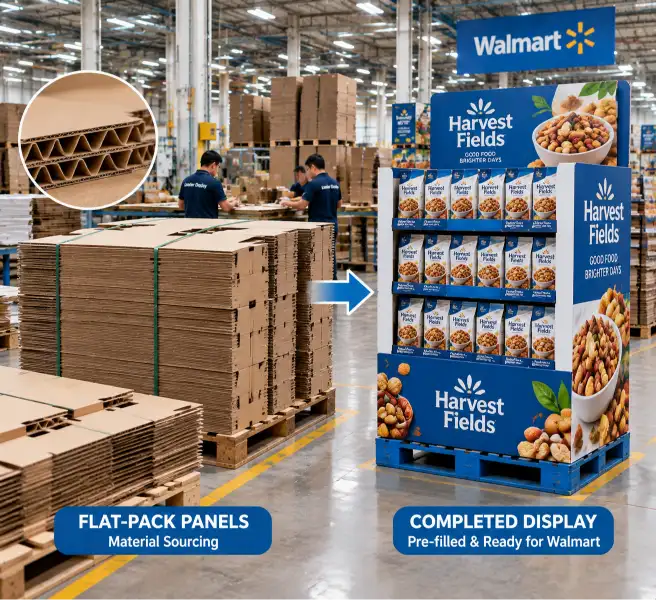
| Pre-fill optional | Flat-pack is accepted for many programs — board sourcing for flat-pack is simpler because transit protection can be added at the destination rather than at the factory |
The Core Difference: Handling vs. Distance
The single biggest material difference between Walmart and club store sourcing is this:
- Club store programs source board optimized for long-distance transit — moisture resistance for ocean freight, high ECT for multi-week stacking loads
- Walmart programs source board optimized for handling endurance — edge crush retention through multiple handling cycles, base panel strength for floor staging, and top cap strength for mixed stacking
A factory sourcing board for a Walmart program focuses on the base and top cap grades first, then optimizes the rest of the structure for the shorter transit distance.
02 Board Grade Selection for Walmart Displays
The board grade decision for a Walmart display starts from the same engineering table as any corrugated display, but the Walmart-specific supply chain shifts the weight of each factor.
Board Grades and Their Use in Walmart Programs
| Grade | Flute | Typical Walmart Application |
|---|---|---|
| Single wall B flute | B | Light PDQ trays, shelf-ready packaging, lightweight counter displays |
| Single wall C flute | C | General trays, light pallet display upper tiers, grocery PDQ units |
| Double wall BC flute | B + C | The workhorse of Walmart pallet displays — heavy trays, base structures, full pallet displays |
| Double wall EB flute | E + B | Printed structural panels where graphics quality and board strength are both needed — headers, branded side panels |
| Triple wall | B + C + B (or similar) | Heavy product programs (pet food, beverages, bulk hardware), reinforced base structures |
Walmart-Specific Grade Decision Factors
| Factor | Engineering Consideration |
|---|---|
| Handling cycle count | More handling cycles require higher edge crush retention — double wall BC is preferred for base structures even on moderate-weight programs |
| Mixed stacking load | Base grade must be selected for the weight of unknown pallets stacked above, not just the display's own product weight |
| Floor staging duration | Longer floor staging pushes the bottom panel toward moisture-resistant board or a barrier liner |
| Transit distance | Shorter regional transit allows a lower grade on upper display levels than a club store program of the same product weight |
| Shelf span | Walmart displays often carry wider product variety — adjust shelf board grade for the heaviest product that will sit on that shelf |
| Pallet footprint | Smaller footprints (48 × 36, 40 × 32) concentrate the same product weight onto a smaller base area — the base board grade may need to increase |
The Walmart Grade Decision Sequence
| Step | Question | Decision |
|---|---|---|
| 1 | What is the total product weight per display? | Establishes the base grade range |
| 2 | How many handling cycles will the display survive? | If 3+ touches, use double wall for base and lower structure |
| 3 | Will the display be mixed-stacked in the DC? | If yes, add a top cap or increase base grade by one step |
| 4 | How long will the display be floor-staged? | If over 72 hours, specify a moisture barrier on bottom panels |
| 5 | What is the transit distance? | If regional (under 500 miles), upper levels can use a lower grade than long-distance |
| 6 | What pallet footprint will be used? | Smaller footprints may need thicker base board to carry the same load density |
For the full board grade comparison and flute characteristics, see the grade table in our Costco display structural engineering guide — the flute grades (B, C, BC, EB, triple wall) are the same, but the decision factors shift toward handling endurance rather than long-distance transit protection.
03 Fiber Source and Moisture Protection for Walmart
Fiber source decisions for Walmart displays differ from club store programs because the moisture risk comes from a different source. Club store programs must protect against ocean freight humidity. Walmart programs must protect against concrete floor moisture and short-term exposure in regional DCs.
Fiber Source Decision
| Fiber Type | Strength | Moisture Behavior | Best Use for Walmart |
|---|---|---|---|
| Virgin fiber | Highest | Best moisture resistance | Heavy product programs, displays with extended floor staging, high-stacking-load base panels |
| Recycled (OCC) | Good, variable | Absorbs moisture more readily | Light to moderate Walmart programs with short floor staging; PDQ trays and flat-pack panels |
| Blended | Middle | Middle | Most general Walmart pallet displays |
Moisture Protection for the Walmart Supply Chain
| Moisture Risk | Source | Protection Method |
|---|---|---|
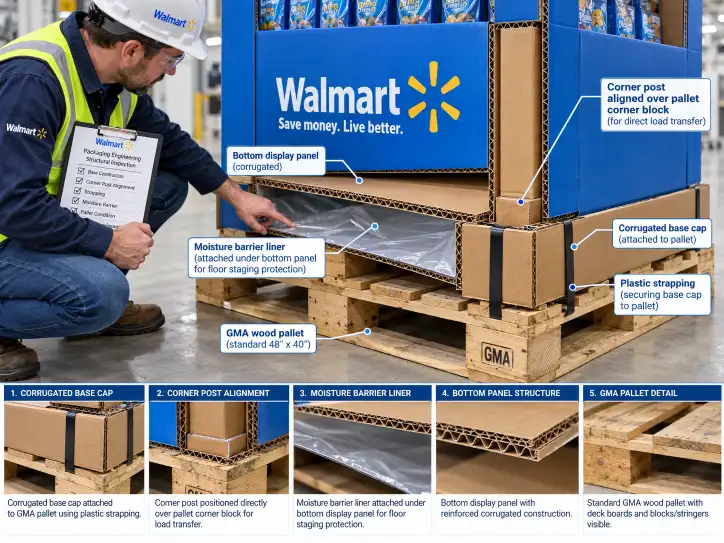
| Concrete floor moisture | Floor staging in Walmart DCs and store back rooms | Bottom panel moisture barrier (wax coating, poly coating, or barrier liner); avoid direct board-to-concrete contact |
| Short-term humidity | Regional DC storage (usually under 2 weeks) | Standard board with stretch wrap is usually sufficient — no need for ocean-grade moisture protection |
| Transit moisture | Truck transport (regional, covered trailers) | Minimal — covered trucking rarely exposes displays to enough moisture to warrant barrier protection |
| Cold chain condensation | Chilled or frozen product programs | For displays with chilled products, specify moisture-resistant board or barrier layer sheets between product and corrugated panels |
04 Material Lead Times for Walmart Programs
Walmart launch dates are driven by the Walmart retail calendar — quarterly resets, seasonal programs, and category reviews. The factory's material lead time must align with these dates, and the buying cycle for Walmart programs follows a different rhythm than club store programs.
Walmart Program Timeline vs. Material Lead Time
| Program Stage | Typical Duration | Material Dependency |
|---|---|---|
| Buyer discussion and program confirmation | Starts 12–16 weeks before launch | Open |
| Structural sample and approval | 2–4 weeks | Sample board only |
| Board sourcing and confirmation | 1–2 weeks | Grade, price, and availability locked |
| Production run | 2–4 weeks | Board must arrive 1 week before production starts |
| Flat-pack packing or pre-fill | 1–2 weeks | Board + product must be at the factory together |
| Transit to Walmart DC | 1–3 weeks | Regional — shorter than club store ocean transit |
What Affects Board Availability for Walmart Programs
| Factor | Effect on Lead Time |
|---|---|
| Common grades (BC, B, C) | In stock at most corrugating plants — standard 1–2 week lead time |
| Specialty grades (moisture-resistant, triple wall) | Made to order — 2–4 week lead time |
| Regional board sourcing | Walmart programs that ship from a factory near a Walmart regional DC may use locally sourced board, which can reduce lead time by 1 week vs. board sourced from a distant plant |
| Seasonal demand | Q3 back-to-school, Q4 holiday, and spring lawn & garden — all drive board demand spikes that stretch lead times |
The Walmart Launch Date Rule
The same rule applies as for Costco programs: do not commit to a launch date until the board is confirmed. But for Walmart programs, there is an additional consideration — Walmart's category reset calendar is fixed. Missing a reset window means the display sits in a DC for up to 12 weeks until the next reset. The factory must confirm board availability against the reset date, not the ship date.
05 Material Cost Comparison: Walmart vs. Club Store
Board cost for a Walmart display is typically lower than for a club store display of the same product weight — not because the board is cheaper, but because the shorter transit route and different handling profile allow grade optimization on the upper display levels.
Cost Comparison by Structural Zone
| Structural Zone | Club Store Grade (Typical) | Walmart Grade (Typical) | Cost Difference |
|---|---|---|---|
| Base structure | Double wall BC or triple wall | Double wall BC (handling endurance priority) | Similar |
| Lower trays (heavy load) | Double wall BC | Double wall BC | Same |
| Upper trays (light load) | Double wall BC or single wall C | Single wall C or B | Lower — saves 10–20% per tray |
| Header / top cap | Double wall EB or litho-lam backed | Double wall EB or single wall with backing | Similar |
| Side panels | Double wall BC | Single wall C or double wall BC (if structural) | Lower — saves 5–15% per panel |
| Moisture protection | Barrier board for ocean transit | Bottom-panel barrier only for floor staging | Lower — saves 15–25% on barrier cost |
Why Walmart Board Cost Is Usually Lower
| Reason | Explanation |
|---|---|
| Shorter transit | Less vibration fatigue — upper levels can use lighter grades |
| Regional sourcing | Board sourced from nearby corrugating plants — lower freight cost passed through |
| No ocean transit | No need for ocean-grade moisture protection on all panels — only floor-contact panels need barriers |
| Flat-pack flexibility | Flat-pack programs can use lighter board because the panels are not loaded during transit |
For the full cost breakdown of how board grade, print method, structure complexity, and packing affect the total display cost, see our Costco pallet display cost guide — the same cost drivers apply, but the specific board and moisture costs are typically lower for a Walmart program.
06 Sourcing for Flat-Pack vs. Pre-Filled Walmart Programs
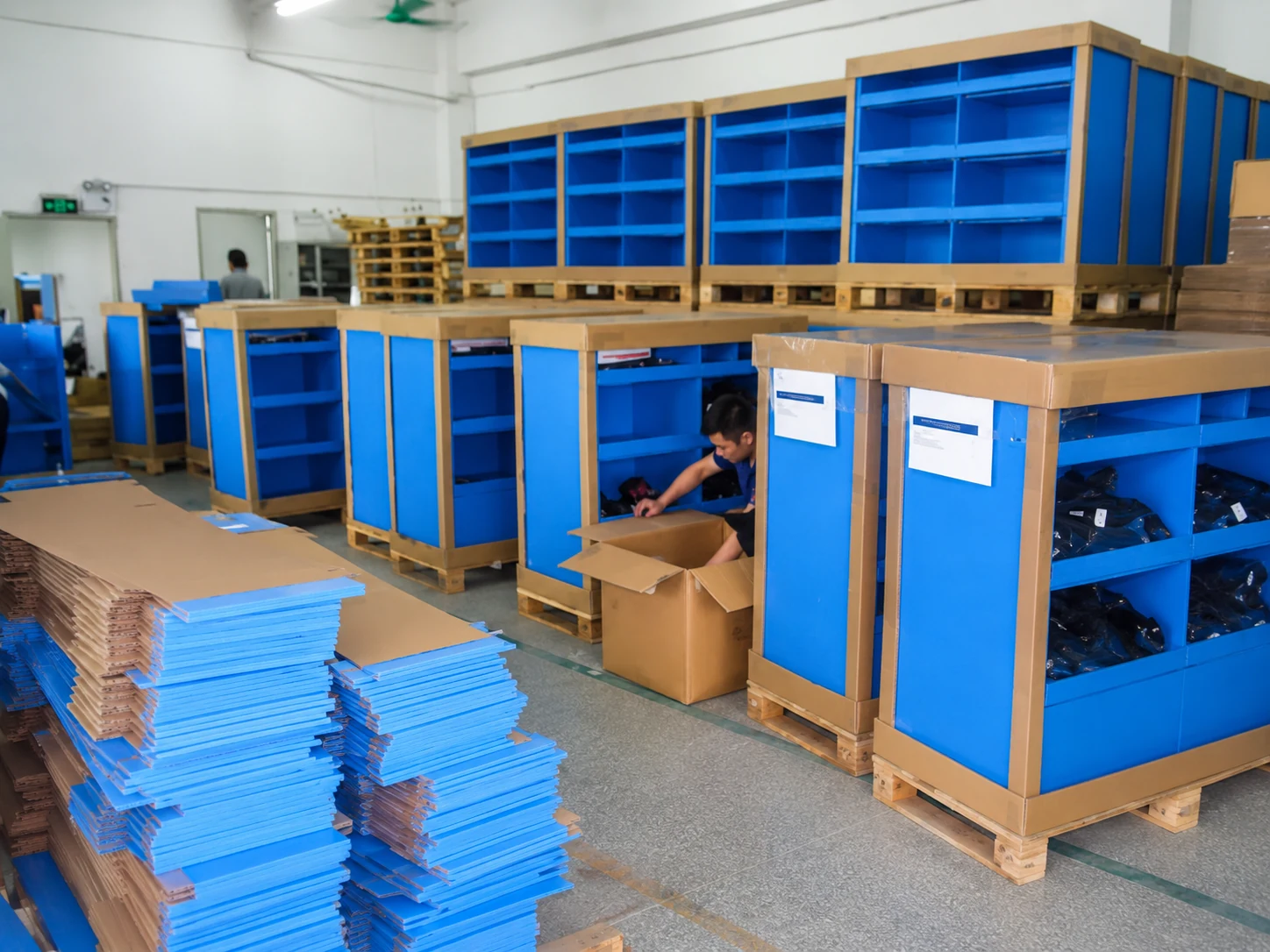
Walmart accepts both flat-pack and pre-filled displays, and the material sourcing plan differs between the two formats. Flat-pack programs give the factory more flexibility in board sourcing, while pre-filled programs require tighter alignment between board arrival, print completion, and product arrival.
Sourcing Comparison by Program Format
| Sourcing Factor | Pre-Filled Display | Flat-Pack Display |
|---|---|---|
| Board grade | Selected for loaded transit — must carry product weight + stacking + handling | Can be selected for structural display requirements only — no transit load concern |
| Moisture protection | Needed on base panels and potentially side panels | Minimal — panels ship flat and are assembled after transit |
| Board arrival timing | Must arrive before pre-fill assembly starts | Can arrive later — assembly happens at destination |
| Product arrival alignment | Product must arrive at the factory during the same window as board | No product alignment needed — display panels ship separately |
| Inventory storage | Loaded units take warehouse space | Flat panels stack flat — minimal storage space |
| Regional sourcing flexibility | Board can be sourced regionally to the factory | Board can be sourced regionally to the factory |
When to Source for Each Format
| Program Type | Recommended Sourcing Approach |
|---|---|
| Single SKU, high-volume Walmart program | Pre-filled — source board for loaded transit; confirm product arrival date before ordering board |
| Multi-SKU program with multiple display versions | Flat-pack — source board without transit load concerns; pack panels by version |
| Seasonal program with fixed reset date | Pre-filled or flat-pack — confirm board availability against the reset date first, then choose the format |
| Heavy product program (pet food, beverages) | Pre-filled preferred — but confirm that the board grade can carry the loaded transit load at the target cost |
For how pre-filled display loading works and the factory coordination involved, see our pre-filled pallet displays guide.
07 Material Sourcing Checklist for Walmart Programs
Before a Walmart display program moves into mass production, run this sourcing review. It adapts the standard sourcing checklist for Walmart's specific supply chain.
| Check | Status |
|---|---|
| Board grade selected for handling endurance — not just product load | ☐ |
| Base board grade rated for mixed stacking load (1.5× product load minimum) | ☐ |
| Upper display levels optimized for shorter transit — not over-specified | ☐ |
| Moisture protection matched to the actual risk — floor staging barrier, not ocean-grade barrier | ☐ |
| Board order confirmed against the Walmart category reset date, not just the ship date | ☐ |
| Regional board sourcing considered to reduce lead time and freight cost | ☐ |
| Flat-pack vs. pre-filled format selected — board grade and transit protection adjusted for the chosen format | ☐ |
| For pre-filled programs: board arrival and product arrival aligned in the production window | ☐ |
| Board cost reviewed against the structural zone optimization table — no over-specified zones | ☐ |
08 How the Factory Sources Material for a Walmart Program
Walmart display material sourcing follows the same principles as any corrugated program, but the decisions are optimized for Walmart's shorter, more handling-intensive supply chain:
- Select the base grade for handling endurance — the base and lower structure are the priority. Double wall BC is the default for most full pallet programs
- Optimize upper levels for the shorter transit — upper trays and non-structural panels can use lighter grades than a club store program of the same product weight
- Match moisture protection to the real risk — floor staging barrier on bottom panels is usually sufficient; ocean-grade protection is not needed
- Confirm board against the reset calendar — Walmart's category reset schedule is fixed. Board delivery must align with the reset, not a flexible launch date
- Choose the ship form by supply chain fit — flat-pack gives more material flexibility; pre-filled needs tighter coordination but may be required by the program
This is how a factory proves it understands Walmart display material sourcing — not by applying a universal board table, but by selecting grades, protection, and lead times that match Walmart's actual distribution network. For an overview of Walmart display formats and program requirements, visit our Walmart pallet display requirements guide. For how the material sourcing decisions flow into the structural engineering, see our Walmart pallet display structural engineering guide.
FAQ
Q: How is Walmart display material sourcing different from Costco?
A: The core difference: Walmart programs are optimized for handling endurance (more forklift cycles, mixed stacking), while Costco programs are optimized for long-distance transit (ocean freight moisture, multi-week stacking loads). Walmart programs typically use lower board grades on upper display levels and need less moisture protection overall — but the base must be stronger to survive more handling touches.
Q: What board grade is most common for Walmart pallet displays?
A: Double wall BC flute is the workhorse, same as for club store programs. The difference is in how it is applied — Walmart base structures use double wall for handling endurance, while upper levels can often use single wall C or B flute, which would be less common on a long-distance club store program.
Q: Does Walmart require moisture protection on displays?
A: Walmart typically requires moisture protection on the bottom panels for floor staging. Ocean-grade moisture protection (barrier board on all panels) is usually not needed because Walmart's supply chain is regional and covered-truck transport. The protection is matched to the actual risk, not a default spec.
Q: How far in advance should board be ordered for a Walmart program?
A: Common grades (BC, B, C) have a 1–2 week lead time. Specialty grades take 2–4 weeks. The key difference: Walmart board must be confirmed against the category reset date because the reset calendar is fixed — missing the reset means the display waits weeks for the next window.
Q: Is Walmart display board cheaper than club store board?
A: Typically, yes — because the shorter transit route allows lighter grades on upper display levels, regional board sourcing reduces freight cost, and no ocean moisture protection is needed on most panels. The base structure cost is similar, but the total board cost can be 10–20% lower.
Q: Does flat-pack or pre-filled affect board sourcing for Walmart?
A: Yes. Flat-pack programs give more flexibility because panels ship flat and are not loaded during transit — the board grade only needs to satisfy structural display requirements. Pre-filled programs need the board to carry both product load and transit load, which may push the grade one step higher.
Q: What fiber source is best for Walmart displays?
A: Recycled (OCC) board is suitable for most light to moderate Walmart programs with short floor staging. Virgin fiber is preferred for heavy product programs, displays with extended floor staging, and base panels that carry mixed stacking loads. Blended board works for the majority of general Walmart pallet displays.
Q: How does the Walmart category reset calendar affect material sourcing?
A: Walmart's reset calendar is fixed — missing a reset means the display waits at a DC for up to 12 weeks. The factory must confirm board availability against the reset date, not just against the ship date. This is one of the biggest material sourcing differences between Walmart and club store programs.