
Not every product needs a full-size pallet display. For new product trials, seasonal promotions, endcap positions, and smaller product lines, a half pallet display for club stores offers the right footprint without the investment of a full GMA pallet program.
Costco and Sam's Club both accept half pallet displays in standard configurations. The buyer may even prefer a half pallet for certain positions — especially endcaps, action alleys, and cross-aisle promotional spots where floor space is limited.
This guide covers the half pallet display options available for club store vendors, including dimensions, weight limits, structural considerations, and when to choose half over full.
What Is a Half Pallet Display for Club Stores?
A half pallet display is a corrugated display unit built on a pallet base that is half the width or half the length of a standard GMA pallet. It holds less product than a full pallet display but requires less floor space, making it suitable for endcap and secondary positions in club stores.
Key Characteristics
| Feature | Description |
|---|---|
| Smaller footprint | Half the floor area of a standard 48×40 GMA pallet |
| Lighter weight | Lower total product weight, easier to handle |
| Lower investment | Less product per display, lower production cost |
| Flexible positioning | Fits endcaps, action alleys, and space-restricted positions |
| Retailer accepted | Costco and Sam's Club accept half pallet displays |
Common Applications
Half pallet displays are commonly used for:
- New product trials — Launch a product without committing to a full pallet
- Seasonal promotions — Limited-time offers that do not need full-scale rollout
- Smaller product lines — Products with fewer SKUs or lower volume
- Endcap positions — Store endcaps often require a smaller footprint
- Cross-aisle promotions — Special display positions between main aisles
For an overview of full-size display options, see our PALLET DISPLAY product page.
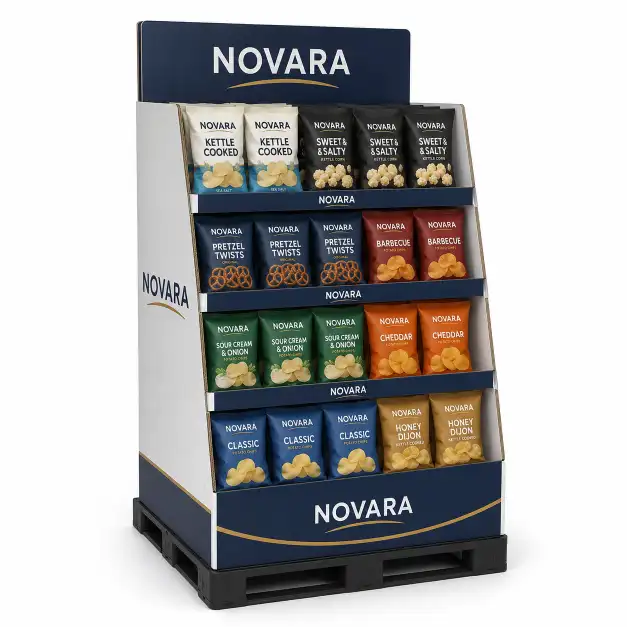
Half Pallet Dimensions: 48×20 vs 24×40
Costco and Sam's Club accept two standard half pallet configurations. Each has different space requirements and structural considerations.
48×20 Half Pallet (Half-Length)
| Specification | Requirement |
|---|---|
| Footprint | 48 × 20 in (1219 × 508 mm) |
| Orientation | Long side matches the aisle direction |
| Typical positions | Endcaps, cross-aisle, secondary floor positions |
| Forklift entry | Standard 3.5 in clearance, two-way entry on the 48 in side |
| Height | Same limits as full pallet: 72–84 in (confirmed with buyer) |
Best for: Products displayed along the end of an aisle where the 48 in width matches the standard shelf depth.
24×40 Half Pallet (Half-Width)
| Specification | Requirement |
|---|---|
| Footprint | 24 × 40 in (610 × 1016 mm) |
| Orientation | Narrow side faces the aisle |
| Typical positions | Action alleys, narrow endcaps, center-aisle promotions |
| Forklift entry | Standard 3.5 in clearance, two-way entry on the 40 in side |
| Height | Same limits as full pallet |
Best for: Narrow spaces where the 40 in dimension fits the depth of the display position.
For detailed pallet base specifications, see our Costco Pallet Display Requirements guide.
Dimension Comparison
| Aspect | 48×20 Half Pallet | 24×40 Half Pallet | Full GMA (48×40) |
|---|---|---|---|
| Floor area | 960 sq in | 960 sq in | 1,920 sq in |
| Relative size | 50% of full | 50% of full | 100% |
| Aisle-facing width | 48 in | 24 in | 48 in |
| Typical max weight | 500–800 lbs | 500–800 lbs | 1,500–2,500 lbs |
| Stacking during transit | 2–3 high | 2–3 high | 2–3 high |
When to Use a Half Pallet Display
Choosing between a half pallet and full pallet display depends on the product, the promotion, and the retail position.
New Product Trials
When entering Costco or Sam's Club for the first time, a half pallet display reduces risk:
- Lower product commitment — half the inventory per store
- Less display investment — fewer materials and less assembly time
- Easier to test multiple SKUs — use half pallets for different product variations
- Faster exit strategy — if the product does not perform, less product to clear
Seasonal Promotions
Seasonal items have a limited sales window. A half pallet display:
- Requires less production lead time
- Fits in seasonal promotional areas that may have restricted floor space
- Reduces leftover inventory after the season ends
- Allows retailers to test seasonal products without allocating full pallet positions
Smaller Product Lines
Brands with limited product ranges may not have enough volume for a full pallet display. A half pallet display:
- Works with 1–3 SKUs instead of the 3–6 typically needed for full pallets
- Maintains brand presence without overcommitting inventory
- Can be paired with another brand's half pallet in a shared position
Endcap and Secondary Positions
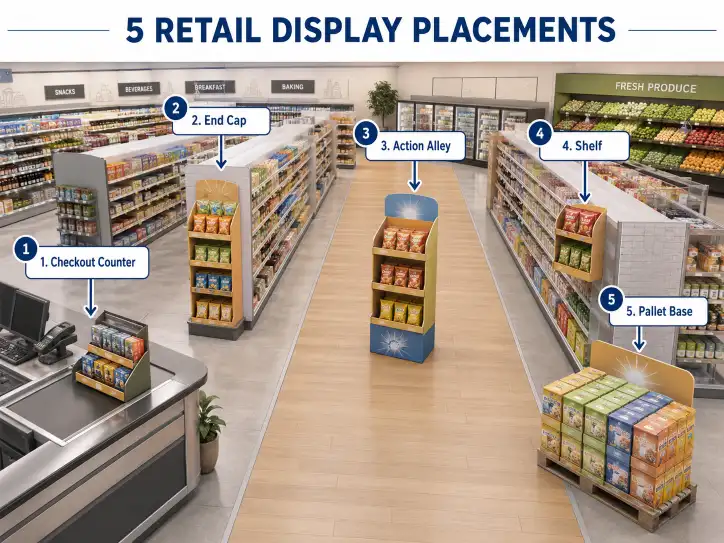
Club stores have limited full pallet positions. Endcaps and action alley positions often require a smaller footprint. Half pallet displays are designed for these locations.
For product category-specific display requirements, see our COSTCO DISPLAYS product page.
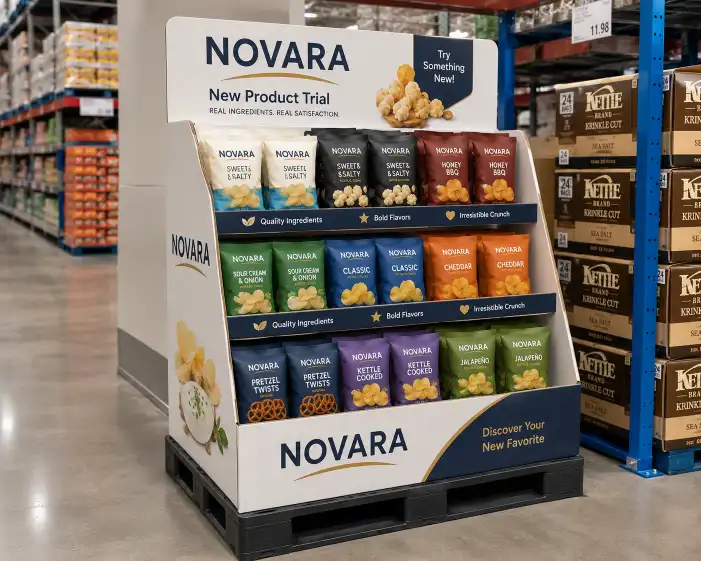
Endcap and Action Alley Placement
Endcaps and action alleys are prime retail positions. Understanding how half pallet displays fit these locations helps vendors plan the display design.
Endcap Positions
Endcaps are the display positions at the end of store aisles. They have specific size constraints:
| Store | Typical Endcap Width | Typical Endcap Depth | Notes |
|---|---|---|---|
| Costco | 48–60 in | 40–48 in | Varies by club layout |
| Sam's Club | 48–60 in | 40–48 in | Similar to Costco |
| BJ's | 48–54 in | 40–44 in | Check with buyer |
48×20 half pallet — Fits most endcaps with the 48 in side flush to the aisle. The 20 in depth leaves room behind for storage or other products.
24×40 half pallet — Fits narrower endcaps or can be placed two side-by-side (48×40) to fill a standard full pallet position.
Action Alley Positions
Action alleys are the main walkways that run through the center of club stores. Displays in action alleys must:
- Allow clear passage for shopping carts
- Not obstruct sight lines to endcaps
- Fit within designated promotional floor space
Half pallet displays are ideal for action alley promotions because they take up less floor space while still carrying enough product to justify the position.
Dual Half Pallet Configurations
Two half pallet displays can be placed together to fill a full pallet position:
- Two 48×20 units placed side-by-side = 48×40 full pallet area
- Two 24×40 units placed side-by-side = 48×40 full pallet area
This allows vendors to display two products or two variations in the same floor space, or to test two products in a single position.
Weight Limits for Half Pallet Displays
Half pallet displays have lower total weight capacity than full pallet displays due to the smaller base area. Weight distribution across a smaller footprint requires careful planning.
General Weight Guidelines
| Product Type | Typical Weight per Half Pallet | Recommended Board Grade |
|---|---|---|
| Light snacks, candy, crackers | 150–300 lbs | B-flute, ECT 28–32 |
| Cereal, granola bars, coffee | 300–500 lbs | B-flute or C-flute, ECT 32 |
| Pet food (bagged), household | 400–700 lbs | C-flute or BC-flute, ECT 38+ |
| Beverage multipacks | 500–800 lbs | BC-flute double-wall, ECT 48+ |
| Heavy liquids, bulk items | 600–900 lbs | BC-flute or triple-wall |
Half Pallet Display Stability
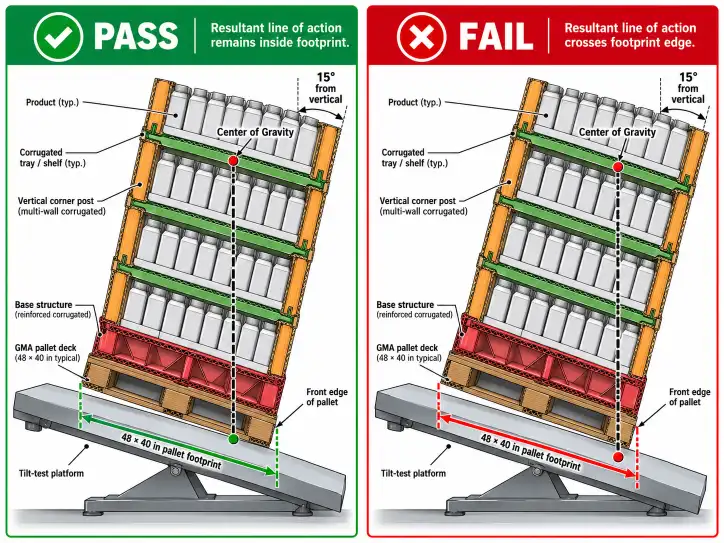
Because the footprint is smaller, half pallet displays can tip more easily than full pallet displays if not properly designed:
- Center of gravity must remain low — heaviest items at the bottom
- Width-to-height ratio — a 24 in wide display that is 72 in tall has a 3:1 height-to-width ratio. This requires a stable base design
- Tilt testing — critical for half pallet displays. Test at 15–20 degrees
- Base ballast — consider adding weight to the base section for tall, narrow half pallet displays
For structural testing and board grade specifications, see our PRODUCTION page.
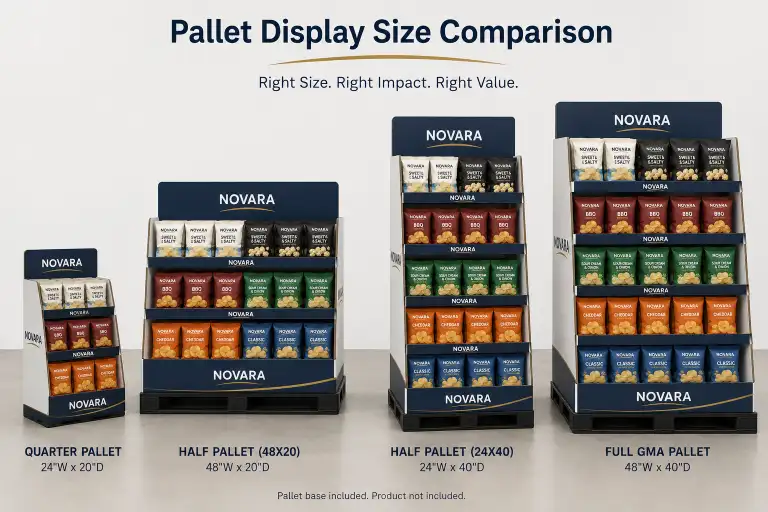
Half Pallet vs Full Pallet vs Quarter Pallet
Understanding the trade-offs between sizes helps buyers select the right display format.
| Factor | Quarter Pallet | Half Pallet | Full Pallet |
|---|---|---|---|
| Footprint | 24×20 in (480 sq in) | 48×20 or 24×40 in (960 sq in) | 48×40 in (1,920 sq in) |
| Relative area | 25% of full | 50% of full | 100% |
| Typical weight | 100–400 lbs | 200–800 lbs | 500–2,500 lbs |
| Product capacity | Low | Medium | High |
| Floor space cost (per store) | Lowest | Low | Standard |
| Best for | Counter displays, small trials | Endcaps, secondary positions | Main floor positions |
| Club store acceptance | Limited | Good | Standard |
| Freight cost per display | Lowest | Low | Standard |
When to Choose Each Size
| Scenario | Recommended Size |
|---|---|
| Full program launch, high-volume product | Full pallet |
| Endcap promotion, new product trial | Half pallet (48×20 or 24×40) |
| Countertop or very small trial | Quarter pallet |
| Seasonal product with limited SKUs | Half pallet |
| Two-product side-by-side promotion | Two half pallets or one full pallet with dividers |
| Testing a new category | Half pallet — lower commitment |
For quarter pallet and other size options, see our PALLET DISPLAY product page.
Structural Design for Half Pallet Displays
Half pallet displays require the same structural attention as full pallet displays, with some additional considerations for the smaller footprint.
Base Design
The pallet base for a half pallet display must be built on a half-size pallet or a custom corrugated base that matches the footprint:
- 48×20 base — Standard half GMA pallet or corrugated base on a half pallet
- 24×40 base — Standard half GMA pallet or corrugated base
- Forklift entry — Required on at least two opposite sides
- Base height — 5–6 in (same as full pallet), included in total display height
Tray Design for Half Pallet
Trays for half pallet displays are smaller and must fit the exact footprint:
| Display Size | Tray Dimensions | Typical Trays per Tier |
|---|---|---|
| 48×20 | 23.5 × 19.5 in | 2 across, 1 deep |
| 24×40 | 23.5 × 19.5 in | 1 across, 2 deep |
| Custom | Matches product size | Varies |
Stability Features
- Wider base, narrower top — Tapering the display slightly inward from base to top improves stability
- Lower center of gravity — Keep the heaviest products in the bottom 1/3 of the display
- Pallet skirt — A printed skirt on a half pallet display adds visual weight and stability perception
- Stretch wrap reinforcement — Additional wrap at the base (5+ layers) for narrow half pallet displays
Half Pallet Displays for Different Product Categories
Different product categories use half pallet displays differently. Understanding category-specific applications helps vendors design displays that match the retailer's expectations.
Snacks and Confectionery
Snack products are the most common category on half pallet displays. Chip bags, candy multipacks, and cracker boxes fit well in the smaller footprint.
- Best half pallet size: 48×20 for full aisle-facing exposure
- Tray design: Wide, shallow trays for bagged snacks. Divided trays for candy variety packs
- Typical tiers: 3–4 tiers, depending on bag height
Beverages
Beverage half pallet displays are popular for seasonal drink promotions and new product introductions.
- Best half pallet size: 48×20 for stability with heavy products
- Weight consideration: Use BC-flute double-wall for water and soda. Max 2–3 tiers
- Moisture protection: Moisture-resistant adhesive and aqueous coating required
Pet Products
Pet food and treat brands often use half pallet displays for new product trials and seasonal promotions.
- Best half pallet size: 24×40 for narrow positions
- Tray design: Reinforced trays for bagged pet food. Standard trays for treat boxes
- Weight: Medium (300–500 lbs). C-flute board recommended
Personal Care and Household
Soap, detergent, and household product brands use half pallet displays for category-specific promotions.
- Best half pallet size: Both 48×20 and 24×40 work well
- Tray design: Standard open trays for boxed products
- Weight: Light to medium (200–400 lbs)
Seasonal and Gift
Seasonal products — holiday gift packs, summer items, Valentine's candy — are ideal for half pallet displays.
- Best half pallet size: 48×20 for high-visibility seasonal endcaps
- Pallet skirt: Highly recommended for seasonal displays to maximize brand impact
- Header card: Add a branded header card for seasonal messaging
For food and snack display-specific requirements, see our Costco Food & Snack Pallet Displays guide.
Buyer Checklist for Half Pallet Displays
| Check Item | Status | Notes |
|---|---|---|
| Half pallet size confirmed | ☐ | 48×20 or 24×40 |
| Pallet base sourced | ☐ | Half GMA pallet or corrugated base |
| Height confirmed with buyer | ☐ | Include pallet base |
| Board grade matches product weight | ☐ | BC-flute for heavy products |
| Tray dimensions fit half pallet | ☐ | Test with actual product |
| Stability test passed (tilt) | ☐ | 15–20 degree tilt test |
| Cent of gravity confirmed low | ☐ | Heaviest products at bottom |
| Pallet skirt included | ☐ | Printed branding on base |
| Stretch wrap 3–5 layers | ☐ | Extra at base for narrow units |
| Endcap or position confirmed | ☐ | Buyer confirms placement |
| Transit stacking plan | ☐ | 2–3 high during shipping |
| Sample approved with real product | ☐ | Full product load test |
Conclusion
A half pallet display for club stores is a practical, cost-effective option for vendors who do not need or cannot justify a full pallet display. Whether for new product trials, seasonal promotions, or smaller product lines, the half pallet format gives vendors access to endcap and secondary positions that full pallet displays cannot fit.
For B2B buyers, the key decision is choosing between 48×20 and 24×40 based on the available store position. Once the size is confirmed, the same design principles apply — proper board grade, weight distribution, pallet skirt branding, and transit testing.
If you are planning a half pallet display project for Costco or Sam's Club, start with the COSTCO DISPLAYS product page or the PALLET DISPLAY product page. For structural and testing specifications, see our PRODUCTION page and SAMPLING page.
FAQ
What is a half pallet display for club stores?
A half pallet display is a corrugated display unit built on a half-size pallet base — either 48×20 inches (half-length) or 24×40 inches (half-width). It holds less product than a full pallet display and is used for endcap and secondary positions.
What are the standard half pallet dimensions for Costco?
Costco accepts two standard half pallet sizes: 48×20 inches (half-length GMA) and 24×40 inches (half-width GMA). Both provide 960 square inches of floor area — half the area of a full GMA pallet.
When should I use a half pallet display instead of a full pallet?
Use a half pallet display for new product trials, seasonal promotions, smaller product lines, endcap positions, and action alley promotions. If the product has limited SKUs or you want to test demand, start with a half pallet.
Are half pallet displays stable in club stores?
Yes, if designed correctly. Because the footprint is smaller, half pallet displays require careful weight distribution and tilt testing. Keep the center of gravity low and test stability at 15–20 degrees.
Can two half pallet displays fill one full pallet position?
Yes. Two 48×20 half pallets placed side-by-side or two 24×40 half pallets placed side-by-side occupy the same 48×40 footprint as a full GMA pallet.
Do half pallet displays need a pallet skirt?
A printed pallet skirt is recommended for half pallet displays. It adds brand presence and gives the smaller display a finished, professional appearance on the sales floor.
How much weight can a half pallet display hold?
A half pallet display typically holds 200–800 lbs depending on the board grade, tray design, and product type. Heavy products like beverages should use BC-flute double-wall board.

One Response