When a pallet display sits on the club store floor, the bottom 5–6 inches is the pallet base — and on most displays, that space is empty, unprinted, or covered by a plain brown skirt. A pallet skirt display turns that wasted area into a branding opportunity. The printed skirt wraps around the pallet base, carrying brand colors, product messaging, and promotional graphics to the very bottom of the display.
For B2B buyers supplying Costco, Sam's Club, and other warehouse retailers, adding a pallet skirt is one of the most cost-effective ways to improve the visual impact of a display. A printed skirt costs a fraction of what a full display redesign costs, yet it adds 20–30% more branded surface area at eye-catching floor level.
This guide covers everything buyers need to know about pallet skirt displays — materials, printing options, installation methods, Costco compliance considerations, and how to spec a skirt for your next club store project.
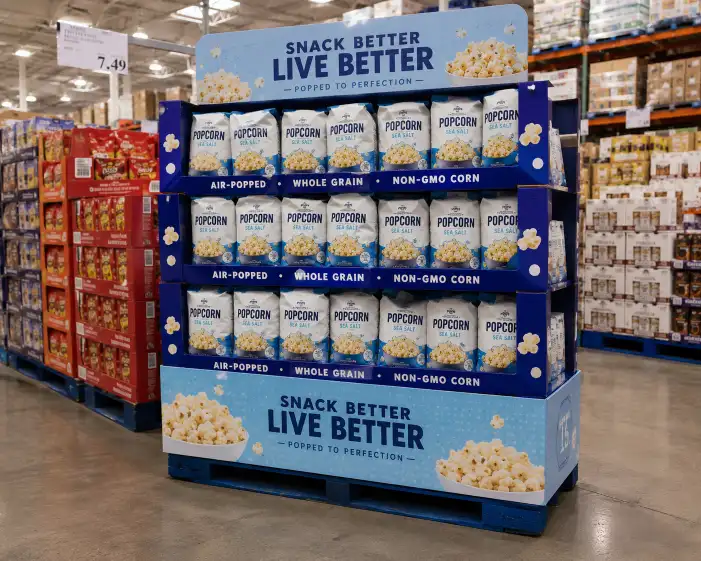
What Is a Pallet Skirt Display?
A pallet skirt display is a corrugated or heavy paper panel that wraps around the base of a pallet display. It covers the wood pallet and the lower inches of the display structure, creating a continuous branded surface from the floor to the bottom of the first product tier.
Key Features
| Feature | Description |
|---|---|
| Full perimeter wrap | Covers all four sides of the pallet base |
| Branded surface | Printed with brand colors, logos, product images, or promotional messaging |
| Quick installation | Attaches to the display with adhesive, tape, or interlocking tabs |
| Removable | Can be removed for pallet re-use or recycling |
| Transit-compatible | Installed before stretch wrap, survives shipping intact |
Common Names for Pallet Skirts
| Term | Meaning |
|---|---|
| Pallet skirt | Wraps around the pallet base perimeter |
| Pallet base wrap | Another term for the same component |
| Display skirt | Focus on the display, not the pallet |
| Base wrap | Short term used in factory communication |
| Pallet shroud | Full wrap covering the entire pallet (not just the skirt area) |
A pallet skirt display is different from a full pallet wrap. The skirt covers only the base section of the pallet, leaving the product tiers visible above. This gives the display a "finished" look — like a retail fixture rather than a shipping pallet with products stacked on it.
For an overview of complete pallet display structures, see our PALLET DISPLAY product page.
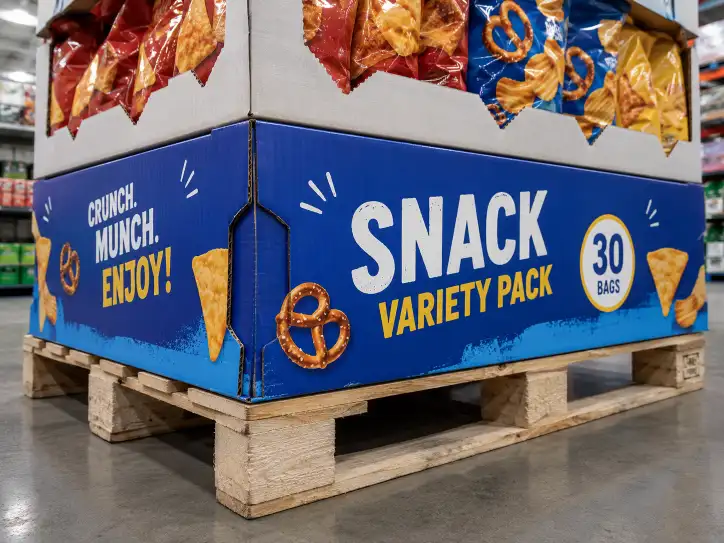
Why Club Store Displays Need Pallet Skirts
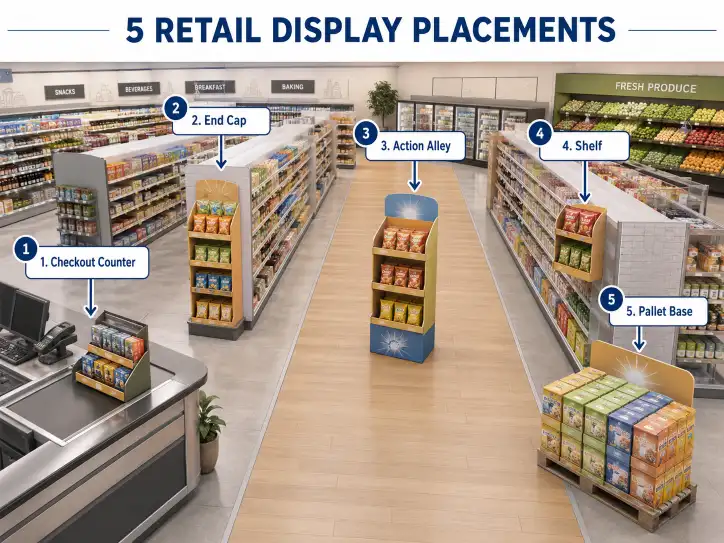
Club stores like Costco and Sam's Club sell directly from pallets. The pallet is visible on the sales floor. An unprotected wood pallet with no skirt looks unfinished and reduces the perceived value of the product above it.
The Unbranded Pallet Problem
When a pallet display arrives on the sales floor without a skirt:
- The wood pallet is visible on all four sides
- The display looks incomplete — like a shipping unit, not a retail display
- Brand messaging stops at the bottom tray — the pallet base is dead space
- Other brands' printed boxes on adjacent pallets may distract customers
- The display blends in instead of standing out
What a Pallet Skirt Adds
| Benefit | Impact |
|---|---|
| Complete brand presentation | Every visible surface carries the brand |
| Additional messaging space | 1,760+ sq in of printed area on a standard GMA pallet |
| Shelf-level visibility | Skirt graphics are at shopper eye level when walking past |
| Product differentiation | Makes the display look premium compared to unskirted competitors |
| Promotional flexibility | Seasonal messaging, price promotion, or product benefits on the skirt |
Costco and Sam's Club Expectations
Most club store buyers expect a printed pallet skirt on full-size pallet displays. At Costco, where displays go directly to the sales floor without additional store decoration, the skirt is often considered a standard component — not an optional upgrade. For Sam's Club, the requirement varies by category, but a printed skirt is strongly recommended for branded displays.
For specific Costco display expectations, see our COSTCO DISPLAYS product page.
Pallet Skirt Materials and Construction
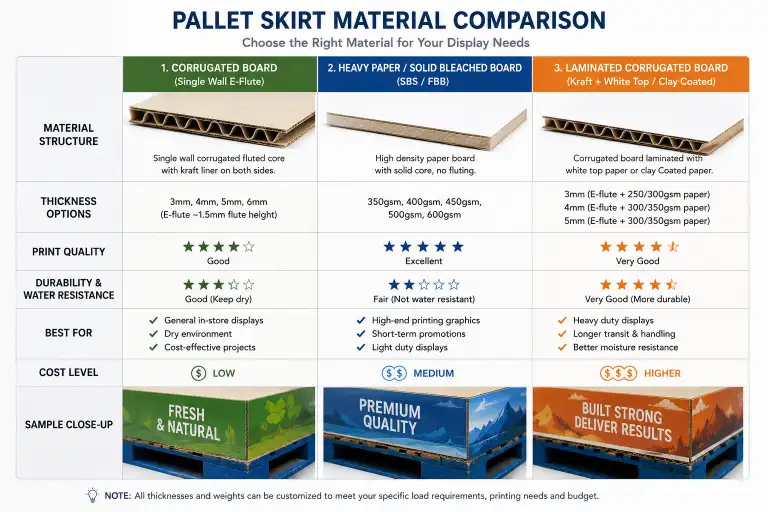
The choice of material affects the skirt's appearance, durability, and cost.
Common Materials
| Material | Thickness | Best For | Considerations |
|---|---|---|---|
| Corrugated board (B-flute) | 3–4 mm | Most club store displays | Sturdy, holds shape, recyclable |
| Corrugated board (E-flute) | 1.5–2 mm | Lightweight displays, smaller skirts | Good print surface, less structural |
| Heavy paper / kraft wrap | 0.3–0.5 mm | Budget options, disposable promotions | Lower cost, but may tear in transit |
| Laminated corrugated | 3–4 mm + laminate | Premium displays, high-traffic positions | Added scuff resistance and durability |
Construction Options
| Construction | How It Works | Pros | Cons |
|---|---|---|---|
| Single-piece wrap | One continuous panel wraps all 4 sides | Clean look, fewer seams | Larger flat size, harder to pack |
| Two-piece wrap | Two L-shaped panels (front+side, back+side) | Easier to pack flat | Seam visible at corners |
| Four-panel wrap | Four separate panels, one per side | Compact flat packing | More installation time, multiple seams |
| Folded one-piece | Pre-creased panel with fold lines at corners | Quick install, clean lines | Requires precise die-cutting |
Pallet Skirt Display vs Full Pallet Wrap
For the PALLET DISPLAY product page at Leader Display, the pallet skirt is one of the customizable options within the display structure. The skirt can be combined with any display type — shelf pallet display, modular pallet display, or pre-filled pallet display. The factory integrates the skirt into the overall display design during the structure planning stage.
For material selection and structural options, see our PRODUCTION page.
Printing Options for Pallet Skirts
The printing method determines the visual quality, cost, and lead time for the pallet skirt.
Printing Methods
| Method | Quality | Best For | Typical Run Size |
|---|---|---|---|
| Flexographic (1–3 colors) | Basic, solid colors | Simple logos, text-only messaging | Any volume |
| Litho-lamination | Premium, full-color | Photo-quality product images, complex designs | 1,000+ units |
| Digital printing (high-speed) | Full CMYK, photo quality | Short runs, multiple versions, seasonal promotions | Under 1,000 units |
| Screen printing | Thick ink layer, opaque | Large text, bold graphics on kraft paper | Medium runs |
Design Considerations for Pallet Skirts
- Keep critical content above 2 inches from the floor — The bottom edge may contact floor moisture or cleaning equipment
- Avoid placing barcodes on the skirt — barcodes belong on GS1-128 labels, not decorative components
- Use high-contrast colors — Club store lighting is bright but distant. Skirt graphics should be readable from 10–15 feet away
- Consider the seam — If using a two-piece or four-panel wrap, place seams at the back or on less visible sides
- Match the tray design — Skirt graphics should visually connect with the printed pallet tray design above it
Surface Finishing
| Finish | Benefit |
|---|---|
| Aqueous coating (gloss) | Scuff resistance, bright colors, recyclable |
| Aqueous coating (matte) | Premium look, non-reflective |
| UV coating | Maximum scratch protection for high-traffic positions |
| No coating | Lowest cost, suitable for short-term promotions |
For printing and finishing details, see our PRODUCTION page.
Pallet Skirt Sizes and Dimensions for Club Stores
The skirt must match the exact pallet dimensions. A skirt that is too small leaves gaps. A skirt that is too large bunches up or interferes with stretch wrapping.
Standard Dimensions
| Pallet Type | Skirt Width (per side) | Skirt Height | Total Panel Length (single-piece wrap) |
|---|---|---|---|
| Full GMA (48×40 in) | 48 in (front/back), 40 in (sides) | 5–8 in | 176 in (48+40+48+40) |
| Half GMA (48×20 in) | 48 in (front/back), 20 in (sides) | 5–8 in | 136 in (48+20+48+20) |
| Half GMA (24×40 in) | 24 in (front/back), 40 in (sides) | 5–8 in | 128 in (24+40+24+40) |
| Quarter GMA (24×20 in) | 24 in (front/back), 20 in (sides) | 5–6 in | 88 in (24+20+24+20) |
Height Guidelines
| Skirt Height | Best For |
|---|---|
| 5 in (13 cm) | Standard pallet base, minimum coverage |
| 6 in (15 cm) | Most common — covers pallet + bottom of display structure |
| 7–8 in (18–20 cm) | Displays with taller pallet base or when bottom tray is visible below product |
| 10+ in (25+ cm) | Extended skirt that covers part of the bottom product tier |
Important Note
The skirt height must be confirmed with the factory based on the actual pallet base height and display structure. If the pallet base is 5.5 inches and the skirt is only 5 inches, it will leave a gap.
For half pallet and quarter pallet display dimensions, see our PALLET DISPLAY product page.
Installation Methods for Pallet Skirts
The installation method affects how quickly the skirt can be applied in the factory and how secure it is during transit.
Method 1: Adhesive Attachment
The skirt is attached to the display base or pallet using adhesive.
- Best for: Corrugated skirts attached to a corrugated display base
- Application: Factory applies adhesive to the display base, then presses the skirt into place
- Security: Strong bond, no movement during transit
- Disadvantage: Not easily removable if the pallet needs re-use
Method 2: Tape Attachment
The skirt is taped to the pallet or display base at multiple points.
- Best for: Heavy paper skirts, or when skirt must be removable
- Application: 2–4 strips of reinforced tape on each side
- Security: Good for lighter skirts. May fail on heavy corrugated skirts in high-humidity
- Advantage: Easy to remove for pallet re-use
Method 3: Interlocking Tabs (No Adhesive)
The skirt has pre-cut tabs that lock into slots on the display base.
- Best for: Integrated display designs where the skirt is part of the die-cut structure
- Application: Tabs on the skirt match slots on the display base. Push in and fold
- Security: Moderate. Depends on tab design and board grade
- Advantage: No adhesive needed, easy assembly, recyclable
Method 4: Stretch Wrap Retention
The skirt is held in place entirely by the stretch wrap applied around the loaded display.
- Best for: Lightweight paper skirts, budget projects
- Application: Skirt is positioned around the base, then held by 3–5 layers of stretch wrap
- Security: Lower than adhesive methods. Skirt may shift if stretch wrap loosens
- Advantage: Fastest installation, lowest cost
Factory Installation
At Leader Display, the pallet skirt is installed during the packing stage of the pre-filled process or during the final palletizing stage for flat-pack displays. The factory team positions the skirt, secures it with the chosen method, and then applies stretch wrap over the entire display. This ensures the skirt stays in place through sea freight and last-mile delivery.
Pallet Skirt vs Full Pallet Wrap vs Printed Pallet Base
Understanding the difference between these three options helps buyers choose the right solution for their display project.
| Feature | Pallet Skirt | Full Pallet Wrap | Printed Pallet Base |
|---|---|---|---|
| Coverage | Base only (5–8 in) | Entire pallet + display | Pallet base only |
| Material | Corrugated or paper | Corrugated, paper, or plastic film | Laminated paper on wood pallet |
| Printed surface | High (can print full graphics) | High (full display graphics) | Low (paper-on-pallet printing is basic) |
| Cost | Low–medium | High | Medium |
| Removable | Yes | No (part of display) | No (permanent on pallet) |
| Best for | Standard club store displays | Premium branded displays | Displays with exposed pallet |
| Club store acceptance | Standard | Acceptable | Less common |
Which One Should You Choose?
- Choose a pallet skirt if you have a standard pallet display and want cost-effective branding at the base
- Choose a full pallet wrap if you want the entire display surface — including the base — to carry continuous brand graphics
- Choose a printed pallet base only if the pallet is clearly visible and the rest of the display cannot accommodate a skirt
For most Costco and Sam's Club projects, a corrugated pallet skirt is the standard choice. It provides good branding coverage at a reasonable cost and does not complicate the display structure.
For complete display structural options, see our COSTCO DISPLAYS product page.
Cost Considerations for Pallet Skirts
Adding a printed pallet skirt is one of the lowest-cost ways to upgrade a pallet display. The cost depends on material, printing method, and installation complexity.
Cost Factors
| Factor | Impact on Cost |
|---|---|
| Material | Corrugated costs more than paper. Laminated costs more than uncoated |
| Printing method | Digital (short runs) is higher per unit. Flexo (long runs) is lower |
| Number of colors | Full CMYK costs more than 1–2 spot colors |
| Size | Larger panels (full GMA) cost more than half-panel skirts |
| Installation | Adhesive attachment costs more in labor than stretch wrap retention |
| Quantity | Per-unit cost drops significantly at 1,000+ units |
Typical Cost Range
- Paper skirt, 1-color print: Very low — the most economical option
- Corrugated skirt, full-color litho-lamination: Low–medium — the standard for club store displays
- Corrugated skirt with UV coating + adhesive installation: Medium — for premium displays
Return on Investment
The cost of a printed pallet skirt is typically recovered through:
- Higher in-store visibility — branded displays attract more attention than unbranded ones
- Consistent brand presentation — no gap in messaging between the product and the floor
- Buyer preference — Costco buyers expect printed skirts on full-size displays
- Differentiation from competitors — a branded skirt makes the display look complete
Buyer Checklist for Pallet Skirt Displays
| Check Item | Status | Notes |
|---|---|---|
| Pallet dimensions confirmed | ☐ | 48×40 GMA or half-pallet size |
| Skirt height matches pallet base | ☐ | Measure actual pallet base height |
| Material selected | ☐ | Corrugated (B-flute or E-flute) vs paper |
| Printing method chosen | ☐ | Flexo, litho-lamination, or digital |
| CMYK artwork approved | ☐ | Full-color graphics or spot colors |
| Skirt construction confirmed | ☐ | Single-piece, two-piece, or four-panel |
| Installation method decided | ☐ | Adhesive, tape, tabs, or stretch wrap |
| Surface finish selected | ☐ | Aqueous coating, UV, or none |
| Artwork avoids barcode areas | ☐ | Barcodes on GS1-128 labels only |
| Transit testing with skirt | ☐ | Verify skirt stays in place during vibration |
| Sample approved with real product | ☐ | Visual check of skirt fit and appearance |
| Cost impact confirmed | ☐ | Additional cost vs unbranded pallet base |
Conclusion
A pallet skirt display is a simple, cost-effective upgrade that transforms a standard pallet display into a complete branded retail unit. For club store projects at Costco and Sam's Club, the skirt is not just decorative — it is often expected by buyers who want every visible surface of a pallet display to carry the brand.
For B2B buyers, adding a pallet skirt is one of the easiest decisions in the display design process. The material cost is low, the installation is straightforward, and the visual impact is immediate. The key is to spec the skirt early in the design stage — during the dieline and structure planning — so it integrates cleanly with the display base.
If you are planning a club store display project and want to include a printed pallet skirt, review the PALLET DISPLAY product page for structural options, or start with the COSTCO DISPLAYS product page for Costco-specific requirements. For complete production capabilities, see our PRODUCTION page.
FAQ
What is a pallet skirt display?
A pallet skirt display is a corrugated or paper panel that wraps around the base of a pallet display, covering the wood pallet and creating a continuous branded surface from the floor to the bottom product tier.
Why do club stores need pallet skirts?
Club stores sell directly from pallets. An unskirted pallet shows the wood base, which looks unfinished. A printed skirt adds professional branding and makes the display look like a retail fixture rather than a shipping unit.
What size pallet skirt do I need for a Costco display?
For a standard GMA pallet (48×40 inches), the skirt panel is 176 inches total length (48+40+48+40) with a height of 5–8 inches depending on the pallet base height.
What material is best for a pallet skirt?
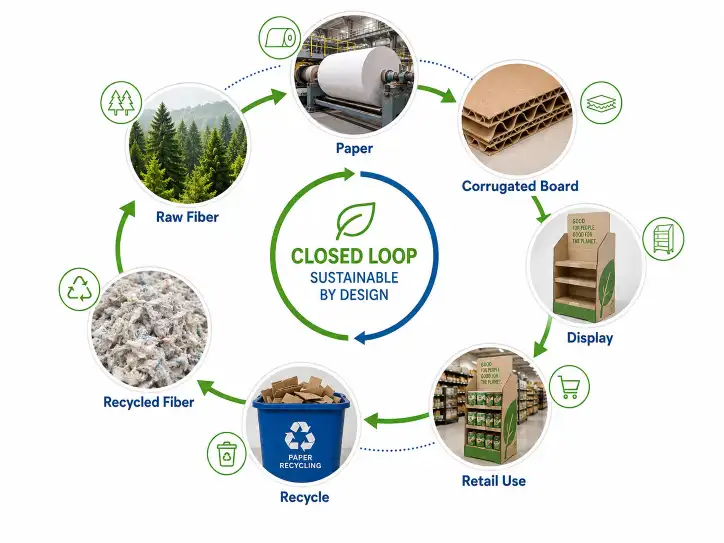
Corrugated board (B-flute or E-flute) is the most common and recommended material for club store displays. It is sturdy, holds its shape, accepts high-quality printing, and is fully recyclable.
Can a pallet skirt be recycled?
Yes. Corrugated pallet skirts are fully recyclable with other corrugated materials. Paper skirts are also recyclable. Remove adhesive or tape before recycling if required by the local recycling facility.
How is a pallet skirt attached to the display?
Pallet skirts can be attached with adhesive, tape, interlocking tabs, or held in place by stretch wrap. The best method depends on the skirt material, display type, and factory capability.
Is a pallet skirt required by Costco?
Most Costco buyers expect a printed pallet skirt on full-size pallet displays. While not always explicitly listed in compliance documents, it is considered a standard component of a retail-ready display.
Does a pallet skirt add much cost to the display?
No. A printed pallet skirt is one of the lowest-cost display upgrades available. The cost is significantly lower than adding a second printed tray tier or custom structural feature.