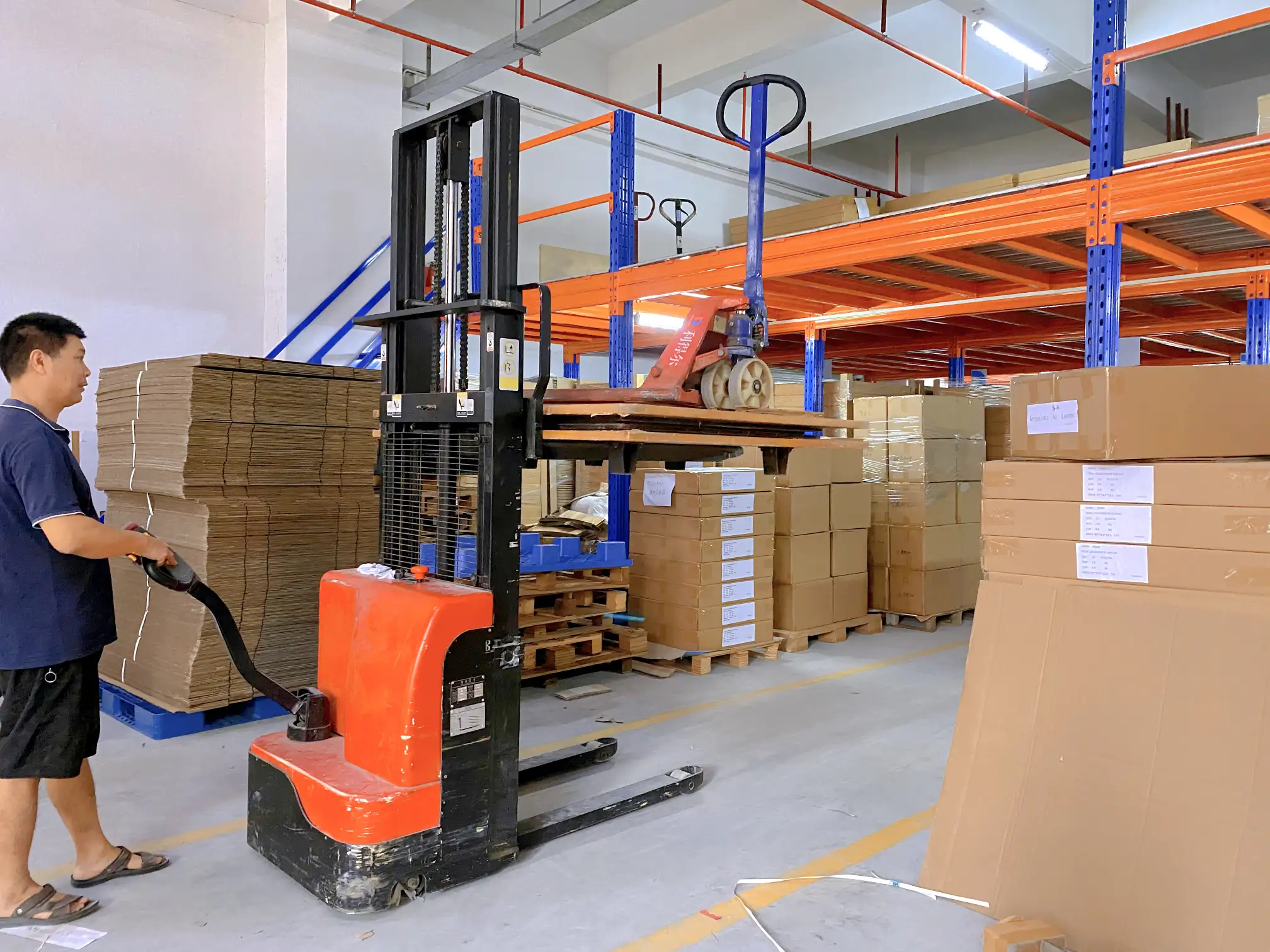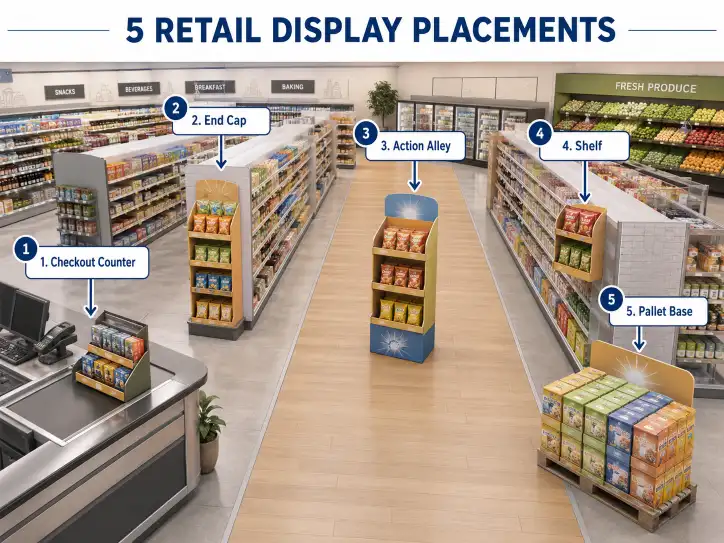
When a pallet display arrives at a club store, every minute of in-store handling costs money. Pre-filled pallet displays — units that are assembled and loaded with products at the factory before shipment — eliminate almost all in-store labor. The display goes from truck to sales floor without anyone opening cartons, assembling structures, or placing products on trays.
For B2B buyers supplying Costco, Sam's Club, or other warehouse club retailers, pre-filled displays are not just a preference — they are often a requirement. Understanding how factory loading works, what it costs, and how to plan for it can save significant time and money across a retail rollout.
This guide explains the pre-filled display process, the cost benefits, and what buyers need to know before ordering.
What Is a Pre-Filled Pallet Display?
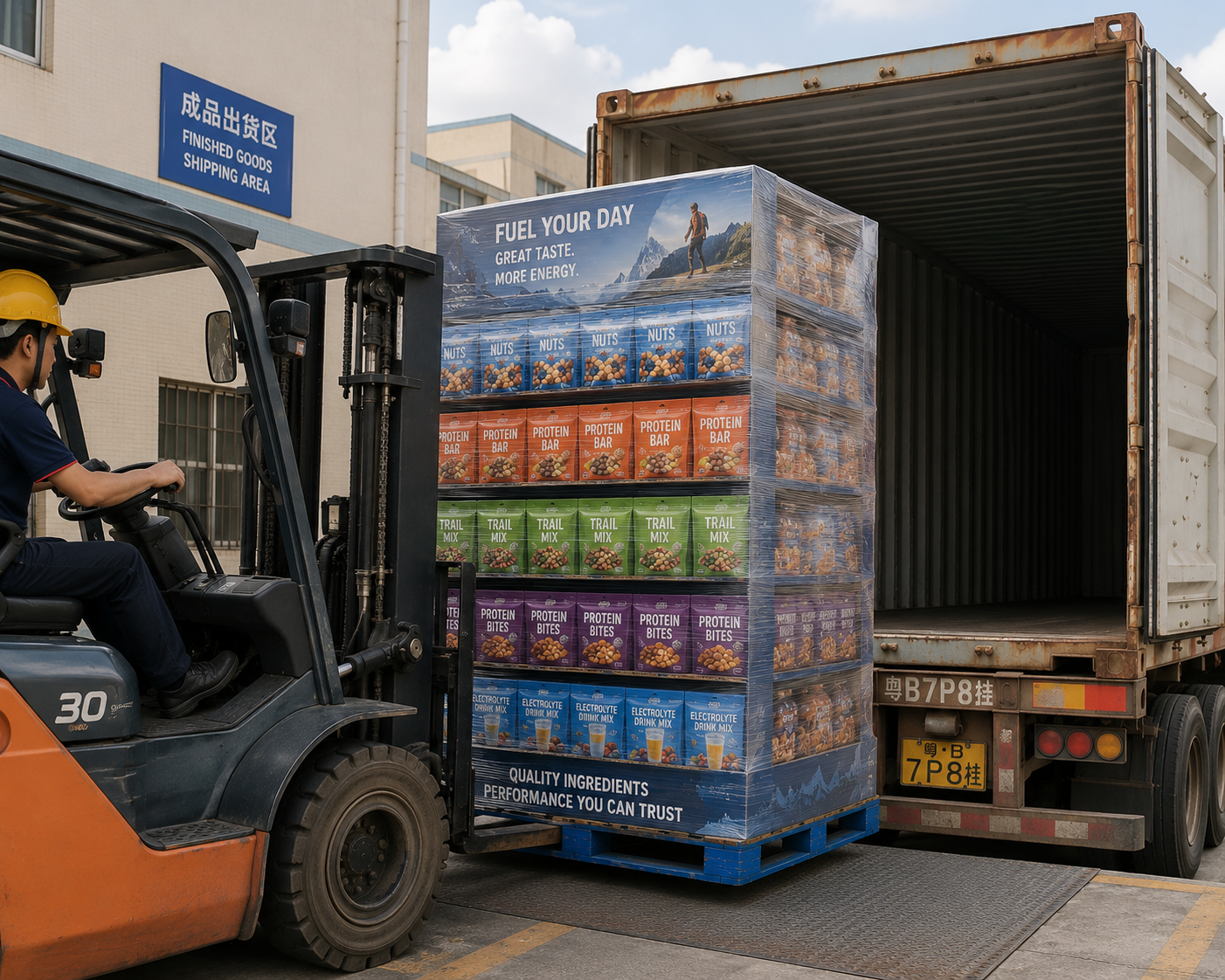
A pre-filled pallet display — also called a factory-loaded or pre-packed display — is a corrugated display unit that is assembled and loaded with products at the manufacturing facility before shipment. The store receives a complete, ready-to-sell unit.
Key Features
| Feature | Description |
|---|---|
| Factory assembled | The corrugated structure is built at the factory |
| Factory loaded | Products are placed into the display at the factory |
| Barcode verified | Each product SKU is scanned during loading |
| Wrapped for transit | The filled unit is stretch-wrapped with corner boards |
| Labeled for retail | GS1-128 and retail price labels applied at the factory |
| Ready to sell | Store staff unwrap and place on the sales floor |
Common Names for Pre-Filled Displays
| Term | Meaning |
|---|---|
| Pre-filled pallet display | Products loaded at factory, ready to sell |
| Factory loaded pallet display | Same as pre-filled — loaded at the factory |
| Pre-packed display | Products packed into display before shipment |
| Retail-ready display | Pre-filled + properly labeled + transit-tested |
| PDQ pallet display | Pre-filled display on a pallet base (PDQ = Pretty Darn Quick) |
For a broader overview of retail-ready standards, see our Retail-Ready Pallet Displays article.
How Factory Loading Saves Store Labor Costs
The primary advantage of a pre-filled pallet display is labor savings at the store level. Club stores operate with minimal staffing, and there is no dedicated team for display assembly or product stocking.
Labor Cost Comparison
| Task | Flat Pack Display | Pre-Filled Display |
|---|---|---|
| Remove from carton | 2 minutes | 0 (no carton) |
| Assemble structure | 10–15 minutes | 0 (factory assembled) |
| Insert trays and dividers | 3–5 minutes | 0 (factory installed) |
| Load products onto trays | 10–20 minutes | 0 (factory loaded) |
| Apply price labels | 2–3 minutes | 0 (factory applied) |
| Place on sales floor | 2 minutes | 2 minutes |
| Total store labor per display | 29–45 minutes | 2 minutes |
Cost Per Display
Assuming an average store labor cost of $15–20 per hour:
| Packing Method | Store Labor Cost per Display | 500-Store Rollout Cost |
|---|---|---|
| Flat pack | $7.25–$15.00 | $3,625–$7,500 |
| Semi-assembled | $3.75–$7.50 | $1,875–$3,750 |
| Pre-filled | $0.50 | $250 |
A pre-filled display saves $7–$14 per unit in store labor costs. For a 500-store rollout, that is $3,500–$7,000 in total savings — more than enough to cover any additional factory co-packing fees.
Additional Savings
- Faster time to floor — Pre-filled displays are selling in minutes, not hours. Faster placement means earlier sales
- Reduced shipping damage — Factory-loaded products are packed more securely than store-loaded products
- Consistent presentation — Every store looks identical. No variation from different store staff
- Fewer chargebacks — Proper labeling and packing at the factory reduces compliance violations
For detailed fulfillment logistics, see our Display Fulfillment and Palletizing article.
The Pre-Filled Process at the Factory
Understanding what happens at the factory helps buyers plan the logistics and avoid surprises.
Step-by-Step Process
Step 1: Product Receipt
Products arrive at the factory warehouse from the brand,
third-party supplier, or are sourced by the factory.

Step 2: Inspection
Products are checked for quantity, condition, expiry dates.
Damaged or expired products are flagged.

Step 3: Display Assembly
Corrugated display structure is assembled to the specified
configuration (flat, semi, or full assembly).

Step 4: Product Loading
Products are placed into the display following the planogram
or pack-out plan. Loading order must match the retail layout.

Step 5: Barcode Scanning
Each product barcode is scanned. The system confirms correct
SKU, verifies quantity, and logs the scan for traceability.

Step 6: Packing
The filled display is wrapped with stretch wrap (3–5 layers),
corner boards on all 4 pallet corners, and edge protectors.

Step 7: Labeling
GS1-128 pallet label, carton content label, retail price label,
handling labels, and country of origin are applied.

Step 8: Palletizing
The unit is placed on or integrated with a GMA pallet.

Step 9: Staging
Finished pallets are staged for container loading or truck pickup.
What to Check at Each Stage
| Stage | What the Buyer Should Confirm |
|---|---|
| Product receipt | Who supplies the product? Brand, third-party, or factory? |
| Inspection | Who inspects? What happens to damaged products? |
| Assembly | What assembly level? Flat, semi, or full? |
| Loading | Is there a planogram? Who approves the loading layout? |
| Barcode scanning | Is every unit scanned? Can you get scan logs? |
| Packing | What wrap, corner boards, and protection are used? |
| Labeling | Are label artworks approved by the retailer buyer? |
| Palletizing | GMA pallet? Four-way entry? Correct orientation? |
| Staging | Container loading plan provided? Photos taken? |
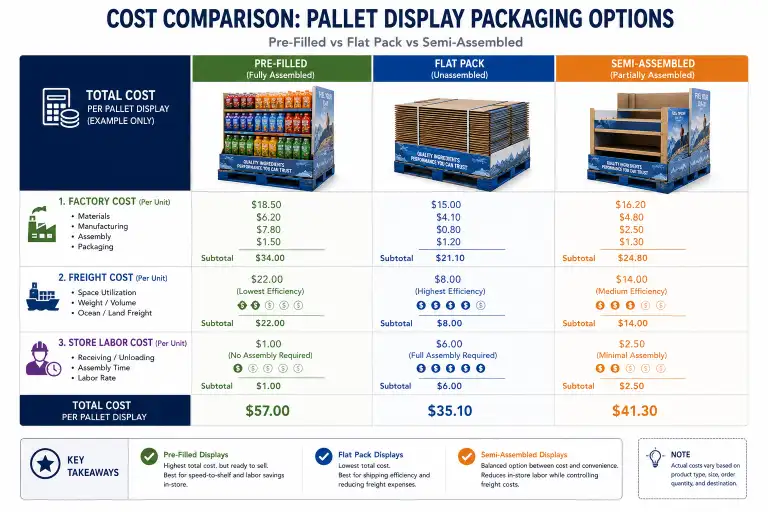
Cost Comparison: Pre-Filled vs Flat Pack vs Semi-Assembled
Each packing method has different costs. The total cost includes factory production, freight, and store labor.
Cost Factors
| Factor | Pre-Filled | Semi-Assembled | Flat Pack |
|---|---|---|---|
| Factory assembly cost | Higher | Medium | Lowest |
| Co-packing (product loading) cost | Yes | No | No |
| Shipping volume per unit | Highest | Medium | Lowest |
| Freight cost per unit | Highest | Medium | Lowest |
| Store labor cost per unit | Lowest | Medium | Highest |
| Risk of in-store assembly errors | Lowest | Medium | Highest |
| Compliance rejection risk | Lowest | Medium | Highest |
When Pre-Filled Makes Financial Sense
| Scenario | Best Method |
|---|---|
| 100+ store rollout | Pre-filled — store labor savings outweigh freight cost |
| Club store (Costco, Sam's Club) | Pre-filled — required by retailer |
| Small trial (under 20 stores) | Semi-assembled or flat pack — lower upfront cost |
| International shipment | Depends on freight cost vs store labor cost analysis |
| Heavy or fragile products | Pre-filled — factory packing is more secure |
For a full comparison of packing methods, see our Retail-Ready Pallet Displays article.
Product Supply Models for Pre-Filled Displays
There are three common models for getting products into the factory for pre-filled displays.
Model 1: Brand Supplies Product
The brand ships products to the factory from their own warehouse or a third-party logistics provider.
- Best for: Brands with existing inventory in China or nearby warehousing
- Advantage: Brand controls product sourcing and quality
- Risk: Shipping delays from the brand can delay the entire project
- Coordination needed: The brand must arrange logistics to the factory and provide a packing list
Model 2: Factory Procures Product
The factory sources and procures the products on behalf of the brand.
- Best for: Turnkey programs where the brand wants a single point of contact
- Advantage: Factory manages the entire supply chain
- Risk: Factory must find the correct product version and packaging
- Coordination needed: Brand must provide product specifications and approved supplier list
Model 3: Third-Party Logistics
A 3PL warehouse near the factory receives and stores products, then supplies them to the factory for loading.
- Best for: Brands with multiple factories or ongoing programs
- Advantage: Buffer inventory reduces risk of production delays
- Risk: Additional warehousing cost
- Coordination needed: Brand, 3PL, and factory must coordinate on inventory levels
Product Requirements
| Requirement | Why It Matters |
|---|---|
| Packaging must fit display slots | Test with actual product before production |
| Barcodes must be scannable | Required for verification during loading |
| Expiry dates must be clearly marked | For FIFO loading of food products |
| Product must arrive at factory on time | Delays hold up the entire production line |
| Case quantities should match planogram | Reduces leftover product and rework |
For co-packing and fulfillment details, see our Display Fulfillment and Palletizing article.
Barcode Scanning and SKU Verification
Barcode scanning is a critical step in the pre-filled process. It ensures that the correct products are loaded into each display, in the correct quantity.
Why Scanning Matters
- Prevents wrong SKU errors — The most common co-packing mistake
- Provides traceability — Scan logs can be reviewed if there is a discrepancy
- Meets retailer requirements — Some club stores require barcode verification records
- Reduces chargebacks — Incorrect SKU loading can result in compliance penalties
Scanning Process
| Step | What Happens |
|---|---|
| 1. Load product | Worker places product into the display tray |
| 2. Scan barcode | Handheld scanner reads the product barcode |
| 3. System confirms | Software confirms the SKU matches the planogram |
| 4. Log entry | Scan timestamp, worker ID, and SKU are recorded |
| 5. Error alert | If wrong SKU is scanned, system alerts the worker |
What to Ask Your Factory
- Do you use barcode scanning during co-packing?
- Can you provide scan logs for each display or pallet?
- What happens if a barcode does not scan?
- How do you handle mixed SKU displays with different product types?
Transit Testing for Pre-Filled Units
Pre-filled displays must survive the same transit conditions as any other display, but the stakes are higher — the product is already loaded. Damage during transit means losing both the display and the product.
Required Tests
| Test | What It Simulates | Passing Criteria |
|---|---|---|
| Vibration | Truck transit vibration | No structural failure, no product damage |
| Drop | Forklift handling impacts | No damage from 6–12 inch drops |
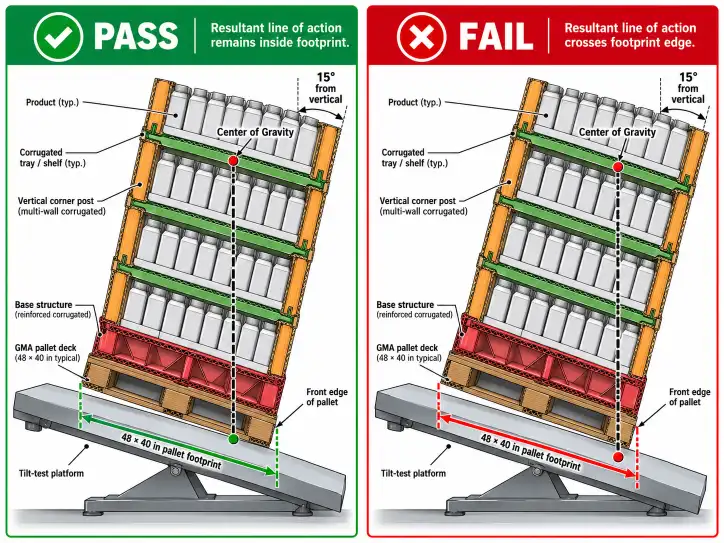
| Tilt | Stability during movement | Display must not tip at 15–20 degrees |
| Compression | Stacking during storage | Min 32 lbs/in (single-wall), 48+ (double-wall) |
Pre-Filled Specific Testing
- Product shift test — Verify that products do not move out of position during vibration
- Wrap integrity test — Check that stretch wrap remains secure after simulated transit
- Label readability test — Confirm labels are scannable after transit
For detailed testing procedures, see our Costco Pallet Display Requirements guide.
Buyer Checklist for Pre-Filled Pallet Displays
| Check Item | Status | Notes |
|---|---|---|
| Product supply model confirmed | ☐ | Brand supplies, factory procures, or 3PL? |
| Planogram / pack-out plan ready | ☐ | Approved by brand and retailer |
| Barcode scanning confirmed | ☐ | Every product scanned during loading |
| Expiry date management (if food) | ☐ | FIFO loading plan in place |
| Display assembly level confirmed | ☐ | Flat, semi, or full assembly? |
| Stretch wrap specification set | ☐ | 3–5 layers, corner boards on all 4 corners |
| GS1-128 labels approved by buyer | ☐ | Label artwork submitted for approval |
| Transit testing completed | ☐ | Vibration, drop, tilt, compression passed |
| Container loading plan provided | ☐ | Loading diagram from factory |
| QC inspection scheduled | ☐ | In-process photos, final inspection |
| Product packaging fit tested | ☐ | Real product fits display trays without force |
Conclusion
Pre-filled pallet displays are the most efficient way to supply products to club stores. They eliminate in-store assembly and product loading, reduce the risk of compliance rejections, and ensure consistent presentation across every store in a retail rollout.
For B2B buyers, the key is planning the pre-filled process early. Confirm the product supply model, the planogram layout, barcode scanning requirements, and transit testing before the factory begins production. The upfront planning effort pays back in lower store labor costs, faster time to floor, and fewer chargebacks.
If you are planning a pre-filled display project for Costco or Sam's Club, start with the COSTCO DISPLAYS product page or the PALLET DISPLAY product page. For complete labeling and compliance specifications, read our Costco Pallet Display Requirements guide.
FAQ
What is a pre-filled pallet display?
A pre-filled pallet display is a corrugated display unit that is assembled and loaded with products at the factory before shipment. The store receives a complete, ready-to-sell unit that only needs to be unwrapped and placed on the sales floor.
How much does pre-filling add to the display cost?
Pre-filling adds the cost of factory labor for product loading and barcode scanning. However, this cost is typically offset by savings in store labor — often $7–$14 per display compared to flat-pack alternatives.
How do products get to the factory for pre-filling?
Products can be supplied by the brand, procured by the factory, or managed through a third-party logistics provider near the factory.
What is the difference between pre-filled and retail-ready?
Pre-filled means products are loaded at the factory. Retail-ready means pre-filled plus properly labeled, wrapped, transit-tested, and ready for immediate sale on the sales floor.
Do club stores require pre-filled displays?
Yes. Costco and Sam's Club strongly prefer pre-filled displays. In-store assembly and product loading are rarely accepted because club stores do not have the labor for these tasks.
How do I verify that the correct products are loaded?
Barcode scanning during the loading process confirms that each product SKU matches the planogram. Ask your factory for scan logs as part of the QC documentation.
What transit testing is needed for pre-filled displays?
Pre-filled displays require vibration, drop, tilt, and compression testing. Additional product shift testing is recommended to ensure products do not move out of position during transit.