If your project is headed for a club store, the wrong pallet plan will hurt long before the display reaches the sales floor. Many teams notice the problem too late, after the sample looks fine, freight goes up, and the buyer starts asking questions about stacking, handling, and rollout. A club store pallet display has to work in transit, in the warehouse, and in store at the same time.
That is why club-store projects should not start with graphics. They should start with footprint, product count, load pattern, and how the display will move from factory packing to retail placement. Once those points are locked, artwork becomes easier, samples become more useful, and approval discussions get shorter.
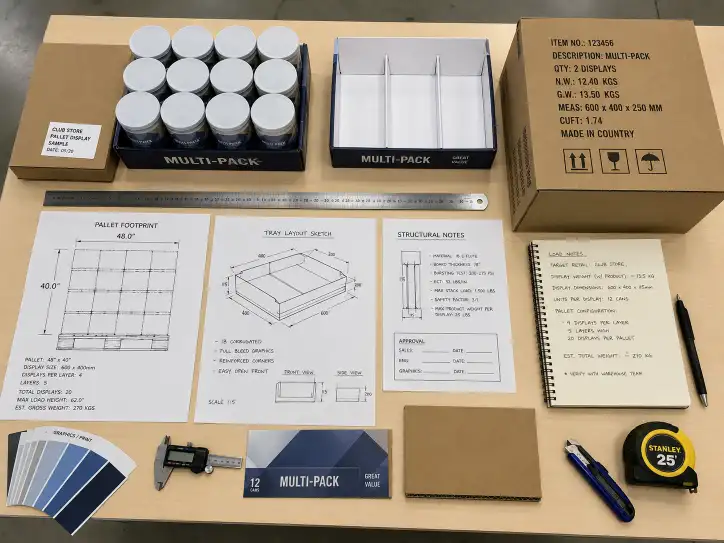
Start With the Pallet Footprint Before You Approve Artwork
A pallet display for a club store is not only a display. It is also a shipping unit, a handling unit, and a retail unit. That changes the order of decisions. If the footprint is wrong, the rest of the project keeps paying for that mistake.
Buyers often want to review the print first because it is easy to react to. The harder questions come later: how many trays fit the pallet, how much dead space is left in the master carton, whether the base stays stable after partial sell-through, and whether the display still looks full after the first week. Those are the questions that decide whether the rollout feels controlled or expensive.
For that reason, the first sample discussion should cover:
- outer footprint
- overall height
- base strength
- tray count
- unit load
- whether the product ships inside the display or separately
If you are already comparing options, look first at pallet display structures and then connect that choice to your retailer path, not the other way around.
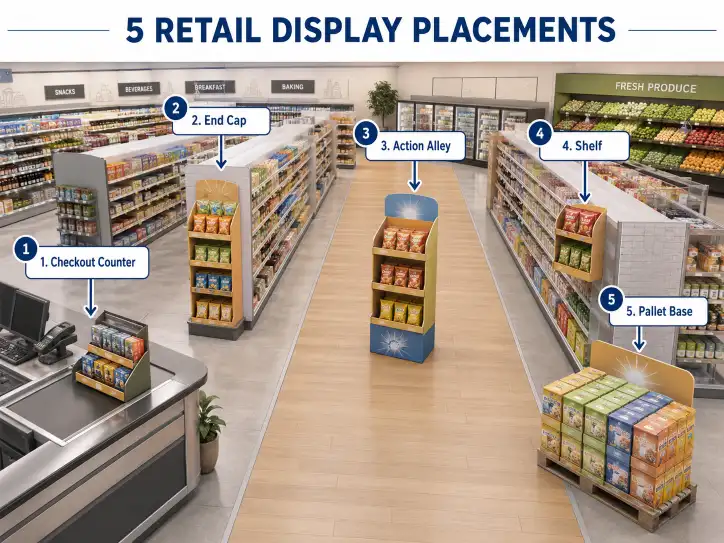
Decide Whether the Product Sells From the Pallet or From a Rebuilt Shelf Block
Not every pallet unit behaves the same after arrival. Some projects are meant to sell directly from the pallet base with minimal setup. Others use a pallet as the transport base and rely on a cleaner shelf block or tray presentation once the outer wrap is removed. That difference matters.
A display that sells directly from the pallet has to look acceptable as soon as the wrap comes off. The front edge, tray openings, header position, and product rhythm need to make sense fast. There is less room for correction on site. A rebuilt or partially staged format allows more control, but it adds handling steps.
That is where many projects drift off course. The team thinks it is approving one retail format, but the warehouse and store teams inherit another. The safest fix is to name the execution model early:
- direct pallet sell-through
- semi-staged pallet unit
- palletized transport with in-store rebuilding
Each route changes labor, packing, freight, and display logic. It also changes which questions your factory should answer during sampling.
If the project is aimed at a warehouse-club environment, it helps to compare your plan against existing Costco display programs and Sam’s Club display directions so the display discussion stays tied to channel reality.
Check Product Weight and Stack Pattern Together
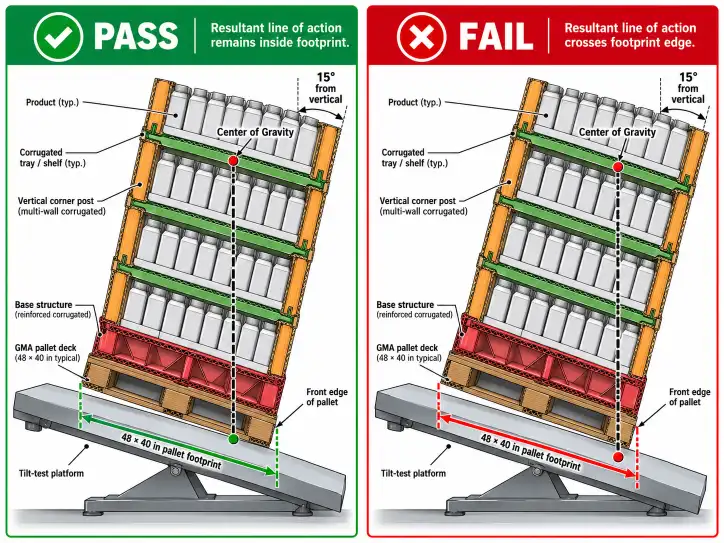
Pallet displays get judged on appearance, but they fail on load. That is common with heavier packs, bundled items, glass containers, bottled products, and club-size multipacks. The base may look solid in a render and still weaken once real goods are loaded across several layers.
This part is not glamorous. It matters anyway.
A good club store pallet display is planned around product behavior, not only around product dimensions. Two cartons with the same size can create different stress patterns if one has shifting weight and the other has a stable center. The tray depth, divider style, reinforcement points, and board selection all depend on that load behavior.
Before sample approval, ask:
- Does the heaviest section sit over the strongest support area?
- Will the front trays deform after repeated product removal?
- Does the display still stand square after partial sell-through?
- Will pallet movement during export weaken the base corners?
Industry guidance from FEFCO’s shelf-ready packaging resources and the Fibre Box Association is useful here because both point back to the same commercial truth: performance depends on the relationship between structure, handling, and replenishment, not on print alone.
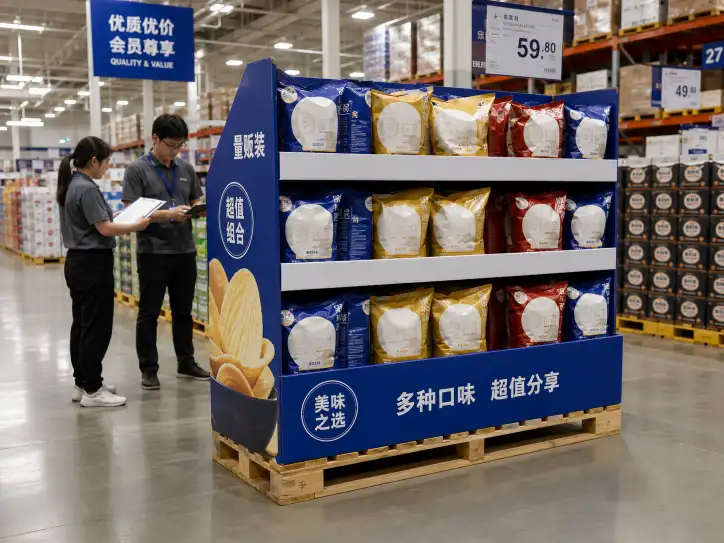
Plan Packing Method Early or Freight Will Start Making the Decisions
Club-store display projects often lose margin in the packing stage, not in the print stage. The reason is simple. Teams approve the retail shape first, then discover too late that the shipping method turns a workable idea into a bad freight story.
The earlier choice is this: flat-pack, semi-assembled, or pre-filled.
Flat-pack saves volume, but it pushes more setup pressure downstream. Semi-assembled reduces some labor, but it can make cartons larger than expected. Pre-filled units help store speed, but they raise transport risk and often require tighter transit planning. None of these options is automatically best. The best one is the one that matches the retailer workflow and the shipping budget together.
That is why export discussion should happen before artwork approval. If you wait until after the visual file is locked, structural changes start feeling expensive even when they would have saved more money overall.
Your site already has a good place to support this buying logic through display shipping planning, so this article should feed traffic there instead of sitting alone as a blog post.
Use the Sample to Test Store Handling, Not Only Factory Finish
Many display samples get approved because they look neat in the sample room. That is not enough for a club-store project. The sample should answer warehouse and store questions too.
For example:
- Can the outer protection be removed without damaging the printed area?
- Does the display keep its shape after the first product layer is sold?
- Can store staff understand setup without a long instruction sheet?
- Will the tray edges stay clean after repeated handling?
A sample is supposed to catch friction. If it only proves the design can be photographed, it is doing half the job.
This is where your existing sampling process page should be linked naturally. Buyers reading this article are already close to that step. The article should move them there with a reason, not with a random CTA.
Do Not Treat Club Store Approval Like a Normal Floor Display Rollout
Warehouse-club projects put more pressure on volume logic. A standard retail floor display can survive a little inefficiency if the footprint is small and the store team adjusts on site. A club-store pallet display gives you less room for that kind of correction. The unit is bigger, the product load is heavier, and the logistics chain is less forgiving.
That is why the document package matters more than many teams expect. Buyers and internal retail teams often want a clearer view of:
- final dimensions
- pack-out method
- unit count per pallet
- estimated shipping format
- setup logic
- sample confirmation notes
When those items are vague, the display may still move forward, but it usually moves slower. In B2B packaging work, slow approval is a cost line even when nobody writes it that way.
A Practical Club Store Pallet Display Checklist
| Checkpoint | What Buyers Should Confirm | Why It Matters |
|---|---|---|
| Footprint | Base size matches retailer and logistics plan | Wrong dimensions create freight and handling problems early |
| Load pattern | Heaviest items sit where the structure is strongest | Prevents leaning, collapse, and tray fatigue |
| Sell-through logic | Display still looks organized after partial depletion | Club-store units lose impact fast when the front breaks down |
| Packing method | Flat-pack, semi-assembled, or pre-filled is decided early | Avoids late structural changes and freight surprises |
| Sample test | Sample is checked with real product load and handling | Photogenic samples do not reveal operational problems |
| Approval documents | Dimensions, count, packing plan, and setup notes are clear | Reduces delay in buyer review and internal handoff |
What to Prepare Before You Ask for a Quotation
If you want a supplier to give useful structural advice, do not send only a mood board. Send the variables that decide the pallet logic.
At minimum, prepare:
- product dimensions
- unit weight
- pack quantity per facing
- target retailer or channel type
- whether the project sells directly from the pallet
- rough shipping destination
- whether the display needs flat-pack, semi-assembled, or pre-filled planning
That small package of information changes the quality of the first quotation. It also changes the quality of the first sample, because the factory is solving the real job instead of guessing the retail environment from the artwork brief.
Where This Article Should Push the Reader Next
This article should not end as a dead-end blog post. It should move the reader toward the right next page based on where they are in the decision process.
- If they are comparing retail formats, push them to pallet display options.
- If they are preparing a club-store rollout, push them to Costco display pages or Sam’s Club display pages.
- If they are already thinking about sample approval and freight, push them to sampling and shipping.
- If they are ready to start the project, push them to custom cardboard displays.
That is how this page helps indexing and business at the same time. It does not try to rank for a vague display word and stop there. It brings a club-store buyer into a tighter path.
If you want the next sample to be useful, the next step is not another round of broad inspiration images. It is a one-page brief with footprint, product load, pack-out preference, and rollout target. Once those four items are clear, the structural conversation gets sharper fast.