Which cardboard display supplier looks more authoritative? Buyers often answer that question too quickly. A polished website, a fast quote, or a long list of logos can look impressive, but authority in custom cardboard display work is not built on appearance alone. It is built on proof.
For brands, retailers, and importers, the right cardboard display supplier should show clear experience, useful certifications, practical factory ability, and a sample process that reduces risk before mass production starts. This guide explains how to judge those signals in a way that helps you choose a supplier with real substance instead of surface-level marketing.

Authority Starts With Verifiable Experience, Not Big Claims
Many suppliers describe themselves as professional, experienced, or reliable. Those words mean little on their own. A more useful question is this: what can the supplier show that proves experience in the kind of retail display project you need right now?
A strong cardboard display supplier should be able to connect experience to real project types. Floor displays for beverages. Sidekick displays for cross-selling. Peg displays for accessories. Counter displays for impulse products. Sample-before-production workflows. Flat-pack export shipments. Those are not generic claims. They are operating signals.
This is where buyers should look beyond slogans and ask whether the supplier’s public pages, product pages, and examples all point in the same direction. If a supplier says it specializes in cardboard displays, the site should show that clearly. It should not feel like a general packaging site with one display page added later.
If you want to check a supplier’s product focus first, our cardboard display category and custom cardboard displays page show the kind of product alignment buyers should expect to see.
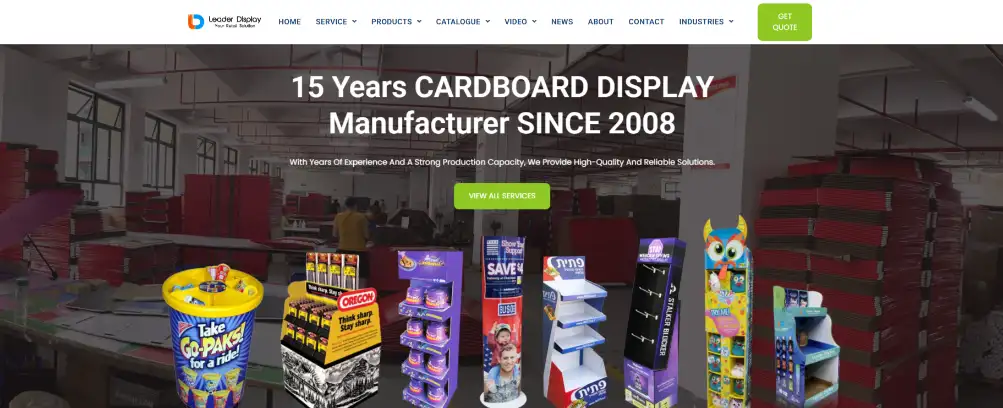
What Real Experience Looks Like on a Supplier Website
Real experience leaves traces. You can usually see it in how the supplier talks about structure, retail use, sampling, shipping, and rollout. A supplier with genuine experience tends to describe projects in operational terms. Product weight. Shelf load. Hook spacing. Refill speed. Sample approval. Export packing. These are the details that come from doing the work, not just marketing the work.
That is the difference. A weaker site often stays abstract. A stronger site becomes concrete. It shows how the supplier thinks.
Buyers should also look for consistency across the site. Does the About page match the product pages? Does the factory story support the services being offered? Do the articles sound like they come from a real manufacturer perspective, or do they read like generic SEO copy that could belong to any industry?
A strong cardboard display manufacturer usually does not sound broad for the sake of sounding broad. It sounds focused. It sounds like a team that has seen the same retail problems many times and knows where projects usually go wrong.
If you want to see what that kind of operational thinking looks like, our display sample approval guide is a good example of how supplier experience should show up in content, not only in sales language.
Certifications Matter, but They Do Not All Prove the Same Thing
Buyers often treat certifications like a simple scoreboard. More logos must mean a better supplier. That is too shallow. The better question is: what does each certification or audit actually tell you about the supplier?
Some certifications point to process control. Some point to sourcing. Some relate to social compliance or audit visibility. That means you should judge them by function, not by decoration.
What ISO 9001 Usually Tells You
ISO 9001 is a quality management standard. It is useful because it signals that the company is working against a structured quality management framework rather than relying only on ad hoc decisions. That does not mean every project will be perfect, but it does suggest a more disciplined approach to process control, repeatability, and continual improvement.
For buyers, that matters most when the project involves repeated sampling, tight approval flow, multiple cartons, or scale production. If the supplier has no process discipline, the display may still look fine in the first batch and become inconsistent later.
For the official overview, see ISO’s explanation of ISO 9001.
What FSC Usually Tells You
FSC is not a display-performance certification. It is a sourcing and supply-chain signal. In paper-based products, that still matters. It tells buyers something about responsible forestry and, when relevant, chain-of-custody control in the supply chain. For brands that care about sourcing transparency, this can be an important trust signal.
But buyers should judge it correctly. FSC does not tell you whether the display structure is smart, whether the hooks are spaced correctly, or whether the supplier can design for refill speed. It tells you something else. Useful. Not complete.
For the official reference, see FSC certification and how the FSC system works.
What Social Audits and Compliance Signals Usually Tell You
Social audits and compliance-related signals can matter a lot for brand buyers, especially when the project serves major retailers, international programs, or corporate sourcing policies. These signals usually tell you more about factory oversight, social compliance expectations, and supply-chain acceptability than about display engineering itself.
This is why authority should never be judged from certifications alone. Certifications tell one part of the story. Factory capability, sample discipline, and retail execution tell the rest.
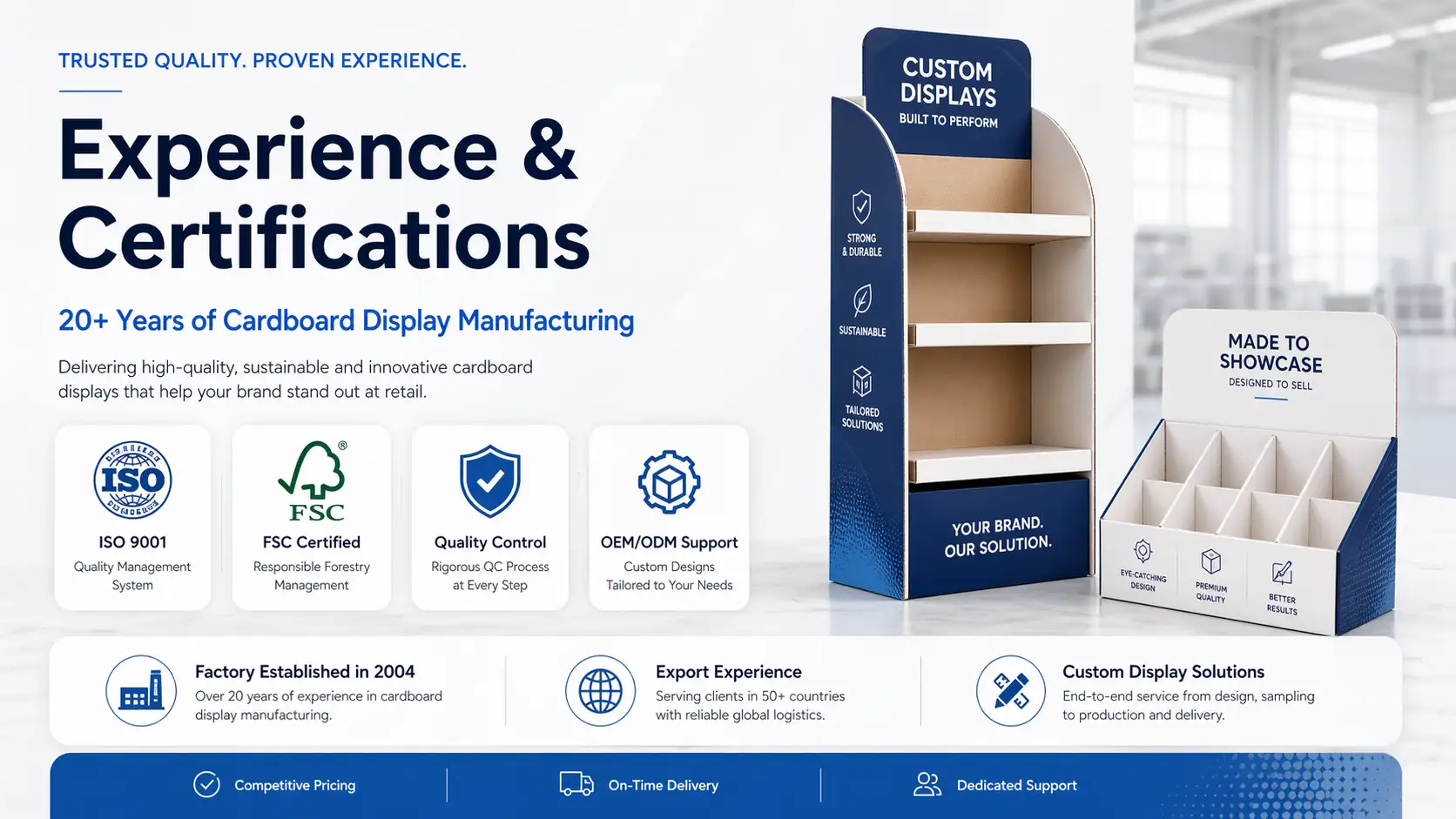
The Most Authoritative Supplier Usually Shows How the Factory Thinks
Some suppliers show certificates. Better suppliers show process.
This is where buyers should look at how the supplier explains sampling, production, quality control, and shipping. Does the supplier talk clearly about what the sample is meant to prove? Does it explain how the display will be packed? Does it mention fit checks, structure checks, or pre-production review? Those details matter because they show that the company thinks like a manufacturer, not only like a trading contact.
That is a stronger authority signal than a generic “high quality” promise. A supplier that can explain how a display moves from concept to sample to mass production is easier to trust because the thinking is visible.
If you are checking whether a supplier really understands execution, our easy setup guide and easy refill guide show the kind of store-side logic that a capable retail display supplier should already understand.
How to Judge Experience and Certifications Together Instead of Separately
The smartest buyers do not treat experience and certifications as two separate checklists. They compare them together.
For example, a supplier may show several certifications but give weak answers about structure, fit, and sample approval. That supplier may be compliant, but not necessarily strong for your display project. Another supplier may speak clearly about sampling, packing, and store execution, but have weak public documentation or unclear factory proof. That is also incomplete.
The stronger supplier usually does both. It shows enough independent trust signals and also explains the work in practical terms. That combination is harder to fake. It is also much more useful when you need to move from inquiry to production with fewer surprises.
| Authority Signal | What It Can Tell Buyers | What It Does Not Prove by Itself |
|---|---|---|
| ISO 9001 | Process and quality-management discipline | Retail display creativity or in-store execution quality |
| FSC | Responsible sourcing and supply-chain control | Structure performance or sample quality |
| Social audits / compliance signals | Supply-chain oversight and sourcing acceptability | Hook spacing, shelf logic, or refill design |
| Detailed sample process | Project discipline and risk control | Long-term sourcing policy compliance |
| Clear project examples | Relevant experience by display type or retail use | Independent management certification |
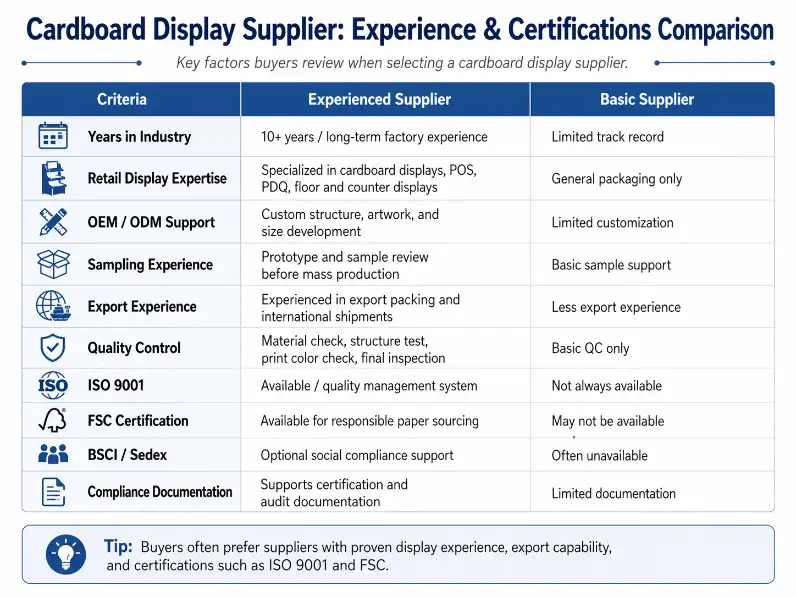
What Buyers Should Ask When a Supplier Looks Authoritative on the Surface
This is where the decision gets practical. If a supplier looks strong, ask questions that force the visible signals to connect with the actual work.
- Which types of cardboard displays do you produce most often?
- What does your sample stage usually test before approval?
- How do you choose board grade for different product weights?
- How do you pack displays for export or chain-store rollout?
- Which certifications relate to quality control, and which relate to sourcing or audit visibility?
- Can you show similar projects that match this product type and retail channel?
The answers matter more than the logos. A supplier with real experience usually answers quickly and specifically. A weaker supplier often moves back to general promises.
If pricing is already part of the conversation, our quote comparison guide helps you connect supplier authority with quotation quality.
How This Topic Supports GEO and Trust Better Than a Generic Supplier Post
This topic works well for GEO because it is built around a direct judgment question. It also supports trust because it gives buyers a way to interpret visible supplier signals instead of repeating generic advice like “choose a reliable partner.”
That difference matters. Google’s people-first guidance encourages content that shows clear expertise, sourcing, background, and useful evaluation help for readers. A page like this is stronger when it helps buyers judge real authority signals instead of only repeating general supplier language. See Google’s helpful, reliable, people-first content guidance.
That is also why this article should sit near your About page and supplier/manufacturer content instead of floating as a generic blog post. It works best when the site itself reinforces the same trust signals.

Conclusion
Which cardboard display supplier looks more authoritative? The better answer usually comes from how experience and certifications work together. A strong cardboard display supplier shows verifiable display experience, relevant certifications, a disciplined sample process, and practical factory thinking that can be checked before mass production starts. Use those signals together, and you will judge supplier authority more accurately than logos or pricing ever can on their own. Then ask the supplier to prove the next step.
For help reviewing a supplier or comparing project requirements, please contact us.
FAQ
Does more certification always mean a better cardboard display supplier?
No. Certifications can be useful, but buyers should judge what each one actually proves instead of treating more logos as automatic proof of better capability.
What does ISO 9001 tell buyers?
It usually tells buyers that the supplier works within a structured quality-management framework, which can support process consistency and better control.
What does FSC tell buyers?
FSC usually tells buyers something about responsible sourcing and supply-chain control for paper-based materials, not about retail display engineering itself.
Can a supplier look authoritative online and still be weak in execution?
Yes. A polished website or strong certificate page does not automatically prove strong sample discipline, structure thinking, or rollout support.
What is the strongest sign of real supplier experience?
Clear, specific answers about structure, sampling, packing, and retail execution are often stronger signals than broad marketing claims.
How should buyers compare two authoritative-looking suppliers?
Compare how well each supplier connects public trust signals with real project thinking, sample logic, and factory execution before production begins.