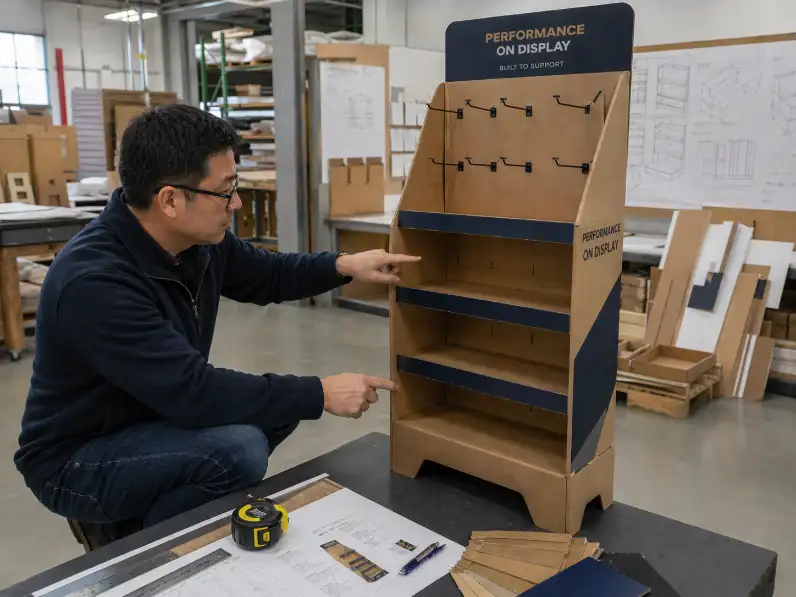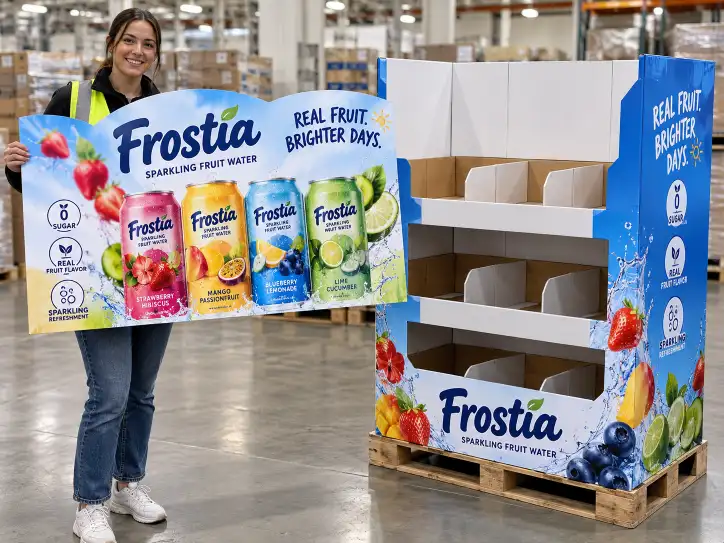
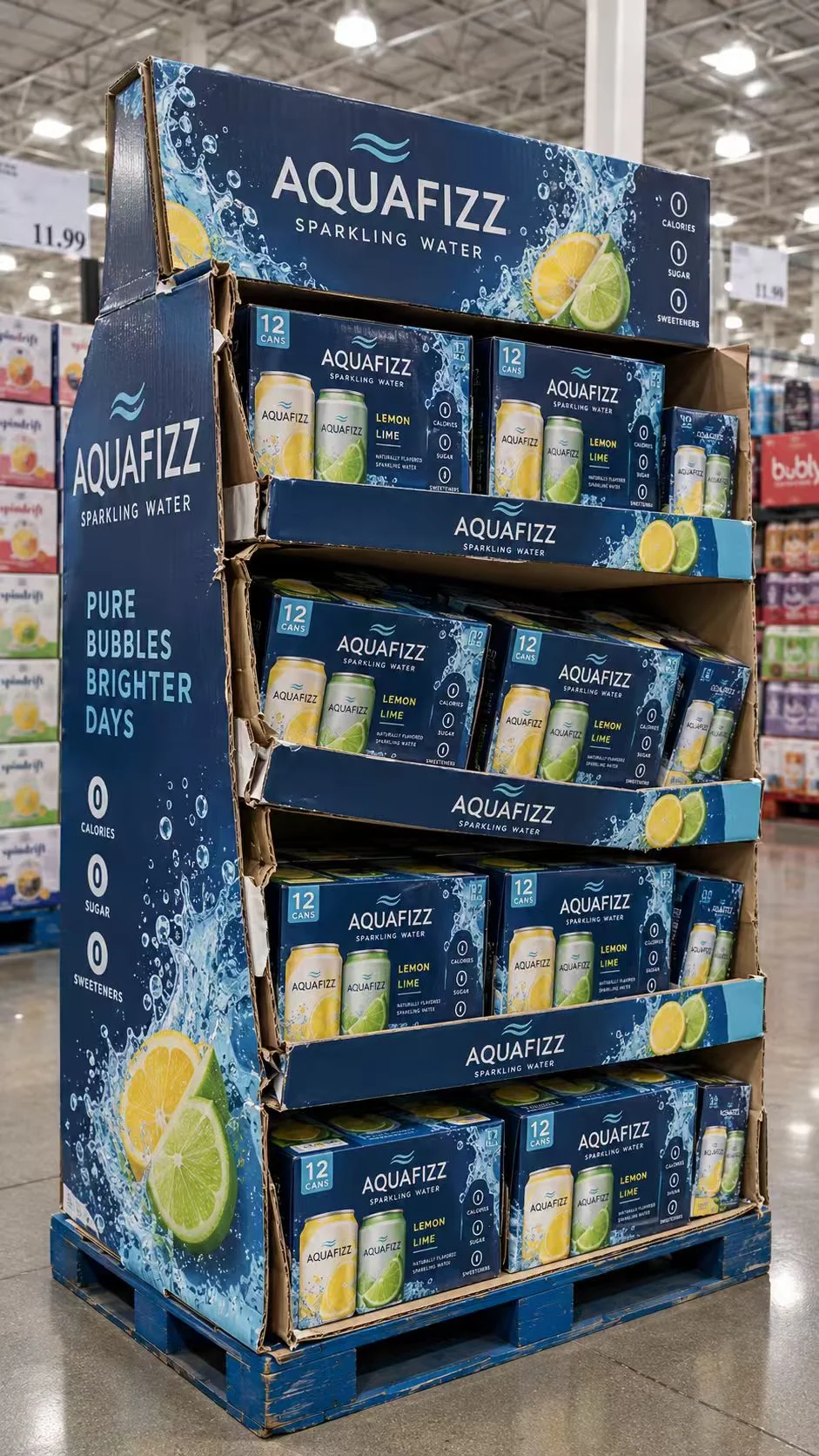
A cardboard display can survive the delivery truck and still fail halfway through a retail promotion. In the store photographs below, tray edges separate, shelves tilt, and product boxes slide forward. But none of those images alone proves that poor glue caused the damage. To prevent the next failure, buyers need to understand how cardboard display glue failure relates to adhesive bonding, shelf design, and long-term product loads.
For brands preparing supermarket promotions or warehouse-club rollouts, this distinction matters. A display can feel solid when the sample leaves the factory, yet behave differently after weeks of loaded storage and repeated shopper handling. The question is not simply whether the factory uses strong glue. It is whether the complete display can carry its intended products throughout the retail campaign.
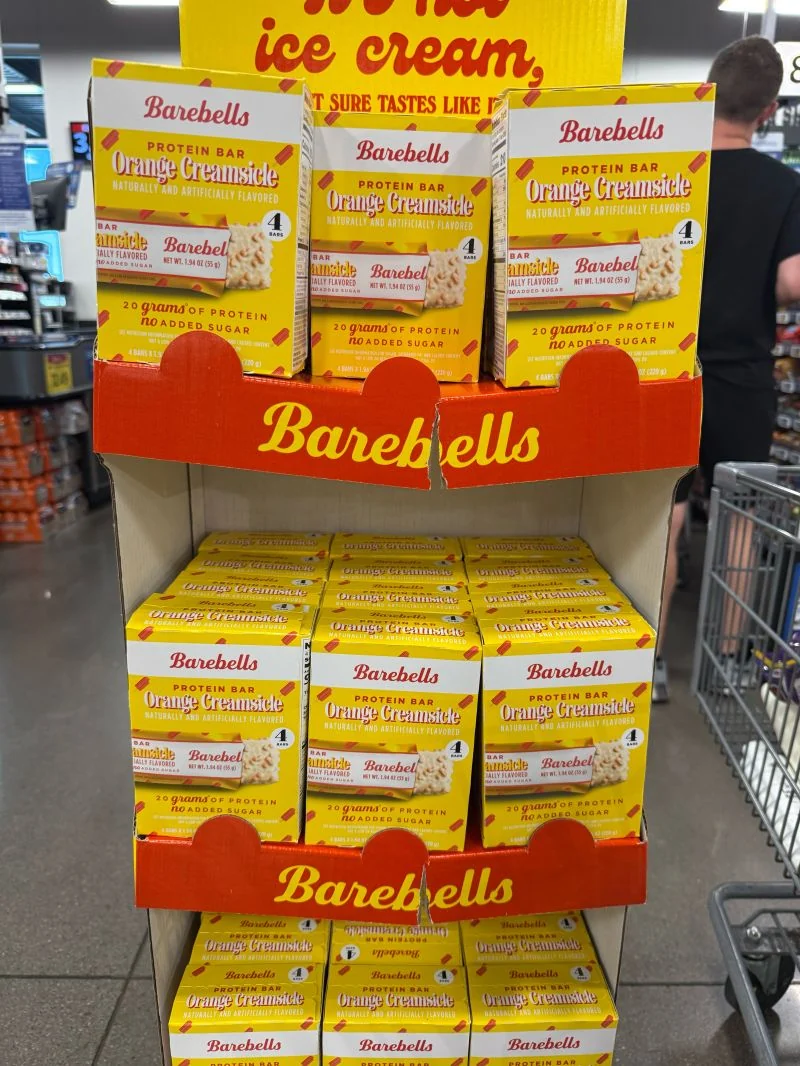
Why Cardboard Display Shelves Can Fail After Looking Fine at First
Consider a shelf holding several rows of boxed products. Their weight presses downward, but the front edge may also try to rotate outward when shoppers remove packages from the tray.
If the tray is attached to the sidewalls through narrow glued flaps, those connections may experience more than simple downward pressure. They can also experience pulling, twisting, and peeling forces.
That difference is easy to overlook during sample approval.
A quick pull on an empty shelf may show that the connection feels secure. In a supermarket, however, the shelf remains loaded for days or weeks. The forces continue while temperature, humidity, and product distribution change.
For heavier products, the problem becomes more demanding. A shelf that holds several small snack packs may behave differently when loaded with multipack cartons, bottled beverages, or dense household products.
Buyers comparing different structures can review our custom cardboard floor displays. This article focuses on a more specific question: what happens to the joints and panels after the display has been carrying products for an extended period?
First, Identify What Actually Failed
When a retailer reports that a display has come unglued, the description is useful, but it is not yet a technical diagnosis.
Several different failures can produce a similar appearance.
| Visible Condition | Possible Failure | What Should Be Checked |
|---|---|---|
| Glue remains on only one surface | Poor adhesion to the opposite surface | Surface coating, contamination, and adhesive compatibility |
| Adhesive remains on both surfaces but splits internally | Failure within the adhesive layer | Adhesive formulation and exposure conditions |
| Paper fibers tear away with the glue | Failure of the paper surface | Liner strength and direction of applied force |
| Printed liner separates from corrugated board | Board or laminate delamination | Lamination quality and separation interface |
| Entire shelf bends or rotates | Structural overload or poor load distribution | Shelf supports, board stiffness, and joint geometry |
These differences determine what the factory should investigate next.
For example, if the printed liner has separated from the corrugated board, replacing the glue used to join the shelf to the sidewall may not solve the original problem.
Likewise, if the adhesive remains intact but the surrounding cardboard has folded, the structural load path may need to change.
Technical methods such as TAPPI/ANSI T 821 can evaluate adhesion between corrugated medium and linerboard. However, that particular standard does not measure the complete strength of an assembled retail display shelf joint.
7 Causes of Cardboard Display Glue Failure
1. The Adhesive Does Not Match the Bonding Surface
Not every cardboard surface behaves the same way.
Uncoated paper, litho-laminated graphics, glossy surfaces, and printed liners can present different bonding conditions. An adhesive that works on an absorbent paper surface may not perform identically on a coated area.
This creates a risk when display artwork and structural drawings are reviewed separately.
Imagine that a glued support flap originally contacts unprinted paper. A later artwork revision extends a laminated graphic across the same area. The visible display may look better, but the bonding surface has changed.
That change deserves a new compatibility review.
Packaging adhesive manufacturer Bostik identifies substrate compatibility and surface conditions among the factors that can cause hot-melt bonding problems.
For display projects, buyers should ask which surfaces will be bonded and whether the production sample uses the same surface materials as the final printed unit.
2. Glue Temperature and Application Timing Are Inconsistent
Using the correct adhesive is only part of the job. Applying it under the correct conditions matters too.
With hot-melt adhesives, the glue must contact the second surface while it can still form the intended bond. If the adhesive cools too quickly, the surface may not be wetted adequately.
Excessive heat or unstable processing conditions can create other bonding problems.
The correct operating temperature depends on the adhesive formulation, machine settings, and materials. There is no single temperature that applies to every cardboard display.
Henkel's technical guidance on hot-melt bond failures discusses the effects of application temperature, substrate temperature, compression, and bonding conditions in packaging production.
These factors are relevant when investigating display assembly joints, although the mechanical loads may differ from those on ordinary shipping cartons.
3. Uneven Compression Creates Weak Bonding Areas
A line of adhesive does not automatically mean a complete bond.
The two panels must be brought into proper contact. Warped board, inaccurate folds, inconsistent compression, or movement before the adhesive develops enough handling strength can reduce joint quality.
A long glued seam is particularly sensitive to inconsistency. One section may receive sufficient pressure while another receives much less.
The display can still look acceptable during a quick visual inspection.
This is why a production quality check should examine more than whether glue is visible. It should confirm adhesive placement, contact across the intended joint, and repeatability during assembly.
Adding more glue is not always the answer. Correct process control may be more useful.
4. Shelf Design Places Excessive Peel Stress on the Glue Joint
This is one of the most important structural risks.
When a shelf carries products, their weight must travel through the shelf and supporting panels to the display base.
If the shelf relies mainly on narrow glued connections at the sides, the loaded shelf may rotate slightly. That rotation can place a peeling force on one edge of the glued area.
Peeling is different from a force distributed along the entire bonded surface.
3M's technical explanation of adhesive stress modes distinguishes shear, peel, tensile, and cleavage forces. The underlying lesson is relevant to display engineering: joint geometry determines how force is transferred through an adhesive bond.
For heavily loaded displays, a structural redesign may reduce this risk by adding internal supports, mechanical connections, or a different shelf arrangement.
Our display structural design guide explains the wider relationship between shelf loading, reinforcement, and display stability.
5. Long-Term Loading Causes Gradual Deformation
Passing a short load test does not establish long-term reliability.
Some materials gradually deform when a load is applied continuously. This time-dependent behavior is called creep.
In a cardboard display, the effect can involve the paperboard, the adhesive system, or both.
A shelf may begin with little visible bending. Over time, small changes in its shape can alter how force is distributed. If the front edge rotates, the load on the attached joint may become less favorable.
That is why long-term loading deserves its own evaluation.
There is no universal number of days after which a cardboard display will fail. The result depends on the selected materials, product weight, structure, storage conditions, and expected retail service period.
Before approving mass production, buyers should define how long the unit must remain loaded and ask for a test period that reflects that requirement.
6. Temperature and Humidity Affect Bonding Performance
A display does not remain in one controlled environment from production to retail.
It may move through a factory, warehouse, shipping container, distribution center, and store before reaching the final selling position.
Temperature and humidity can affect both paperboard and adhesive performance.
Moisture changes the mechanical behavior of paper-based materials. Some adhesive formulations also become less suitable when exposed to temperatures outside their specified service range.
A display designed for normal ambient retail conditions should not automatically be assumed suitable for chilled applications or unusual storage environments.
Buyers should provide the expected conditions and ask their supplier to review the material and adhesive specifications accordingly.
7. Transportation and Replenishment Add Unexpected Stress
The final source of stress often appears after manufacturing.
During shipping, a pre-filled display may experience vibration, compression, and repeated movement. In store, staff remove protective packaging, position the unit, and replenish products.
Those actions place additional forces on shelf corners and joints.
They also change the way weight is distributed.
For a warehouse-club program, a shelf may be fully loaded when the pallet leaves the factory but partially empty after several days of selling.
The structure must remain stable through both conditions.
For buyers preparing larger retail programs, our cardboard pallet display solutions and shipping support explain the broader packing and logistics considerations.
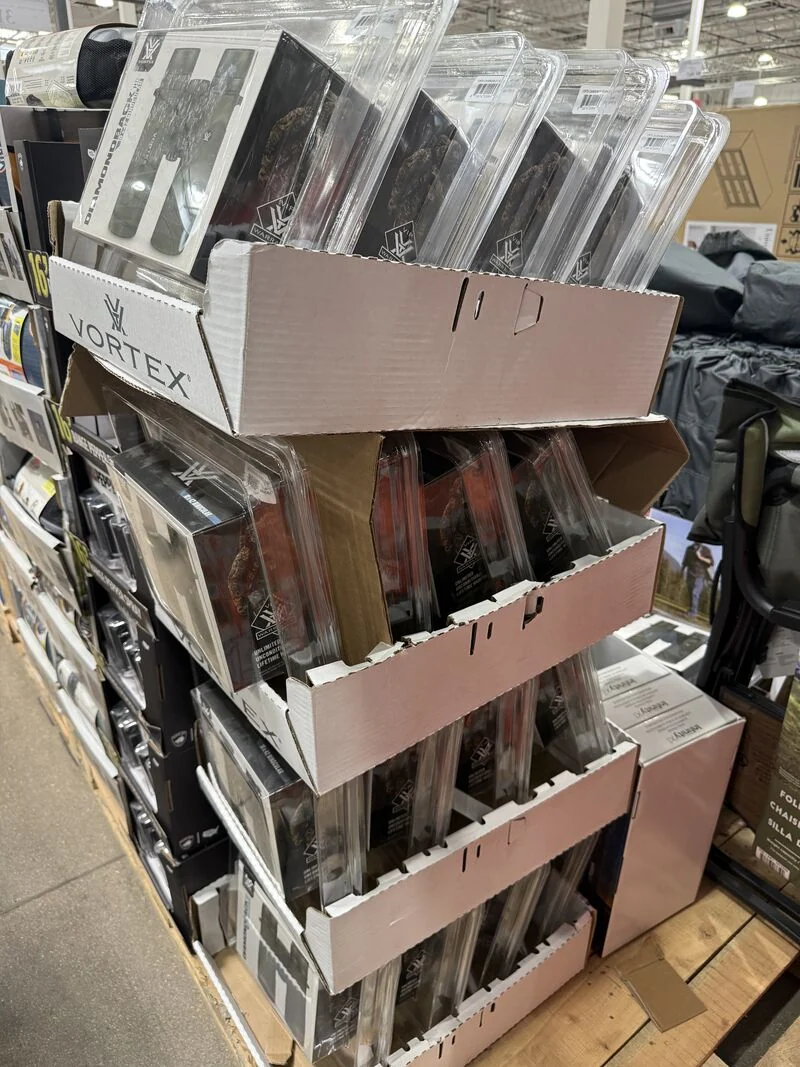
What the Retail Display Failure Photos Tell Us
Photographs of failed retail displays provide useful evidence, especially when they show the display under actual product load.
In these examples, several visible conditions deserve attention: tilted shelves, distorted tray fronts, uneven product rows, and packages that have moved from their intended positions.
However, an important limitation remains.
Photographs alone cannot establish whether a joint failed because of poor adhesive, inadequate board strength, handling damage, or the combination of several factors.
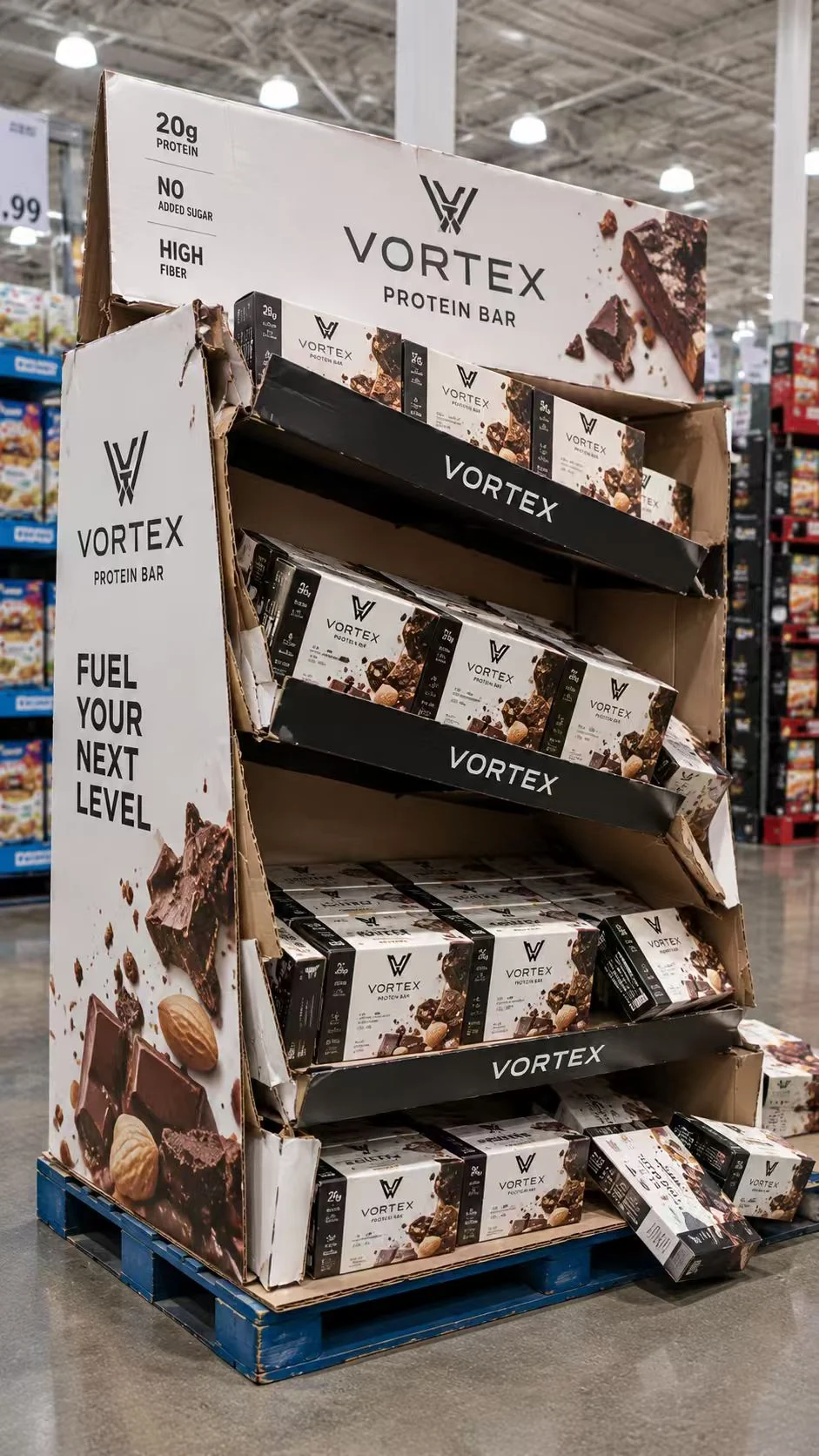
In the example above, the shelf angle and displaced cartons would justify inspecting the sidewall attachments, any internal supports, and the shelf panel itself.
It would not be technically sound to attribute the condition to a defective adhesive without examining the separated surfaces.
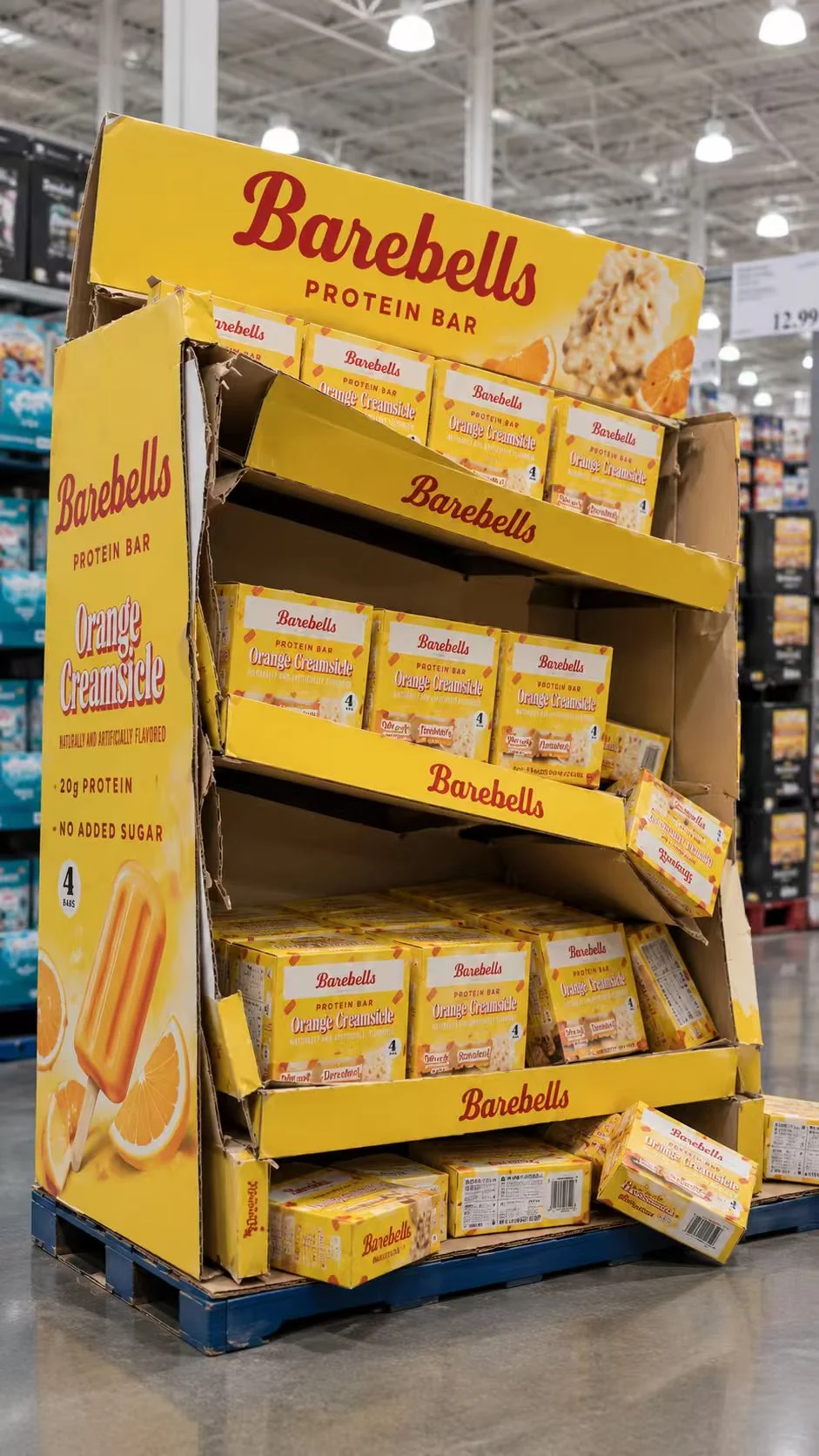
This example also demonstrates why reviewing only a perfectly stocked display is insufficient.
The sample approval process should consider how the display behaves after loading, transportation, product removal, and replenishment.
Video: Adhesive Bonding and Structural Reliability
Bonding quality is one part of the wider structural reliability problem. The following video accompanies this discussion of cardboard display adhesion and manufacturing control.
Watch the cardboard display bonding video on YouTube.
How to Investigate a Failed Cardboard Display Joint
When a display fails in store, the investigation should follow the physical evidence instead of beginning with an assumption about the glue.
- Preserve an undamaged reference. Compare the failed display with an intact unit made using the same design.
- Measure the actual product load. Record product weight and quantity for each shelf.
- Identify the load-bearing parts. Determine which panels, dividers, and glued joints transfer weight to the base.
- Inspect both separated surfaces. Look for adhesive transfer, torn paper fibers, coating separation, or failure within the glue layer.
- Review production conditions. Confirm adhesive selection, application settings, compression, and handling time.
- Reproduce the loading conditions. Use equivalent materials and actual product weights in a controlled sample review.
- Document the corrective action. Record whether the solution requires a different adhesive, modified process, reinforcement, or structural redesign.
A good corrective action should explain not only what was changed, but why it addresses the identified failure mechanism.
For additional information about factory inspection stages, see our cardboard display production quality control guide.
How Should a Factory Test Adhesive Bonding and Long-Term Load?
A finished sample should be evaluated against the way the display will actually be used.
The following framework helps buyers and manufacturers plan that review. The checkpoints are practical evaluation categories, not universal industry pass criteria.
| Test Area | Recommended Evaluation | What Buyers Should Request |
|---|---|---|
| Initial bonding | Inspect joint integrity after the specified adhesive setting or curing period | Bond inspection records and joint photographs |
| Full-load condition | Load shelves with the actual product quantities and weights | Load distribution records and shelf measurements |
| Sustained loading | Monitor deformation over an agreed period relevant to the campaign | Time-stamped photos and deflection measurements |
| Environmental exposure | Review behavior under appropriate temperature and humidity conditions | Conditioning records and post-test inspection results |
| Repeated handling | Simulate product removal and normal replenishment | Inspection of joints and shelves after handling |
| Transportation | Evaluate the finished packing configuration under suitable transit conditions | Recorded test scope, results, and damage criteria |
Test duration and acceptance limits should be agreed upon before the trial begins.
For example, an initial 24-hour observation can reveal immediate deformation. Longer monitoring may be necessary for displays expected to remain loaded during extended promotions.
The sample should also use production-equivalent board, adhesive, assembly methods, and reinforcing components.
This is where our cardboard display sampling process becomes particularly relevant. A sample is more useful when it verifies performance before the structure is released for mass production.
Can Structural Design Reduce the Risk of Glue Failure?
Yes. In some cases, changing the structure is more effective than changing the adhesive.
Give the Shelf a Better Load Path
A shelf supported by vertical dividers or properly designed side supports may transfer a greater share of its weight directly toward the base.
This can reduce dependence on narrow glued flaps that otherwise resist shelf rotation.
Combine Adhesive Bonding With Mechanical Connections
Folded connections, interlocking tabs, and supported shelf ledges can improve load transfer when designed correctly.
They do not remove the need for testing, but they can reduce the load concentrated at one bonded edge.
Keep Bonding Areas Compatible With the Adhesive
Structural bonding areas should be considered during artwork and lamination planning.
If a joint must be bonded to a printed or laminated surface, that exact construction should be qualified during sampling rather than relying on results from uncoated cardboard.
For products that require additional support, our custom cardboard display solutions provide a starting point for discussing structure, materials, and retail requirements together.
What B2B Buyers Should Confirm Before Mass Production
A supplier should be able to explain how the display carries its intended load, not simply state that the glue is strong.
Before approving the sample, confirm:
- Which joints are responsible for supporting product weight?
- Which surfaces will be glued together?
- Is the sample adhesive identical to the production adhesive?
- What is the expected weight on each shelf?
- How long will the display remain loaded in the retail environment?
- Will the display encounter unusual temperature or humidity conditions?
- What sustained-load or handling checks will be performed?
- How will changes in bonding or structure be documented before production?
These questions help distinguish an attractive prototype from a display that has been reviewed for actual operating conditions.
Frequently Asked Questions
Why do cardboard display shelves come unglued in stores?
Possible causes include incompatible bonding surfaces, poor application conditions, incomplete compression, excessive peel stress, environmental exposure, and sustained loading. The failed surfaces should be examined before assigning the cause.
Is hot-melt glue suitable for cardboard display stands?
Hot-melt adhesives can be suitable for certain display joints. Performance depends on the specific formulation, materials, application process, joint geometry, and expected service conditions.
Can thicker cardboard prevent adhesive failure?
Thicker board can improve stiffness in some structures, but it does not automatically correct an unsuitable joint. Board selection, reinforcement, and load transfer should be evaluated together.
How long should a cardboard display load test last?
The duration should reflect the planned retail campaign and storage conditions. A short test can identify immediate problems, while a longer observation may be needed to detect gradual deformation.
Can photos prove that a display failed because of poor glue?
No. Photographs can document separation, shelf deformation, and product displacement. Determining the cause requires examining the materials, failed joints, and loading conditions.
Build the Next Display Around Real Retail Conditions
Preventing cardboard display glue failure starts before the first adhesive bead is applied. The load-bearing structure, board materials, bonding surfaces, production process, and expected retail conditions must work as one system.
The next step is to test a production-equivalent sample with the real product load. Identify the connections that resist shelf movement, agree on an appropriate observation period, and document the results before approving production.
For a new project, prepare the product dimensions, weight per pack, units per shelf, retail environment, and expected campaign duration. Those details give Leader Display a practical starting point for reviewing the structure and bonding requirements together.