A factory ships a pallet display to Target that was built with standard kraft corrugated board. The display meets every structural requirement, passes the stacking test, and arrives in perfect condition. Target's compliance team rejects it because the corrugated board is brown kraft instead of white. The vendor pays a chargeback, the display is returned, and the entire production run must be reprinted on white board at an additional cost of 15–25% per unit.
Target's material requirements are unique among major US retailers. The "clean, crisp, curated" aesthetic means white or neutral corrugated board is the standard. Full-color photographic wraps require specific pre-approval from Target's Fixture Team. The Target Forward sustainability program requires minimum 30% post-consumer recycled content. And the adoption of ISTA 6-SAM'S-CLUB testing in late 2024 changed the board grade requirements for stackable displays.
This guide covers Target pallet display material sourcing from the factory floor: how white board differs from kraft in structural performance and cost, how board grades are selected for Target's 48-inch displays, how FSC certification and recycled content requirements affect sourcing, how lead times are managed around Target's reset calendar, and how material sourcing for Target differs from Walmart and Costco programs.
01 — How Target Display Programs Affect Material Decisions
Target's supply chain and aesthetic standards create specific material demands that differ from Walmart and Costco programs. Before selecting a board grade, the factory reviews how these factors affect material choices.
| Supply Chain Factor | How It Affects Board Selection |
|---|---|
| White corrugated aesthetic | White board is required for all visible corrugated surfaces. White board has different structural properties than natural kraft — the same flute grade in white may have lower crush resistance |
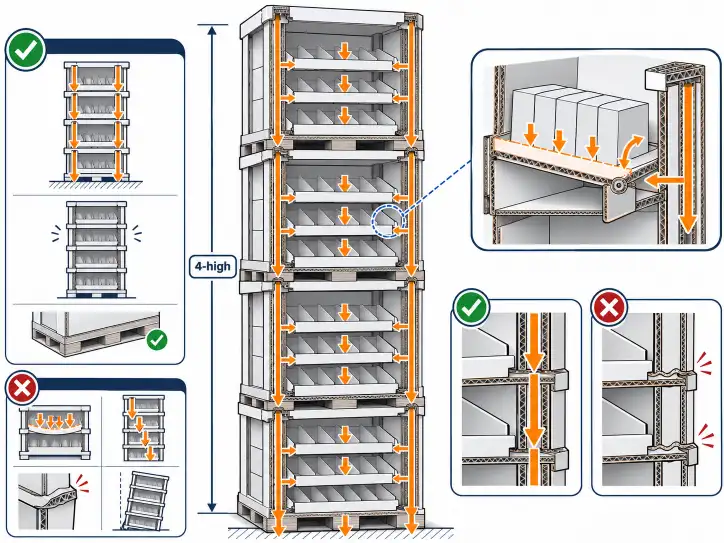
| 4-high stacking in DC | The base board must support the weight of 3 pallets above. Stacking pressure is higher than Walmart (2-high typical) |
| ISTA 6-SAM'S-CLUB testing | 180-minute random vibration testing requires stronger board joints and higher edge crush retention than shorter tests |
| 48-inch standard height | Fewer shelves means more weight per shelf — shelf board grade must be higher than a taller display carrying the same product |
| Target Forward sustainability | Minimum 30% post-consumer recycled content. FSC or SFI certification preferred |
| Regional distribution network | Target uses consolidation centers and regional DCs — transit distances are moderate but handling cycles are higher than Costco |
| Oscillating shelf requirement | Stackable displays need a structural shelf (BC-flute minimum) that transfers stack load to the pallet base |
The Core Difference: Aesthetic-Driven Material Selection
The single biggest material difference between Target and every other retailer is this:
- Walmart and Costco select board based on structural requirements and print quality — board color is not a compliance factor
- Target selects board based on aesthetic requirements first (white corrugated), then structural performance — and white board costs more while performing differently
A factory sourcing board for a Target program must understand how white board behaves under load, how it prints, and how much extra cost the aesthetic standard adds to each structural zone.
02 — White Board vs. Kraft Board: What the Factory Must Know
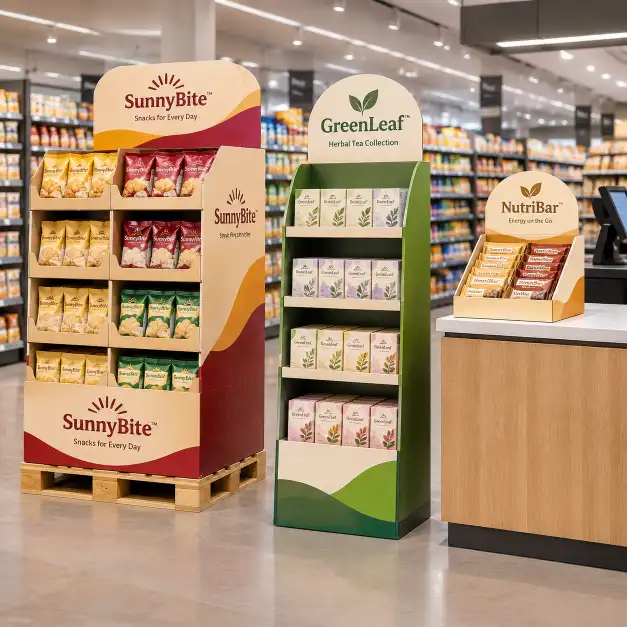
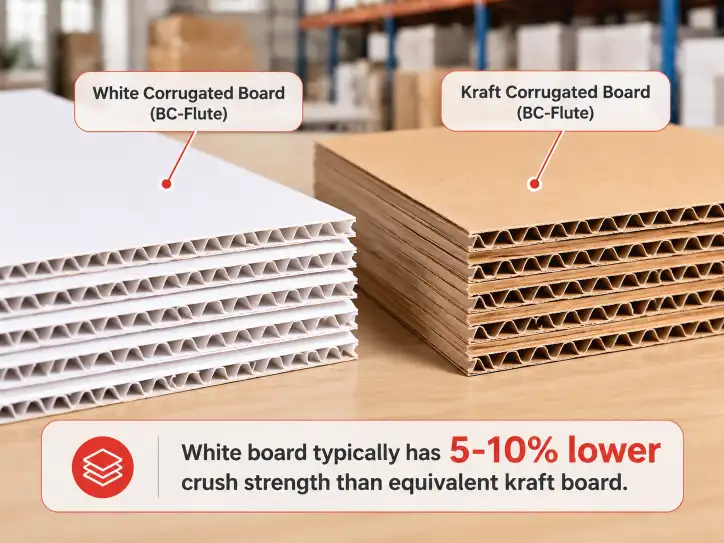
Target requires white or neutral corrugated board for all visible surfaces of in-store displays. This aesthetic requirement has structural and cost implications that the factory must account for during material sourcing.
Structural Differences
| Property | White Board (Bleached) | Natural Kraft (Unbleached) | Impact for Target Displays |
|---|---|---|---|
| Fiber source | Virgin bleached kraft or bleached recycled | Virgin unbleached kraft or OCC recycled | White board often uses more virgin fiber to achieve the color |
| Edge crush strength | 5–10% lower than equivalent kraft grade | Higher per same flute and weight | A Target display may need one grade higher than the same display built in kraft |
| Moisture resistance | Similar when dry; slightly less when wet | Better moisture retention in humid conditions | Less of a concern for Target (no ocean transit) |
| Print quality | Excellent — bright white base for litho-lam and digital UV | Good — kraft color shows through thin ink coverage | White board is better for Target's clean aesthetic |
| Cost | 15–25% higher per MSF | Base pricing | Significant cost impact on large programs |
| Recycled content availability | Available with recycled content but color uniformity varies | Readily available in recycled grades | Target's 30% post-consumer minimum applies to both |
When White Board Is Required vs. Optional
| Display Component | White Board Required? | Notes |
|---|---|---|
| Visible side panels | Yes | All exterior-facing corrugated panels must be white or neutral |
| Header cards | Yes | Branded headers must print on white stock |
| Shelves (visible front edge) | Yes | The front-facing edge of each shelf must be white |
| Shelves (interior surface) | Recommended | Target stores may reject displays with visible kraft interior surfaces |
| Base tray (not visible) | Optional | If hidden by product or skirt, natural kraft may be accepted |
| Internal dividers (not visible) | Optional | Structural components that are not visible from the shopper's view |
| Pallet skirt | Yes | Any visible skirt or base wrap must be white |
| Oscillating shelf (internal) | Optional | Structural component not visible to shoppers |
How to Optimize Board Cost for Target's White Requirement
- Use white board only where it is visible — internal structural components (oscillating shelves, dividers, base supports) can use natural kraft, reducing overall cost by 8–15%
- Pre-print white liners on kraft base — for some applications, a white liner laminated to a kraft base provides the white surface at lower cost than full bleached board
- Confirm with Target's compliance team — some Target buyers accept certain internal components in natural kraft if it does not affect the visual presentation
03 — Board Grade Selection for Target Displays
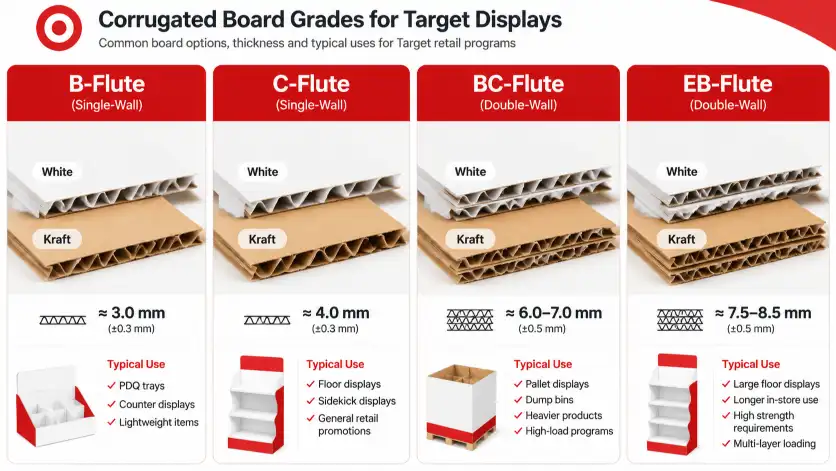
The board grade decision for a Target display starts from the same engineering principles as any corrugated display, but Target's specific requirements shift the selection criteria.
Board Grades and Their Use in Target Programs
| Grade | Flute | White Board Cost Premium | Typical Target Application |
|---|---|---|---|
| Single wall B flute | B | 15–18% | Light PDQ trays, shelf-ready displays, small counter units |
| Single wall C flute | C | 15–20% | General trays, light pallet display upper tiers, grocery PDQ |
| Double wall BC flute | B + C | 18–22% | The workhorse of Target pallet displays — base structures, oscillating shelves, standard pallet displays |
| Double wall EB flute | E + B | 20–25% | Printed structural panels where graphics quality and board strength are both needed — headers, branded side panels, power aisle displays |
| Triple wall | B + C + B | 20–25% | Heavy product programs (pet food, beverages), reinforced base structures for 4-high stacking |
Target-Specific Grade Decision Factors
| Factor | Engineering Consideration |
|---|---|
| Oscillating shelf load | The oscillating shelf must support 3,000 lbs (3 pallets above at 1,000 lbs each). BC-flute double-wall minimum; triple wall recommended for displays over 1,000 lbs |
| 4-high stacking | Base and corner post board grade must be selected for the weight of unknown pallets stacked above, not just the display's own product weight |
| 180-minute vibration | Longer vibration testing requires higher edge crush retention — double wall BC is preferred for all structural panels even on moderate-weight programs |
| 48-inch height | With fewer shelves, each shelf carries more weight. Adjust shelf board grade for the heaviest product per shelf — C-flute minimum for any shelf holding over 10 lbs |
| White board derating | White board has 5–10% lower edge crush than equivalent kraft. If the structural calculation calls for 275# kraft, the white board equivalent may need 350# |
| Endcap footprint | Half-pallet and quarter-pallet endcaps concentrate the same product weight onto a smaller base — the base board grade may need to increase |
The Target Grade Decision Sequence
| Step | Question | Decision |
|---|---|---|
| 1 | Is the display stackable (4-high in DC)? | If yes, BC-flute minimum for base and oscillating shelf. Confirm with Target's structural standards |
| 2 | What is the total product weight per display? | Establishes the base grade range |
| 3 | How many shelves? What weight per shelf? | Determines shelf board grade — C-flute minimum for shelves over 10 lbs per linear foot |
| 4 | Will the display have printed graphics? | White board required. EB-flute for high-quality print, BC-flute for standard structural print |
| 5 | Are visible kraft surfaces acceptable? | Confirm with Target buyer. If not, white board for all visible panels |
| 6 | What pallet footprint? | Full (40x48), half (48x30), or quarter (36x30)? Smaller footprints need thicker base board |
04 — Fiber Source, Sustainability and FSC Certification
Target's Target Forward sustainability program requires minimum 30% post-consumer recycled content in all display materials. FSC or SFI certification is preferred but not always mandatory — the specific requirement depends on the product category and the Target buyer.
Recycled Content Requirements
| Requirement | Standard | Verification Method |
|---|---|---|
| Post-consumer recycled content | Minimum 30% | Supplier certification or mill test report |
| Recyclability | 100% recyclable | No wax coatings, no plastic lamination, no mixed-material laminates |
| Coatings | No wax, no plastic lamination | Water-based coatings only |
| Adhesives | Water-based only | Must not contaminate the recycling stream |
| Stretch wrap | The only acceptable plastic component | Must be removed before recycling |
Fiber Source Decision for Target Displays
| Fiber Type | Strength | Recycled Content Available | Best Use for Target |
|---|---|---|---|
| Virgin bleached white | Highest | Limited — white virgin fiber offers the best color consistency | High-visibility displays where white appearance is critical; printed side panels; header cards |
| Recycled white (bleached OCC) | Good, variable | Yes — 30–100% recycled content available | Most general Target displays; meets sustainability requirements while maintaining white appearance |
| White liner on kraft base | Good | Yes — kraft base can be recycled | Panels where only the visible surface needs to be white; reduces cost by 8–12% vs. full bleached board |
FSC and SFI Certification
Target does not universally require FSC certification across all product categories. However, for certain product categories — particularly paper products, disposable goods, and products marketed as sustainable — FSC certification may be required.
| Certification | What It Covers | When Target Requires It |
|---|---|---|
| FSC (Forest Stewardship Council) | Chain of custody from certified sustainable forests | Product-specific — confirm with Target buyer |
| SFI (Sustainable Forestry Initiative) | Sustainable forest management | Accepted as equivalent to FSC in some categories |
| Recycled Content Certificate | Verifies post-consumer fiber percentage | Required for all displays claiming recycled content |
| Mill Test Report | Board grade (ECT, burst, basis weight) | Required for all structural components |
How to Manage Sustainability Documentation
- Request a recycled content certificate from the paper mill for every board order
- Keep FSC or SFI chain-of-custody documentation on file
- Confirm with the Target buyer which sustainability certifications the program requires
- Document water-based adhesive usage for compliance records
- Maintain a recyclability statement for the finished display
05 — Moisture Protection for the Target Supply Chain
Target's supply chain puts different moisture demands on displays than Walmart or Costco. Target uses consolidation centers where displays may be stored for extended periods, and the 4-high stacking requirement means the bottom display must maintain its structural strength even under humid conditions.
Moisture Risks in the Target Supply Chain
| Moisture Risk | Source | Protection Method |
|---|---|---|
| Consolidation center storage | Displays may sit in consolidation centers for 2–4 weeks before moving to regional DCs | Standard board with stretch wrap is usually sufficient. For programs with expected storage over 4 weeks, add a bottom panel moisture barrier |
| Concrete floor moisture | Floor staging in consolidation centers and store back rooms | Bottom panel moisture barrier (poly coating or barrier liner) for any display that will be floor-staged longer than 48 hours |
| Regional DC storage | Typical storage 1–2 weeks | Minimal risk — standard board is sufficient |
| Transit moisture | Truck transport (covered trailers, moderate distances) | Minimal — covered trucking rarely exposes displays to enough moisture to warrant barrier protection |
| Humidity during 4-high stacking | Compression strength decreases in high humidity — the bottom display in the stack carries more effective load | For high-humidity seasons or locations, specify a slightly higher board grade to maintain safety margin |
Moisture Protection Comparison by Retailer
| Protection Factor | Target | Walmart | Costco |
|---|---|---|---|
| Primary moisture risk | Consolidation center storage + floor staging | Floor staging | Ocean transit + long storage |
| Board-level protection needed | Bottom panel barrier recommended | Bottom panel barrier | Barrier on all panels |
| Stretch wrap requirement | Required — opaque black or clear | Required | Required |
| Special coatings | No wax, no plastic laminate per Target Forward | Wax or poly allowed | Wax or poly allowed |
06 — Material Lead Times for Target Programs
Target's program cycles follow a different rhythm than Walmart or Costco. Target operates on a seasonal reset calendar with key launch windows: Spring (February–March), Back-to-School (July–August), Holiday (October–November), and category-specific resets throughout the year.
Target Program Timeline vs. Material Lead Time
| Program Stage | Typical Duration | Material Dependency |
|---|---|---|
| Buyer discussion and program confirmation | Starts 12–16 weeks before reset | Open |
| Structural sample and approval | 2–4 weeks | Sample board only (white board recommended for accurate representation) |
| White board sourcing and confirmation | 2–3 weeks | White board availability — confirm grade, color consistency, recycled content, and price |
| Pre-press proof and artwork approval | 1–2 weeks | Board grade confirmed; print method selected |
| Production run | 2–4 weeks | Board must arrive 1–2 weeks before production starts |
| Pre-fill assembly (if applicable) | 1–2 weeks | Board + product must be at the factory together |
| Transit to Target DC | 2–3 weeks | Regional — allow additional time for consolidation center processing |
What Affects White Board Availability
| Factor | Effect on Lead Time |
|---|---|
| White BC-flute (common) | Widely available — standard 1–2 week lead time |
| White EB-flute (specialty) | Less common — 2–3 week lead time |
| White board with recycled content | Available — confirm recycled content percentage with the mill. Higher recycled content may have longer lead times |
| FSC-certified white board | Limited supply in some regions — 3–4 week lead time |
| Treated/coated white board | Made to order — 3–4 week lead time |
| Seasonal demand spikes | Q3 back-to-school and Q4 holiday drive white board demand — order 2 weeks earlier than standard lead times |
The Target Reset Date Rule
Target's category reset calendar is fixed. Missing a reset window means the display sits in a consolidation center for up to 8–12 weeks until the next reset window opens. The factory must confirm board availability against the reset date, not the ship date.
When planning material lead times for a Target program:
- Count backward from the Target reset date, not from the ship date
- Add 1 week to standard lead times for white board sourcing (white board has longer lead times than equivalent kraft)
- Add 1 week if the display requires FSC-certified board
- Confirm board arrival 1 week before the start of production
- Allow 2–3 weeks for transit to Target's DC or consolidation center
07 — Material Cost Comparison: Target vs. Walmart vs. Club Store
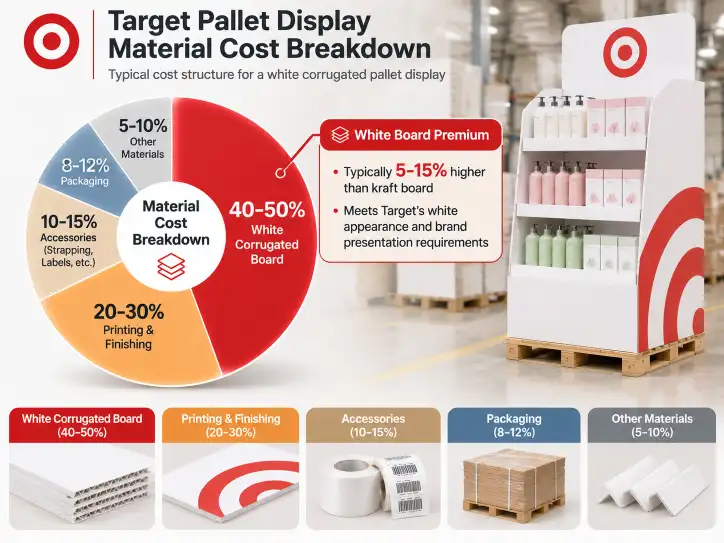
Board cost for a Target display is typically 15–25% higher than the same display built in natural kraft — driven entirely by the white board aesthetic requirement.
Cost Comparison by Structural Zone
| Structural Zone | Walmart Grade (Typical) | Target Grade (Typical) | Target Cost Difference |
|---|---|---|---|
| Base structure | Double wall BC (kraft) | Double wall BC (white) | 18–22% higher — white board premium |
| Oscillating shelf | Not typically required | Double wall BC (kraft — hidden from view) | No cost difference — can use kraft for hidden structural components |
| Shelves | Single wall C (kraft) | Single wall C (white — visible edges) | 15–20% higher — white board premium |
| Side panels | Single wall C or double wall BC | Double wall BC (white — visible) | 18–22% higher — white board + structural requirement |
| Header / top cap | Double wall EB (printed) | Double wall EB (white — printed) | 20–25% higher — white board + high-quality print surface |
| Moisture protection | Bottom-panel barrier only | Bottom-panel barrier (no wax) | Similar — but Target's no-wax restriction may require a different barrier type |
Why Target Board Cost Is Usually Higher
| Reason | Explanation |
|---|---|
| White board premium | White (bleached) corrugated costs 15–25% more per MSF than equivalent kraft |
| Fewer suppliers for white board | Fewer corrugating plants produce white board consistently — less competition, higher prices |
| Recycled content requirement | Board with verified 30%+ post-consumer recycled content may have limited availability |
| No wax coatings allowed | Alternative moisture barriers (poly coatings, barrier liners) may cost more than traditional wax |
| ISTA 6-SAM'S-CLUB testing | The longer vibration test may require higher board grades in certain structural zones |
How to Optimize Material Cost for Target Programs
- Use kraft board for hidden structural components — oscillating shelves, internal dividers, and base supports that are not visible to shoppers can use natural kraft, reducing overall material cost by 8–12%
- Consolidate board grades — if the program allows, use one white board grade (e.g., BC-flute) for all visible components to simplify ordering and reduce waste
- Order white board in mill-direct quantities — for large programs (1,000+ displays), ordering container quantities of white board directly from the paper mill can reduce the per-unit cost by 10–15%
- Confirm visible surface requirements with Target early — some Target buyers accept white-liner-on-kraft construction for certain display types, which is cheaper than full bleached board
08 — Sourcing for Flat-Pack vs. Pre-Filled Target Programs
Target accepts both flat-pack and pre-filled displays. The material sourcing plan differs significantly between the two formats.
| Sourcing Factor | Pre-Filled Display | Flat-Pack Display |
|---|---|---|
| Board grade | Selected for loaded transit — must carry product weight + 4-high stacking + 180-min vibration | Selected for structural requirements only — no transit load on individual panels |
| White board requirement | Same — all visible panels must be white | Same — all visible panels must be white |
| Board arrival timing | Must arrive 1–2 weeks before pre-fill assembly starts | Can arrive later — assembly happens at destination |
| Product arrival alignment | Product must arrive at the factory during the same window as board | No product alignment needed — display panels ship separately |
| Moisture protection | Bottom panel barrier needed for floor staging | Minimal — panels ship flat |
09 — Material Sourcing Checklist for Target Programs
| Check | Status |
|---|---|
| White corrugated board confirmed for all visible surfaces | ☐ |
| Board grade selected for 4-high stacking load (oscillating shelf + base) | ☐ |
| White board crush strength verified — accounted for 5–10% derating vs. equivalent kraft | ☐ |
| Recycled content certificate obtained (minimum 30% post-consumer) | ☐ |
| FSC or SFI certification confirmed if required by Target buyer | ☐ |
| No wax coatings — water-based coatings only | ☐ |
| Moisture protection matched to consolidation center storage duration | ☐ |
| Board order confirmed against Target's reset calendar, not ship date | ☐ |
| White board availability confirmed — lead times account for 1–2 week premium over kraft | ☐ |
| Cost optimized — hidden structural components use kraft where permitted | ☐ |
| Pre-press proof reviewed on white board (colors appear differently on white vs. kraft) | ☐ |
10 — FAQ
Q: Does Target require white corrugated board for all displays?
A: Yes, for all visible surfaces. White or neutral corrugated is the standard for Target's in-store displays. Internal structural components that are not visible to shoppers may use natural kraft — confirm with the Target buyer.
Q: How much more does white corrugated board cost?
A: White (bleached) corrugated board costs 15–25% more per MSF than equivalent natural kraft. The exact premium depends on the flute grade, recycled content, and volume.
Q: Does white board have the same strength as kraft board?
A: No. White board typically has 5–10% lower edge crush strength than the same grade of natural kraft. The factory should account for this by selecting a grade higher than the structural calculation would suggest for kraft.
Q: Does Target require FSC certification?
A: FSC or SFI certification is preferred but not universally required. The specific requirement depends on the product category. Confirm with the Target buyer during the program briefing.
Q: What recycled content does Target require?
A: Target Forward requires minimum 30% post-consumer recycled content in display materials. The factory should obtain a recycled content certificate from the paper mill for every board order.
Q: Can I use natural kraft for internal structural components?
A: Generally yes, if the components are not visible from the shopper's view — oscillating shelves, internal dividers, and base supports can often use kraft. Confirm with the Target buyer before production.
Q: How long does it take to source white board for a Target program?
A: Standard white board grades (BC-flute, C-flute) take 1–2 weeks. Specialty grades (EB-flute, FSC-certified) take 2–4 weeks. Order 1 week earlier than the equivalent kraft timeline.
Q: What moisture protection does Target require?
A: Target does not require ocean-grade moisture protection. Bottom panel barrier is recommended for displays that will be floor-staged in consolidation centers. No wax coatings are allowed.
Q: Can I print on white board the same way as kraft?
A: White board provides a better print surface than kraft, but the pre-press proof should always be reviewed on white board — colors appear differently on white vs. kraft substrates.
Q: How do I verify white board quality for a Target program?
A: Request a mill test report showing ECT, basis weight, and recycled content. Review a pre-production sample on the actual white board grade. Confirm color consistency across the production run.