A vendor ships a pallet display to Target that passed every structural test for Walmart. The display reaches Target's distribution center, gets stacked three pallets high in the warehouse, and the bottom display collapses under the combined weight because the board grade was selected for Walmart's 2,000 lb limit, not Target's higher stacking pressure. The chargeback covers the damaged product, the disposal fee, and a compliance penalty — over $3,000 per occurrence.
Target's structural requirements are different from Walmart and Costco. The 48-inch standard height limit, the oscillating shelf requirement for stackable displays, the 4-high stacking test, and the adoption of the ISTA 6-SAM'S-CLUB testing protocol all create distinct engineering demands that a factory must plan for before the first sample is cut.
This guide covers Target pallet display structural engineering from the factory floor: how Target's supply chain affects display structure, how the 48-inch height changes the load distribution approach, how the oscillating shelf is designed, how stackability up to 4 pallets high is tested, and how Target's engineering requirements differ from Walmart and Costco programs.
01 — How Target's Supply Chain Affects Display Structure
Target's supply chain puts different structural demands on a pallet display compared to Walmart or Costco. The display must survive multiple handling points, mixed stacking in distribution centers, and the specific visual standards that Target enforces at store level.
| Factor | Target | Walmart | Costco |
|---|---|---|---|
| Standard display height | 48 inches (66 power aisle) | 72 inches | 72 inches |
| Pallet footprint | 40 x 48 GMA (full), 48 x 30 or 36 x 30 (endcap) | 48 x 40 typical | 48 x 40 GMA |
| Stacking in DC | Mixed stacking — up to 4 pallets high | Mixed stacking — 2 pallets high typical | Identical display stacking |
| Stacking test | 4-high (must support 3 pallets above) | 2-high typical | Not always required |
| Pre-fill expectation | Pre-filled preferred, flat-pack accepted | Pre-filled preferred | Pre-filled is standard |
| Structural testing protocol | ISTA 6-SAM'S-CLUB (adopted late 2024) | ISTA 3E or vendor-specified | ISTA 3E or vendor-specified |
| Handling frequency | Multiple touches: consolidation center → Target DC → store back room → floor | Multiple touches | Fewer touches |
| Aesthetic standard | White/neutral corrugated, no photo wraps without pre-approval | Printed graphics accepted | Printed graphics accepted |
What These Differences Mean for Structure
| Supply Chain Factor | Structural Implication |
|---|---|
| 4-high mixed stacking | The bottom display must support the weight of 3 additional pallets of potentially different products — not identical displays with matching load distribution |
| 48-inch standard height | Lower height means the weight is distributed over fewer shelves. Each shelf carries a higher proportion of the total load. Shelf strength per linear foot must be higher than a taller display with more shelves |
| Oscillating shelf requirement | Stackable displays require an oscillating shelf that transfers load from the upper tier directly to the pallet base, bypassing the product below |
| ISTA 6-SAM'S-CLUB testing | Random vibration for 180 minutes (vs 60 minutes previously), edge drop testing instead of corner drop, and incline impact simulation — all requiring stronger structural reinforcement |
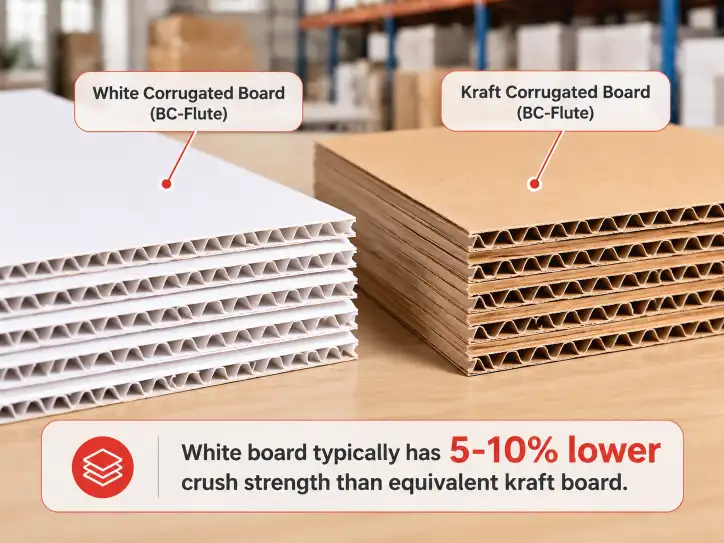
| White/neutral corrugated aesthetic | White board is structurally different from kraft board — the same flute grade in white board may have lower crush resistance than natural kraft |
02 — Target Pallet Footprint and Base Structure
Target uses specific pallet footprints depending on the display placement in the store. The base structure must be engineered to match each footprint.
Full Pallet Displays (Power Aisle and Standard Floor)
| Specification | Requirement | Engineering Implication |
|---|---|---|
| Pallet type | GMA block, 4-way entry, dark blue painted wood | Dark blue paint is a Target-specific requirement. Unpainted or different color pallets are rejected |
| Footprint | 40 x 48 inches | Standard GMA footprint. Overhang is not permitted on any side |
| Max height | 48 inches standard / 66 inches power aisle (with FA#) | At 48 inches, the display must fit within standard rack openings. The lower height limits the number of shelves |
| Max gross weight | 1,500 lbs full pallet / 1,000 lbs per stackable unit | Lower than Walmart's 2,000 lbs and Costco's 3,000 lbs — but stacking pressure is higher relative to weight |
| Base to pallet attachment | Must be strapped, glued, or locked — friction alone is not acceptable | The base-to-pallet connection must survive forklift handling. Strapping through pallet voids is the most common method |
| Corner boards | Required on all four bottom corners of the pallet | Prevents corner damage during handling. Must be 3-ply minimum, 2.5 inches wide |
Endcap Displays (Half and Quarter Pallet)
| Specification | 4-Foot Endcap | 3-Foot Endcap |
|---|---|---|
| Footprint | 48 x 30 inches (half GMA) | 36 x 30 inches (quarter GMA) |
| Max height | 48–54 inches | 48–54 inches |
| Max weight | 500 lbs | 350 lbs |
| Base reinforcement | Full base sheet or corrugated tray required | Full base sheet or corrugated tray required |
| Pallet type | Half GMA block, 4-way entry | Quarter GMA block, 4-way entry |
Base Structure Design Considerations
The base of a Target pallet display must do three things: support the full product load, transfer the weight evenly to the pallet, and survive multiple forklift handling cycles.
Base reinforcement options from most common to most robust:
- Corrugated base tray — A tray that wraps around the bottom of the display and sits directly on the pallet. Suitable for displays under 500 lbs. Uses BC-flute double-wall minimum.
- Base tray with corner supports — Adds reinforced corner posts or gussets between the base tray and the first shelf. Required for displays over 500 lbs.
- Full corrugated base cap with wood pallet attachment — A full corrugated cap that covers the entire pallet surface, with the display structure attached to the cap. Required for displays over 1,000 lbs and all power aisle placements.
- Reinforced base with steel strapping — The base is strapped through pallet voids with steel or heavy-duty plastic strapping. Required for displays over 1,500 lbs or that will be stacked 4-high.
03 — The 48-Inch Height: Structural Design Implications
Target's 48-inch standard display height is significantly shorter than Walmart's 72 inches and Costco's 72 inches. This lower height changes the structural approach in several ways.
Shelf Count and Load Distribution
A 48-inch display typically has 2–3 shelves (depending on product height), compared to 4–5 shelves on a 72-inch display. With fewer shelves, each shelf carries a higher percentage of the total product load.
| Display Height | Typical Shelves | Load Per Shelf (100 units, 8 oz each = 50 lbs total) |
|---|---|---|
| 48 inches (Target standard) | 2–3 shelves | 17–25 lbs per shelf |
| 66 inches (Target power aisle) | 3–4 shelves | 12–17 lbs per shelf |
| 72 inches (Walmart standard) | 4–5 shelves | 10–12 lbs per shelf |
A shelf on a Target 48-inch display must be engineered for higher per-shelf loads than an equivalent Walmart display. This typically requires:
- Higher board grade for each shelf (e.g., BC-flute instead of C-flute for medium-weight products)
- Shorter shelf spans or additional vertical supports
- Shelf supports (gussets or corrugated beams) at closer intervals
Center of Gravity in a Shorter Display
A shorter display with fewer shelves concentrates the product weight in a smaller vertical space. The center of gravity is typically lower than a taller display — which improves stability — but the load concentration means each shelf support must be stronger.
| Factor | 48-Inch Display | 72-Inch Display |
|---|---|---|
| Typical center of gravity | 20–24 inches from base | 30–36 inches from base |
| Tip-over risk | Lower (shorter lever arm) | Higher (taller lever arm) |
| Shelf load concentration | Higher per shelf | Lower per shelf |
| Base reinforcement needed | Moderate | Higher (taller displays need more base weight) |
For a 48-inch Target display, the factory should focus more engineering attention on shelf strength and less on base ballast compared to a taller display. The tip-over risk is lower at 48 inches, but shelf collapse risk is higher if the board grade and supports are not matched to the concentrated load.
04 — Oscillating Shelf Design for Stackable Displays
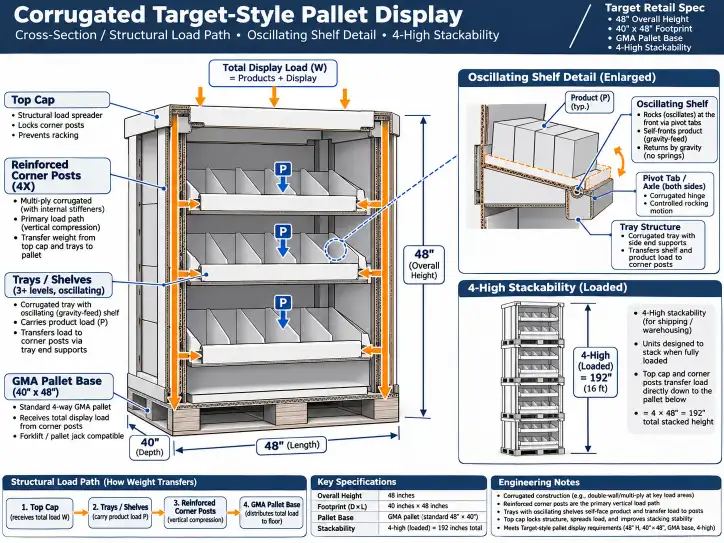
One of the most distinctive structural requirements for Target pallet displays is the oscillating shelf. Target requires stackable pallet displays to include an oscillating shelf — a structural platform that transfers the weight of upper stacked pallets directly to the pallet base, bypassing the product below.
What an Oscillating Shelf Does
When pallet displays are stacked 3 or 4 high in Target's distribution center, the weight of the upper pallets must be supported by the structure of the display below — not by the product inside. The oscillating shelf creates a load path from the top of the display through the side walls or corner posts to the base.
Stacking Load (upper pallets)
        ↓
   [Top Cap / Oscillating Shelf]
        ↓
   [Reinforced Corner Posts or Side Walls]
        ↓
   [Base Tray / Pallet]
Oscillating Shelf Specifications
| Requirement | Specification | Notes |
|---|---|---|
| Material | BC-flute double-wall corrugated minimum | Must support stack load without deflection exceeding 0.25 inches |
| Depth | 17 inches standard | Target's standard oscillating shelf depth for the 40 x 48 pallet footprint |
| Front lip | 2-inch front and side leak guard | Prevents product spillage and contains small items |
| Position | Must sit above the top product row | Product below the shelf must not bear stack load |
| Load capacity | Must support the weight of 3 pallets above | At 1,000 lbs per pallet, the shelf must support 3,000 lbs minimum |
| Attachment | Must be locked into side walls or corner posts | Friction fit is not acceptable — requires mechanical lock (tabs, slots, or adhesive) |
Engineering the Oscillating Shelf
The oscillating shelf is the most heavily loaded single component in a Target stackable pallet display. The factory engineer should design it with these considerations:
-
Board grade selection — BC-flute double-wall or EB-flute double-wall. Single-wall board is not acceptable for any stackable display over 500 lbs.
-
Support structure — The shelf must be supported by reinforced corner posts or full side walls, not by the product. Corner posts should be 2-ply (double-wall laminated) or 3-ply for heavy stack loads.
-
Load distribution — The shelf must transfer load evenly to the corner posts. A flat sheet spanning the full pallet width distributes load better than a partial shelf.
-
Deflection limit — The shelf should not deflect more than 0.25 inches under full stack load. Excessive deflection causes the upper pallet to tilt, creating instability in the stack.
-
Guard requirement — The 2-inch front and side leak guard prevents small products from falling off the shelf and creates a containment area. The guard should be integrated into the shelf structure, not added as a separate component.
When an Oscillating Shelf Is Required
Not every Target display needs an oscillating shelf. The requirement applies when:
- The display will be stacked in Target's distribution center (3 or 4 high)
- The display weighs over 500 lbs when loaded
- The display ships through Target's consolidation centers or regional DCs
Displays that ship as floor-ready single units (not stacked) do not require an oscillating shelf. Check with the Target buyer or compliance team to confirm whether the display will be stacked in the DC.
05 — Stackability Testing: 4-High Stacking Requirements
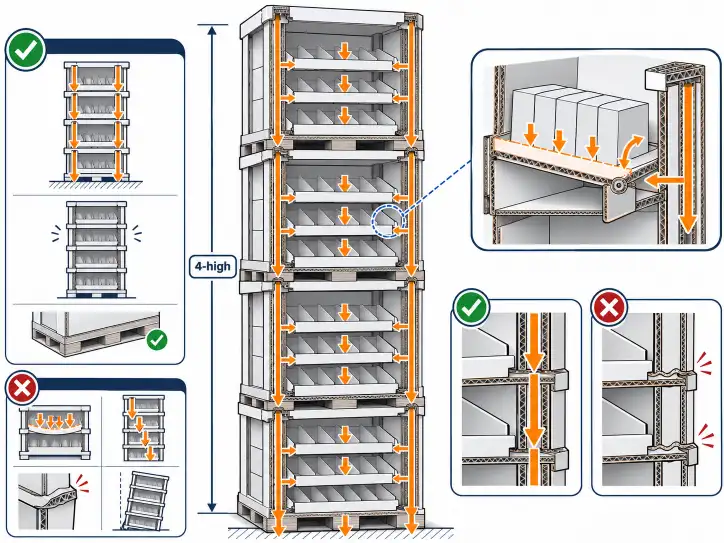
Target requires stackable pallet displays to pass a 4-high stacking test. The bottom display must support the weight of 3 additional pallets above it without structural failure.
Stacking Test Parameters
| Parameter | Specification |
|---|---|
| Stack height | 4 pallets high |
| Test duration | 24 hours minimum |
| Load weight | 1,000 lbs per pallet above (3,000 lbs total) |
| Temperature | Standard room temperature (73°F ± 5°F) |
| Humidity | 50% ± 5% RH |
| Pass/fail criteria | No structural collapse, no corner post buckling, no shelf deflection > 0.5 inches |
Common Stacking Test Failures
-
Corner post buckling — The most common failure. Single-wall corner posts collapse under the weight of 3 pallets above. Solution: use double-wall laminated corner posts or add internal support columns.
-
Base tray separation — The base tray separates from the pallet under stack load. The strapping or adhesive fails, and the display shifts off the pallet. Solution: use steel strapping through pallet voids with corner protection.
-
Oscillating shelf collapse — The oscillating shelf fails at the center span, causing the upper pallets to tilt. Solution: increase board grade (BC-flute minimum) and add center support if the span exceeds 30 inches.
-
Side wall bulging — The side walls bow outward under stack pressure, causing the display to lose its square shape. Solution: add internal cross-bracing or use thicker board for side walls.
-
Tier separation — In multi-tier displays, the connection between tiers fails under stack load. Solution: use interlocking tabs or straps between tiers.
Stackability Engineering Checklist
- Corner posts rated for 3,000 lbs minimum compressive strength
- Oscillating shelf depth 17 inches with 2-inch leak guard
- Base-to-pallet attachment using steel or heavy-duty plastic strapping
- Board grade BC-flute or heavier for all structural panels
- Side walls reinforced with internal bracing for displays over 48 inches tall
- Top cap designed to distribute stack load evenly
- All structural joints locked (tabs, slots, adhesive) — friction fit not acceptable
06 — ISTA 6-SAM'S-CLUB Testing Protocol
In late 2024, Target adopted the ISTA 6-SAM'S-CLUB testing protocol for pallet display structural verification. This replaced the earlier ISTA 3E-based protocol and introduced more demanding test parameters.
Test Protocol Overview
| Test Element | ISTA 6-SAM'S-CLUB (Target Current) | Previous Protocol |
|---|---|---|
| Random vibration | 180 minutes, 3–100 Hz band-limited | 60 minutes |
| Rotational edge drop | Replace rotational corner drop | Corner drop was standard |
| Incline impact | Horizontal impact simulation | Not always required |
| Compression | 4-high stacking for full pallet displays | 2-high typical |
| Drop test | ISTA 1A-type handling drops | ISTA 1A |
What the New Protocol Means for Structure
180-minute random vibration — The display must survive 3 hours of vibration across a wide frequency range. This is significantly more demanding than the previous 60-minute test. The factory should:
- Use vibration-resistant joints (tabs with locking features, not straight push-tabs)
- Add reinforcement at glue points and fold lines
- Test the display on a vibration table before shipping production samples
Rotational edge drop — The display is dropped on a bottom edge, not a corner. Edge drops create different failure modes — the base-to-pallet connection and the bottom shelf supports are stressed more than in corner drops.
Incline impact — Simulates the display being struck by a forklift or another pallet. This tests the structural integrity of the side panels and the base attachment.
Testing Approval Process
- Design the display per Target specifications
- Produce a structural sample (white sample)
- Send to a Target-approved third-party testing lab (QIMA, SGS, Bureau Veritas)
- Lab runs ISTA 6-SAM'S-CLUB protocol
- If the display passes: testing report is submitted to Target's compliance team
- If the display fails: engineering team reinforces weak points and resubmits
- Approved testing report is kept on file for the program duration
Third-party testing costs typically range from $500 to $2,000 per design, depending on the number of test samples required and the complexity of the protocol.
07 — Target vs Walmart vs Costco: Structural Engineering Comparison
When a vendor works with a factory that handles multiple retailer programs, it is important that the factory understands the structural differences between each retailer's requirements. Below is a comparison of the key engineering differences.
| Engineering Factor | Target | Walmart | Costco |
|---|---|---|---|
| Standard display height | 48 inches | 72 inches | 72 inches |
| Max pallet weight | 1,500 lbs (1,000 lbs stackable) | 2,000 lbs | 3,000 lbs |
| Stacking test | 4-high required | 2-high typical | Not always required |
| Board grade (typical) | BC-flute for structural, C-flute for shelves | C-flute standard, BC for heavy | BC-flute standard |
| Shelf strength | 15 lbs per linear foot minimum | 15 lbs per linear foot | 20 lbs per linear foot |
| Testing protocol | ISTA 6-SAM'S-CLUB | ISTA 3E or vendor-specified | ISTA 3E or vendor-specified |
| Pallet color | Dark blue GMA | Natural or painted GMA | Natural GMA |
| Corrugated color | White or neutral preferred | Any color | Any color |
| Pre-fill | Preferred but not always required | Preferred | Standard |
| Footprint options | Full (40x48), half (48x30), quarter (36x30) | 48x40, 48x36, 40x32 | 48x40 GMA only |
Key Takeaway for Factory Engineers
A display designed for Walmart cannot be repurposed for Target without structural changes. The lower height (48 vs 72 inches), the 4-high stacking requirement, the oscillating shelf, and the ISTA 6-SAM'S-CLUB protocol all require a different structural approach. The most common mistake is taking a Walmart pallet display design and simply reducing the height — without accounting for the different stacking pressure, the oscillating shelf requirement, and the testing protocol.
08 — Pre-Filled Display Structural Considerations
Target prefers pre-filled pallet displays that arrive at the store ready for the sales floor. Pre-filled displays add structural considerations beyond empty flat-pack designs.
Pre-Fill Load Distribution
When a display is pre-filled with products, the product weight is distributed differently than when the products are added in the store. In a pre-filled display:
- The products settle during transit, shifting the load distribution
- The base must support the full product weight from the moment the display is assembled
- Stack pressure from upper displays in the DC compresses the products below, which affects the display structure over time
Reinforcement for Pre-Filled Displays
| Pre-Fill Factor | Structural Solution |
|---|---|
| Product settling during transit | Use internal dividers or trays that keep products in position. Avoid relying on the outer walls to contain loose products |
| Base load from pallet stacking | Oscillating shelf is required. The product must not bear the weight of upper pallets |
| Compression over time | Use BC-flute or heavier for any panel that contacts the product. Single-wall panels may bulge or fail after 24+ hours under compression |
| Product shift during vibration | Add horizontal strapping or shrink wrap around the product block inside the display. The outer display walls alone may not prevent product shift during 180-minute vibration testing |
09 — Structural Design Checklist for Target Pallet Displays
Before approving a Target pallet display design for production, confirm each item:
Base and Pallet
- Pallet is GMA block, 4-way entry, dark blue
- Corner boards installed on all four bottom corners
- Base-to-pallet attachment uses strapping, glue, or locking mechanism (not friction alone)
- No overhang beyond pallet footprint on any side
Structure and Load
- Board grade selected for total product weight and shelf load per linear foot
- Shelf supports (gussets or beams) installed for shelves spanning over 24 inches
- Display height: 48 inches or less for standard floor display
- Display height: 66 inches or less for power aisle (with FA#)
- Center of gravity within middle 60% of pallet
Stackability (if applicable)
- Oscillating shelf designed with 17-inch depth and 2-inch leak guard
- Corner posts double-wall laminated or heavier
- Stacking test passed at 4-high with 3,000 lbs load
- All structural joints locked (tabs, slots, or adhesive)
Testing
- ISTA 6-SAM'S-CLUB protocol confirmed with Target compliance team
- Third-party testing lab approved by Target
- Vibration test: 180 minutes random vibration at 3–100 Hz
- Rotational edge drop and incline impact included in test plan
Pre-Fill (if applicable)
- Internal dividers or trays keep products in position
- Oscillating shelf installed above product level
- Horizontal strapping or shrink wrap secures product block
10 — FAQ
Q: What is the standard height for a Target pallet display?
A: The standard height is 48 inches including the pallet. Power aisle displays can be 66 inches with pre-approval (requires a Fixture Approval Number from Target).
Q: Does Target require stackable pallet displays?
A: Many Target programs require stackable displays. Stackable displays must pass a 4-high stacking test and include an oscillating shelf that transfers stack load to the pallet base without compressing the product.
Q: What is an oscillating shelf?
A: An oscillating shelf is a structural platform inside a stackable pallet display that transfers the weight of upper stacked pallets directly to the display base, bypassing the product. Target requires a 17-inch depth with a 2-inch front and side leak guard.
Q: Can I use the same pallet display design for Target and Walmart?
A: Not without structural changes. Target's 48-inch standard height is lower than Walmart's 72 inches, Target requires 4-high stacking testing, and Target uses the ISTA 6-SAM'S-CLUB testing protocol. A Walmart design must be re-engineered for Target.
Q: What board grade does Target require for pallet displays?
A: Target does not specify a single board grade. The factory selects board grade based on product weight, shelf load, display height, and stackability requirements. BC-flute double-wall is common for structural panels, with C-flute or B-flute for shelves depending on the load.
Q: Does Target require third-party structural testing?
A: Yes. Target requires structural testing through an approved third-party lab using the ISTA 6-SAM'S-CLUB protocol. Testing reports must be submitted before production approval.
Q: What happens if a pallet display fails Target's stacking test?
A: The vendor must reinforce the structure and retest. Common fixes include upgrading board grade, adding laminated corner posts, reinforcing the oscillating shelf, and improving base-to-pallet attachment. Each retest round costs $500–$2,000 depending on the lab.
Q: Can a Target pallet display be shipped flat-packed?
A: Flat-pack is accepted for some Target programs, but pre-filled displays are preferred. If shipped flat-pack, the display must still pass the ISTA 6-SAM'S-CLUB protocol for the assembled and loaded condition.
Q: What pallet type does Target require?
A: GMA block pallet, 4-way entry. For full pallet displays: 40 x 48 inches. For endcap displays: 48 x 30 inches (4-foot) or 36 x 30 inches (3-foot). Pallets must be dark blue.
Q: How long does the structural testing process take?
A: Testing typically takes 1–2 weeks including sample preparation, lab testing, and report generation. If the display fails and needs redesign, add another 1–2 weeks per retest round.