A brand commits to 100% recyclable packaging by 2027. The packaging team switches to recycled cartons. The product packaging passes the sustainability audit. Then someone asks about the in-store display. The floor display for the 2026 holiday campaign is made from virgin corrugated board with litho-laminate printing. It will be used for 8 weeks and then thrown away. The display's carbon footprint is higher than the product packaging it sits next to.
The brand has a sustainability problem they did not see coming.
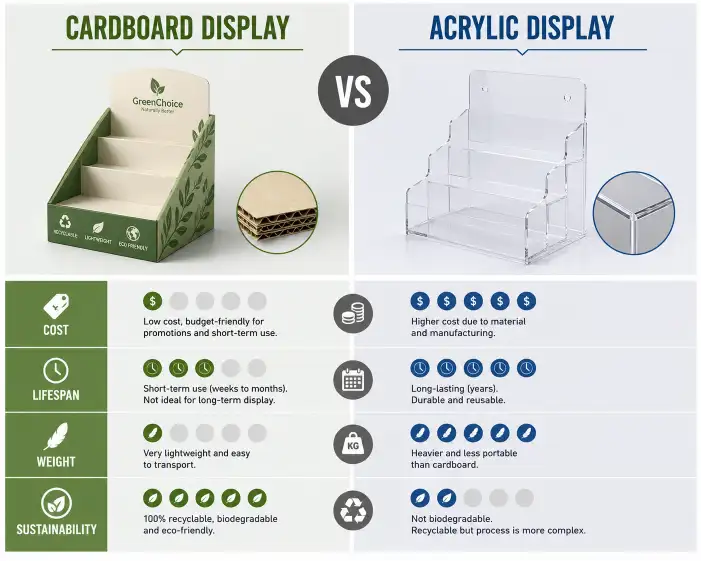
Cardboard displays are generally more sustainable than plastic or acrylic alternatives, but "generally" is not a metric. Brands that need to report on ESG targets need specific numbers: recycled content percentage, FSC certification status, end-of-life recyclability rate, and [[Cardboard Display vs Acrylic Display - Which One Should You Choose|carbon footprint comparison to alternative materials]].
This guide covers the environmental profile of [[Corrugated Grades Explained- How to Choose the Right Material for Displays|corrugated cardboard displays]] — what makes them sustainable, what limits their recyclability, how to verify supplier claims, and how to specify sustainable displays without compromising structural performance.
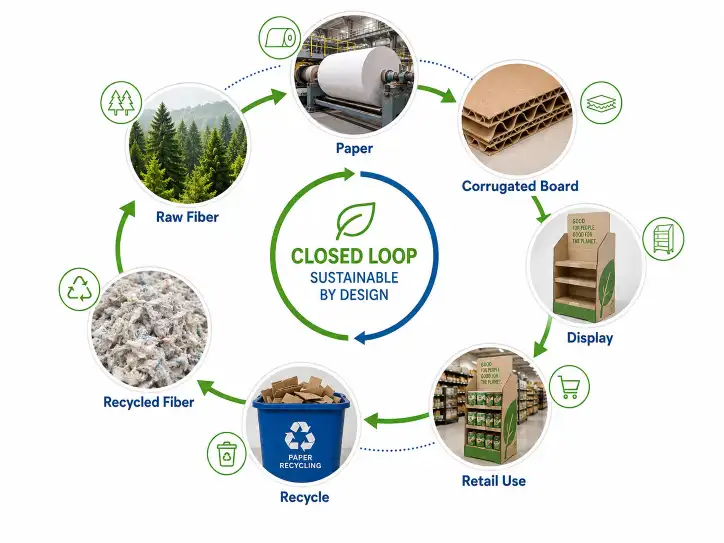
01 Why Display Sustainability Matters
Retailers are increasingly asking suppliers about display sustainability:
- Walmart's [[Walmart Pallet Display Requirements Guide|sustainability index includes packaging and display materials]]
- Target requires suppliers to report on packaging recyclability
- Costco's packaging guidelines prioritize recyclable and reduced-footprint materials
- UK retailers (Tesco, Sainsbury's) levy plastic packaging taxes that can apply to display components
- EU regulations on single-use plastics and packaging waste are expanding
A brand that cannot answer "what is the recycled content of your display?" may find their display program deprioritized or excluded from [[How to Brief a Cardboard Display Factory - Buyer's Communication Guide|retailer sustainability programs]].
Beyond compliance, display sustainability affects brand perception. A consumer-facing display made from recycled materials with a recyclability message communicates brand values at the point of purchase. A display made from virgin materials with no end-of-life plan communicates the opposite.
02 Corrugated Board Recycled Content
Standard Composition
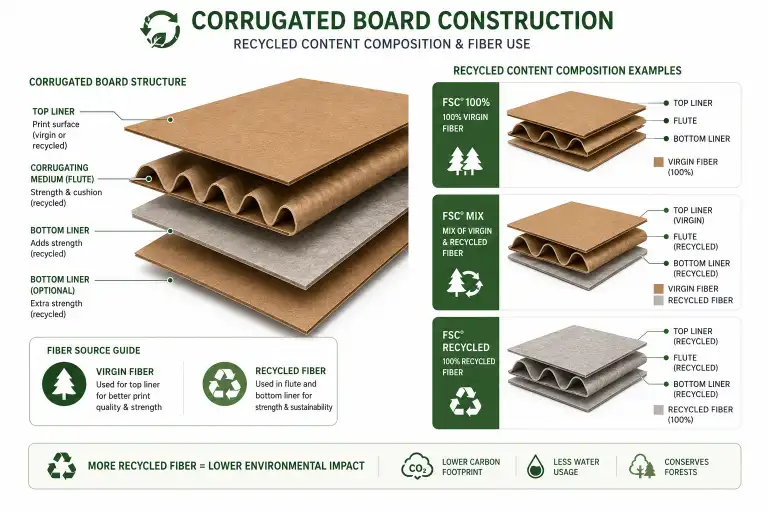
Corrugated board is made from a mixture of virgin and recycled fibers. The ratio depends on the board grade and the mill source.
| Component | Typical Recycled Content |
|---|---|
| Linerboard (outer layers) | 0–50% recycled (kraft or test liner) |
| Medium (fluted middle layer) | 80–100% recycled (semichemical or waste-based) |
| Total board | 40–80% recycled content |
Standard corrugated board typically contains 40–70% recycled content. The exact percentage depends on the mill and the board grade. High-strength boards (275 lb test and above) tend to use more virgin fiber for strength. Lower strength boards can use higher recycled content.
How to Specify Recycled Content
If your brand requires minimum recycled content, specify it in the display brief:
- 70%+ recycled content — Achievable for most display types. Ask for "high recycled content board" or "waste-based liner." The board will be slightly lower in crush strength (10–15% reduction vs virgin) but adequate for most display applications.
- 100% recycled content — Available for lightweight displays (counter displays, PDQs, dump bins) where the structural load is low. Not recommended for heavy-load displays (pallet displays, multi-shelf floor displays) where strength demands are higher.
- FSC Recycled or FSC Mix — See Section 03 below.
Trade-Off: Recycled Content vs Board Strength
Higher recycled content reduces board strength. The reduction is predictable:
| Board Property | Virgin Fiber | 70% Recycled | 100% Recycled |
|---|---|---|---|
| Crush strength (ECT) | 100% baseline | 85–90% | 75–80% |
| Burst strength (Mullen) | 100% baseline | 80–85% | 65–75% |
| Moisture resistance | Good | Moderate | Reduced |
For a lightweight counter display (load under 3 kg), 100% recycled board is structurally adequate. For a [[Pallet Display for Heavy Products- Structural Design Guide for Club Stores|pallet display holding 200 kg of product]], virgin or low-recycled-content board is the safer choice. For a full board grade selection guide with load ratings, see [[Corrugated Grades Explained- How to Choose the Right Material for Displays|Corrugated Grades Explained]].
03 FSC Certification
What FSC Means for Displays
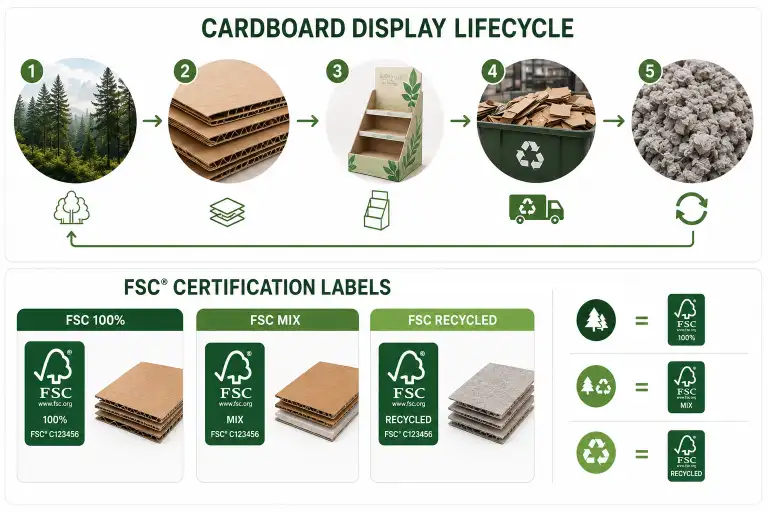
FSC (Forest Stewardship Council) certification confirms that the wood fiber used in the board comes from responsibly managed forests. For displays, the relevant certifications are:
| Certification Label | What It Means | Cost Impact |
|---|---|---|
| FSC 100% | All fiber from FSC-certified forests | +10–20% board cost |
| FSC Mix | At least 70% FSC-certified or recycled fiber | +5–10% board cost |
| FSC Recycled | 100% recycled fiber | Similar to standard recycled board |
| Non-certified | Fiber source not verified | No premium |
When to Specify FSC
- Required by retailer — Some retailers (particularly in Europe) require FSC-certified materials
- Brand ESG commitment — If the brand has a sustainable sourcing policy, FSC certification supports it
- Consumer-facing sustainability claim — An FSC logo on the display communicates certified sourcing to shoppers
How to Verify
Not all factories carry FSC-certified board as standard. If you require FSC certification:
- Ask the factory for their FSC chain-of-custody certificate number
- Verify the certificate on the FSC database (info.fsc.org)
- Confirm the certificate covers the specific board grade and mill that will produce your display
- Specify "FSC Mix" or "FSC Recycled" in the display artwork for logo printing
04 Printing and Lamination Impact on Recyclability
What Makes a Display Less Recyclable
Corrugated board is inherently recyclable. But printing and finishing treatments can reduce recyclability:
| Treatment | Recyclability Impact | Alternative |
|---|---|---|
| Water-based ink (flexo) | Minimal — fully recyclable | Preferred method |
| UV-cured ink | Moderate — may contaminate recycling stream | Use water-based where possible |
| Litho-laminate (paper) | Low — laminated paper is removable in the repulping process | Standard litho-laminate is acceptable |
| Lamination (plastic film) | High — plastic film cannot be removed in standard paper recycling | Avoid plastic film lamination |
| Foil stamping | High — metallic foil contaminates the recycling stream | Use printed metallic effects instead of foil |
| UV spot coating | Moderate — accepted by most mills at low coverage | Minimize area of UV coating |
| Glue (water-based) | Minimal — dissolves in the repulping process | Standard white glue is acceptable |
| Hot-melt adhesive | Moderate — forms sticky residue in the recycling process | Use water-based glue where possible |
| Metal rivets or fasteners | High — must be removed before recycling | Use corrugated locks and tabs instead |
How to Design for Full Recyclability
If full recyclability is the goal:
- Use water-based flexo printing or paper-based litho-laminate
- Avoid plastic film lamination
- Avoid foil stamping or metallic effects
- Minimize UV spot coating (keep under 10% of surface area)
- Use water-based glue for all joints
- Use corrugated lock tabs instead of metal rivets or plastic fittings
- Design for monomaterial construction (all corrugated, no plastic or metal components)
A display built to these specifications can enter the standard paper recycling stream with no sorting or disassembly required.
05 Carbon Footprint: Cardboard vs Alternatives
Comparative Carbon Footprint
| Material | CO₂ per kg of Material | CO₂ per Display (typical 2 kg floor display) |
|---|---|---|
| Corrugated cardboard (virgin) | 0.6–0.9 kg CO₂/kg | 1.2–1.8 kg CO₂ |
| Corrugated cardboard (recycled) | 0.3–0.5 kg CO₂/kg | 0.6–1.0 kg CO₂ |
| Acrylic (PMMA) | 4.0–6.0 kg CO₂/kg | 8.0–12.0 kg CO₂ |
| Polypropylene (plastic) | 2.0–3.5 kg CO₂/kg | 4.0–7.0 kg CO₂ |
| Wood (solid, untreated) | 0.1–0.3 kg CO₂/kg (carbon-negative if sustainably sourced) | N/A |
Cardboard's [[Cardboard Display Cost Breakdown - What Buyers Actually Pay For|carbon footprint is significantly lower than plastic or acrylic alternatives]]. Recycled-content cardboard has roughly half the carbon footprint of virgin cardboard.
Carbon Storage (Biogenic Carbon)
Corrugated board stores biogenic carbon absorbed by trees during growth. A 2 kg cardboard display stores approximately 3.5 kg of CO₂ equivalent in the fiber. If the display is recycled at end of life, this carbon remains stored in the paper cycle. If it goes to landfill, the carbon is released as methane during decomposition (landfill conditions).
Key point: The carbon storage benefit applies only if the fiber comes from sustainably managed forests (which regrow to absorb the carbon). Recycled fiber from post-consumer waste also stores carbon but does not provide additional carbon removal.
06 End of Life: What Happens to Displays After Use
Cardboard Display End-of-Life Options
| Option | Typical Rate | Description |
|---|---|---|
| Curbside recycling | 70–85% (US average) | Display enters household paper recycling stream |
| Commercial recycling | 90–95% (retail DC) | Retail baled cardboard program — highest recycling rate |
| Landfill | 15–30% | Display ends up in landfill if not separated for recycling |
| Reuse (intentional) | <5% | Display is reused for a second promotional cycle |
Why Displays End Up in Landfill
The main reason cardboard displays are not recycled is that they are not separated from general store waste. A display that is thrown into a mixed-waste bin goes to landfill regardless of its recyclability.
To improve recycling rates:
- Add a recycling instruction to the display ("This display is made from recycled paper. Please recycle after use.")
- Work with the retailer's sustainability team to ensure displays are included in the store's [[Cardboard Display vs Acrylic Display - Which One Should You Choose|cardboard recycling program]]
- Design displays that break down easily (flat, no mixed materials) so store staff are more likely to recycle them
07 How to Specify a Sustainable Display
Use this checklist when briefing a factory:
Board:
- Specify minimum recycled content (e.g., 70%+ recycled fiber)
- Request FSC certification if required
- Confirm board grade matches load requirements (do not sacrifice strength for recycled content)
- Request ECT (edge crush test) rating to verify board strength
Printing:
- Use water-based flexo or paper-based litho-laminate
- Avoid plastic film lamination
- Avoid foil stamping
- Minimize UV coating
Construction:
- Use water-based glue (no hot-melt if avoidable)
- Use corrugated lock tabs instead of metal or plastic fasteners
- Design for monomaterial construction if possible
End of life:
- Add recycling instructions to the display
- Confirm with retailer that displays enter the cardboard recycling stream
- Design for easy flattening after use
What to Ask Your Factory
| Question | Why It Matters |
|---|---|
| What is the recycled content of your standard board? | Establishes the baseline before specifying higher recycled content |
| Do you carry FSC-certified board? | Confirms availability and lead time for FSC orders |
| What glue do you use for assembly? | Water-based glue is recyclable; hot-melt is not |
| Can you print with water-based inks? | Water-based inks are preferred for recyclability |
| What is the board's ECT rating? | Confirms the board can handle the load at the specified recycled content level |
For a complete [[How to Brief a Cardboard Display Factory - Buyer's Communication Guide|checklist of what to provide the factory]] for an accurate quote, see our factory briefing guide.
08 Common Sustainability Mistakes
Mistake 1: Assuming all cardboard is the same
"Cardboard is eco-friendly" is a simplification. Virgin kraft linerboard from old-growth forests has a different environmental profile than 100% recycled waste-based board. Specify what you need rather than assuming "cardboard = green."
Mistake 2: Specifying 100% recycled board for a heavy-load display
A pallet display holding 50 kg of product per shelf needs structural strength that 100% recycled board may not provide. The display fails, the product is damaged, and the sustainability benefit is lost. Use the right board grade for the load, not the highest recycled content available.
Mistake 3: Not considering the print method's environmental impact
A brand specifies recycled board for the structure but uses full-coverage UV litho-laminate with foil stamping. The printing and finishing treatments reduce the display's recyclability more than the board choice improved it.
Mistake 4: Ignoring the display's carbon footprint relative to the product
A single-serve snack bar has a carbon footprint of 80 g CO₂ per unit. The display holding 24 units has a carbon footprint of 1.5 kg CO₂. The display's carbon footprint per product is 62.5 g — similar to the product itself. A sustainable display choice directly contributes to the product's total footprint.
09 Sustainability Claims: What to Say and What to Avoid
| Claim | Supported? | Notes |
|---|---|---|
| "Made from recycled materials" | Yes, if board contains minimum 70% post-consumer recycled fiber | Specify the percentage and verify with the factory |
| "FSC certified" | Yes, if the factory has valid chain-of-custody certification | Verify on info.fsc.org |
| "100% recyclable" | Yes, if the display contains no plastic, metal, or non-recyclable coatings | Confirm with the recycling facility |
| "Carbon neutral" | Requires carbon offset purchase | Not inherent to cardboard displays |
| "Biodegradable" | Technically true but misleading — corrugated board is recyclable, not designed for biodegradation | Avoid this claim; "recyclable" is more accurate |
| "Plastic-free" | Yes, if no plastic components or laminations are used | Requires verification of all components |