You have a great product. You have retail placement. But on the store floor, your product is competing with dozens of other brands for a shopper's attention. Without the right display, even the best product gets overlooked.
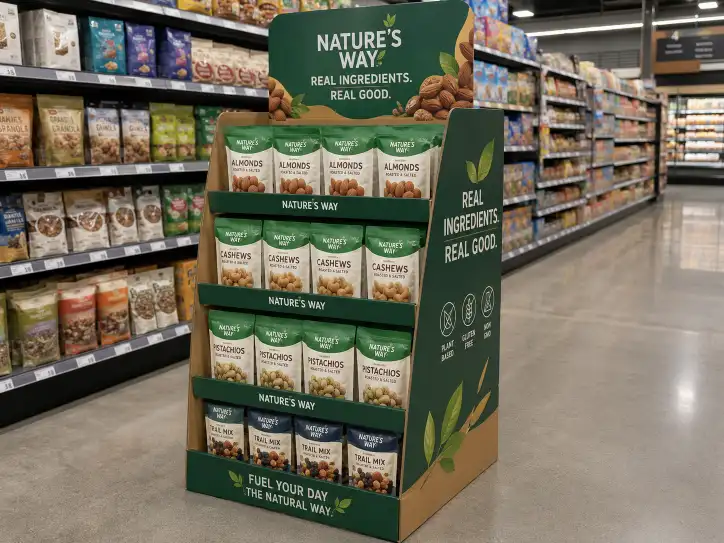
A retail display is any in-store fixture designed to showcase products and drive sales. From floor displays and counter displays to pallet displays and peg displays, the right retail display solution turns passive shelf space into an active selling tool that captures attention and converts shoppers into buyers.
I have designed and manufactured custom retail displays for over 16 years, and I have seen the same pattern repeat: brands that invest in the right display strategy consistently outsell competitors who treat displays as an afterthought. In this guide, I will cover the full landscape of retail display solutions — from types and placement to design, compliance, and choosing the right partner.
What Is a Retail Display and Why Does It Matter?
A retail display is any fixture or structure used to present products in a store environment. Retail displays range from small countertop trays to massive pallet displays holding hundreds of units. Their common purpose is to make products visible, accessible, and appealing to shoppers.
Retail displays matter because they directly influence purchase decisions. Studies consistently show that products placed on branded displays sell significantly more than the same products on standard shelving. A well-designed display:
- Grabs attention from across the aisle
- Communicates brand identity at the point of purchase
- Organizes products for easy comparison and selection
- Creates urgency through promotional messaging
- Increases the likelihood of impulse purchases
For brands selling through retail, a custom retail display is not optional — it is the difference between being noticed and being ignored.
The Complete Retail Display Type Guide
Different retail situations require different display types. Here is a comprehensive overview of every major retail display format.
| Display Type | Placement | Typical Size | Product Capacity | Best For |
|---|---|---|---|---|
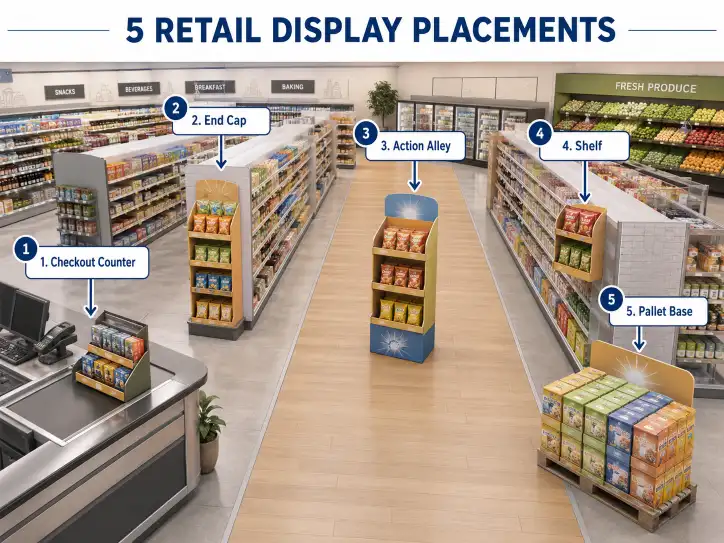
| Floor Display | Floor, aisle, endcap | 100–180 cm tall | 20–400+ units | High-volume promotions, new launches |
| Counter Display | Checkout counter, service desk | 10–40 cm tall | 6–80 units | Impulse buys, small products |
| Pallet Display | Club store floor, power aisle | 100 × 120 cm footprint | 200–600 units | Bulk sales, club stores |
| Peg Display | Aisle, wall, gondola | 60–160 cm tall | 12–144 units | Hanging products, accessories |
| PDQ Display | Checkout counter | 8–25 cm tall | 6–80 units | Pre-packed impulse items |
| Sidekick Display | Side of shelving | 30–70 cm wide | 8–60 units | Secondary placements |
| Dump Bin | Floor, endcap | 80–120 cm tall | 100–300+ units | Discounted or bulk items |
| Standee Display | Store entrance, aisle | 150–180 cm tall | N/A (signage) | Brand awareness, directional signage |
Floor Displays
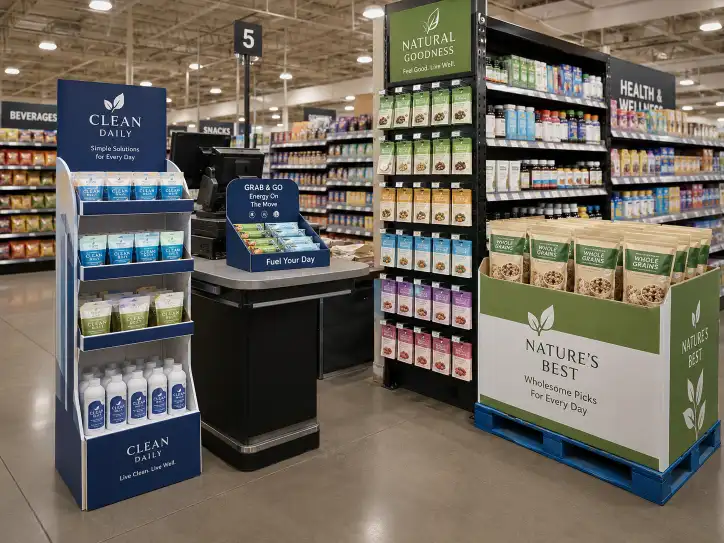
A floor display (also called an FSDU — Free Standing Display Unit) is the most versatile retail display format. It sits on the floor, holds 20 to 400+ products, and can be placed in main aisles, endcaps, or anywhere with sufficient floor space. Floor displays are ideal for promotional campaigns, new product launches, and high-volume SKUs.
For a detailed breakdown, see the full floor display guide.
Counter Displays
Counter displays are compact units placed on checkout counters and service desks. They target impulse purchases — items customers decide to buy in the final seconds before paying. Counter displays are smaller and hold fewer products than floor displays, but they capture buyers at the moment of purchase.
For a detailed breakdown, see the full counter display guide.
Pallet Displays
Pallet displays are built on a standard 100 × 120 cm pallet footprint and are designed for club stores like Costco and Sam's Club. They hold the highest product volume of any display type and are often pre-filled at the factory for immediate placement on the sales floor.
For a detailed breakdown, see the full pallet display guide.
Peg Displays
Peg displays use hooks to hold hanging products. They are the best format for small products that shoppers need to compare visually — electronics accessories, jewelry, toys, and packaged goods. Peg displays keep products organized and visible without taking up shelf space.
For a detailed breakdown, see the full peg display guide.
PDQ Displays
PDQ stands for "Pretty Darn Quick." These pre-packed displays are ready to sell the moment they are placed on the counter — no assembly, no stocking. PDQ displays are the fastest way to get products in front of customers at the point of purchase.
For a detailed breakdown, see the full PDQ display guide.
Sidekick Displays
Sidekick displays (also called power wing displays) attach to the side of existing store shelving. They add selling space without taking floor space, making them perfect for secondary placements in high-traffic zones like checkout lanes and endcaps.
Retail Display Solutions by Retail Channel
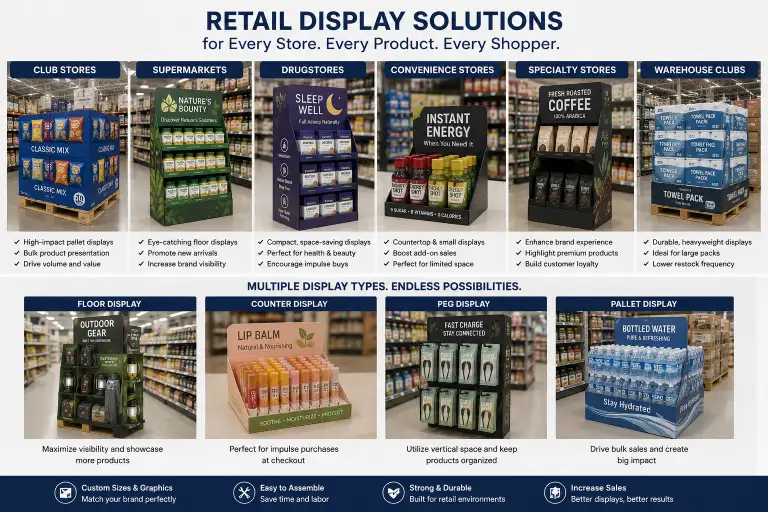
Different retail channels have different display requirements. A display that works in a supermarket may not meet the requirements of a club store.
| Retail Channel | Preferred Display Types | Key Requirements |
|---|---|---|
| Supermarket / Grocery | Floor display, counter display, sidekick | Standard shelving compatibility, easy restock |
| Club Store (Costco, Sam's Club) | Pallet display, large floor display | 100 × 120 cm footprint, stackable, pre-fill |
| Mass Retail (Walmart, Target) | Floor display, peg display, sidekick | Compliance with retailer guidelines, DSD-friendly |
| Drugstore / Pharmacy | Counter display, peg display, sidekick | Compact footprint, quick setup |
| Convenience Store | Counter display, PDQ display, sidekick | Small size, impulse-focused, fast delivery |
| Department Store | Floor display, standee, counter display | Premium appearance, branding focus |
For club store vendors, I recommend reviewing the Costco display requirements and Sam's Club display guidelines before designing your display. Each retailer has specific compliance rules that must be followed.
How to Choose the Right Retail Display for Your Product
Selecting the right display type depends on four factors: product characteristics, retail environment, campaign goals, and budget.
Decision Framework
| If Your Product Is... | And Your Goal Is... | Choose a... |
|---|---|---|
| Small, lightweight, under $15 | Impulse sales at checkout | Counter display or PDQ display |
| Hanging pack or blister card | Clear SKU comparison | Peg display |
| Heavy, bulky, or case-packed | High volume in club stores | Pallet display |
| Medium size, moderate price | Brand visibility in aisles | Floor display (FSDU) |
| Seasonal or promotional | Secondary placement | Sidekick display |
| New product launch | Trial and awareness | Digital print floor display |
Budget Guidelines
- Under $2,000: Start with a PDQ display or small counter display for testing
- $2,000–$10,000: Medium floor display or peg display for a regional rollout
- $10,000–$50,000: Full floor display or pallet display for national chains
- $50,000+: Multi-display campaign across different formats and channels
Retail Display Design: What Makes a Display Work
After designing thousands of displays, I have identified five factors that separate high-performing displays from ones that underperform.
1. Visibility at Distance
A shopper should be able to see your display from at least 5 meters away. This means bold colors, clear product images, and minimal text. The brand logo should be visible at the top of the display, where it is not blocked by products or other displays.
2. Product Accessibility
If a shopper cannot easily reach and grab a product, they will not buy it. The display should have an open front, adequate spacing between products, and a shallow enough depth that products at the back are still reachable.
3. Stability
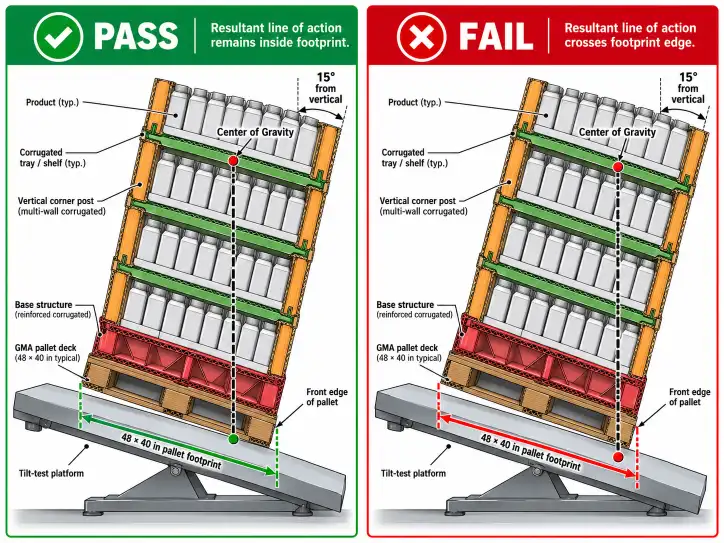
A display that wobbles or tips over is dangerous and damages brand perception. The base should be at least one-third of the display height for floor displays. Pallet displays should survive being stacked two pallets high.
4. Easy Assembly
Store staff will not set up a complicated display. A display that takes more than 5 minutes to assemble often stays in the back room. Design for flat packing and tool-free assembly.
5. Restock Friendliness
A display that is difficult to restock will not stay full. If store staff cannot refill it quickly, it will go empty and stop selling. Pre-filled displays eliminate this problem entirely.
Materials and Printing for Retail Displays
The material and print quality of your retail display directly affects how shoppers perceive your brand.
| Material | Strength | Print Quality | Best For | Cost |
|---|---|---|---|---|
| E-flute corrugated | Moderate | Very good | Counter displays, small formats | Low |
| B-flute corrugated | Good | Good | Standard floor displays | Low–Moderate |
| C-flute corrugated | Strong | Moderate | Large floor displays, heavy products | Moderate |
| BC double wall | Very strong | Limited | Pallet displays, heavy loads | Higher |
| Litho laminate | Strong | Excellent | Premium branded displays | Higher |
For printing, litho laminate delivers the best results for retail environments. It combines the strength of corrugated board with magazine-quality print. Flexographic printing is more affordable for simple designs and large quantities. Digital printing is best for test runs and small batches.
Retail Display Compliance: Meeting Retailer Requirements
Every major retailer has specific display requirements. Non-compliance can result in rejected shipments, chargebacks, or lost placement opportunities.
Common Retailer Requirements
| Requirement | Why It Matters |
|---|---|
| Correct footprint dimensions | Display must fit allocated space |
| Weight limits | Floor loading and shelf capacity |
| No overhang | Prevents damage during shipping and stocking |
| Barcode placement | Scannable at receiving and checkout |
| Pallet specifications | Must fit warehouse racking systems |
| Fire code compliance | Materials must meet safety standards |
| Assembly instructions | Required for store staff setup |
For Costco and Sam's Club specifically, see the Costco display page and Sam's Club display page for detailed requirements.
How Much Do Custom Retail Displays Cost?
Retail display costs vary widely by type, size, print method, and quantity. Here is a general pricing guide.
| Display Type | 500 Units | 1,000 Units | 5,000 Units |
|---|---|---|---|
| PDQ tray, digital print | $0.70–$1.20 | $0.50–$0.90 | $0.25–$0.45 |
| Counter display, offset | $1.20–$2.00 | $0.90–$1.50 | $0.50–$0.85 |
| Sidekick display, flexo | $2.50–$4.50 | $1.80–$3.50 | $1.00–$2.00 |
| Peg display, litho | $7–$12 | $5.50–$9 | $3.20–$5.50 |
| Floor display (3–4 shelves), litho | $12–$18 | $9–$14 | $5.50–$8.50 |
| Pallet display, litho | $24–$38 | $18–$30 | $11–$18 |
Choosing a Retail Display Manufacturer
The manufacturer you choose determines the quality, timeline, and success of your retail display project.
What to Look For
| Factor | What to Check |
|---|---|
| Experience | Years in the industry, relevant case studies |
| Capacity | Production volume, lead times, factory size |
| Compliance knowledge | Familiarity with specific retailer requirements |
| Quality control | Sampling process, inspection procedures |
| Communication | Design support, project management, language |
| Shipping | Experience with domestic and international logistics |
I have been designing and manufacturing retail displays for over 16 years at Leader Display. We work with brands of all sizes — from startups launching their first product to Fortune 500 companies running national campaigns. If you need a reliable retail display supplier, contact us to discuss your project.
FAQ
What is the most effective type of retail display?
There is no single "most effective" display — it depends on your product, retail channel, and campaign goals. Floor displays work best for brand visibility, counter displays for impulse sales, and pallet displays for club store volume.
How much does a custom retail display cost?
Costs range from $0.30 per unit for simple PDQ trays to $35+ per unit for premium litho laminate floor displays. The cost depends on size, complexity, print method, and quantity.
What is an FSDU?
FSDU stands for Free Standing Display Unit. It is a self-supporting floor display that does not need to be attached to a wall or fixture. Most cardboard floor displays in retail are FSDUs.
How do I get my product into Costco or Sam's Club?
You must first be approved as a vendor, then work with the buyer to determine display requirements. Costco typically requires pallet displays with a 100 × 120 cm footprint. See the Costco display guide for details.
What is the lead time for custom retail displays?
Lead times range from 10 business days for simple digital-printed displays to 30 business days for complex litho laminate displays with custom structures.
What is the MOQ for custom retail displays?
MOQs range from 100 units for digital-printed counter displays to 2,500 units for litho laminate pallet displays. Smaller MOQs are available for test runs.
Are cardboard retail displays eco-friendly?
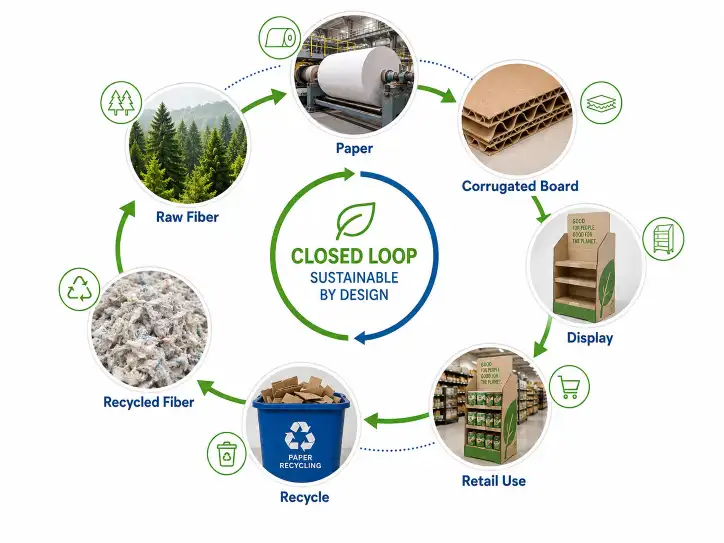
Yes. Corrugated cardboard displays are made from renewable resources and are fully recyclable. Most contain 30–70% recycled content.
What printing method is best for retail displays?
Litho laminate offers the best print quality and is the standard for premium retail displays. Flexographic printing is more affordable for simple designs. Digital printing is best for small test runs.
How do I design a retail display that retailers will accept?
Follow retailer guidelines for size, weight, and compliance. Design for easy assembly and restocking. Use high-quality graphics that match your product packaging. Test the display with actual products before production.
How do I choose the right retail display manufacturer?
Look for experience in your retail channel, knowledge of retailer compliance requirements, quality control processes, and clear communication. A manufacturer with a track record of successful retail display projects will save you time and prevent costly mistakes.