Selling into a club store like Costco or Sam's Club is a different game than standard retail. Your product needs to sit on a pallet, hold massive inventory, and move fast — while looking good enough to sell itself.
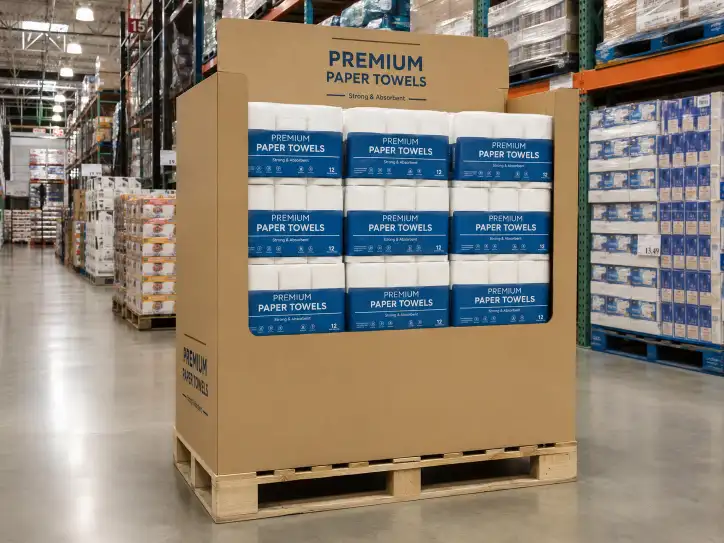
A pallet display is a large corrugated display built on a pallet base, designed for club stores and high-volume retail. Unlike standard floor displays, pallet displays are often pre-filled at the factory and placed directly on the sales floor without additional shelving. They are the most cost-effective way to move high volumes of product in one location.
I have designed and manufactured pallet displays for club store vendors for over 16 years. Getting into Costco or Sam's Club is a major milestone for any brand, but the display requirements are strict. In this guide, I will cover everything you need to know about pallet displays — from types and sizing to compliance, pre-filling, and cost planning.
What Is a Pallet Display and Who Uses It?
A pallet display is a large corrugated display structure built on a standard pallet footprint. It is designed to hold products at bulk quantities and is placed directly on the sales floor in club stores and mass retailers.
The key difference between a pallet display and a counter display or standard floor display is scale. Pallet displays:
- Hold 100–500+ units of product
- Ship pre-filled or empty on a pallet
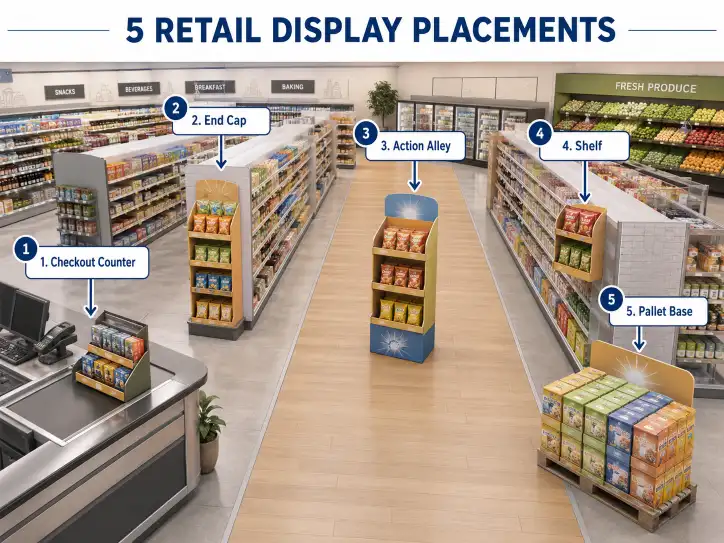
- Are placed in power aisles or club store floors
- Are designed for high-velocity SKUs with short sell-through periods
Pallet displays are used by:
- CPG brands selling into Costco, Sam's Club, and Walmart
- Food and beverage companies launching new products
- Seasonal brands running holiday promotions
- Pet food, household, and personal care brands with high-volume products
If your product is priced for volume and your target retail is a club store, a pallet display is your primary packaging solution.
Pallet Display Types: Full, Half, Quarter, and Modular
Pallet displays come in standard footprints based on the pallet size. The right choice depends on your product volume and the retailer's requirements.
| Type | Footprint | Typical Product Capacity | Best For |
|---|---|---|---|
| Full pallet display | 100 × 120 cm | 200–600 units | High-volume products, Costco |
| Half pallet display | 60 × 80 cm or 100 × 60 cm | 80–250 units | Sam's Club, medium-volume |
| Quarter pallet display | 60 × 40 cm | 40–100 units | Endcaps, test runs |
| Modular pallet display | Stackable units | 100–500+ units | Flexible store placement |
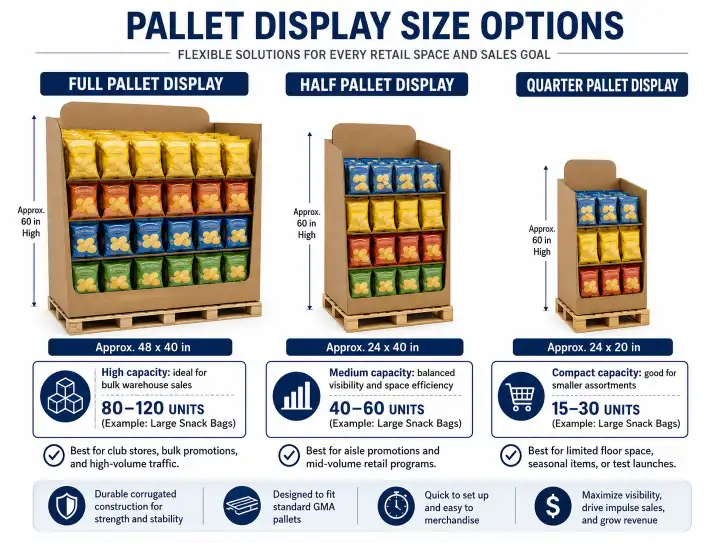
Full Pallet Display
The full pallet display sits on a standard 100 × 120 cm pallet (the North American standard). It is the most common format for Costco and large club stores. The display typically has 2–4 tiers with shelves or trays holding the product.
I recommend a full pallet display if you have a proven product with consistent sales volume. The investment is higher, but the return per square foot of retail space is excellent.
Half Pallet Display
A half pallet display is roughly 60 × 80 cm — half the footprint of a full pallet. It is common at Sam's Club and for endcap placements. Half pallets are easier to move and can fit in tighter retail spaces.
Quarter Pallet Display
Quarter pallet displays are ideal for testing new products in club stores. They hold enough inventory to validate demand without the commitment of a full pallet display. I suggest starting with quarter pallets for new product launches.
Modular Pallet Display
Modular displays are designed to stack vertically or sit side by side. They give retailers flexibility to configure the display layout based on available floor space. Modular designs cost more to produce but offer better reuse across campaigns.
What Are the Size Requirements for Costco and Sam's Club?
Club stores have strict size requirements for pallet displays. Getting the dimensions wrong means your display will not be accepted.
Costco Pallet Display Requirements
| Requirement | Specification |
|---|---|
| Pallet footprint | 100 × 120 cm (standard North American pallet) |
| Maximum height (on pallet) | 180 cm (including pallet height) |
| Height without pallet | 165–170 cm |
| Maximum overhang | 0 cm (product must stay within pallet edge) |
| Pallet type | GMA-grade wood pallet or approved alternative |
| Stability | Must withstand stacking 2 pallets high in warehouse |
| Labeling | Barcode, SKU, and handling labels required |
Sam's Club Pallet Display Requirements
| Requirement | Specification |
|---|---|
| Pallet footprint | 100 × 120 cm or 60 × 80 cm |
| Maximum height (on pallet) | 165 cm |
| Display weight limit | Under 1,000 kg (loaded) |
| Wrapping | Full stretch wrap required |
| Pallet type | Wood pallet, CHEP pallet, or block pallet |
General Rules for Club Store Displays
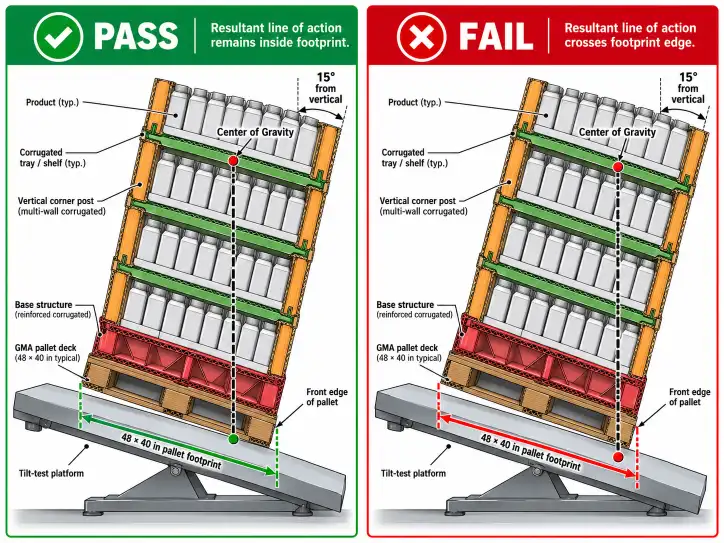
- No overhang — The product and display must sit entirely within the pallet footprint. Overhang causes damage during shipping and on the sales floor.
- Sturdy base — The bottom of the display must be strong enough to support the full weight of the product above it.
- Easy access — Shoppers need to reach products easily. A display that is difficult to access will not sell well.
For more detail on Costcompliance, see the dedicated Costco display requirements guide.
Pre-Filled vs Empty Pallet Displays: Which Should You Choose?
One of the biggest decisions when ordering a pallet display is whether to have it pre-filled at the factory or ship it empty for in-store stocking.
| Factor | Pre-Filled | Empty |
|---|---|---|
| Labor cost | Lower (factory loads the product) | Higher (store staff must stock) |
| Shipping volume | Higher (product + display together) | Lower (flat-packed display only) |
| Time to shelf | Immediate — place and sell | 1–2 hours for stocking |
| Product damage risk | Lower (factory-controlled packing) | Moderate (handled multiple times) |
| Best for | High-volume, proven products | New products, test runs |
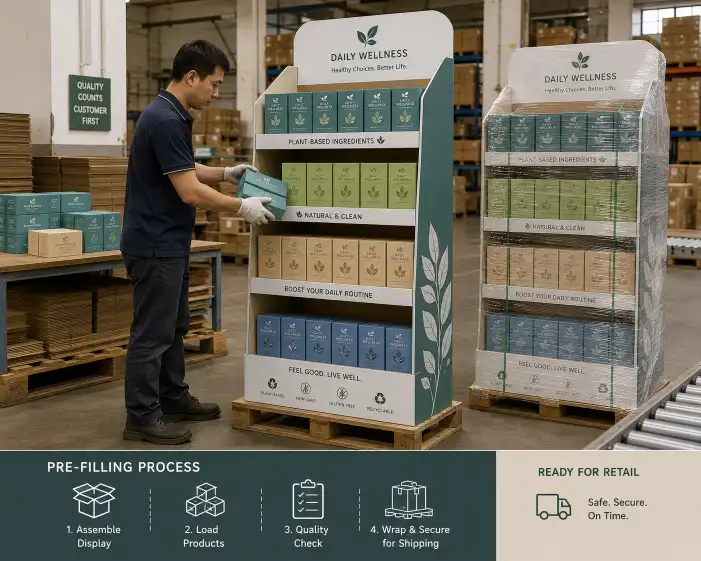
Pre-Filled Pallet Displays
Most club stores prefer pre-filled displays because they are ready to sell immediately. The factory fills the display with product, wraps it, and ships it as a single unit. The retailer places it on the floor, removes the wrap, and the display is ready.
The downside is shipping cost — you are paying to ship the display and the product together. For long-distance or international shipping, this can be significant.
Empty Pallet Displays
Empty displays ship flat-packed and are assembled and stocked in-store. This gives you lower shipping costs but requires store labor. Some retailers charge a fee for display set-up, which can offset the shipping savings.
I generally recommend pre-filled displays for established products with predictable volume. For first-time club store entries, empty displays reduce financial risk.
What Materials and Printing Work Best for Pallet Displays?
Pallet displays need stronger materials than standard floor displays because they hold more weight and must survive pallet stacking.
Recommended Board Grades
| Board Grade | Strength | Best For |
|---|---|---|
| BC double wall | Very strong | Full pallet displays, heavy products |
| C-flute single wall | Good | Half pallet displays, standard weight |
| B-flute single wall | Moderate | Quarter pallet displays, lightweight products |
| EB double wall | Strong + good print | Premium pallet displays with branding |
For most pallet displays, BC double wall is the safest choice. The extra strength prevents collapse when displays are stacked two high in the warehouse.
Printing Options
| Printing Method | Quality | MOQ | Cost | Best For |
|---|---|---|---|---|
| Flexographic | Good, spot colors | 500+ | Low | Basic branding, budget projects |
| Litho laminate | Excellent, full CMYK | 1,000+ | Moderate | Premium pallet displays |
| Digital | Very good, CMYK | 100+ | Moderate | Small batches, test runs |
For club store displays, litho laminate is the standard. Costco and Sam's Club expect high-quality graphics that match the product packaging. A flexo-printed display with limited colors can make your product look out of place next to major brands using litho laminate.
How Much Does a Pallet Display Cost?
Pallet display pricing varies significantly based on size, complexity, and quantity.
| Display Type | 500 Units | 1,000 Units | 2,500 Units | 5,000 Units |
|---|---|---|---|---|
| Quarter pallet, flexo | $8–$14 | $6–$10 | $4.50–$8 | $3.50–$6 |
| Half pallet, litho | $16–$26 | $12–$20 | $9–$16 | $7–$12 |
| Full pallet, flexo | $14–$22 | $10–$17 | $8–$13 | $6–$10 |
| Full pallet, litho | $24–$38 | $18–$30 | $14–$23 | $11–$18 |
| Pre-filling service | +$1–$3 per unit | Added to total cost | — | — |
Additional Costs
| Cost Item | Typical Range |
|---|---|
| Die/tooling (one-time) | $150–$400 |
| Litho laminate vs flexo | +30–50% per unit |
| Pre-filling labor | $1–$3 per display |
| Pallet cost | Included or $3–$8 per pallet |
| Stretch wrapping | $0.50–$1.50 per pallet |
| Shipping (domestic, full truck) | $500–$2,000 per truckload |
For a project-specific quote, contact a pallet display manufacturer with your product dimensions, target quantity, and club store requirements.
What Is the MOQ for Pallet Displays?
Pallet displays have higher MOQs than other display types due to the material volume and tooling costs.
| Display Type | Typical MOQ | Notes |
|---|---|---|
| Quarter pallet, flexo | 500 units | Entry-level option |
| Half pallet, litho | 1,000 units | Common for Sam's Club |
| Full pallet, flexo | 500–1,000 units | Budget option for Costco |
| Full pallet, litho | 1,000–2,500 units | Standard for club store vendors |
| Pre-filled (factory loaded) | 1,000+ units | Depends on product volume |
If your first order is below MOQ, ask about:
- Combining multiple display designs in one run
- Digital printing for a pilot run (lower MOQ, higher per-unit cost)
- A setup surcharge to reduce the quantity
Club Store Compliance: What Costco and Sam's Club Require
Getting a pallet display into a club store involves more than good design. You must meet the retailer's compliance standards.
Costco Display Compliance Checklist
- Pallet footprint: exactly 100 × 120 cm
- Maximum height: 180 cm on pallet
- No product overhang beyond pallet edge
- Sturdy enough to stack 2 pallets high
- Barcode and SKU labels on all 4 sides
- Pallet meets GMA grade specifications
- Stretch wrapped for shipping
- Pre-fill or easy-assembly design
- Passes pallet jack and forklift access
Sam's Club Display Compliance Checklist
- Pallet footprint: 100 × 120 cm or 60 × 80 cm
- Maximum height: 165 cm on pallet
- Weight under 1,000 kg loaded
- Full stretch wrap coverage
- Clear product visibility from all sides
- Easy restock design for store staff
- CHEP pallet or block pallet accepted
- Display must fit on standard racking
Common Compliance Mistakes
| Mistake | Consequence |
|---|---|
| Overhang beyond pallet | Display rejected at receiving |
| Too tall (over 180 cm) | Cannot be stacked, sent to overflow |
| Weak structure | Collapse in warehouse, chargeback |
| Missing labels | Delayed receiving, storage fees |
| Wrong pallet type | Returned to vendor at your cost |
I recommend working with a pallet display supplier who has experience with club store compliance. Mistakes are expensive and can delay your product launch by weeks.
FAQ
What is the difference between a pallet display and a floor display?
A pallet display is built on a standard pallet footprint (100 × 120 cm) and is designed for club stores and high-volume retail. A floor display is typically smaller and used in standard retail aisles. Pallet displays hold more product and are often pre-filled at the factory.
What size pallet display does Costco require?
Costco requires a 100 × 120 cm pallet footprint with a maximum height of 180 cm including the pallet. No overhang is allowed.
What is a pre-filled pallet display?
A pre-filled (or factory-loaded) pallet display is loaded with product at the factory before shipping. The retailer places it on the floor, removes the wrap, and it is ready to sell. This saves labor costs at the store.
What is the MOQ for a custom pallet display?
Standard MOQ is 500–1,000 units for flexo-printed displays and 1,000–2,500 units for litho-printed displays. Pre-filled displays may have higher MOQs depending on product volume.
How much weight can a pallet display hold?
A BC double-wall pallet display can hold 500–1,000 kg distributed across its shelves. The base must be strong enough to support the full weight without collapsing.
Can I use a half pallet display at Costco?
Costco typically requires full pallet displays (100 × 120 cm). Half pallet displays are more common at Sam's Club and other club stores. Always confirm with the buyer before designing.
What is the lead time for pallet displays?
Standard lead time is 20–30 business days from artwork approval. Pre-filled displays require additional time for product packing. Digital print runs can ship in 10–15 business days.
How do I get a pallet display into Costco?
You must first be approved as a Costco vendor. Once approved, work with your Costco buyer to determine display requirements, product placement, and timeline. Then partner with a custom pallet display manufacturer to design and produce the display.
Are pallet displays recyclable?
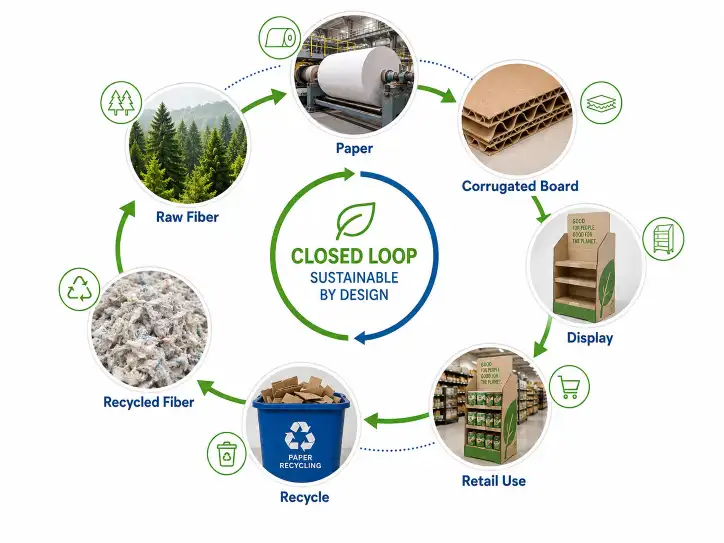
Yes. Corrugated cardboard pallet displays are fully recyclable. The wood pallet can be reused or recycled separately.
Can pallet displays be used for seasonal promotions?
Yes. Pallet displays are ideal for seasonal promotions because they can hold large quantities and are placed in high-traffic areas. Holiday, summer, and back-to-school seasons see the highest use of pallet displays in club stores.