Sustainability is no longer optional in retail. Major retailers are setting recycled content targets, restricting non-recyclable materials, and requiring suppliers to provide environmental compliance documentation. For B2B buyers sourcing cardboard displays, understanding what makes a display recyclable — and what does not — is essential for meeting retailer requirements and avoiding last-minute specification changes.
This guide explains how recyclable cardboard displays work, what certifications matter, and how B2B buyers can specify eco-friendly retail displays without compromising strength, print quality, or budget.
What Makes a Cardboard Display Recyclable?
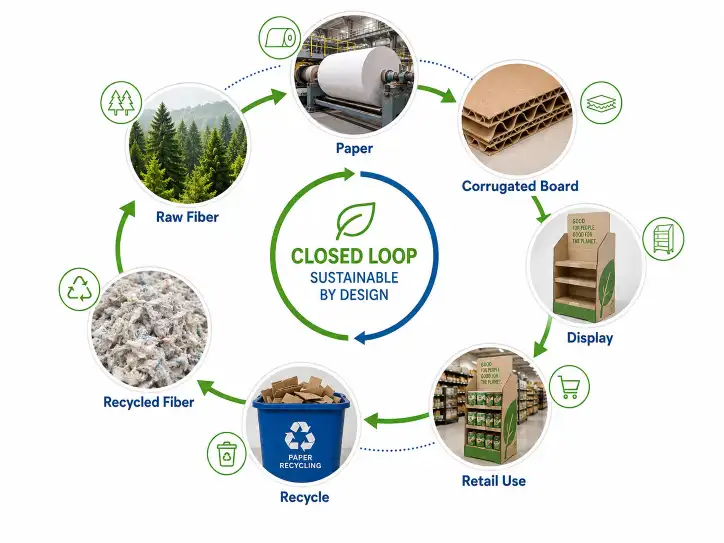
A recyclable cardboard display is one that can be processed through standard paper recycling streams after use. For a display to be recyclable, three conditions must be met:
- The material must be paper-based — Corrugated board and paperboard are recyclable. Plastic, foam, and metal components are not.
- Coatings must be water-soluble or removable — Some coatings prevent the paper fibers from separating during the pulping process.
- No contamination — Displays mixed with food waste, adhesives that do not dissolve, or non-paper materials cannot be recycled.
What is NOT recyclable:
- Displays laminated with non-soluble plastic film
- Units with foam inserts or plastic trays that cannot be separated
- Displays heavily contaminated with food or grease
- Mixed-material displays that cannot be disassembled
For an overview of standard display materials and their recyclability, see our CARDBOARD DISPLAY range.
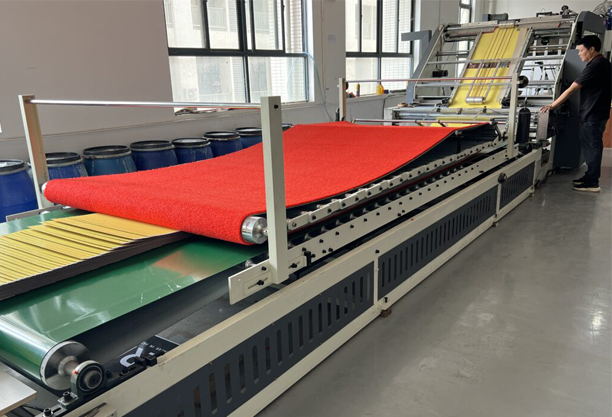
Materials Used in Recyclable Displays
Corrugated Board
Corrugated is the most recyclable display material. It is made from paper fibers and contains no plastic in its standard form. Over 90% of corrugated is recovered for recycling in North America.
| Material | Recyclable? | Recycled Content Available? |
|---|---|---|
| Standard corrugated (B-flute, E-flute) | Yes | Yes (up to 100% recycled fiber) |
| Kraft liner corrugated | Yes | Yes (typically 70–100% recycled) |
| White-top corrugated | Yes | Partial (top layer virgin, base recycled) |
| Coated corrugated (aqueous) | Yes | Yes |
| Laminated corrugated (plastic) | No | No |
| Wax-coated corrugated | No | No |
Paperboard
Paperboard is also highly recyclable. It is commonly used for counter displays and small POS units.
| Material | Recyclable? | Recycled Content Available? |
|---|---|---|
| Uncoated paperboard | Yes | Yes (up to 100% recycled) |
| Clay-coated paperboard (CCNB) | Yes | Yes (typically 50–80% recycled) |
| Solid bleached sulfate (SBS) | Yes | Limited (mainly virgin fiber) |
| Plastic-coated paperboard | No | No |
Virgin vs Recycled Fiber
| Factor | Virgin Fiber | Recycled Fiber |
|---|---|---|
| Strength | Higher | Moderate (shorter fibers) |
| Brightness | Brighter white | Slightly duller |
| Consistency | Uniform | May vary by batch |
| Cost | Higher | Lower (10–20% less) |
| Environmental Impact | Higher | Lower |
| Best Use | Premium displays, heavy loads | Standard displays, SRP trays |
Coatings and Finishes: Which Are Recyclable?
Not all finishes are recyclable. The coating type determines whether the display can go into standard recycling.
| Finish | Recyclable? | Notes |
|---|---|---|
| Aqueous coating (gloss/matte) | Yes | Water-based, dissolves in pulping |
| UV coating | Partial — depends on thickness | Thin UV: OK. Thick UV: may not separate |
| Lamination (plastic film) | No | Must be removed before recycling |
| Lamination (biodegradable film) | Yes — certified only | Check compostability certification |
| Spot UV | Partial — small areas OK | Large areas may cause issues |
| No coating (raw kraft) | Yes | Fully recyclable |
| Varnish (water-based) | Yes | Similar to aqueous coating |
Best practice for recyclable displays: Use aqueous coating instead of plastic lamination. If UV coating is needed, keep it to small spot areas.
For finishing options that support recyclability, see our CONCEPT TO DESIGN page.
Recycling Certifications for Retail Displays
Many retailers require proof of recyclability or recycled content. The most recognized certifications are:
| Certification | What It Proves | Where It Matters |
|---|---|---|
| FSC (Forest Stewardship Council) | Paper sourced from responsibly managed forests | Global retail, premium brands |
| SFI (Sustainable Forestry Initiative) | Sustainable forestry practices | North American retail |
| PEFC (Programme for Endorsement of Forest Certification) | Sustainable forest management | European retail |
| How2Recycle Label | Clear recycling instructions for consumers | US retail, consumer-facing packaging |
| Green Seal | Environmental standard compliance | US institutional buyers |
| EU Ecolabel | Reduced environmental impact across lifecycle | European retail |
What to Ask Your Factory
- Do you offer FSC-certified corrugated board?
- What is the recycled content percentage of the board you recommend?
- Can you provide a recyclability statement for the display?
- Are the coatings and adhesives compatible with standard paper recycling?
Retailer Sustainability Requirements
Major retailers are implementing supplier sustainability requirements that affect cardboard displays.
| Retailer | Requirement | Effective |
|---|---|---|
| Walmart | Sustainable packaging scorecard, recyclability preferred | Ongoing |
| Costco | FSC-certified paper products preferred | Ongoing |
| Target | Recyclable packaging target for own brands | Ongoing |
| IKEA | 100% renewable or recycled materials by 2030 | By 2030 |
| Amazon | Frustration-Free Packaging (recyclable, no plastic) | Ongoing |
| Carrefour | All paper packaging FSC or PEFC certified by 2026 | By 2026 |
If your display project targets these retailers, specify the relevant certification requirements in your factory brief. Adding certifications after production is not possible — they must be sourced from certified mills.
Does Recyclable Mean Weaker?
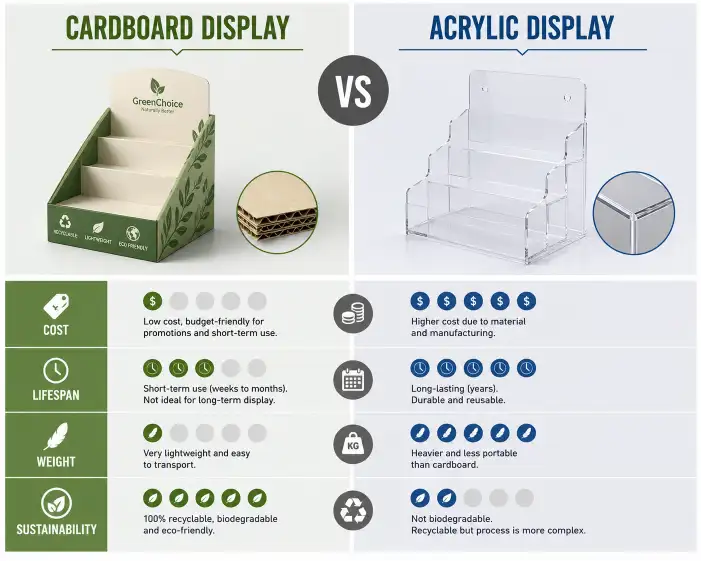
No. Recyclable corrugated board has the same structural strength as non-recyclable board. The strength comes from the flute structure and board grade, not from coatings or plastic additives.
| Concern | Reality |
|---|---|
| Recycled fiber is weaker | Slightly, but compensated by using heavier board grade if needed |
| Aqueous coating is less durable | Adequate for 4–8 week retail campaigns. UV or laminate only needed for high-abuse environments |
| Recyclable displays cost more | Base material cost is similar. Premium certification (FSC) adds 5–15% |
| Recyclable displays look worse | Print quality on recyclable board is identical to standard board |
The key variable is board grade selection, not the presence of plastic coatings. A well-designed floor display using 100% recycled B-flute corrugated with aqueous coating is structurally identical to a display using virgin fiber with plastic lamination.

Cost Impact of Eco-Friendly Displays
| Factor | Cost Impact | Notes |
|---|---|---|
| Recycled fiber board | −10–20% | Lower than virgin fiber |
| FSC certification | +5–15% | Premium for certified fiber |
| Aqueous coating (vs laminate) | Same or slightly lower | Aqueous costs less than plastic lamination |
| Biodegradable adhesives | +5–10% | Specialty adhesives cost more |
| How2Recycle label design | Minimal | Artwork update only |
| Certification documentation | Minimal | Factory overhead cost |
Net impact: A standard recyclable display (recycled fiber + aqueous coating) typically costs 5–10% less than a comparable non-recyclable display with virgin fiber and plastic lamination. An FSC-certified display with premium finishes may cost 5–10% more but meets retailer compliance requirements.
Buyer Checklist
| Check Item | What to Confirm |
|---|---|
| Board material | Corrugated or paperboard? Recycled content percentage? |
| Coating type | Aqueous (OK), UV (partial), Laminate (not OK)? |
| Adhesive | Water-soluble and recyclable-compatible? |
| Certification required | FSC, SFI, PEFC, or How2Recycle? |
| Retailer requirement | Any specific sustainability rules per channel? |
| Compostability needed | Industrial or home compost certification? |
| Structural impact | Does recycled board meet the ECT requirement? |
| Cost comparison | Recycled vs virgin fiber cost difference? |
| Labeling | Recycling instructions on display or carton? |
| Disassembly | Can non-paper components be separated easily? |
Conclusion
A recyclable cardboard display is not a compromise. It can match the strength, print quality, and durability of a standard display while meeting retailer sustainability requirements and often costing less. The key is specifying the right board grade, coating, and certification at the quoting stage — not trying to add sustainability features after production has started.
For B2B buyers, the simplest approach: specify recyclable materials as the default. If the project requires a non-recyclable feature (plastic lamination, foam inserts), treat it as an exception that needs justification. This saves cost, meets retailer requirements, and positions your brand as environmentally responsible.
For sustainable display options, review our CARDBOARD DISPLAY range and ask your factory about recycled content and FSC certification.
FAQ
What is a recyclable cardboard display?
A recyclable cardboard display is made from paper-based materials with water-soluble coatings that can be processed through standard paper recycling streams after use.
Are all cardboard displays recyclable?
No. Displays with plastic lamination, wax coatings, foam inserts, or heavy contamination are not recyclable through standard paper recycling.
What is the most recyclable type of display?
A display made from uncoated corrugated board with no lamination and water-based ink is the most recyclable. Aqueous-coated displays are also widely recyclable.
Does recycled fiber affect display strength?
Slightly. Recycled fibers are shorter and produce slightly weaker board. However, this can be compensated by selecting a higher board grade or adding a flute size.
Is FSC certification required for retail displays?
Not universally, but major retailers (Costco, IKEA, Carrefour) prefer or require FSC-certified paper. Check each retailer's supplier requirements.
Do eco-friendly displays cost more?
Not necessarily. Recycled fiber board costs 10–20% less than virgin fiber. Aqueous coating costs the same or less than plastic lamination. FSC certification adds 5–15%.
Can I add recycling instructions to my display?
Yes. The How2Recycle label is a widely recognized system for providing clear recycling instructions. It can be added to the display or outer carton during the artwork stage.