Many B2B buyers use "corrugated retail display" and "cardboard display" as if they mean the same thing. In practice, manufacturers and retailers distinguish between them based on material structure, strength, and application. Ordering a cardboard display when you need corrugated — or specifying corrugated when cardboard would suffice — can mean paying for unnecessary strength or receiving a display that is too weak for the product load.
This guide explains the difference between corrugated and cardboard displays from a factory perspective. Instead of focusing on terminology, it helps buyers understand how each material type is specified, quoted, and manufactured.
Corrugated Retail Display vs Cardboard: What Is the Difference?
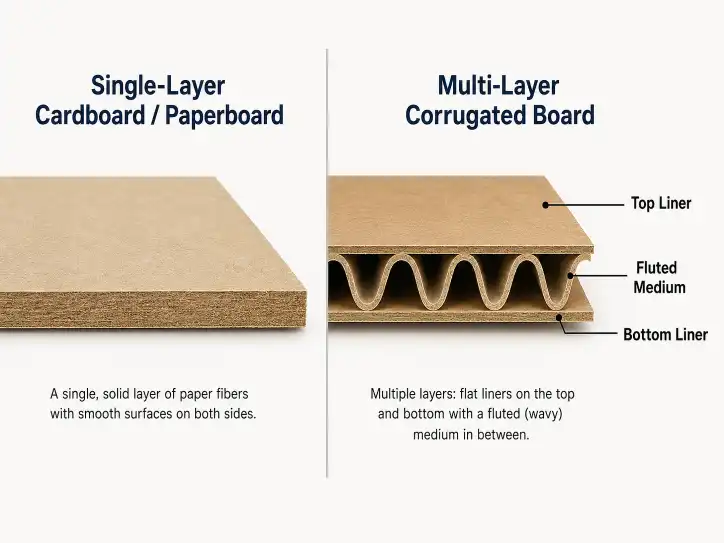
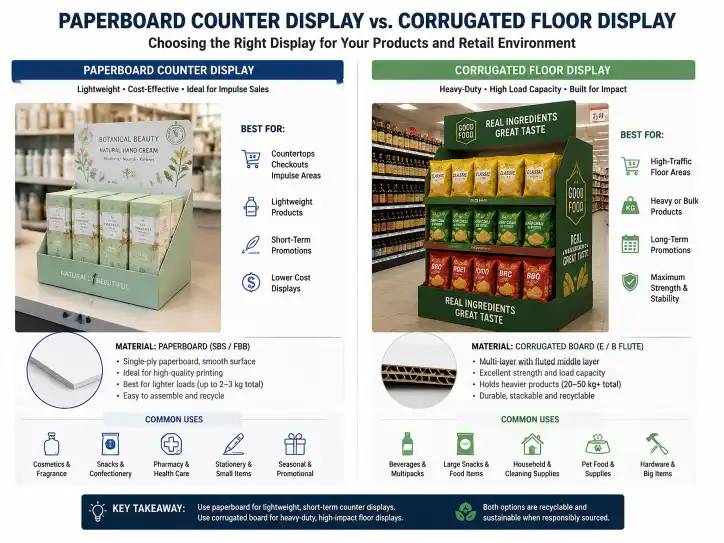
The short answer: Cardboard (paperboard) is a single-layer material used for lightweight counter displays and small POS units. Corrugated is a multi-layer material with a fluted middle layer, used for floor displays, pallet displays, and any unit that needs structural strength.
In factory terminology:
- Cardboard = paperboard, solid board, or chipboard (0.3–2 mm thick, single layer)
- Corrugated = corrugated fiberboard (3–8 mm thick, three layers: liner + fluting + liner)
For B2B buyers, the choice between them depends on product weight, display size, and expected retail lifespan.
Quick Comparison Table
| Feature | Cardboard Display | Corrugated Retail Display |
|---|---|---|
| Material Structure | Single-layer paperboard | Multi-layer with fluted core |
| Typical Thickness | 0.3–2 mm | 3–8 mm |
| Common Names | Paperboard, solid board, chipboard | Corrugated fiberboard, B-flute, E-flute |
| Typical Weight Capacity | Up to 2–3 kg per display | Up to 25–100+ kg per display |
| Print Quality | Excellent (smooth surface) | Good to excellent (depends on flute) |
| Best For | Counter displays, small POS, gift boxes | Floor displays, pallet displays, bulk retail |
| Unit Cost | Lower | Higher |
| Minimum Order | 500–2,000 units | 300–1,000 units |
What Is a Cardboard Display?
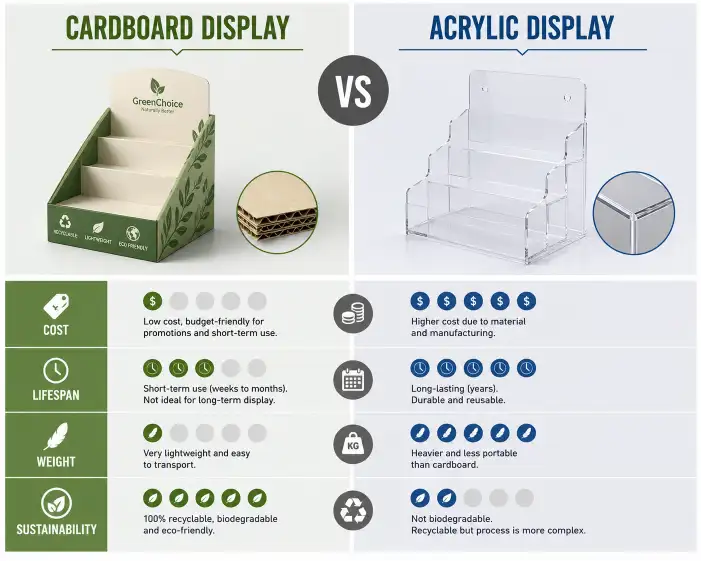
In the display industry, "cardboard" usually refers to paperboard — a single-layer material made from paper pulp. It is flat, smooth, and lightweight. It is the same material used for cereal boxes, gift boxes, and cosmetic packaging.
Characteristics of Cardboard Displays
- Smooth surface — Excellent for high-quality print. Ideal for cosmetic and premium brand displays.
- Limited strength — Cannot hold heavy products. Best for items under 200 g each.
- Thinner material — Typically 0.3–2 mm thick. Less structural rigidity.
- Easier to cut — Less wear on die-cutting tools. Lower tooling cost.
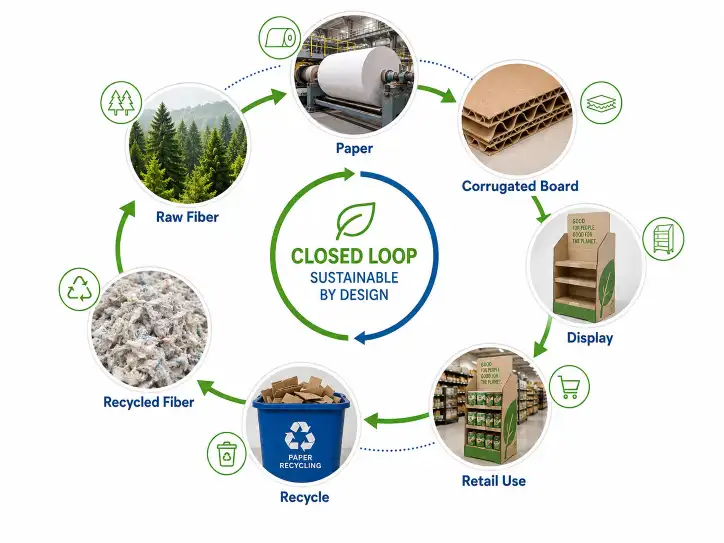
- Recyclable — Widely recyclable through standard paper recycling streams.
Common Cardboard Display Types
| Type | Typical Use |
|---|---|
| Counter display | Small POS units near the register |
| Gift box display | Premium packaging for cosmetics and jewelry |
| Small PDQ tray | Lightweight impulse items on shelves |
| Header card | Brand signage attached to corrugated displays |
For lightweight counter-top options, our COUNTER DISPLAY range covers paperboard and small corrugated units.
What Is a Corrugated Retail Display?
A corrugated retail display is made from corrugated fiberboard — a material with three or more layers. The middle layer (fluting) is corrugated into wave shapes and sandwiched between flat liner layers. This structure gives corrugated its strength-to-weight ratio.
Why Fluting Matters
The fluted middle layer is what makes corrugated different from cardboard. It creates air pockets that absorb impact, distribute weight, and provide rigidity. Without fluting, a display cannot support the weight of products in a floor-standing unit.
Characteristics of Corrugated Retail Displays
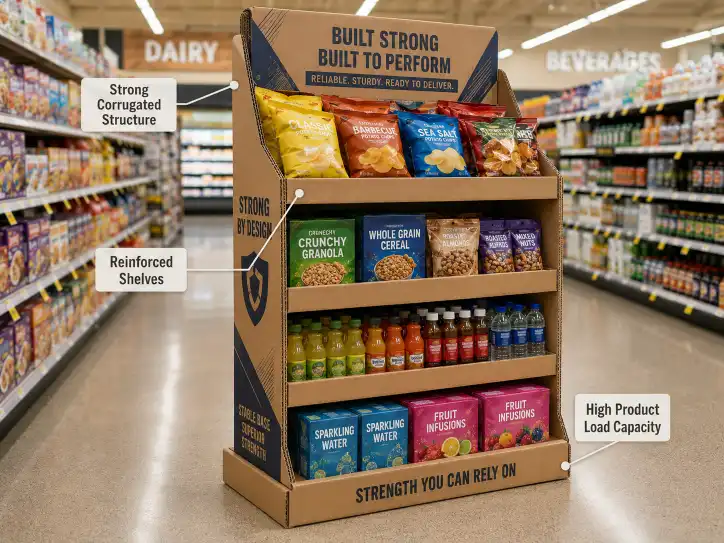
- High strength-to-weight ratio — Strong enough for floor displays, but light enough to ship economically.
- Impact resistance — Fluted core absorbs shock during transit and handling.
- Multiple flute options — E-flute, B-flute, BC-flute, and double-wall allow strength customization.
- Larger format possible — Can be built as floor displays, pallet displays, and club store units up to 2 meters tall.
- Print limitations — The corrugated surface is not as smooth as paperboard. Fine print details may not reproduce as sharply.
Common Corrugated Display Types
| Type | Typical Use |
|---|---|
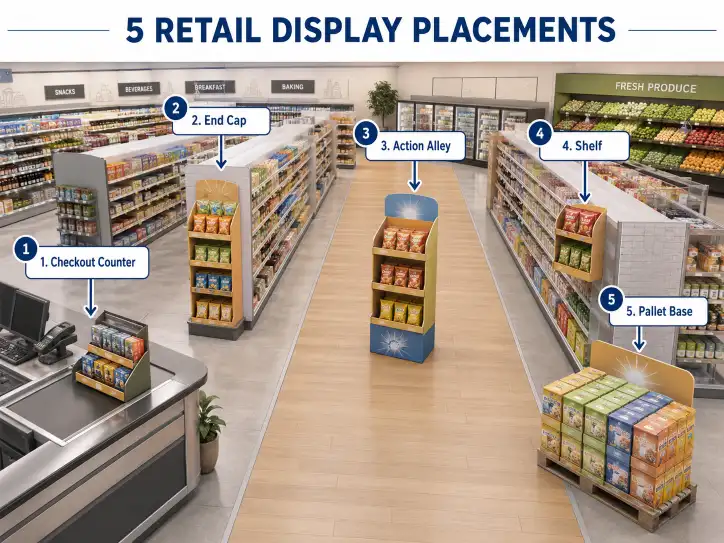
| Floor display | Free-standing unit in aisles and endcaps |
| Pallet display | Bulk unit on a pallet base for club stores |
| Sidekick display | Hang-on unit for shelves and endcaps |
| Dump bin | Open-top floor unit for fast browsing |
| SRP tray | Shelf-ready packaging for grocery restocking |
For a full overview of available structures, see our CARDBOARD DISPLAY product range (note: the product page uses "cardboard display" as a category name for both corrugated and paperboard products).
Flute Types and Their Retail Applications
The flute type determines the strength, thickness, and print quality of a corrugated display.
| Flute Type | Thickness | Strength | Print Quality | Common Use |
|---|---|---|---|---|
| E-flute | 1.5–1.8 mm | Low-Medium | Excellent (near paperboard quality) | Counter displays, small POS, PDQ trays |
| F-flute | 0.8–1.0 mm | Low | Excellent | Micro-flute for premium packaging |
| B-flute | 2.5–3.2 mm | Medium | Good | Floor displays, sidekicks, SRP trays |
| C-flute | 3.5–4.0 mm | Medium-High | Fair | Shipping cases, heavier displays |
| BC-flute (double-wall) | 6.0–7.0 mm | High | Fair | Pallet displays, heavy-duty floor units |
| EB-flute (double-wall) | 4.0–5.0 mm | High | Good | Premium heavy-duty displays |
Selection rule of thumb:
- E-flute or F-flute when print quality is the priority (cosmetics, premium brands)
- B-flute when balance of strength and print is needed (most retail floor displays)
- BC-flute or double-wall when product weight exceeds 15 kg per display
For material selection guidance, our PRODUCTION page explains how flute type affects structural testing and transit performance.
Board Grade Comparison: Paperboard vs Corrugated
Paperboard (Cardboard) Grades
| Grade | Thickness | Common Use |
|---|---|---|
| 14 pt (350 µm) | 0.35 mm | Light gift boxes, cosmetic inserts |
| 18 pt (450 µm) | 0.45 mm | Counter displays, PDQ trays |
| 24 pt (600 µm) | 0.60 mm | Sturdy counter displays, small floor units |
Corrugated Board Grades
| Grade | Flute + Liners | ECT Rating | Common Use |
|---|---|---|---|
| Single-wall E-flute | E-flute + 23 lb liners | 23–26 lbs/in | Counter displays, light POS |
| Single-wall B-flute | B-flute + 26 lb liners | 28–32 lbs/in | Floor displays, sidekicks |
| Single-wall C-flute | C-flute + 33 lb liners | 32–38 lbs/in | Medium floor displays |
| Double-wall BC-flute | B + C flute + 42 lb liners | 48–55 lbs/in | Pallet displays, bulk units |
Cost Comparison
| Material | Relative Cost per Square Meter | Notes |
|---|---|---|
| Paperboard (14 pt) | 1.0x (baseline) | Lowest cost, limited use |
| Paperboard (24 pt) | 1.4x | Sturdy but limited weight capacity |
| E-flute corrugated | 1.3x | Better strength than paperboard at similar cost |
| B-flute corrugated | 1.5x | Best value for most floor displays |
| BC-flute double-wall | 2.2x | Highest cost, necessary for heavy loads |
When to Use Each Material Type
Choose Cardboard (Paperboard) When:
- Products weigh under 100 g each
- Display is placed on a counter or shelf (not the floor)
- Print quality is the top priority (cosmetics, luxury goods)
- Order quantity is under 2,000 units
- Budget is very tight
Choose Corrugated Retail Display When:
- Products weigh over 100 g each
- Display stands on the floor (floor display, pallet display)
- Display height exceeds 60 cm
- Transit requires stacking strength
- Display needs to survive 4–8 weeks in a high-traffic store
- Products are sold in bulk (club stores, grocery)
For floor-standing projects, start with our RETAIL DISPLAY page to see which format matches your product and store environment.
Manufacturing Differences
| Factor | Cardboard Display | Corrugated Retail Display |
|---|---|---|
| Printing | Litho or digital (superior quality) | Flexo, digital direct-to-corrugate, or litho-lam |
| Die-cutting | Faster, less tool wear | Slower, more tool wear |
| Folding | Easy, precise folds | Needs crease alignment with flute direction |
| Gluing | Standard PVA glue | PVA or hot melt, depending on flute type |
| Assembly | Usually single-piece | Often multi-piece for larger structures |
| Packing | Flat in small cartons | Flat-packed or palletized in larger volumes |
Print Quality on Corrugated
Corrugated board has a textured surface because the fluted middle layer creates slight ridges. For high-quality print on corrugated:
- Direct-to-corrugate digital printing — Good quality for most retail displays. Ink is applied directly to the corrugated surface.
- Litho-lamination — A pre-printed paper sheet is laminated to the corrugated board. Produces the highest quality print, at higher cost.
- Flexographic printing — Good for 1–3 color designs. Lower cost but limited color range.
Buyer Checklist
| Check Item | Cardboard | Corrugated |
|---|---|---|
| Product weight per unit? | Under 100 g | Over 100 g |
| Display location? | Counter or shelf | Floor, pallet, or endcap |
| Display height? | Under 40 cm | 60–200 cm |
| Print priority? | Highest quality | Good to excellent |
| Transit strength needed? | Low (counter units ship protected) | High (floor units stack on pallets) |
| Retail duration? | 2–4 weeks | 4–8 weeks |
| Budget priority? | Lowest cost | Best value for strength |
| Flute type (if corrugated)? | — | E-flute, B-flute, or double-wall |
Conclusion
The difference between a corrugated retail display and a cardboard display is not just terminology. It is a material decision that affects strength, print quality, cost, and retail performance. Cardboard (paperboard) is the right choice for lightweight counter displays where print quality matters most. Corrugated is the right choice for floor displays and any unit that must support product weight and survive transit and store traffic.
For B2B buyers, the simplest rule: if the display touches the floor, use corrugated. If it sits on a counter and holds very light products, cardboard may be sufficient. When in doubt, specify the product weight and display location to your factory — they will recommend the right material.
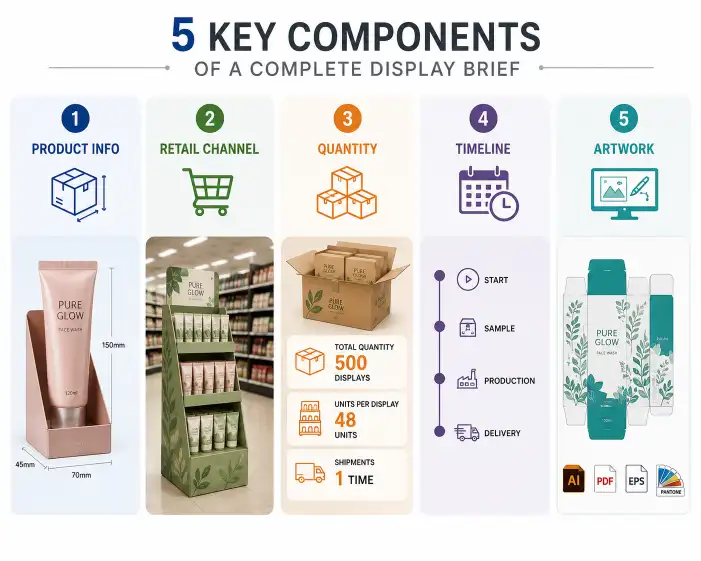
For custom retail display projects, review our CARDBOARD DISPLAY range and contact us with your product specifications.
FAQ
What is the difference between cardboard and corrugated displays?
Cardboard (paperboard) is a single-layer material used for lightweight counter displays. Corrugated is a multi-layer material with a fluted core, used for floor displays and heavy-duty retail units.
Which is stronger — cardboard or corrugated?
Corrugated is significantly stronger. The fluted middle layer provides structural rigidity and impact resistance that single-layer cardboard cannot match.
Can corrugated displays be printed with high-quality graphics?
Yes. E-flute corrugated accepts near-paperboard quality print. For larger flutes (B-flute, BC-flute), litho-lamination or direct-to-corrugate digital printing produces excellent results.
When should I use cardboard instead of corrugated?
Use cardboard when the display is small, placed on a counter, holds very light products (under 100 g each), and print quality is the top priority. Cardboard is also more cost-effective for short-run cosmetic and gift displays.
Is corrugated more expensive than cardboard?
Yes, corrugated costs more per square meter than paperboard. However, for floor displays, corrugated is necessary because cardboard cannot support the structural load.
What flute type is best for a retail floor display?
B-flute is the most common choice for retail floor displays. It offers a good balance of strength, print quality, and cost. For heavier products, use BC-flute double-wall.
Are both cardboard and corrugated recyclable?
Yes. Both materials are recyclable through standard paper recycling streams. Corrugated is one of the most recycled materials in the world, with over 90% recovery rate.