Most B2B buyers focus on how a display looks and how much it costs. Few think about what happens after production ends — how displays get packed, kitted with products, palletized, and shipped to retailers. That gap between production completion and store delivery is called display fulfillment, and it is where many projects lose time and money.
A display that is perfectly designed and printed still fails if it arrives at the wrong warehouse, with missing components, on the wrong pallet type, or labeled incorrectly for the retailer's receiving system.
This guide explains how display fulfillment and palletizing work from a factory perspective, so B2B buyers can plan the logistics stage as carefully as they plan the design stage.
What Is Display Fulfillment?
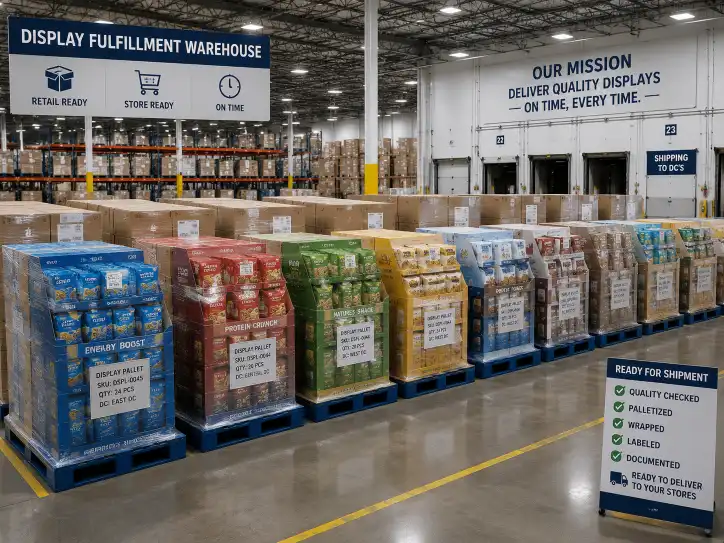
Display fulfillment is the process of preparing finished displays for delivery to retail stores or distribution centers. It includes co-packing (loading products into displays), kitting (assembling all display components), palletizing (arranging units on pallets for transit), labeling, and coordinating shipment to the correct destination.
Fulfillment is the bridge between the factory production line and the retail sales floor. When fulfillment is planned well, displays arrive on time, complete, and ready for store placement. When it is not, projects face receiving dock rejections, missing parts, damaged goods, and chargebacks from retailers.
Why Fulfillment Matters for B2B Buyers
| Factor | Impact |
|---|---|
| Retailer compliance | Incorrect labeling or pallet type = rejection at receiving dock |
| Store labor cost | Pre-packed displays reduce in-store work by 80%+ |
| Transit damage | Poor palletizing = crushed displays, damaged product |
| Rollout speed | Pre-fulfilled displays can be placed in minutes, not hours |
| Freight cost | Optimized pallet patterns reduce container count and freight spend |
Our SHIPPING page covers the basic packing and shipping options. This article focuses on the fulfillment layer — what happens between packing and delivery.
Co-Packing: When Products Are Loaded at the Factory
Co-packing is the most common fulfillment service for retail displays. The factory receives the products (either from the brand's own stock or from a third party), loads them into the displays, and packs the filled units for shipment.
Co-Packing Process
- Product receipt — Products arrive at the factory warehouse. They are inspected for quantity, condition, and expiry dates.
- Display assembly — Displays are assembled to the specified level (flat, semi, or full).
- Product loading — Products are placed into the display according to the planogram or pack-out plan.
- Packing — Filled displays are packed into cartons or prepared for pallet loading.
- Palletizing — Units are stacked on pallets using the specified pattern.
- Labeling — Pallet and carton labels are applied per retailer requirements.
- Staging — Finished pallets are staged for container loading or truck pickup.
Co-Packing Models
| Model | How It Works | Best For |
|---|---|---|
| Brand supplies product | Brand ships products to factory; factory loads into displays | Brands with existing inventory or third-party logistics |
| Factory sources product | Factory procures products on behalf of the brand | Turnkey programs, club store projects |
| Mixed SKU co-pack | Multiple SKUs loaded into same display per planogram | Multipack displays, variety promotions |
| Single SKU co-pack | One product type per display | Simple promotions, single-product launches |
What to Check in Co-Packing
- Product compatibility: Does the product packaging fit the display slots without force? Test with real product before production.
- Loading order: Products must be loaded in the correct sequence for the planogram. Mistakes cause store-level rework.
- Expiry date management: For food and perishable products, older stock must be loaded first (FIFO).
- Barcode verification: Each product barcode should be scanned during loading to confirm correct SKU.
For co-packing projects, our PRODUCTION page covers the factory capabilities for handling product loading at scale.
Kitting and Component Assembly
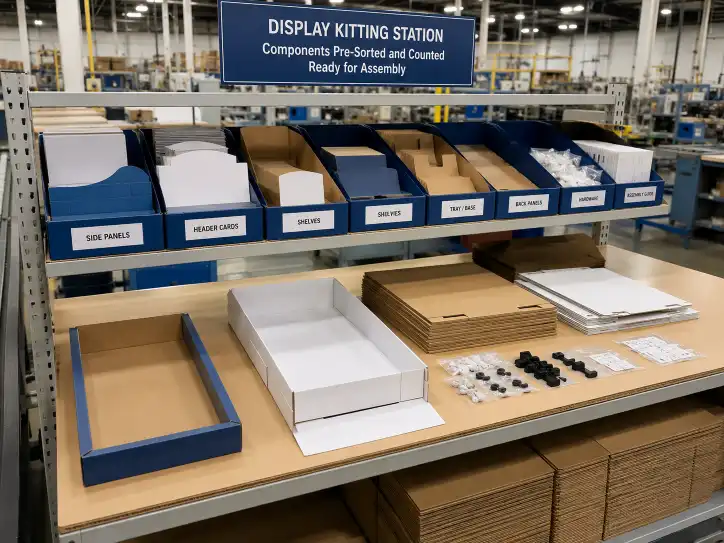
Kitting means assembling all the components of a display into a complete unit before shipment. A typical display kit may include:
- The main display structure (flat or assembled)
- Trays, shelves, or inserts
- Header card or signage
- Attachment hardware (hooks, clips, brackets)
- Assembly instructions
- Product (if co-packing is included)
- Returnable packaging materials (if applicable)
Kitting Checklist
| Component | Check |
|---|---|
| Main structure | Quantity matches order. No damage. |
| Trays/inserts | Correct count. Correct size for product. |
| Header/signage | Print matches approval. Correct orientation. |
| Hardware | Enough hooks/clips for all units. Right type. |
| Instructions | Clear assembly steps. Language matches target market. |
| Product (if co-packed) | Correct SKU, quantity, expiry. Barcode verified. |
| Packaging | Carton size correct. Void fill sufficient. |
Kitting Errors to Avoid
- Missing components: A display arrives without header cards or hooks. Store staff cannot set it up.
- Wrong hardware: Plastic hooks supplied when the store fixture requires metal brackets.
- Mislabeled cartons: Carton label says 24 units but contains 20. Retail receiving rejects the shipment.
- Mixed SKUs in wrong proportions: Planogram calls for 12 of SKU A and 6 of SKU B, but kit contains equal quantities.
Palletizing: How Displays Are Stacked for Transit
Palletizing is the process of arranging packed displays onto pallets in a stable pattern that protects the product during transit and allows efficient handling at warehouses and stores.
Pallet Types
| Pallet Type | Dimensions | Common Use |
|---|---|---|
| GMA pallet (North America) | 48 × 40 in (1219 × 1016 mm) | Club stores, grocery, mass retail |
| EUR pallet (Europe) | 1200 × 800 mm | European retail, export |
| Half pallet | 48 × 20 in / 600 × 800 mm | Smaller displays, endcap units |
| Custom pallet | Varies by project | Specialized retail formats |
Palletizing Rules
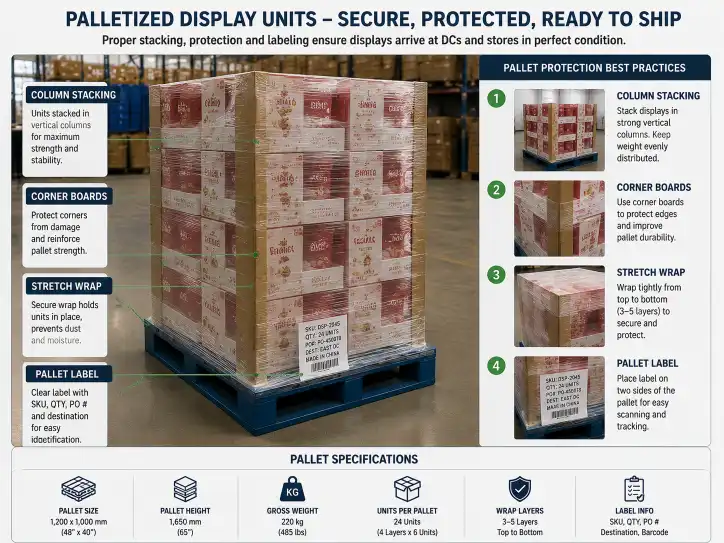
- Column stacking: Units are stacked directly on top of each other for maximum strength. Best for sturdy displays.
- Interlocking (brick pattern): Units are offset in alternating layers for stability. Best for mixed-size cartons.
- Layer pads: Corrugated sheets placed between layers to distribute weight evenly.
- Corner boards: L-shaped cardboard protectors on pallet corners to prevent strap damage.
- Stretch wrap: Each pallet is wrapped with 3–5 layers of stretch film to secure the load.
- Edge protectors: Placed under straps or wrap to prevent compression damage at contact points.
Stack Height Limits
| Transit Mode | Typical Stack Height | Notes |
|---|---|---|
| Truck (domestic) | 2–3 pallets high | Depends on trailer height (96–110 in) |
| Sea container | 1–2 pallets high | Standard container height (8 ft 6 in) |
| Air freight | Single pallet | Height limited by aircraft cargo door |
For detailed packing specifications, see our SHIPPING page.
Pallet Patterns and Load Optimization
The arrangement of cartons on a pallet determines how many units fit in a container and how stable the load is during transit.
Common Pallet Patterns
| Pattern | Description | Stability | Space Efficiency |
|---|---|---|---|
| Column stack | Each layer identical, units aligned vertically | High | Medium |
| Brick stack | Layers alternate like bricks | Very high | Medium |
| Pinwheel | Cartons face different directions per layer | High | High |
| Split pattern | Two or more patterns used on same pallet | Medium | Very high |
Container Load Optimization
A standard 20-ft container holds approximately 10 GMA pallets. A 40-ft container holds approximately 20–22 GMA pallets.
The factory should provide a loading diagram showing:
- Number of units per pallet
- Number of pallets per container
- Total units per container
- Layer pattern for each pallet
- Weight per pallet and total container weight
Target utilization: 80–85% of container volume for standard display cartons. Higher for uniform cartons, lower for irregular shapes.
Sample Loading Plan (40-ft container):
Pallet row 1: 4 pallets, 48×40, facing forward
Pallet row 2: 4 pallets, 48×40, facing forward
Pallet row 3: 4 pallets, 48×40, facing forward
Pallet row 4: 4 pallets, 48×40, facing forward
Pallet row 5: 4 pallets, 48×40, facing forward
Total: 20 pallets, 480 display units, ~70% container utilization
Labeling for Retail Receiving
Retailers use labels to track shipments from the factory to the store. Incorrect labeling is the most common reason for receiving dock rejection.
Common Label Types
| Label | Information | Retailer Requirement |
|---|---|---|
| GS1-128 (UCC/EAN-128) | SSCC-18 pallet ID, PO number, quantity, weight | Most major retailers (Costco, Walmart, Target) |
| GMA pallet label | Supplier code, item number, PO, case count | Club stores, grocery chains |
| Retail price label | Unit price, member price, effective date | Required for floor-ready displays |
| Hazard label | For displays containing batteries, liquids, etc. | International shipping compliance |
| Country of origin | "Made in China" or applicable | Customs requirement |
Label Placement Standards
- Front-facing: Label must be visible from the front of the pallet
- Two sides minimum: Labels on at least two adjacent sides
- Readable after wrapping: Label must remain scannable through stretch wrap
- No overlay on barcode: Avoid placing tape or wrap directly over barcode
Fulfillment for Different Retail Channels
Each retail channel has unique fulfillment requirements.
Club Stores (Costco, Sam's Club)
- Pre-filled displays preferred (product loaded at factory)
- GMA pallet base required (48×40 in)
- GS1-128 pallet labels mandatory
- Floor-ready presentation (unwrap and sell)
- Tilt test and vibration test reports often required
Grocery and Mass Retail (Walmart, Kroger, Target)
- Mix of pre-filled and flat-pack depending on category
- Specific pallet labeling standards (varies by retailer)
- SRP-compliant packaging increasingly required
- Co-packing services often requested
Specialty Retail
- Lower volume, higher mix of SKUs
- Flat-pack or semi-assembled more common
- Custom labeling requirements vary by chain
- Smaller pallets or LTL shipments
For retail-specific display requirements, see our RETAIL DISPLAY page.
Common Fulfillment Mistakes
| Mistake | Consequence | How to Avoid |
|---|---|---|
| Wrong pallet type | Cannot be handled by warehouse forklifts | Confirm GMA/EUR/half pallet with buyer |
| Missing labels | Rejected at receiving dock | Submit label artwork to buyer for approval |
| Incorrect pack quantity | Store receives wrong count | Verify pack-out during sample stage |
| Mixed SKUs in wrong ratio | Planogram violation, store rework | Use barcode scanning during co-packing |
| Overweight pallet | Safety issue, carrier refusal | Check weight limit per pallet (typically 2,500 lbs) |
| No container loading plan | Inefficient container use, higher freight cost | Request loading diagram from factory |
| Damaged displays in transit | Store cannot set up display | Test with vibration and drop before shipment |
Buyer Checklist for Display Fulfillment
| Check Item | What to Confirm |
|---|---|
| Fulfillment scope | Co-packing, kitting, or display-only? |
| Product supply | Brand supplies or factory procures? |
| Co-packing plan | SKU count, loading order, barcode verification? |
| Pallet type | GMA, EUR, half, or custom? |
| Pallet pattern | Column, brick, pinwheel, or split? |
| Container plan | Loading diagram provided? Utilization target? |
| Labeling | GS1-128, GMA, or retailer-specific? |
| Label verification | Buyer-approved artwork before production? |
| Transit testing | Vibration and drop tests completed? |
| Retailer requirements | Any specific fulfillment rules per channel? |
| Lead time | Fulfillment added to production timeline? |
Conclusion
Display fulfillment is not an afterthought. It is a critical stage that determines whether a well-made display arrives at the retailer ready to sell or causes delays, rejections, and chargebacks. For B2B buyers, planning fulfillment as early as the design stage saves time, reduces cost, and ensures a smoother retail rollout.
The most important steps: confirm the co-packing plan, pallet type, labeling requirements, and transit testing before production starts. A few hours of fulfillment planning at the beginning of the project can save weeks of problems at the end.
Ready to plan your display fulfillment? Review our SHIPPING and PRODUCTION pages, or contact us to discuss your project requirements.
FAQ
What is display fulfillment?
Display fulfillment is the process of preparing finished displays for delivery to retailers. It includes co-packing, kitting, palletizing, labeling, and coordinating shipment.
What is co-packing in display manufacturing?
Co-packing means loading products into displays at the factory before shipment. The display arrives at the store pre-filled and ready to sell.
What is the difference between kitting and co-packing?
Kitting means assembling all display components (structure, trays, hardware, instructions) into a complete unit. Co-packing means loading actual products into the display. Both services are often combined.
What pallet type do most retailers require?
North American retailers use GMA pallets (48×40 inches). European retailers use EUR pallets (1200×800 mm). Always confirm pallet requirements with the buyer.
Why do retailers reject displays at the receiving dock?
Common reasons: incorrect labeling, wrong pallet type, damaged packaging, incorrect quantity, or missing compliance documentation.
How many displays fit in a shipping container?
A standard 40-ft container holds 20–22 GMA pallets. The number of displays depends on the pallet pattern and display size. Request a loading diagram from your factory.
Do I need transit testing for my displays?
Yes, especially for club store and mass retail projects. Vibration and drop testing help prevent damage during transit and ensure displays arrive in sellable condition.