Before a cardboard display moves into mass production, the most important question is not whether the design looks good on screen. The real question is whether the display can perform reliably in real retail conditions. A custom display may look impressive in a render or even in a first sample, but if it has not been tested properly, problems can appear during assembly, shipping, shelf loading, or store use.
For brands, retailers, and importers, pre-production testing is one of the best ways to reduce project risk. It helps confirm structure, load performance, print quality, and packing logic before a larger investment is made. In this guide, we explain what cardboard display testing should include before mass production starts, what buyers should check during sample review, and which failures are most important to catch early.
Executive Summary
A cardboard display should usually pass at least six important checks before mass production: structural fit, load-bearing performance, assembly accuracy, print approval, transport readiness, and retail usability. The exact test level depends on the product type and project complexity, but skipping these checks often leads to expensive corrections later. Testing is not just for heavy products. Even lightweight retail displays should be checked for fit, balance, and assembly consistency.
Why Testing Matters Before Mass Production
Mass production multiplies every small mistake. If the sample has a weak shelf, unclear fold logic, poor product fit, or misaligned print placement, that problem can repeat across hundreds or thousands of units. That is why testing should be treated as a decision stage, not a formality.
Buyers who confirm performance before production usually save time and money later. They also reduce the risk of damaged products, poor in-store appearance, and retailer complaints. If you are planning the project timeline now, our lead time guide helps explain how sample review affects the full production schedule.
Test 1: Product Fit Test
The first and most basic test is product fit. Every product should sit correctly in the display without excessive looseness, pressure, leaning, or wasted space. This includes checking the dimensions of the shelf area, dividers, hooks, slots, and product-facing windows if the display uses them.
Product fit is not only about whether the item physically enters the space. It is also about whether the product presents well from the shopper’s point of view. If products lean forward, sit too low, hide branding, or create messy spacing, the display may technically function but still perform poorly in retail.
Test 2: Load-Bearing Test
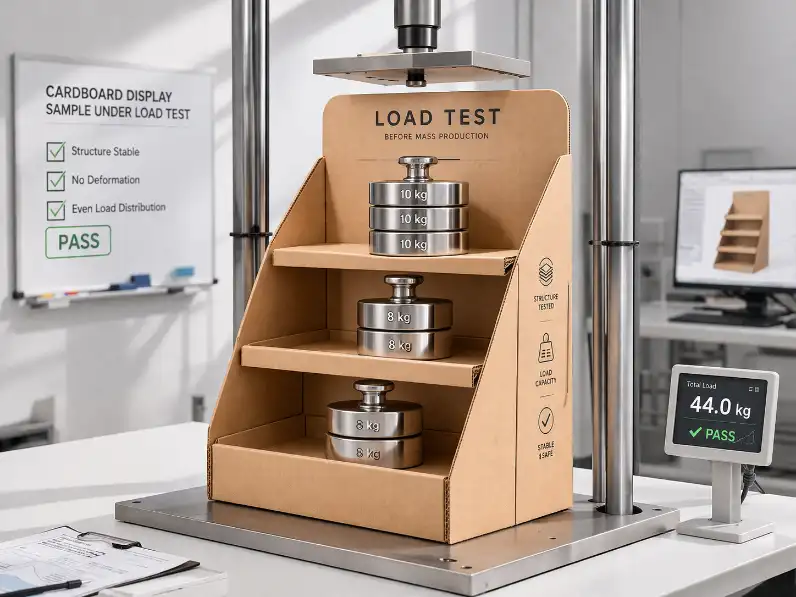
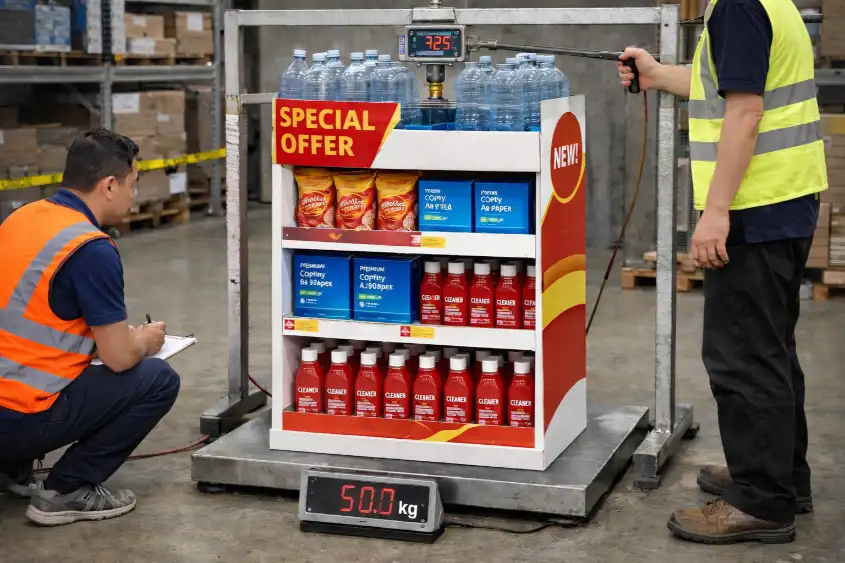
Load testing is one of the most important structural checks, especially for beverages, pet products, household items, or larger packaged goods. A display may look stable when empty, but the real question is how it behaves when fully loaded with the intended product quantity.
During load testing, buyers should observe:
- whether shelves bend or sag
- whether the base remains stable
- whether the display leans under real product weight
- whether side panels and back panels provide enough support
If your project includes heavier products, our corrugated grades guide can help explain why board choice matters just as much as structure design.
Test 3: Assembly Test
A display that looks great in design files can still fail if store staff cannot assemble it quickly and correctly. The assembly test checks whether the structure folds, locks, slots, and stands in the intended way without confusion or unnecessary force.
Buyers should ask simple but important questions:
- Can one person assemble the display without tools?
- Are the fold lines and tabs easy to understand?
- Can the display be assembled consistently by different people?
- Does the structure stay stable after repeated setup?
If the display requires a more complex process, simple instructions should be tested at the same time. Ease of assembly is not just a convenience issue. It affects store execution and the final retail result.
Test 4: Print and Artwork Approval Test
Printing should be reviewed as a production test, not only a visual preference. Buyers should confirm whether logos, colors, text, cut lines, and visible panel alignment all work correctly on the real structure. It is common for artwork to look acceptable on a flat layout but become weaker after folding and assembly.
At this stage, review the display from the actual shopper angle rather than only from a file view. Check whether the main message remains visible, whether colors are consistent, and whether important content falls too close to folds or edges. For more on this topic, our printing and finishing guide and our article on custom POP display artwork can help you review the graphics more professionally.
Test 5: Packing and Transport Test
Many display problems appear after shipment rather than during design review. This is why buyers should check how the display is packed before production begins. A flat-pack display may still fail in transit if the master carton is weak, if the parts rub against each other, or if the load per carton is not well balanced.
Transport-related checking usually includes:
- carton strength
- inner protection between printed parts
- carton quantity per set
- pallet or loose-carton planning
- practical handling at destination
If export shipping is part of your project, our export packaging guide is the next article you should review.
Test 6: Retail Usability Test
A display that passes structure and print checks may still perform poorly if it does not work well in-store. Retail usability testing looks at product access, refill convenience, shopper visibility, and overall balance once the display is placed in its intended selling environment.
This matters especially for:
- impulse displays near checkout
- multi-SKU promotional displays
- seasonal retail campaigns
- displays with frequent product replenishment
Retail usability often determines whether the display helps sales or simply creates visual clutter.
Pre-Production Test Matrix
| Test Type | What It Checks | Why It Matters | Common Failure |
|---|---|---|---|
| Product fit | Size, shelf spacing, presentation | Prevents poor product display | Products lean or do not face well |
| Load test | Shelf strength and stability | Prevents collapse or bending | Shelves sag under real load |
| Assembly test | Ease and consistency of setup | Reduces store execution problems | Tabs lock poorly or confuse staff |
| Print approval | Color, alignment, message visibility | Protects brand image | Logos or text sit in wrong areas |
| Transport check | Packing strength and shipment logic | Reduces shipping damage | Cartons crush or parts rub |
| Retail usability | Refill, access, shopper interaction | Improves in-store performance | Products are hard to browse or refill |
What Buyers Should Approve Before Production Starts
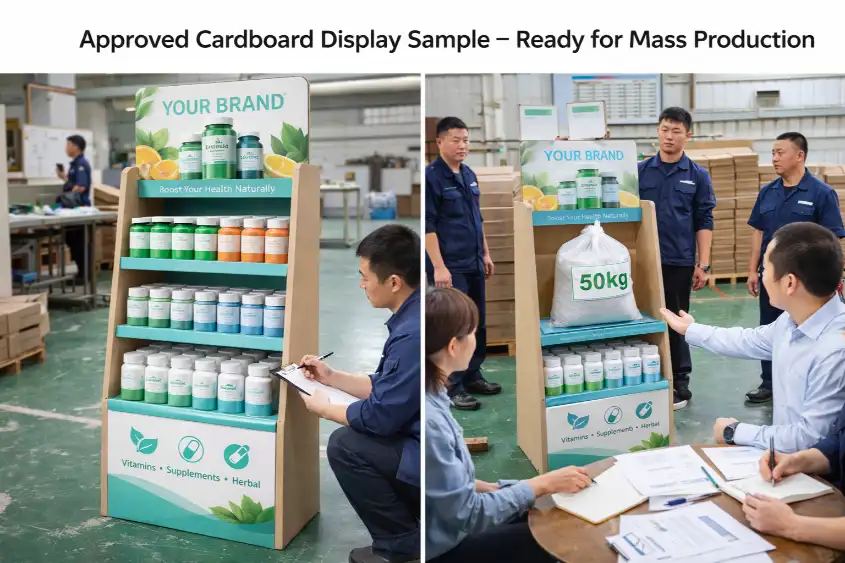
Production should only begin once the sample has been reviewed from three perspectives: structure, graphics, and logistics. Buyers should not approve a sample only because “it looks good.” They should confirm whether the display is correct for real product weight, real store handling, and real shipping conditions.
Before final approval, buyers should make sure:
- the sample uses the intended structure
- the product quantity per shelf is realistic
- the graphics are final and correctly positioned
- the display can be assembled without confusion
- the packing plan matches the shipping method
For buyers who are also checking pricing logic before approval, our cost guide and quote requirements guide are useful support articles.
Common Mistakes That Should Be Caught Early
Some of the most expensive display problems are also the easiest to detect before production, if the testing stage is taken seriously. Common examples include overly wide shelves without reinforcement, incorrect carton counts, product facings that hide the brand logo, or structures that only work when assembled by the design team but not by retail staff.
These are not small details. Once repeated across a full run, they can affect the whole campaign.
Useful External References
For broader context on corrugated material and packaging structure, the Fibre Box Association overview of corrugated is useful. For structural terminology, the FEFCO code reference is also helpful. If your logistics team uses transport testing language, the ISTA site is a useful external reference for transport-related testing standards and general package testing context.
Conclusion
A cardboard display should pass more than a visual review before mass production. Product fit, load performance, assembly logic, print accuracy, transport readiness, and retail usability all matter. Buyers who test these areas early usually reduce project risk, improve in-store results, and avoid expensive corrections later.
If you want support reviewing a display before mass production, feel free to contact us with your sample or project requirements.
FAQ
What is the most important test before mass production?
Load-bearing and product fit tests are usually the most important because they affect both structure and retail performance.
Do lightweight displays still need testing?
Yes. Even lightweight displays should be checked for fit, assembly, and print accuracy before production begins.
Should I approve a sample only based on appearance?
No. Appearance matters, but buyers should also confirm structure, assembly, and packing logic before approving production.
How many sample rounds are usually needed?
It depends on project complexity, but many projects use at least one white sample and one approved production sample or color sample.
Why is assembly testing important?
Because a display that is difficult to assemble can create problems for store staff and reduce retail execution quality.
What should I confirm about shipping before production?
You should confirm flat-pack logic, carton strength, inner protection, carton count, and whether the shipment matches your destination handling needs.