A Costco pallet display is rarely approved on the first sample. Sampling is where the engineering table meets the physical board — and the gap between what was drawn and what stands up under load is where most display programs spend their sample rounds. The factory's job during sampling is not just to cut and fold a panel; it is to prove that the engineered structure works with real product, in real transit conditions, and passes the buyer's visual and dimensional standards before mass production begins.
This guide covers the Costco display sampling process from the factory floor: the three-stage sampling sequence, what each stage proves, how many rounds are normal, the cost and speed of sampling, and what buyers should check before approving each stage. It is the sampling companion to our structural engineering guide (how the structure is designed) — sampling is where that engineering is verified before production.

01 The Three-Stage Sampling Sequence
Costco display programs typically follow a three-stage sampling sequence. Each stage answers a different question, and each must be approved before the next begins.
| Stage | What Is Produced | Question It Answers | Who Approves |
|---|---|---|---|
| 1. Structural sample | Plain brown corrugated, no print | Does the structure fit the product, pass load testing, and assemble correctly? | Factory QA + brand buyer |
| 2. Printed sample | Full-color printed sample | Do the graphics, colors, and branding match the approved artwork? | Brand buyer |
| 3. Loaded sample | Printed + filled with product | Does the display hold the product correctly and pass final fit and stability checks? | Factory QA + brand buyer |
Why Three Stages
Skipping stages is the most common cause of sampling delays. A combined structural + printed sample saves one shipping cycle, but if the structure fails, the print on the failed panels is wasted. The three-stage sequence keeps each approval independent, so a structural change does not require re-printing.
02 Stage 1: Structural Sample
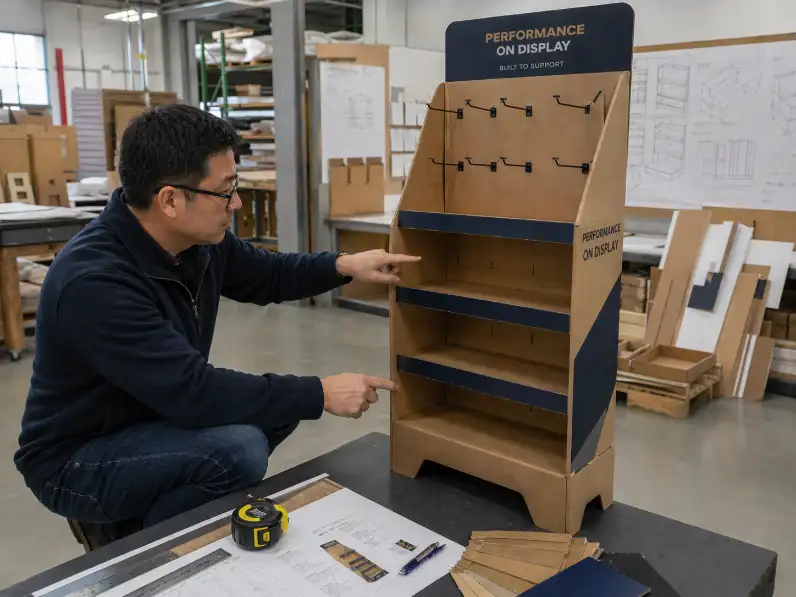
The structural sample is the first physical proof that the engineered design works. It is made from the specified board grade but without print — plain brown corrugated, cut on the production dies or on a sample table.
What the Structural Sample Proves
| Check | What It Confirms |
|---|---|
| Product fit | Each product unit fits into its tray or shelf position without interference, excessive gaps, or crushing |
| Assembly sequence | The blank folds and locks correctly — tabs engage, panels align, glue points meet |
| Load path | The structure carries the loaded product weight with no visible sag, buckle, or crease in the load-bearing panels |
| Compression | The loaded display passes a compression check — either a machine test or a loaded observation confirming no deflection |
| Stability | The loaded display does not tip, rock, or shift when placed on a level surface |
| Pallet base fit | The corrugated base attaches to the GMA pallet correctly, with the base panels sitting flat on deck boards |
| Flute direction | All compression panels have the flutes running vertically — verified on the actual sample |
How Many Structural Samples Are Normal
| Round | Typical Outcome |
|---|---|
| First sample | Identifies 1–3 issues — usually product fit adjustments, load path corrections, or tab alignment fixes |
| Second sample | Confirms fixes from round 1 — typically passes or shows minor remaining issues |
| Third sample (rare) | Needed only when a structural redesign was required from round 1 — e.g., a grade change or complete panel layout change |
Most Costco display programs pass structural sampling in 1–2 rounds. A program that needs 3+ rounds usually had an incomplete engineering review before the first sample was cut — the load path or board grade was not fully calculated. For how to avoid this, see the engineering review checklist in our Costco display structural engineering guide.
What the Factory Delivers with the Structural Sample
| Item | Purpose |
|---|---|
| Assembled structural sample | The complete structure loaded with product (if available) |
| Flat blank set | A second set of unassembled panels so the buyer can inspect the die-cut and fold lines |
| Board grade certificate | Confirmation that the sample was cut from the specified grade |
| Test report (if available) | Compression or stability test results from the factory's in-house check |
What the Buyer Should Check on the Structural Sample
- Does every product unit fit without force or excessive play?
- Do the tray edges align with the support posts and walls?
- Are the corner posts straight with flutes vertical?
- Does the base sit flat on the pallet deck with no bridging?
- Does the display feel rigid when lifted or moved?
03 Stage 2: Printed Sample
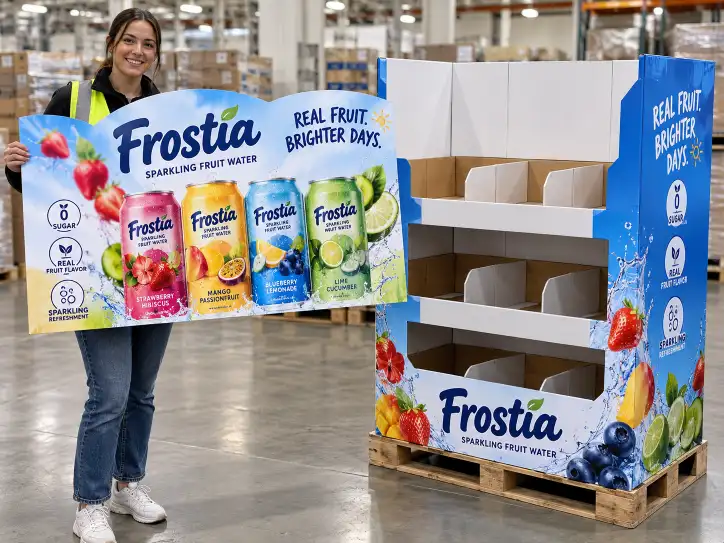
Once the structural sample is approved, the printed sample is produced. This is the same structure as the approved structural sample, but printed with the final artwork, colors, and finishing.
What the Printed Sample Proves
| Check | What It Confirms |
|---|---|
| Color accuracy | Brand colors match the approved reference — digital proof vs. printed panel vs. brand color standard |
| Registration | Print is registered correctly — text, logos, and color zones fall within the specified tolerances |
| Artwork placement | Graphics, product names, claims, and messaging are correctly positioned on each panel |
| Finishing quality | Coating, lamination, spot UV, or other finishes are applied correctly and consistently |
| Panel fit after print | The printed board folds and assembles the same way as the structural sample — print does not change the board's folding behavior |
| Label position | GS1-128 label zone is clear and correctly positioned |
How Many Printed Samples Are Normal
| Round | Typical Outcome |
|---|---|
| First printed sample | Usually passes or requires minor color adjustments. Color matching is the most common reason for a second round |
| Second printed sample (if needed) | A small color correction panel or second header sheet — not a full re-sample |
Most Costco display programs pass printed sampling in 1 round. A second round is normally a small color strip or header correction, not a complete re-print. If the structural design is still being adjusted when the printed sample is ordered, the print cost on the changed panels is wasted.
What the Factory Delivers with the Printed Sample
| Item | Purpose |
|---|---|
| Printed display sample | The complete display with final graphics |
| Flat printed sheets | Unassembled printed panels for artwork inspection |
| Color reference | Proof against the brand standard — delta-E readings or Pantone comparison |
| Digital proof | The approved digital proof mounted beside the printed panel for visual comparison |
What the Buyer Should Check on the Printed Sample
- Do the brand colors match the approved reference under standard lighting?
- Is the product name and spelling correct on every panel?
- Are claims, trademarks, and disclosures accurate?
- Is the GS1-128 label zone clear and correctly positioned?
- Does the print registration hold across all panels — no misalignment of color zones?
- Does the finishing (coating, laminate) look consistent?
For how print methods and color accuracy are controlled, see our Costco display graphics guide.

04 Stage 3: Loaded Sample
The loaded sample is the final verification. The printed display is filled with actual product, palletized, and wrapped to simulate the in-store or in-transit condition. This is the sample that confirms the structure, print, and product work together as a single unit.
What the Loaded Sample Proves
| Check | What It Confirms |
|---|---|
| Product fit in the printed structure | Confirms that the printed board does not change the fit tolerances established in the structural sample |
| Full-load stability | The loaded display stands stable on the pallet base — no rocking, tipping, or shifting |
| Sell-through stability | The display remains stable with product removed from one side or from the front (partial sell-through test) |
| Wrapped unit condition | The fully wrapped unit can be handled by pallet jack or forklift without structural damage |
| Label position on the loaded unit | GS1-128 label and any handling labels are visible and scannable on the wrapped unit |
| Total package weight | Confirmed against the Costco handling limit and the display's rated load |
How Many Loaded Samples Are Normal
| Round | Typical Outcome |
|---|---|
| First loaded sample | Usually passes if the structural and printed samples were approved correctly. Minor adjustments to packing or wrapping are possible |
| Second loaded sample (rare) | Needed only when the product arrived late and the structural fit was never verified with actual product |
What the Factory Delivers with the Loaded Sample
| Item | Purpose |
|---|---|
| Loaded and wrapped display | The complete unit in its shipping condition |
| Packing documentation | Stretch wrap pattern, corner board placement, label position |
| Weight and dimension record | Total weight, pallet footprint, and overall height confirmed |
| Stability report | Tilt and load distribution observations |
What the Buyer Should Check on the Loaded Sample
- Does every product position hold the product securely in transit position?
- Is the wrapped unit stable when tilted to 15 degrees?
- Are labels visible and scannable through the stretch wrap?
- Does the total weight stay within the display's rated load and the Costco handling limit?
- Is the pallet base still flat and stable after loading?
For what happens if the loaded sample fails structural checks, see the chargeback triggers in our Costco display chargebacks guide. For how the loaded sample fits into the full program timeline, see our Costco display approval process guide.
05 Sampling Speed and Lead Time
How fast a sample is produced depends on the complexity of the display and whether the required board grade is in stock. Buyers who understand sampling lead times plan their program schedules around them, not against them.
Typical Sampling Lead Times
| Sample Type | Typical Lead Time | Fastest Possible |
|---|---|---|
| Structural sample (plain brown) | 5–10 working days | 3–5 working days if board is in stock and die is simple |
| Printed sample (full color) | 10–15 working days | 7–10 working days if print plates exist and artwork is ready |
| Loaded sample | 5–7 working days after printed sample approval | Depends on product arrival at the factory |
What Affects Sampling Speed
| Factor | Effect |
|---|---|
| Board availability | Common grades (BC, C, B) are usually in stock; specialty grades add 3–5 days |
| Die-making | Simple dies are cut in 1–2 days; complex dies with multiple panel layouts take 3–5 days |
| Print plate availability | Existing plates from a previous program = immediate; new plates = 3–5 days |
| Artwork readiness | Clean artwork at the start of sampling saves the print preparation time |
| Product availability | For loaded samples — product must be at the factory. This is often the longest wait |
The Buyer's Role in Sampling Speed
The factory controls the die, board, and print. But the buyer controls two variables that determine total sampling time:
- Approval speed — Each round of sampling requires a buyer decision. A same-day or next-day approval keeps the next round moving. A week-long review doubles the total sampling lead time.
- Product delivery — For loaded samples, the factory cannot load product it does not have. Sending product to the factory early — ideally during the structural sampling stage — eliminates the wait between printed sample approval and loaded sample production.
06 Combined and Accelerated Sampling
For programs with compressed timelines, the factory can speed up sampling by combining stages or running them in parallel. Each acceleration method has a trade-off.
Accelerated Sampling Options
| Method | What It Means | Trade-Off |
|---|---|---|
| Combined structural + printed | A single sample that is both structural and printed — skips the plain brown stage | If the structure fails, the print on the structural panels is wasted. Only recommended when the structure is well-proven on a similar program |
| Parallel structural and print prep | The structural sample is produced while print plates are being made. The printed sample uses the same die as the structural sample | Print plate cost is committed before structural approval. If the structure changes, new plates may be needed |
| Structural verification on a previous program | The structure is adapted from an approved Costco display of similar product weight and footprint — no structural sample needed | Only works when the product dimensions, weight, and case pack are close to the previous program |
When Accelerated Sampling Works
| Condition | Method |
|---|---|
| Repeat program with the same brand and similar product | Combined structural + printed |
| Program with a tight launch date and well-understood product | Parallel preparation |
| Simple PDQ tray with one product size | Combined structural + printed |
| New product category, unknown load behavior | Stick to three-stage — do not accelerate |
07 Sampling Cost and Who Pays
Sampling is a cost line in the display program budget. Understanding how sampling cost is calculated helps buyers plan the program budget realistically.
Sampling Cost Elements
| Cost Element | Typical Range | Who Normally Bears It |
|---|---|---|
| Structural sample (plain brown) | Low to moderate (board + labor + die-cutting) | Factory absorbs as part of the program development |
| Printed sample | Moderate to higher (board + labor + print setup + finishing) | Factory absorbs on the first round; buyer may bear cost of additional rounds if caused by artwork changes |
| Loaded sample | Moderate (labor + packing materials + wrapping) | Factory absorbs if the structure passes; buyer may bear cost if the loaded sample requires product handling beyond normal |
| Shipping of samples | Varies by destination and speed | Usually shared — factory ships, buyer pays or reimburses |
| Additional rounds (beyond normal) | Full re-run of the sample stage | Usually charged to the buyer if caused by spec changes, new artwork, or structural redesign requested after approval |
The Typical Sampling Budget
For a standard Costco display program with 1–2 structural rounds and 1 printed round:
| Item | Estimated Cost |
|---|---|
| First structural sample | Absorbed by factory |
| Second structural sample (if needed) | Absorbed by factory |
| First printed sample | Absorbed by factory |
| Sample shipping (2–3 shipments) | Shared |
| Typical total sampling cost to buyer | Low to moderate — mainly shipping |
Additional rounds caused by late spec changes, new artwork, or structural redesign after approval are typically quoted separately.
08 How Sampling Rounds Affect the Program Schedule
Each sampling round adds time to the total lead time — not only the factory's production time, but the buyer's review time, the shipping time, and the decision time.
The Cost of Each Additional Round
| Stage | Factory Time Added | Shipping Time | Buyer Review Time | Total Added |
|---|---|---|---|---|
| Extra structural round | 5–10 days | 1–3 days | 1–5 days | 7–18 days |
| Extra printed round | 7–10 days | 1–3 days | 1–5 days | 9–18 days |
| Extra loaded round | 3–5 days | 1–3 days | 1–3 days | 5–11 days |
How to Minimize Rounds
| Practice | Effect |
|---|---|
| Complete the engineering review before the first sample is cut | Fewer structural rounds — load path, grade, and reinforcement are confirmed on paper first |
| Provide accurate product dimensions and weight at the start | The structural sample fits on the first try — no "product does not fit" re-sampling |
| Have the buyer present during the sample review | Real-time decisions eliminate the 1–5 day review wait |
| Submit clear artwork with correct bleeds, fonts, and color specs | Fewer printed rounds — no artwork correction delays |
| Send product to the factory early | No delay between printed sample approval and loaded sample production |
For what product information the factory needs at the start of the program, see our Costco pallet display requirements guide. For the cost implications of sampling delays, see our Costco pallet display cost guide.
09 Sampling Review Checklist
Before approving each sampling stage, run this checklist. It confirms the sample has proved what it needs to prove before mass production begins.
| Check | Structural Sample | Printed Sample | Loaded Sample |
|---|---|---|---|
| Product fits correctly in all positions | ☐ | — | ☐ |
| Structure assembles without force | ☐ | ☐ | — |
| Load path is continuous — no sag or buckle under product weight | ☐ | — | ☐ |
| Board grade matches the engineering spec | ☐ | ☐ | — |
| Corner posts have vertical flutes | ☐ | — | — |
| Display passes stability check (no tip, rock, or shift) | ☐ | — | ☐ |
| Brand colors match approved reference | — | ☐ | — |
| Artwork, claims, and product names are correct | — | ☐ | ☐ |
| GS1-128 label zone is clear and correctly positioned | — | ☐ | ☐ |
| Finishing (coating, lamination) is consistent | — | ☐ | — |
| Loaded unit is stable under full load and partial sell-through | — | — | ☐ |
| Total weight and dimensions are within limits | — | — | ☐ |
| Labels are visible and scannable on the wrapped unit | — | — | ☐ |
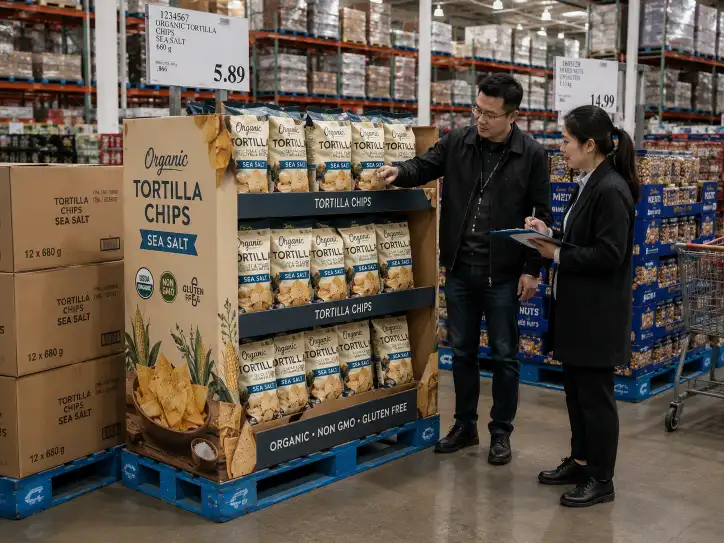
10 How the Factory Moves from Sampling to Production
Sampling ends when all three stages are approved. The transition to mass production depends on the sample approval being documented correctly.
What the Factory Needs Before Production Begins
| Document | Why |
|---|---|
| Structural sample approval (signed or emailed confirmation) | Confirms the structure is correct — no further changes |
| Printed sample approval (signed or emailed confirmation) | Confirms the graphics, colors, and finishing are approved |
| Loaded sample approval (signed or emailed confirmation) | Confirms the unit is production-ready |
| Approved dimensions and weight | Final footprint, height, and weight for the PO and shipping documentation |
| Any late changes | If a change was requested during sampling, it must be documented and confirmed |
The Production Handoff Sequence
- All sample approvals collected
- Engineering summary updated with any changes made during sampling
- Board order placed (if not already confirmed during material sourcing)
- Print plates and dies confirmed against the approved sample
- Production slot reserved
- First-off inspection standard set to match the approved loaded sample
This is how a factory proves it can take a Costco display program from concept to production — not by cutting the first sample and hoping, but by verifying at every stage until the loaded unit matches the engineering table. For the full range of display formats Leader Display develops for club stores, visit our Costco display product page. For a walkthrough of what happens after production begins, see our Costco display approval process guide.
FAQ
Q: How many sampling rounds does a Costco display normally need?
A: Most programs pass in 1–2 structural rounds and 1 printed round. A third structural round is rare and usually indicates an incomplete engineering review before the first sample was cut. The loaded sample normally passes on the first round if the earlier stages were approved correctly.
Q: What is the difference between a structural sample and a printed sample?
A: A structural sample is plain brown corrugated with no printing — it verifies product fit, assembly, load path, and stability. A printed sample is the same structure with final graphics — it verifies color accuracy, artwork placement, and finishing quality. They are separate stages because a structural failure would waste the print on the failed panels.
Q: How long does it take to get a Costco display sample?
A: A structural sample takes 5–10 working days. A printed sample takes 10–15 working days after structural approval. A loaded sample takes 5–7 working days after printed approval. Total sampling time is typically 4–6 weeks including shipping and buyer review.
Q: Who pays for sampling?
A: The factory normally absorbs the cost of the first structural sample, first printed sample, and first loaded sample. Additional rounds caused by late spec changes, new artwork, or structural redesign requested after approval are typically quoted separately. Sample shipping is usually shared between the factory and the buyer.
Q: Can sampling be accelerated?
A: Yes — by combining structural and printed samples into one (risk: print waste if the structure fails), running print plate preparation in parallel with structural sampling (risk: plate cost committed before structural approval), or adapting an approved structure from a similar program (risk: product fit differences).
Q: What delays sampling the most?
A: Three things: slow buyer approval between rounds (each day of review adds to total lead time), late product arrival at the factory for loaded samples, and incomplete product information at the start of the program that causes product fit issues in the structural sample.
Q: What should I check when I receive a structural sample?
A: Product fit in every position, assembly without force, load path with no sag or buckle, corner post flute direction, stability on the pallet base, and board grade matching the spec. Do not approve a structural sample until it is loaded with actual product.
Q: Can I request changes after the printed sample is approved?
A: Yes, but any change that affects the structure or the board requires a new structural sample, which means re-running the first stage. Changes that affect only the color or artwork can be handled with a corrected printed panel. The factory will advise which applies.