A buyer sends an email to three factories: "I need a cardboard display for my product. Please quote." Factory A responds with 10 questions. Factory B responds with a catalog. Factory C responds with a price range and asks for more details. The buyer goes with Factory A because they asked the right questions. But the email exchange takes 5 days. The spec changes twice. The quote changes each time. By the time the quote is final, the buyer has spent 2 weeks on email.
This happens because the buyer did not brief the factory correctly the first time. A complete brief gets you an accurate quote in one round. An incomplete brief gets you questions, revisions, and delays.
This guide covers exactly what information a cardboard display factory needs from you, how to organize it, what format to send, and the briefing mistakes that waste the most time.
01 Why a Good Brief Matters
A factory cannot design or price a display without knowing what it needs to hold, where it needs to fit, and how many are needed. When any of this information is missing, the factory has two choices:
- Ask for the missing information — This adds 2–5 days of email exchange
- Make an assumption and quote with contingency — This adds 20–30% padding to the price
Both cost you time or money. A complete brief eliminates both.
A well-prepared brief gets you:
- An accurate quote on the first try
- A structural design that fits your product and retailer
- A realistic timeline based on your launch date
- No surprise charges for revisions or changes later
02 The Seven Information Categories
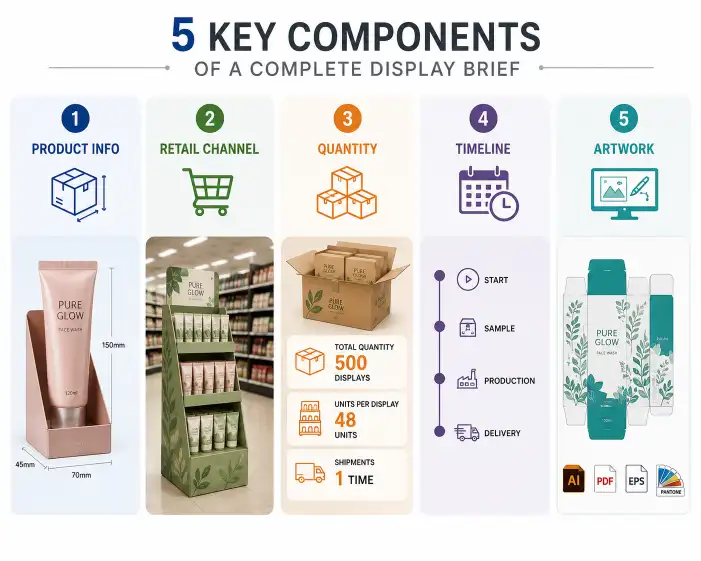
Every complete display brief covers seven categories. Missing any one will result in an inaccurate quote or a design that does not fit.
01 Product Information
| Required Item | Why It Matters | Example |
|---|---|---|
| Product weight per unit | Determines board grade, shelf reinforcement, and display stability | 340 g (12 oz) |
| Product dimensions (packaged) | Determines shelf height, compartment width, and overall display size | 6.5" × 4" × 2" |
| Product photo or rendering | Shows the factory the product shape, packaging design, and orientation | Photo attached |
| SKU count | Determines number of compartments or shelves needed | 2 SKUs (original + variety pack) |
| Units per display | Determines display size and total display weight | 24 units per display |
Missing product weight is the single most common briefing error. A factory cannot confirm the board grade without it.
02 Retail Channel
| Required Item | Why It Matters | Example |
|---|---|---|
| Target retailer | Each retailer has different compliance rules for height, footprint, and labeling | Walmart |
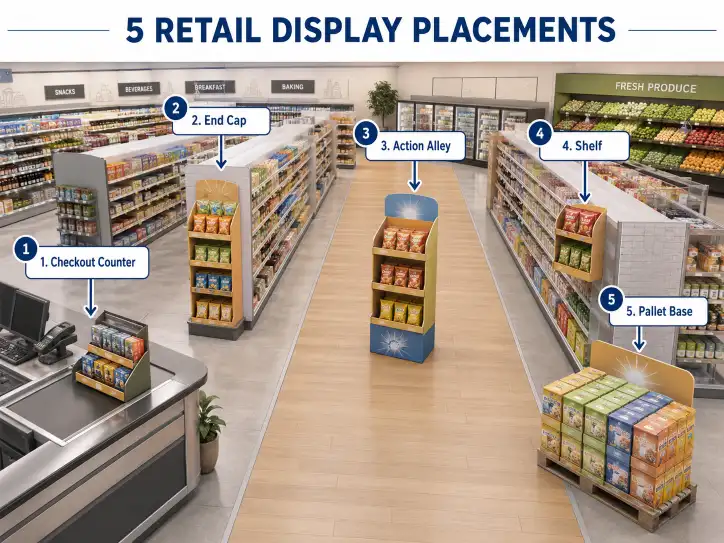
| Display location | Determines the display type needed (shelf vs floor vs counter vs pallet) | End cap |
| Shelf dimensions | For PDQ or shelf displays — confirms the display fits the shelf | 22" wide × 18" deep |
| Height restriction | Retailers limit display height based on aisle visibility requirements | 60" max (including base) |
| Store assembly | Who assembles the display — store staff or factory pre-assembled? | Store assembly |
03 Quantity and Timeline
| Required Item | Why It Matters | Example |
|---|---|---|
| Total order quantity | Determines per-unit pricing (higher quantity = lower unit cost) | 1,500 units |
| Launch date | Drives the production schedule and shipping method | November 1, 2026 |
| Sample required by | Determines if expedited sampling is needed | October 1, 2026 |
| Shipping destination | Drives freight cost calculation and packing method | Bentonville, AR (Walmart DC) |
| Preferred shipping method | Sea freight (cheaper, slower) vs air freight (expensive, fast) | Sea freight (40' container) |
04 Design Requirements
| Required Item | Why It Matters | Example |
|---|---|---|
| Display type | Counter, PDQ, floor, sidekick, pallet, or dump bin | Floor display |
| Shelf count | Determines how many product levels the display has | 3 shelves |
| Print method | Digital, litho-laminate, or flexo | Litho-laminate |
| Brand color references | Ensures accurate color matching | Pantone 186 C (red), Pantone Cool Gray 11 |
| Existing artwork | If artwork is ready, provide the file; if not, state whether the factory will design | Artwork in progress, due in 2 weeks |
05 Budget
| Required Item | Why It Matters | Example |
|---|---|---|
| Target unit price | Helps the factory recommend the most suitable board grade and print method | Under $8.00/unit |
| Tooling budget | Some projects have separate die and sample budgets | Included in unit price |
| Freight budget | Pallet display freight costs can approach the display cost itself | Separate budget |
Many buyers hesitate to share budget. This is a mistake. If you tell the factory "under $8/unit," they can recommend a design that hits that target. If you say nothing, they may design to $15/unit and waste everyone's time.
06 Compliance and Certification
| Required Item | Why It Matters | Example |
|---|---|---|
| Retailer compliance requirements | Some retailers require specific testing or labeling | Walmart pallet testing required |
| Certification needed | ISO, FSC, Sedex, or other certifications | FSC certified board |
| Testing standards | ISTA 3A, ASTM F1562, or other | ISTA 3A transport test |
07 Shipping and Packing
| Required Item | Why It Matters | Example |
|---|---|---|
| Assembly level | Flat pack, semi-assembled, pre-assembled, or pre-filled | Flat pack |
| Packing format | Bulk pack, individual cartons, or display-ready pallets | 12 per carton, palletized |
| Labeling requirements | Retailer-specific barcode or compliance labels | GS1-128 barcode on master carton |
For detailed information on what to prepare before contacting any factory, see [[Cardboard Display Selection Guide - Decision Framework for Buyers|Cardboard Display Selection Guide]].
03 Brief Template (Copy and Use)
Below is a template you can copy into an email or document and fill in for every display project. A factory that receives this complete brief can provide an accurate quote in one response.
Project Name: [Name]
Date: [Date]

PRODUCT INFORMATION
- Product name: [Name]
- Product weight (packaged): [Weight]
- Product dimensions (packaged): [W × D × H]
- Product photo: [Attached]
- SKU count: [Number]
- Units per display: [Number]

RETAIL CHANNEL
- Target retailer: [Retailer]
- Display location: [Shelf / End cap / Counter / Pallet base / Aisle]
- Available shelf width × depth: [W × D] (for shelf displays)
- Height restriction: [Height]
- Who assembles the display: [Store / Factory]

QUANTITY AND TIMELINE
- Total order quantity: [Number]
- Launch date: [Date]
- Sample required by: [Date]
- Shipping destination: [City, State / DC]
- Shipping method: [Sea / Air / Express]

DESIGN REQUIREMENTS
- Display type: [Counter / PDQ / Floor / Sidekick / Pallet / Dump bin]
- Number of shelves or compartments: [Number]
- Print method: [Digital / Litho-laminate / Flexo / None]
- Brand colors: [Pantone references]
- Artwork status: [Ready / In progress / Need factory design]
- Artwork file attached: [Yes / No]

BUDGET
- Target unit price: [$]
- Separate tooling budget: [Yes / No]

COMPLIANCE
- Retailer compliance requirements: [List]
- Certifications required: [ISO / FSC / Sedex / None]
- Testing standards: [ISTA / ASTM / None]

SHIPPING AND PACKING
- Assembly level: [Flat pack / Semi-assembled / Pre-assembled / Pre-filled]
- Packing preference: [Bulk / Cartons / Palletized]
- Labeling requirements: [List]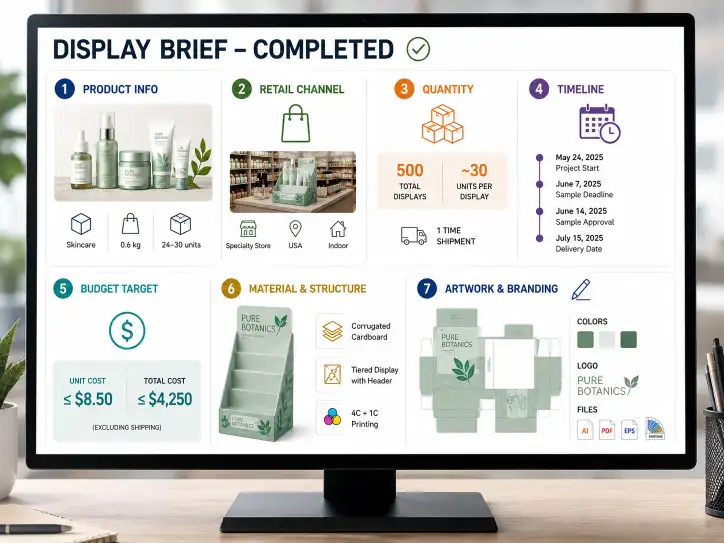
04 Common Briefing Mistakes
Mistake 1: Sending product weight without packaging
A buyer sends "product weight: 200 g." The factory designs the display for 200 g shelves. The actual packaged product weighs 350 g. The shelves sag within 2 weeks.
Prevention: Always provide the packaged weight. If the product is sold in a box, bag, or clamshell, weigh the packaged unit, not the product alone.
For real examples of weight-related display failures, see [[6 Real-World Cardboard Display Failures - Lessons for Retail Buyers|6 Real-World Cardboard Display Failures]].
Mistake 2: Not specifying the retailer
A buyer asks for a floor display quote without naming the retailer. The factory designs a standard 72" tall display. The retailer is Costco, which requires a 72" maximum including the pallet. The display is 4 inches too tall. Redesign costs 2 weeks and $500 in additional sample fees.
Prevention: Always name the retailer in the initial brief. If the retailer is not yet confirmed, state "retailer TBD" and ask the factory to design to the most restrictive common standard (typically 66" max height, 48" × 40" footprint for pallet displays, 20" shelf width for PDQs).
Mistake 3: Hiding the budget
A buyer does not share the budget because they want the "best price." The factory quotes based on premium materials and litho-laminate printing. The quote is $18/unit. The buyer's budget is $8/unit. Three rounds of redesign later, they arrive at a solution that was obvious from the start: a simpler structure with flexo printing at $7.50/unit.
Prevention: Share the target unit price in the first brief. The factory can immediately recommend the right board grade, print method, and structure to hit that price.
Mistake 4: Changing the product after the quote
A buyer requests a quote for a 12 oz bottle. The factory designs and quotes. The buyer then decides to use an 18 oz bottle instead. The shelf height, display weight, and board grade all need to change. The new quote is 30% higher.
Prevention: If the product might change, ask the factory to quote for both scenarios upfront. The cost of two quotes is zero; the cost of redesigning after approval is significant.
Mistake 5: Sending the same vague brief to 10 factories
A buyer sends "I need a cardboard display, please quote" to 10 factories. Each factory responds with different questions. The buyer spends 3 days answering the same questions 10 times. Three factories never follow up.
Prevention: Send the complete brief (using the template above) to every factory. Factories that can handle the project will respond with an accurate quote. Factories that cannot handle it will self-select out. You save time on both sides.
05 How to Compare Quotes from Different Factories
When you receive quotes from multiple factories, compare them on more than unit price:
| Comparison Point | What to Check |
|---|---|
| Board grade specified | Is the flute type and test weight the same across quotes? |
| Print method | Digital vs litho-laminate vs flexo — same print quality? |
| Sample fee | Included in the quote? Deducted from production? |
| Tooling cost | One-time die charge vs included in unit price? |
| Payment terms | 30% deposit / 70% balance? T/T or L/C? |
| Lead time | How many days from sample approval to shipment? |
| Incoterm | FOB, CIF, or EXW — this changes the total cost significantly |
A $7.00 quote on FOB terms may be cheaper than a $6.50 quote on EXW terms once freight and handling are added. Always compare quotes on the same Incoterm basis.
For a detailed cost breakdown across all display types at different order quantities, see [[Cardboard Display Cost Breakdown - What Buyers Actually Pay For|Cardboard Display Cost Breakdown]].
06 Brief Checklist (Printable Summary)
Before sending the brief:
- Product weight (packaged) confirmed
- Product dimensions (packaged) confirmed
- SKU count and units per display confirmed
- Target retailer identified
- Display location confirmed
- Height restriction known
- Order quantity confirmed
- Launch date confirmed
- Display type selected (counter / PDQ / floor / sidekick / pallet / dump bin)
- Print method selected
- Artwork status determined
- Target unit price identified
- Assembly method confirmed (flat pack / pre-assembled / pre-filled)
- Shipping method selected
- Compliance requirements listed
Quote review:
- Board grade matches requirement
- Print method matches requirement
- Sample fee terms clear
- Tooling cost clear
- Lead time matches launch date
- Incoterm confirmed for cost comparison