A brand manager walks into a trade show. A supplier shows them an acrylic display. It is beautiful. Crystal clear. It feels premium. The brand manager orders 500 units for a national launch. The acrylic display costs $28 per unit. The same display in corrugated cardboard would have been $4.50. The brand manager did not ask how long the display needs to last, where it will be placed, or how many stores will receive it.
Six months later, 300 of the acrylic displays are in a warehouse. The promotion ended. The acrylic displays cannot be recycled. The brand paid $14,000 for displays that are now waste.
The supplier was not wrong to offer acrylic. The brand manager was wrong to choose acrylic without understanding the trade-offs.
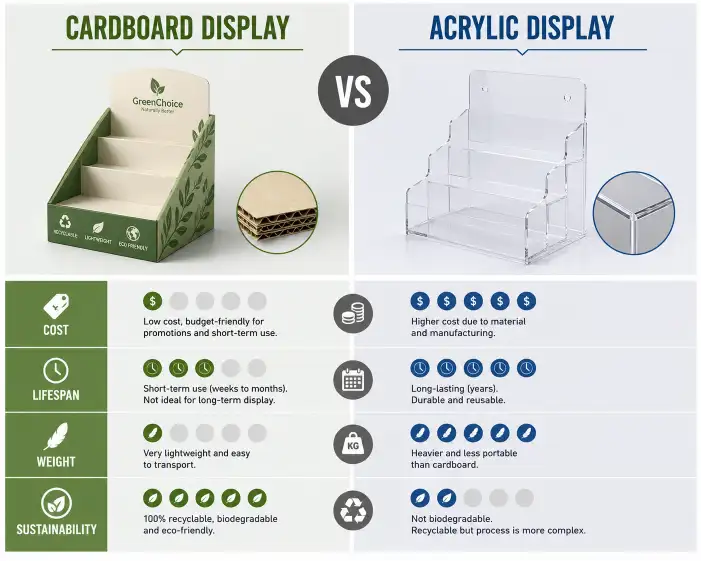
Corrugated cardboard and acrylic are both valid materials for retail displays. They serve different use cases. Cardboard is best for temporary promotions, high-volume rollouts, and disposable programs. Acrylic is best for long-term signage, permanent fixturing, and high-end retail environments where the display is part of the store design. The mistake buyers make is choosing on aesthetics alone without considering the total cost, lifespan, and disposal plan.
This guide compares cardboard and acrylic displays across cost, durability, retail suitability, shipping, and total cost of ownership — with a decision framework to help buyers choose the right material for each project.
01 Material Comparison Overview
| Attribute | Corrugated Cardboard | Acrylic |
|---|---|---|
| Material type | Paper-based (recycled fibers) | Petroleum-based plastic (PMMA) |
| Weight per sq ft (3 mm thickness) | ~0.3 lb | ~1.5 lb |
| Typical lifespan | 4–12 weeks (promotional) | 6–24 months (semi-permanent) |
| Recyclability | Fully recyclable (paper stream) | Limited (specialized recycling only) |
| Customization ease | High — die-cut, print, laminate | Medium — CNC cut, print, or screen |
| per-unit cost (small display) | $2–$8 | $15–$40 |
| per-unit cost (floor display) | $5–$20 | $50–$200 |
| Tooling cost | $100–$500 (steel rule die) | $500–$3,000 (CNC or mold) |
| Assembly in store | Required for flat pack | Usually pre-assembled |
| Shelf weight capacity | 3–25 kg (depends on board grade) | 10–50 kg (depends on thickness) |
02 Cost Comparison
Per-Unit Cost at Different Volumes
| Display Type | Material | 100 Units | 500 Units | 1,000 Units | 5,000 Units |
|---|---|---|---|---|---|
| Counter display (8"×10") | Cardboard | $4.50 | $2.50 | $1.80 | $1.20 |
| Counter display (8"×10") | Acrylic | $18.00 | $14.00 | $12.00 | $10.00 |
| Floor display (18"×24"×60") | Cardboard | $14.00 | $9.00 | $6.50 | $4.00 |
| Floor display (18"×24"×60") | Acrylic | $120.00 | $90.00 | $75.00 | $60.00 |
Cost per Week of Display Life
A more useful comparison than unit cost: what does each display cost per week it spends on the retail floor?
| Display Type | Material | Unit Cost | Typical Lifespan | Cost per Week |
|---|---|---|---|---|
| Counter display | Cardboard | $2.50 | 8 weeks | $0.31 |
| Counter display | Acrylic | $14.00 | 52 weeks | $0.27 |
| Floor display | Cardboard | $9.00 | 12 weeks | $0.75 |
| Floor display | Acrylic | $90.00 | 104 weeks | $0.87 |
At cost per week, cardboard and acrylic are nearly identical. The difference is in how you use them: cardboard for short promotions where you might discard the display after the campaign, acrylic for permanent or semi-permanent placements where the display stays for a year or longer.
03 Durability and Lifespan
Cardboard Display Lifespan
| Display Type | Expected Lifespan | Depends On |
|---|---|---|
| PDQ display (light product, shelf) | 4–8 weeks | Product weight, restock frequency, store traffic |
| Counter display | 6–12 weeks | Customer interaction frequency, location |
| Floor display (heavy product) | 4–8 weeks | Load weight, handling during restock |
| Floor display (light product) | 8–16 weeks | Store traffic, shelf wear |
| Pallet display (club store) | 2–6 weeks | High-traffic, short campaign window |
Cardboard displays are designed for temporary promotions. They hold up well for the duration of a typical promotional cycle (4–12 weeks). Beyond 12 weeks, wear becomes visible: corners soften, graphics fade, and the structure may lose rigidity.
Acrylic Display Lifespan
| Display Type | Expected Lifespan | Depends On |
|---|---|---|
| Counter display (acrylic) | 12–24 months | Handling frequency, cleaning method |
| Sign holder / riser | 24–60 months | UV exposure, cleaning chemicals |
| Floor display (acrylic) | 12–36 months | Traffic, product weight, cleaning |
| Permanent fixture | 36–60 months | Store remodel cycle, rebranding |
Acrylic displays are effectively permanent. They do not absorb moisture, do not soften under load, and maintain their appearance for years if properly maintained. The limitation is that acrylic scratches easily — cleaning with rough cloths or abrasive cleaners will cloud the surface over time.
For a detailed guide on cardboard structural durability and board grade selection, see [[Display Fixture Structural Design Guide|Display Fixture Structural Design Guide: Load Capacity, Stability, and Transport Testing]].
04 Retail Suitability
Where Cardboard Wins
Seasonal and promotional displays. Cardboard is the standard for holiday promotions, seasonal product launches, and short-term campaigns. The display can be brand-specific, custom-printed, and disposed of after the promotion without inventory liability.
High-volume rollouts. When a display goes into 1,000+ stores simultaneously, the per-unit cost difference between cardboard and acrylic becomes a deciding factor. A floor display in 2,000 stores costs $18,000 in cardboard vs $150,000 in acrylic.
Retailers with strict promotional calendars. Walmart, Target, CVS, and similar retailers operate on 4–12 week promotional cycles. Cardboard displays match this timeline perfectly — the display supports the promotion and is removed when the next program arrives.
Products that change frequently. If the product assortment changes every season, cardboard allows the display to be updated with each change at a fraction of the cost of a new acrylic display.
Where Acrylic Wins
Permanent or semi-permanent fixturing. Acrylic is the right choice when the display is part of the store's permanent layout — brand shops, end-cap fixtures, checkout organizers that stay in place for 12+ months.
High-end retail environments. Luxury brands, cosmetics counters, and premium electronics sections use acrylic for its clean, transparent appearance. Acrylic displays do not show the brown corrugated edge that cardboard displays have.
Heavy products in permanent positions. Acrylic supports heavier loads than corrugated board without reinforcement. A display holding 30+ kg of product daily for 24 months needs acrylic (or another permanent material).
Signage and risers. Acrylic sign holders, menu boards, and product risers maintain their appearance indefinitely. Cardboard signage looks worn within weeks in high-traffic areas.
For pharmacy and drugstore display requirements, see [[GMI and CVS Compliance for Packaging and Retail Displays|GMI & CVS Compliance Guide]].
05 Shipping and Logistics
| Factor | Cardboard | Acrylic |
|---|---|---|
| Shipping format | Flat packed (nested) | Pre-assembled or flat (CNC cut) |
| Units per pallet (counter display) | 200–400 | 40–80 |
| Units per pallet (floor display) | 48–80 | 10–20 |
| Freight cost per unit (floor display, China→US) | $0.50–$1.50 | $4.00–$12.00 |
| Breakage risk during transit | Low (flexible material) | High (rigid, cracks under impact) |
| Packaging required | Standard carton | Custom foam + reinforced carton |
Cardboard is significantly cheaper to ship. It nests flat, weighs less, and does not require protective packaging between units. Acrylic requires individual protective wrapping or foam inserts, which add to the per-unit cost and increase freight volume.
For a breakdown of how shipping format affects total display cost, see [[Cardboard Display Cost Breakdown - What Buyers Actually Pay For|Cardboard Display Cost Breakdown]].
06 Sustainability and End of Life
Cardboard
| Attribute | Detail |
|---|---|
| Recyclable | Yes — paper recycling stream |
| Average recycled content | 40–70% post-consumer recycled fiber |
| Biodegradable | Yes — 2–6 months in landfill |
| FSC certification | Available on request |
| Disposal cost | Low — curbside recycling or commercial paper recycling |
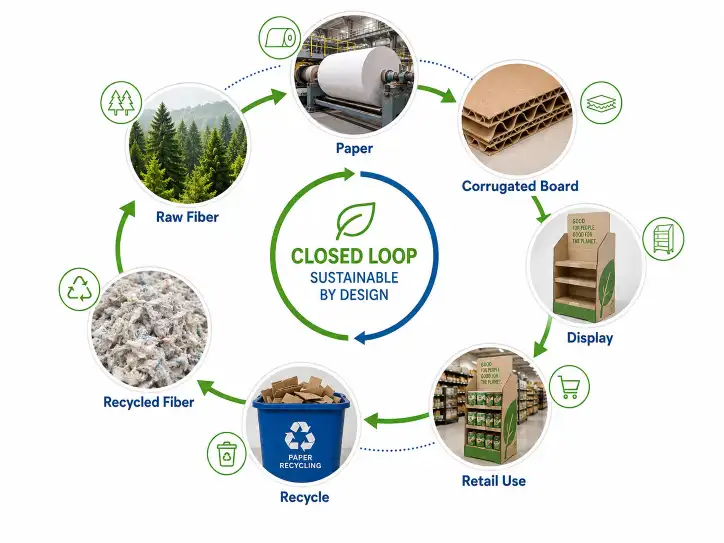
Cardboard displays are fully recyclable at end of life. The corrugated board enters the paper recycling stream and is repulped into new paper products. Most cardboard displays contain 40–70% recycled content as standard.
Acrylic
| Attribute | Detail |
|---|---|
| Recyclable | Limited — specialized acrylic recycling only |
| Average recycled content | 0–10% (virgin acrylic is standard) |
| Biodegradable | No — estimated 200+ years in landfill |
| Disposal cost | High — must be separated and sent to specialized recycler or landfill |
Acrylic is technically recyclable, but the recycling infrastructure for acrylic (PMMA) is limited. Most municipal recycling programs do not accept acrylic. Disposal typically means landfill. Some manufacturers offer acrylic take-back programs, but this requires coordination and added logistics.
If sustainability is a priority for the brand, the choice between cardboard and acrylic is clear. For a comparison of corrugated board grades and their environmental profiles, see [[Corrugated Grades Explained- How to Choose the Right Material for Displays|Corrugated Grades Explained]].
07 Decision Framework
Choose Cardboard When
- The display is for a promotion, seasonal campaign, or product launch with a defined end date
- The order quantity exceeds 500 units
- The display needs to ship flat to control freight costs
- The retailer requires recyclable or disposable displays
- The product weighs less than 15 kg per shelf
- The display lifespan is under 12 weeks
- Sustainability and end-of-life disposal are a consideration
Choose Acrylic When
- The display is part of a permanent or semi-permanent retail fixture
- The order quantity is under 200 units (tooling amortization is acceptable)
- The product is heavy and the display needs to last 12+ months
- The retail environment requires a premium, transparent appearance
- The display is a sign holder, riser, or shelf organizer (not a product display)
- The display will be reused across multiple promotional cycles without design changes
Consider Hybrid When
- The structure is cardboard but the signage or header is acrylic (the most common hybrid configuration)
- The base is acrylic but the shelves are cardboard (for lightweight seasonal products in a permanent fixture)
- Short-term promotions use cardboard inserts within a permanent acrylic frame
08 Case Examples
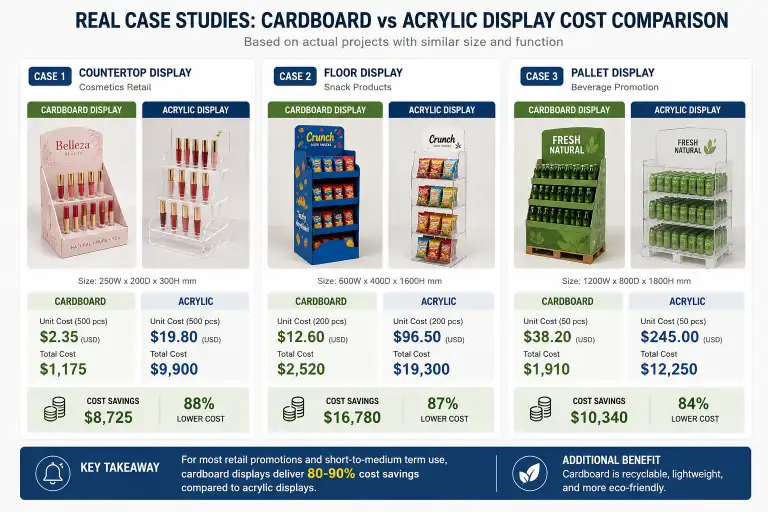
Case 1: Seasonal Candy Promotion
- Requirement: 3,000 floor displays for a 6-week Halloween candy promotion
- Material choice: Cardboard
- Cost: $9.00/unit × 3,000 = $27,000
- Acrylic alternative: $75.00/unit × 3,000 = $225,000
- Verdict: Cardboard is the only economically viable choice for a 6-week promotion at this volume
Case 2: Permanent Cosmetics Counter Display
- Requirement: 150 counter displays for a year-round cosmetics line
- Material choice: Acrylic
- Cost: $25.00/unit × 150 = $3,750
- Cardboard alternative: $3.50/unit × 150 = $525, but would need replacement every 8–10 weeks
- Annual cardboard cost: $525 × 5 replacements = $2,625
- Verdict: Acrylic costs $1,125 more per year but the display stays consistent and premium — for cosmetics, appearance justifies the cost
Case 3: National Grocery Chain End Cap
- Requirement: 500 floor displays for an 8-week snack food launch, with possibility of extension
- Material choice: Cardboard (with acrylic sign holder option)
- Cardboard cost: $7.00/unit × 500 = $3,500
- Acrylic cost: $85.00/unit × 500 = $42,500
- Verdict: Cardboard with a reusable acrylic top sign — the sign can be used for future promotions, the cardboard body is campaign-specific
09 Common Mistakes Buyers Make
Mistake 1: Choosing acrylic because it looks better in the office
A display viewed in a buyer's office under controlled lighting looks different than it does on a retail floor. Acrylic displays do look premium. But if the placement is a standard grocery shelf for an 8-week promotion, the premium appearance does not drive enough additional sales to justify 5× the unit cost.
Mistake 2: Not factoring in disposal cost
An acrylic display that cannot be recycled costs the retailer money to dispose of. Some retailers now charge brands for non-recyclable display components. Check the retailer's sustainability policy before choosing acrylic.
Mistake 3: Ordering acrylic for a volume where cardboard tooling is cheaper
At 100 units, acrylic tooling ($500–$3,000) is spread over fewer units than cardboard tooling ($100–$500). But at 500+ units, the cardboard tooling cost per unit becomes negligible ($0.20–$1.00/unit) while acrylic's per-unit material cost remains 4–5× higher.
Mistake 4: Not considering hybrid
The choice is not always all-cardboard or all-acrylic. A cardboard display with an acrylic header can achieve the premium look at the shelf level while keeping the main structure cost-effective and recyclable.