A poster on the wall gets glanced at. A lifesize cardboard standee standing in the middle of the aisle stops people in their tracks. That is the difference between being seen and being noticed.
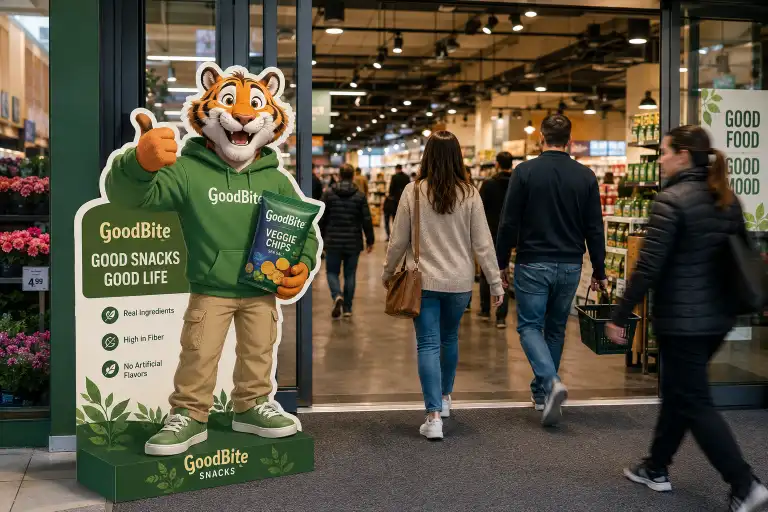
A standee display is a large cardboard cutout used for brand promotion, event signage, and retail visual merchandising. Also called a cardboard standee, standee cutout, or lifesize standee, it is designed to create visual impact by presenting full-size brand imagery in stores, trade shows, and event spaces.
I have been manufacturing cardboard displays for over 16 years, and standees are one of the most effective tools for brand awareness. Unlike product displays that hold inventory, a standee exists purely to grab attention and communicate brand identity. In this guide, I will cover everything you need to know about standee displays — from types and sizing to materials, printing, and cost planning.
What Is a Standee Display and How Is It Different?
A standee display is a large, often lifesize, cardboard cutout that stands on the floor. Unlike a floor display that holds products for sale, a standee is purely a visual marketing tool. Its job is to attract attention, reinforce brand identity, and create an experience.
The key difference between a standee and other cardboard display types is purpose:
| Display Type | Primary Purpose | Holds Products? | Typical Location |
|---|---|---|---|
| Standee | Brand awareness, visual impact | No | Store entrance, event floor |
| Floor Display (FSDU) | Product sales, merchandising | Yes | Retail aisle, endcap |
| Counter Display | Impulse purchase | Yes | Checkout counter |
| Pallet Display | Bulk product sales | Yes | Club store floor |
Standees are most commonly used for:
- Brand mascots or character cutouts
- Movie and entertainment promotions
- New product launch announcements
- Seasonal and holiday decorations
- Trade show and event signage
- Photo opportunities and social media moments
Standee Display Types: Lifesize, Half-Size, and Shaped
Standee displays come in different formats depending on the space available and the visual effect you want to create.
| Type | Height | Best For | Typical Use |
|---|---|---|---|
| Lifesize standee | 150–200 cm | Maximum visual impact | Brand character, celebrity endorsement |
| Half-size standee | 80–120 cm | Countertop or shelf placement | Product announcement, pricing |
| Tabletop standee | 30–60 cm | Event tables, registration desks | Menu, instruction, small signage |
| Shaped cutout standee | Custom | Unique brand shapes | Logo shapes, product silhouettes |
| Group standee set | Variable | Multiple characters/scenes | Themed displays, holiday scenes |
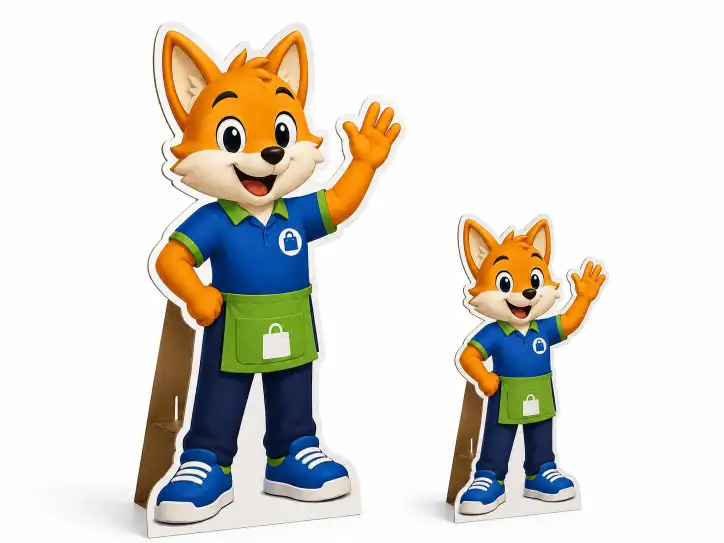
Lifesize Standee
The lifesize standee is the most popular format. It stands 150–200 cm tall and presents a full-height image of a person, character, or product. Lifesize standees are commonly used at store entrances, trade show booths, and event photo zones.
The visual impact of a lifesize standee is immediate. A person-shaped cutout at eye level naturally draws attention because humans are programmed to notice other human forms. This makes lifesize standees particularly effective for brand activation and retail visual merchandising.
Half-Size and Tabletop Standee
Half-size standees (80–120 cm) work well where full-height standees do not fit — on counters, shelves, or registration tables. Tabletop standees (30–60 cm) are popular for event signage, menu displays, and directional information.
Shaped Cutout Standee
Shaped standees follow the contour of the printed image rather than using a rectangular or standard shape. A brand logo cut out in its exact shape, a product silhouette, or a custom design all fall into this category. Shaped standees cost more because of the custom die-cutting, but they create a stronger visual impression.
Where Standee Displays Work Best
Standee displays are versatile and can be used in many environments.
| Location | Effectiveness | Why It Works |
|---|---|---|
| Store entrance | Very high | First thing shoppers see entering the store |
| Retail aisle | High | Creates a photo moment alongside product displays |
| Trade show booth | Very high | Attracts visitors from across the exhibition hall |
| Event registration | High | Directs attendees and creates a branded welcome |
| Window display | High | Visible from outside, draws foot traffic |
| Photo booth area | Very high | Encourages social sharing, extends campaign reach |
| Restaurant entrance | Moderate | Seasonal or promotional character displays |
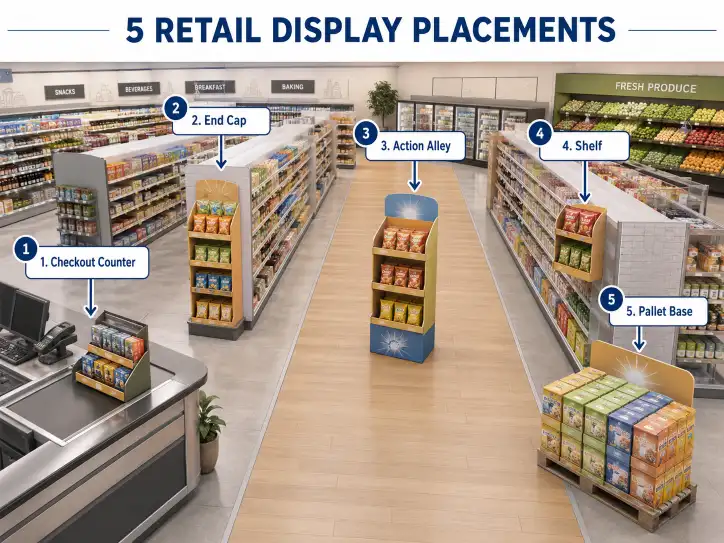
For retail stores, I recommend placing standees at the entrance or in high-traffic aisles where they do not block product displays. A standee should complement your product merchandising, not compete with it. If you are running a product campaign, pair the standee with a counter display or floor display nearby so the visual attention converts into sales.
What Materials Are Used for Standee Displays?
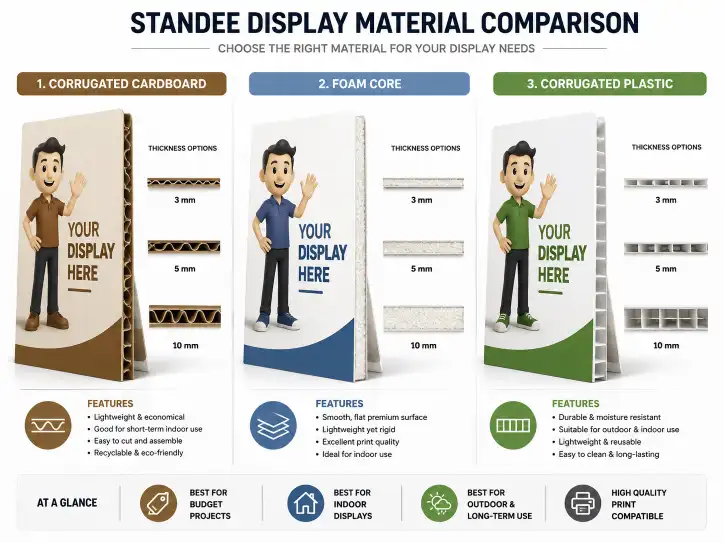
Standee displays need different materials than product-holding displays because they do not bear weight from products — but they do need to stand upright and resist bending or creasing.
| Material | Thickness | Strength | Print Quality | Best For | Cost |
|---|---|---|---|---|---|
| E-flute corrugated | 1.6 mm | Moderate | Very good | Short-term indoor standees | Low |
| B-flute corrugated | 3.2 mm | Good | Good | Standard standees, most uses | Low–Moderate |
| C-flute corrugated | 4.0 mm | Strong | Moderate | Tall standees, outdoor sheltered | Moderate |
| 2-ply E-flute laminated | 3.2 mm | Good | Excellent | Premium standees, both sides printed | Moderate |
| Foam core board (Gatorfoam) | 5–10 mm | Very strong | Excellent | Reusable, premium events | Higher |
| Corrugated plastic (Coroplast) | 3–4 mm | Strong | Good | Outdoor, weather-resistant | Moderate |
For most standee displays, B-flute corrugated is the standard choice. It is thick enough to stand rigidly without bending, and it accepts high-quality printing. If you need a standee that will be reused across multiple events, consider foam core board or 2-ply laminated corrugated — they are more durable and resist edge damage better.
For outdoor or semi-outdoor use (covered entrances, sidewalk placements), specify moisture-resistant coating or use corrugated plastic to prevent moisture damage.
Standee Display Sizing Guide
Standee sizing depends on the space available and the visual impact you need.
| Standee Size | Width × Height | Recommended Board | Typical Use |
|---|---|---|---|
| Mini standee | 30 × 45 cm | E-flute | Countertop signage |
| Small standee | 50 × 80 cm | B-flute | Shelf or table placement |
| Medium standee | 60 × 120 cm | B-flute | Half-size character, product display |
| Large standee | 80 × 160 cm | B-flute or C-flute | Lifesize character |
| Extra large standee | 100 × 200 cm | C-flute or foam core | Oversize brand statement |
Size Rules
- Width should not exceed 100 cm — Standees wider than 100 cm are difficult to ship and handle in stores. If you need a wider display, consider a multi-panel design.
- Height over 180 cm needs special handling — Oversize standees may require freight shipping and special packaging.
- Base must be proportional — A tall standee needs a wide enough base or support structure to prevent tipping. For lifesize standees, the base should be at least 40 cm wide.
- Consider door clearance — A standee that is taller than 210 cm may not fit through standard doorways.
Printing Options for Standee Displays
Standee printing is different from product display printing because standees are viewed from a distance and need to make an immediate visual impact.
| Printing Method | Color Quality | MOQ | Cost | Best For |
|---|---|---|---|---|
| Large format inkjet | Excellent, CMYK | 1+ | Higher | Single custom standees, small runs |
| Offset litho | Excellent, CMYK + Pantone | 500+ | Moderate | Large runs with brand color accuracy |
| Digital print | Very good, CMYK | 50+ | Moderate | Medium runs, custom designs |
| Screen print | Good, bold colors | 100+ | Moderate | Simple designs, solid background |
For standee displays, print quality is critical because the standee IS the product — there are no products on shelves to distract from the print. Large format inkjet printing produces the highest quality for small runs and is the standard for event standees. For larger quantities needed for national retail rollouts, offset litho offers better per-unit cost.
Finish Options
| Finish | Effect | Recommended For |
|---|---|---|
| Matte lamination | Non-reflective, soft feel | Photographic standees, premium look |
| Gloss lamination | Shiny, vibrant colors | Bright characters, promotional standees |
| UV protective coating | Fade resistance | Near-window displays, light exposure |
| Edge sealing | Protects cut edges | Reusable standees |
Standee Display Assembly and Support Options
A standee display needs a support system to stand upright. Several options are available depending on the display size and location.
| Support Type | How It Works | Stability | Best For |
|---|---|---|---|
| Fold-out easel back | Cardboard flap folds out from the back | Moderate | Standard standees, low-traffic areas |
| Plastic snap-on feet | Plastic base clips onto the bottom of the standee | Good | Retail store use, moderate traffic |
| Freestanding A-frame | Standee has an A-frame base that supports both sides | Very good | High-traffic areas, outdoor sheltered |
| Metal stand holder | Metal frame holds the standee upright | Excellent | Premium event displays, reusable |
| Wall-mount bracket | Standee mounts flat on a wall | N/A | Window displays, wall signage |
| Hanging display | Standee hangs from ceiling or fixture | N/A | Above-aisle promotions |
Assembly Rules
- Test stability before placement — A standee that falls over in a store creates a safety hazard and reflects poorly on the brand.
- Use weighted bases for high-traffic areas — In busy aisles or near doors, plastic snap-on feet or metal stands provide better stability than fold-out easels.
- Keep assembly under 2 minutes — Store staff will not spend time on a complicated standee assembly. The simpler, the better.
- Add safety corners for children — If the standee is placed in a family-friendly environment, round sharp corners to prevent accidents.
How Much Does a Custom Standee Display Cost?
Standee pricing varies by size, board grade, printing method, and support type.
| Standee Type | 1 Unit | 50 Units | 500 Units | 1,000 Units |
|---|---|---|---|---|
| Mini standee (30 × 45 cm), digital | $8–$15 | $4–$8 | $2.50–$5 | $1.80–$3.50 |
| Small standee (50 × 80 cm), digital | $15–$25 | $7–$14 | $4–$8 | $3–$6 |
| Medium standee (60 × 120 cm), digital | $20–$35 | $10–$18 | $5.50–$10 | $4–$7.50 |
| Large lifesize (80 × 160 cm), digital | $28–$45 | $14–$24 | $8–$15 | $6–$11 |
| Extra large (100 × 200 cm), digital | $35–$55 | $18–$30 | $10–$18 | $7.50–$14 |
| Premium foam core (lifesize) | $40–$65 | $22–$38 | $14–$24 | $11–$19 |
Additional Costs
| Cost Item | Typical Range |
|---|---|
| Custom contour die-cut | $100–$250 (one-time) |
| Plastic snap-on feet | $0.50–$1.50 per standee |
| Metal stand holder | $8–$20 each (reusable) |
| Fold-out easel back | Included or +$0.50–$1.00 |
| Lamination (both sides) | +20–40% per unit |
| Edge sealing | +$0.50–$1.00 per unit |
Standee displays have one advantage over product displays: you can order a single unit for testing. For event use or in-store testing, you can start with one custom-printed standee before committing to a larger run.
FAQ
What is a standee display?
A standee display is a large cardboard cutout designed for brand promotion and visual merchandising. Unlike product displays, standees do not hold inventory — they exist purely to attract attention and communicate brand identity.
What is the difference between a standee and a poster?
A poster is a flat printed sheet that must be mounted on a wall or board. A standee is a self-supporting cardboard structure that stands on the floor. Standees have more visual impact because they can be lifesize, shaped, and placed anywhere in the store.
How tall is a lifesize standee?
A lifesize standee is typically 150–200 cm tall, matching the average height of an adult. The exact height depends on the image being reproduced.
Can standee displays be used outdoors?
Standard cardboard standees are for indoor use only. For outdoor or semi-outdoor use (covered entrances), specify moisture-resistant coating or use corrugated plastic (Coroplast) instead of cardboard.
How do I keep a standee from falling over?
Use a wide base, plastic snap-on feet, or a metal stand holder. For high-traffic areas, always use plastic or metal supports rather than fold-out easel backs. Weight the base if necessary.
What is the best material for a standee display?
B-flute corrugated is the standard choice for most standees. It balances rigidity, print quality, and cost. For premium or reusable standees, foam core board or 2-ply laminated corrugated offers better durability.
Can I print on both sides of a standee?
Yes. Double-sided printing is common for standees placed in open areas where shoppers can see both sides. Costs more than single-sided printing but doubles the effective branding space.
How are standee displays shipped?
Standees ship flat in large cartons or in flat-packed boxes with the support hardware. Lifesize standees require oversize packaging and may incur additional shipping costs. The standee image is typically printed on one or two panels that are joined at installation.
What is the lead time for custom standee displays?
Digital printing: 3–7 business days. Offset printing (500+ units): 15–20 business days. Large format custom runs: 5–10 business days. Standees have shorter lead times than product displays because there is no structural die-cutting or assembly complexity.
Are cardboard standees eco-friendly?
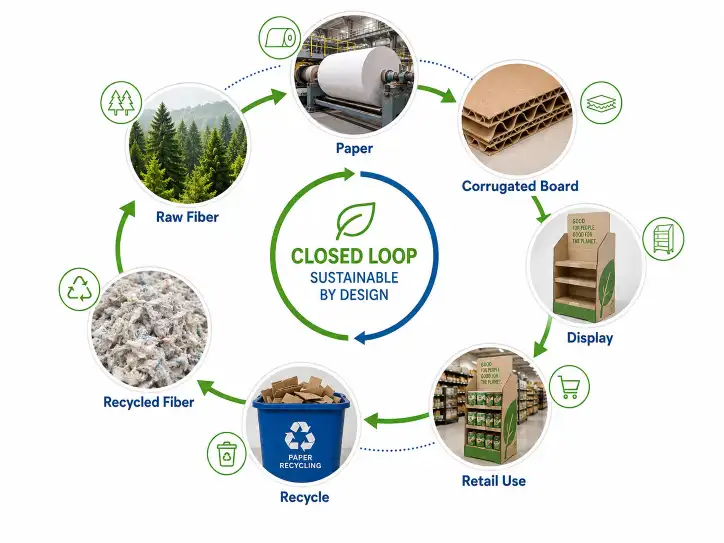
Yes. Corrugated cardboard standees are made from renewable materials and are fully recyclable. Foam core boards are less eco-friendly, so for environmentally conscious campaigns, stick with corrugated cardboard with water-based inks.