Many B2B buyers use "power wing display" and "sidekick display" to mean the same thing. In practice, manufacturers and retailers treat them as two related but structurally different formats. Ordering the wrong one can mean a display that sags under product weight, fails to attach securely to store shelving, or adds unnecessary cost to the project.
This article explains the difference between power wing and sidekick displays from a factory sourcing perspective. Instead of focusing on marketing labels, it helps buyers understand how each format is specified, quoted, and manufactured.
Power Wing Display vs Sidekick Display: What Is the Difference?
The short answer: A sidekick display is a lightweight hang-on unit for shelves and endcaps. A power wing display is a reinforced sidekick built for heavier products or higher load capacity. Both attach to existing retail shelving without taking floor space. The difference is in the material grade, attachment method, and weight rating.
From a factory standpoint, the structural difference is straightforward. A sidekick uses single-wall corrugated board and standard plastic hooks. A power wing uses double-wall board, reinforced back panels, and heavy-duty brackets or metal support bars.
For manufacturers, the key variables are the same: board grade, hook type, print finish, and attachment method. But the engineering brief will differ based on the product weight and the retailer's fixture requirements.
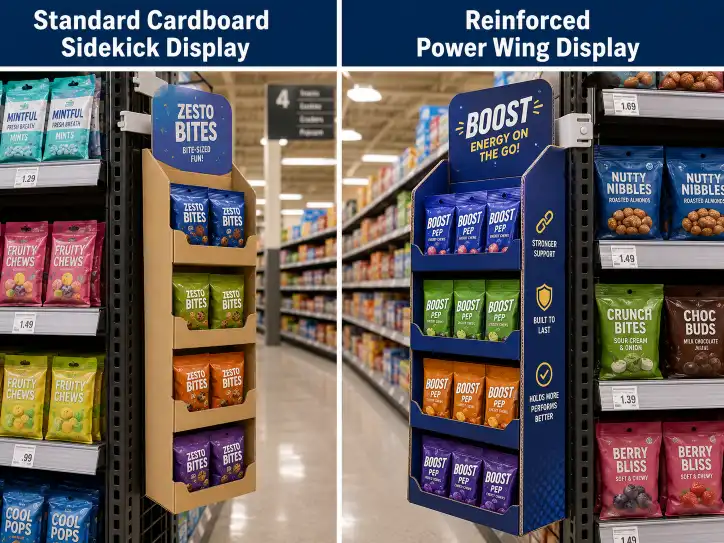
Quick Comparison Table
| Feature | Sidekick Display | Power Wing Display |
|---|---|---|
| Common Term | PDQ display, hang-on display | Reinforced sidekick, heavy-duty power wing |
| Primary Use | Lightweight impulse items | Heavier packaged products |
| Typical Weight Capacity | Up to 4.5 kg (10 lbs) total | 10–25 kg (22–55 lbs) total |
| Board Grade | E-flute or B-flute single-wall | Double-wall or B-flute reinforced |
| Attachment | Plastic hooks or adhesive strips | Metal brackets or heavy-duty clips |
| Common Products | Candy, lip balm, batteries, small toys | Bottled drinks, sauces, tools, pet treats |
| Assembly Time | Under 30 seconds | 1–2 minutes (may require bracket fitting) |
What Is a Sidekick Display?
A sidekick display is a compact cardboard unit that hangs off the side of an existing shelf or endcap. It uses the store's existing fixture for support, so it does not need dedicated floor space. Retailers use sidekick displays primarily for impulse items that shoppers can grab quickly while walking past.
Common Characteristics of Sidekick Displays
- Lightweight construction — Typically E-flute or B-flute corrugated board
- Simple attachment — Plastic hooks that slide onto shelf edges or pegboard
- Single-piece design — Folds flat for shipping, sets up in seconds
- Small footprint — Usually one to three facings wide
- Low unit count — Holds 6–24 units depending on product size
Typical Products for Sidekick Displays
Sidekick displays work best for small, lightweight, high-margin impulse products:
- Confectionery and gum
- Lip balm and small cosmetics
- Batteries and small electronics accessories
- Trial-size health and beauty products
- Key rings, small toys, and novelty items
For a complete overview of how sidekick displays work in retail, our What Products Work Best on a Sidekick Display? guide covers product selection in detail.
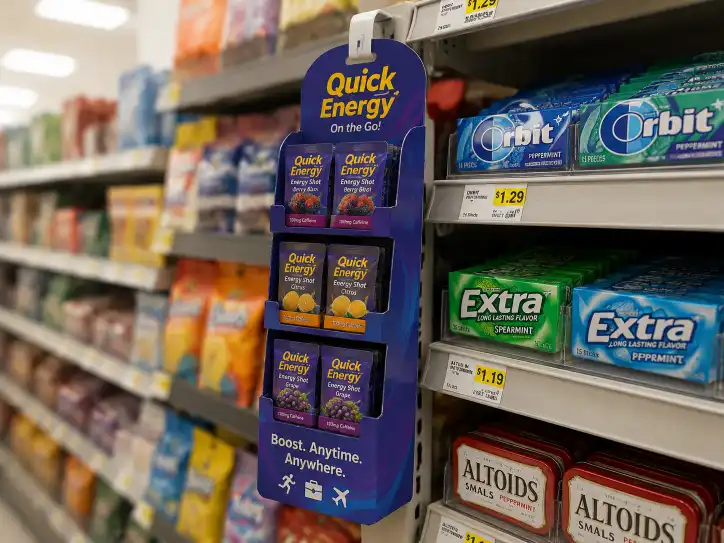
What Is a Power Wing Display?
A power wing display is a reinforced version of a sidekick display. It uses the same hanging format — attaching to existing shelving or endcaps — but is engineered to hold heavier products or higher total weight.
The term "power wing" is used by factories and retailers to distinguish heavier-duty units from standard sidekicks. While some suppliers use the terms interchangeably, manufacturers use different materials and attachment systems for each.
Key Structural Differences
- Double-wall or reinforced board — Standard sidekicks use single-wall corrugated. Power wings use double-wall board or add internal reinforcement panels.
- Metal or heavy-duty brackets — Instead of plastic hooks, power wings use metal support brackets that distribute weight across a larger area of the store fixture.
- Reinforced shelf lips — Each tray or shelf tier has a stronger front lip to prevent sagging under product weight.
- Deeper trays — Power wings accommodate larger or bulkier products that do not fit in standard sidekick trays.
Typical Products for Power Wing Displays
Power wing displays are chosen when the product is too heavy or bulky for a standard sidekick:
- Bottled beverages and canned drinks
- Glass jars (sauces, condiments, artisanal products)
- Pet food pouches and treat bags
- Tool accessories and hardware packaged items
- Larger personal care products (shampoo bottles, body wash)
If your product category is closer to the heavier side, our production capabilities page explains how we handle reinforced corrugated structures.
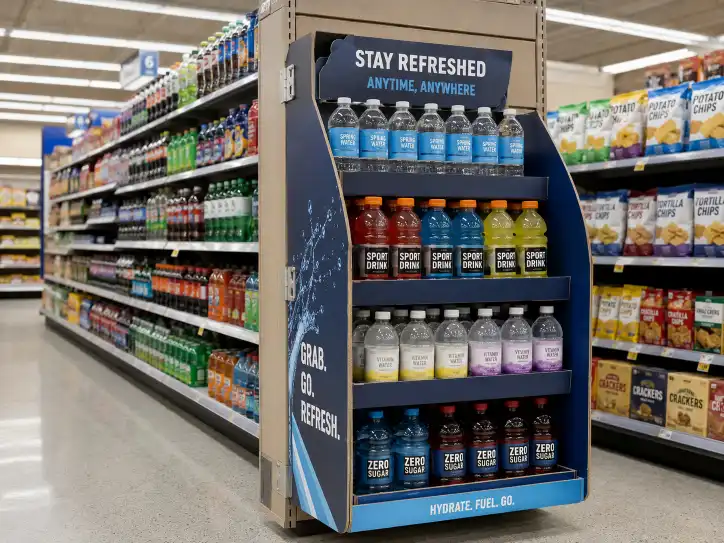
Sidekick vs Power Wing: How the Manufacturing Process Differs
From a factory perspective, both formats share the same basic manufacturing steps: die-cutting, printing, folding, and packing. But three factors change significantly:
1. Material Grade
| Factor | Sidekick Display | Power Wing Display |
|---|---|---|
| Board Type | E-flute or B-flute single-wall | Double-wall or BC-flute reinforced |
| Hook Type | Plastic slide-on hooks | Metal brackets or heavy-duty plastic clips |
| Reinforcement | None (weight held by board alone) | Internal support panels, glued gussets |
| Print Surface | Single-side print (front facing) | Multi-surface print, often wrap-around |
2. Attachment System
The attachment mechanism is the biggest structural difference. Sidekick displays rely on lightweight plastic hooks that hook over the shelf edge. These work well for products under 4.5 kg total.
Power wing displays use metal brackets that bolt or clamp onto the shelf. The brackets distribute the load across a wider area and prevent the display from pulling away from the fixture. Some power wing designs also include a base plate that sits on the shelf below for additional stability.
3. Packaging and Shipping
Sidekick displays ship flat and assemble in under 30 seconds. Power wings may require bracket fitting and take 1–2 minutes to set up. Shipping volume is slightly larger for power wings due to the reinforcement panels and metal components.
Comparison Table: Manufacturing Factors
| Factor | Sidekick Display | Power Wing Display |
|---|---|---|
| Board Grade | E-flute or B-flute | Double-wall or reinforced B-flute |
| Max Weight Capacity | Up to 4.5 kg | 10–25 kg |
| Attachment | Plastic hooks | Metal brackets or heavy-duty clips |
| Assembly Time | Under 30 seconds | 1–2 minutes |
| MOQ | 500–1,000 units | 300–800 units |
| Unit Cost | Lower | Higher (more material, metal hardware) |
| Shipping | Flat-packed, compact | Flat-packed, slightly larger volume |
| Retailer Acceptance | Most retailers approve standard | May require fixture review |
How to Choose: A Practical Decision Framework
When sourcing from a factory, specifying the right format helps you get an accurate quote and avoids structural failures in store.
Use a sidekick display when:
- Your product weighs under 200 g per unit
- Total display load is under 4.5 kg
- The product fits in a standard tray depth (under 10 cm)
- You need the lowest possible unit cost
- Example: Single-pack gum or lip balm on a checkout-adjacent endcap
Use a power wing display when:
- Your product weighs 200 g to 1 kg per unit
- Total display load exceeds 4.5 kg
- The product comes in bottles, jars, or rigid packaging
- The retailer requires metal bracket attachment
- Example: Glass jars of sauce or bottled drinks on a grocery endcap
If in doubt, send your factory the product weight and packaging dimensions. A good manufacturer will recommend the right board grade and attachment system — they should never guess.
Our peg displays page covers related hanging display options if you are still comparing formats.
Buyer Checklist: Power Wing vs Sidekick
Use this checklist when briefing your factory:
| Check Item | Sidekick Display | Power Wing Display |
|---|---|---|
| Product weight per unit? | Under 200 g | 200 g – 1 kg |
| Total display weight? | Under 4.5 kg | 10–25 kg |
| Product type? | Solid, compact, dry | Liquid, glass, bulky |
| Attachment method? | Plastic hooks | Metal brackets |
| Store fixture type? | Standard shelving | Heavy-duty or reinforced shelving |
| Assembly time target? | Under 30 seconds | Under 2 minutes |
| Print finish required? | Standard CMYK | CMYK with coating for durability |
| Sample test priority? | Visual and fit check | Weight and bracket test |
Conclusion
The difference between a power wing display and a sidekick display comes down to product weight and structural reinforcement. Sidekick displays are the right choice for lightweight impulse items. Power wing displays are the right choice when the product is heavier or when the retailer requires a more secure attachment system.
For B2B buyers, the key is to communicate the product weight and store fixture type clearly with your factory. This ensures you get the right board grade, attachment method, and print finish for your campaign.
If you are planning a new impulse display project, review our cardboard display range or contact us for a custom quote.
FAQ
Is a power wing display the same as a sidekick display?
Not exactly. A power wing display is a reinforced version of a sidekick display. The terms are sometimes used interchangeably in retail conversations, but manufacturers distinguish them by board grade, weight capacity, and attachment method.
Can a sidekick display hold heavy products?
No. Sidekick displays are designed for lightweight products under 4.5 kg total. For heavier products, specify a power wing display with reinforced materials and metal brackets.
Does a power wing display cost more than a sidekick display?
Yes. Power wing displays use more material (double-wall board) and additional hardware (metal brackets), so the unit cost is higher. The cost difference is usually justified by the ability to hold heavier products safely.
What weight can a power wing display hold?
A well-engineered power wing display can hold 10–25 kg total, depending on the board grade, bracket design, and the strength of the store fixture it attaches to.
Does the retailer need to approve a power wing display differently?
Yes. Some retailers require a fixture review for power wing displays because the metal brackets and heavier load may affect their shelving. Always confirm with the retailer's planogram team before production.
Can the same display design work for both sidekick and power wing?
The structural specifications are different. You can adapt the same visual design to both formats, but the board grade, attachment system, and reinforcement details must change.